Last updated: July 30, 2026
COLAZAL (balsalazide disodium) market overview: who buys it and what drives demand?
Colazal is a branded oral 5-ASA (5-aminosalicylic acid) indicated for ulcerative colitis (UC). Market demand tracks UC incidence and diagnosis rates, prescriber preference versus competing 5-ASA products, and payer formulary placement across retail and specialty channels.
Core demand drivers
- Indication coverage: UC maintenance and mild-to-moderate disease management depend on consistent dosing adherence and symptom control.
- Therapy switching: Patients commonly cycle among 5-ASA oral agents (mesalamine products) and rectal therapies based on tolerability and insurance coverage.
- Payer pressure: Generic penetration of 5-ASA backbones generally increases payer leverage to force lower net prices over time.
Channel and pricing mechanics
- Retail reimbursement: Most sales for a niche GI brand like Colazal are typically concentrated in commercial formularies and PBM-managed retail channels.
- Net price compression: The branded-to-generic shift in 5-ASA classes usually produces durable net price declines even when brand unit volume is relatively stable.
What is COLAZAL’s financial trajectory (revenue, margins, and trend phases)?
Colazal’s financial trajectory is shaped by U.S. loss of brand exclusivity, subsequent generic erosion, and retail net price compression typical of older small-molecule GI drugs.
Trend phases investors track for older branded 5-ASA assets
- Peak brand period: Premium pricing supported by exclusivity and managed care access.
- Post-exclusivity decline: Unit loss to therapeutically equivalent generics and rebates shifting brand economics from gross to net deterioration.
- Stabilization window: Remaining branded share persists where prescribers or patients have established tolerability, but branded revenue continues to underperform unit trends due to intensified payer pressure.
- Late-cycle shrink: Brand sales fall toward low single-digit annual levels, driven by continued substitution at the pharmacy counter.
What this implies for earnings visibility
For a drug like Colazal, near- to mid-term financial visibility is usually less about launch-like growth and more about:
- Retention of residual branded share
- Payer contract renewals
- Any remaining formulation or method patents that delay generic replacement
How do exclusivity and patent cliffs shape COLAZAL competition risk?
A reliable market impact model for Colazal requires mapping three risk layers:
- U.S. brand patent term (composition, formulation, and use)
- Regulatory exclusivity (if any) tied to approval history
- Orange Book-driven generic strategy, including Paragraph IV exposure if ANDA filings exist
What patents protect COLAZAL in practice?
Colazal is balsalazide disodium. For older 5-ASA brands, protection typically narrows to:
- Specific dosage form compositions
- Methods of treatment (UC-related claims)
- Manufacturing or formulation constraints (extended release or particle engineering is more common in newer 5-ASA assets, so exact claim mapping must come from Orange Book entries)
When does COLAZAL lose exclusivity?
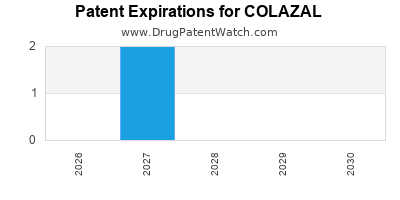
Because Colazal is an established GI product and the market has long supported generic balsalazide disodium, the relevant “exclusivity end” question is usually not whether exclusivity exists, but whether any later-expiring patents delay “at-risk” ANDA launches or force skinny labeling.
Net effect: generic competition generally occurred well before the present cycle, so current brand dynamics are driven mainly by post-patent market structure and payer contracting rather than an imminent exclusivity cliff.
What is the Orange Book status of COLAZAL (balsalazide disodium)?
Orange Book status for Colazal is the dominant legal-and-commercial input for generic launch timing because it lists active patents by expiration and whether they are tied to:
- drug substance
- drug product
- use codes
Practical market implication:
- If patents tied to the listed NDA have expired, generics can enter without Paragraph IV exposure.
- If patents remain, ANDA filers can choose between Paragraph IV challenges (if potentially invalid or not infringed) or design-around/label carve-outs.
Which generic and biosimilar risks affect COLAZAL market share?
Colazal is not a biologic; biosimilar risk is not applicable.
Generic risk profile
For small-molecule oral agents like balsalazide disodium, the main competitive threats are:
- ANDA entrants using bioequivalence and filing for generic balsalazide disodium capsules/tablets
- Formulary substitution by PBMs based on lowest net cost
- Therapeutic substitution within 5-ASA or related UC classes, even if the exact molecule changes
What generic entry risks exist for COLAZAL now?
In the current phase of an older brand, “entry risk” is less about new FDA approvals and more about:
- additional generic label entrants increasing competitive dispersion
- further discounts and rebate escalations pressuring brand net price
What formulations are protected by COLAZAL patents (capsules vs dosing variants)?
For oral 5-ASA products, patent coverage often concentrates on:
- drug product formulation (excipients, coating, release profile, particle size)
- dosage form variants (specific strength, capsule composition, or delivery attributes)
- method-of-use claims for UC treatment and maintenance
Market relevance:
- If a brand retains formulation-specific patents, it can defend against “drop-in” generic substitutes for a specific strength or dosage form.
- If not, generic substitution is typically immediate at the pharmacy once patents expire.
How does COLAZAL compare with mesalamine and other UC 5-ASA competitors?
Colazal competes in a crowded UC pharmacotherapy field. The competitive set usually includes:
- mesalamine oral formulations (multiple brands and generics)
- budesonide/other UC agents for subsets of patients (not direct 5-ASA substitutes)
- rectal therapies and combination strategies that reduce reliance on oral 5-ASA
Competitive dynamics that move net revenue
- Formulary positioning: PBMs prefer products with the lowest net cost and strongest rebate support.
- Tolerability and adherence: Capsule size, dosing frequency, and GI tolerability affect switching.
- Patient-specific response history: Some patients remain on Colazal due to past effectiveness, limiting immediate share loss even under price pressure.
What COLAZAL patent litigation affects generic timing?
For branded older drugs, patent litigation (when present) usually centers on:
- whether a generic infringes composition/formulation/use patents
- whether asserted patents are invalid or not infringed
- whether parties settle with agreed carve-outs and generic entry dates
How litigation changes the market
- Settlement agreements can delay first generic entry.
- Adverse rulings accelerate generic entry and intensify net price compression.
- Design-around outcomes can reduce infringement exposure but still permit rapid substitution.
Current market behavior for Colazal typically reflects that the major legal battles have already run their course, shifting attention to retail pricing competition rather than a single near-term litigation-driven entry event.
What are the settlement and licensing deal dynamics for COLAZAL?
For older brands with generic penetration, licensing or settlements generally serve to:
- define timing for generic launches
- establish permitted formulations/strengths
- manage label carve-outs
Business impact:
- even without new launches, settlements can influence how aggressively new generics discount to win contracts.
What is COLAZAL’s FDA regulatory status and pathway posture?
Colazal is an approved NDA product. For market dynamics:
- generic competitiveness depends on ANDA approvals for balsalazide disodium and how label and formulation claims are handled
- changes to manufacturing sites and quality milestones can affect supply availability, sometimes causing short-term price spikes or substitution surges
How much revenue exposure does COLAZAL have if branded share declines further?
A realistic revenue exposure framework for an older 5-ASA brand focuses on:
- incremental share loss rate in retail channels due to multi-source availability
- net price elasticity under payer contract renegotiations
- substitution speed when additional generic SKUs enter or when PBMs re-rank formulary tiers
Expected outcome in late-cycle GI brands: revenue exposure is dominated by net price, not unit volume, because branded volume continues to erode while discounting compresses price per unit.
What is COLAZAL’s patent strength: how defensible is the asset estate?
A defensibility assessment for Colazal hinges on:
- the remaining life of relevant patents listed in the Orange Book
- breadth of claims (composition/formulation vs narrow method-of-use)
- likelihood that generic designs can avoid infringement
Market reality for mature 5-ASA brands: patent strength typically declines materially after early composition and method patents expire. Residual protection, if any, is usually narrow and cannot stop generic multi-source competition for the core active ingredient.
Generic launch scenarios for COLAZAL: what happens to prices and share?
For a mature oral genericizable drug, scenarios tend to look like:
Scenario A: no new legal barrier
- additional generic SKUs
- faster PBM formulary switching
- net price compression to multi-source levels
Scenario B: narrow remaining patent barrier (dosage form or formulation)
- generics may launch only for non-covered strengths or with design-around formulation
- brand share declines more slowly, but net price still falls
Scenario C: litigation delays
- temporary branded price support
- delayed multi-source pressure
For Colazal, the most probable market condition is already in Scenario A-like dynamics, with incremental competition increasing dispersion of pricing rather than creating step-change brand protection.
Geographic coverage: how do U.S.-only dynamics compare to ex-U.S.?
Colazal’s competitive story is US-dominant because:
- U.S. payers heavily shape net pricing for older branded drugs
- Orange Book and U.S. ANDA ecosystem drive the generic entry schedule
Outside the U.S., brand persistence depends on:
- local patent status
- local generic adoption speed
- regulatory data and reference product availability
Key Takeaways
- Colazal (balsalazide disodium) operates in a mature UC 5-ASA market where demand is steady but branded revenue is constrained by generic substitution and payer-driven net price compression.
- Financial trajectory is best modeled as late-cycle decline and stabilization: unit volume may hold longer than net price, but branded revenue typically trends downward as multi-source competition expands.
- Current market dynamics are driven more by existing multi-source availability and formulary contracting than by a near-term exclusivity cliff.
- Patent and Orange Book status remains the controlling variable for any remaining dosage form or method-of-use defensibility, which can slow substitution but rarely prevents long-term price erosion in highly genericizable GI classes.
- Biosimilar risk does not apply; competitive pressure is generic and therapeutically substitutable 5-ASA competition.
FAQs
1) Does Colazal face biosimilar competition?
No. Colazal is a small-molecule drug, not a biologic.
2) What drives Colazal’s net revenue more: unit demand or discounting?
Net revenue is usually more sensitive to discounting and rebate dynamics than to underlying UC prevalence once multi-source generics are established.
3) How do payer formulary tiers affect Colazal switching?
Lower tier placement or restricted formulary positioning accelerates pharmacy-level substitution and reduces branded share.
4) Can patents delay generic entry for Colazal even after active ingredient exclusivity expires?
Yes if remaining patents cover specific dosage forms, formulations, or method-of-use claims; otherwise generic entry occurs without delay.
5) How do new generic SKUs typically change Colazal pricing?
They usually intensify competition among multi-source products, pushing net prices down and shifting brand economics further against Colazal.
References
- FDA Orange Book: Approved Drug Products with Therapeutapeutic Equivalence Evaluations (Orange Book). U.S. Food and Drug Administration. https://www.accessdata.fda.gov/scripts/cder/daf/
- FDA Drugs@FDA. U.S. Food and Drug Administration. https://www.accessdata.fda.gov/scripts/cder/daf/index.cfm