Last updated: July 29, 2026
CLENPIQ (sodium picosulfate, magnesium oxide, and citric acid) is an oral bowel-prep regimen for colonoscopy and is sold in the US as a prescription product under Salix Pharmaceuticals’ branding (now part of Bausch Health Companies). Market traction is tied to GI endoscopy volume, payer formularies that weigh tablet-sachet convenience versus per-dose cost, and ongoing substitution pressure from lower-priced competitors. Financial trajectory has been shaped more by reimbursement and channel movement than by clinical differentiation, given therapeutic class parity across osmotic and stimulant cathartics.
How is CLENPIQ positioned in the US bowel prep market?
Answer: CLENPIQ sits in the FDA-cleared oral bowel-cleansing class for colonoscopy prep where payers often treat products as clinically equivalent within efficacy tolerability expectations, making negotiated pricing and formulary placement dominant. Competitive set typically includes MoviPrep, Suprep, Plenvu, GoLYTELY (PEG/electrolytes), MiraLAX-based regimens, and other branded split-dose combinations, plus pharmacy benefit substitutions.
Which products most compete with CLENPIQ
CLENPIQ’s commercial “battlefield” is the intersection of:
- Split-dose oral regimens used the day before and/or day of colonoscopy.
- Bowel-prep experience influenced by perceived taste, volume, and dosing complexity.
- Payer economics favoring lower net price or preferred SKUs.
Common substitutes include:
- Suprep (sodium sulfate, potassium sulfate, magnesium sulfate)
- MoviPrep (sodium picosulfate, magnesium oxide, citric acid)
- Plenvu (sodium sulfate, potassium sulfate, magnesium sulfate, plus ascorbic acid component)
- GoLYTELY/PEG-electrolyte solutions and generic PEG-based pathways
What drives demand
Key demand drivers in US bowel prep include:
- Growth and rescheduling of elective colonoscopy volumes post-pandemic normalization cycles.
- Increased colonoscopy screening coverage and GI clinic throughput.
- Provider preference for split-dose schedules to improve cleansing adequacy and reduce cancellations.
- Payer tier placement and prior authorization mechanics in high-cost seasons.
What is CLENPIQ’s sales trajectory and revenue exposure profile?
Answer: CLENPIQ’s sales trajectory has tracked US bowel prep market expansion and payer preference dynamics. The product is exposed to margin compression from discounting and competitive substitution rather than structural demand collapse, because bowel prep remains procedural standard of care.
Revenue sensitivity to payer contracting
For a branded GI prep, net sales typically swing with:
- Annual PBM and wholesaler contracting.
- Conversion among preferred alternatives based on formulary bids.
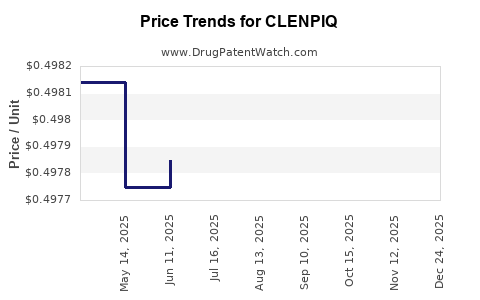
- Wholesale acquisition cost (WAC) to net-to-gross effects.
Even when utilization remains steady, net price and rebates can drive the majority of annual margin movement.
Seasonality and channel effects
Bowel prep demand often shows:
- Seasonal spikes aligned with elective endoscopy scheduling patterns.
- Timing impacts from prescribing shifts at the clinic level (new GI groups adopt protocols; formularies follow).
Financial trajectory risk map
CLENPIQ faces three primary financial risks:
- Preferred slot loss to a cheaper or more restricted-PA-limited competitor (net price down).
- SKU substitution within the same ingredient family or within class (unit sales down).
- Margin pressure from increased competitive promotions by branded peers and generics (gross-to-net down).
When do CLENPIQ exclusivity and patent rights expire, and how does that affect forecast?
Answer: CLENPIQ’s exclusivity stack and patent estate determine the timing of generic or “authorized” competition risk. For bowel-prep combinations, pathway and exclusivity are crucial because many players can attempt market entry once primary formulation and composition-of-matter or method patents lapse.
What to watch for on the exclusivity timeline
A forward-looking forecast depends on:
- Expiration of Orange Book-listed patents tied to composition, dosage form, and specific bowel prep use.
- Any regulatory exclusivity (for example, orphan, exclusivity for new drug application) that could delay generic substitution even after patents end.
- Paragraph IV filings indicating intent to challenge listed patents and force litigation-driven delay.
How generic entry impacts financial trajectory
When patent barriers lift:
- Unit volume usually falls first as PBMs switch members to lower-cost alternatives.
- Price follows as net-to-gross compresses; remaining market share becomes “rest-of-class” rather than “category-leading.”
What patents protect CLENPIQ and what is the strength of the estate?
Answer: CLENPIQ’s protection is anchored by Orange Book-listed patents covering active ingredient combination, dosage form/regimen, and related manufacturing or method-of-use. Patent strength is measured less by patent count and more by whether key claims block generic formulation equivalence or use instructions.
Common CLENPIQ patent families to evaluate
For bowel cleansing products, patent estates often include:
- Composition claims for the combination of sodium picosulfate, magnesium oxide, citric acid.
- Dosage form/regimen claims for split-dose packaging and dosing schedule instructions.
- Manufacturing/process claims for producing the specific powder/pH-dependent system.
How to score patent strength for business planning
Business teams should score:
- Whether patents are composition-of-matter versus narrower regimen or process claims.
- Claim breadth against likely generic design-around.
- Whether there are multiple “independent” blocks (harder to design around).
- History of litigation or settlements among Abbreviated New Drug Application (ANDA) challenges in this category.
What generic entry risks exist for CLENPIQ?
Answer: Generic entry risk is typically tied to ANDA filings and the outcome of patent challenges. If courts or settlements remove barriers early, generic substitution can accelerate within the same reimbursement cycle.
Paragraph IV and litigation-driven entry scenarios
A generic can enter via:
- Paragraph IV certification against Orange Book patents followed by Hatch-Waxman litigation.
- Settlement that shifts entry dates or includes authorized generic arrangements.
- Post-expiration entry once listed patents expire.
What generic strategy would likely target
For a bowel-prep combination, successful generic entrants generally aim to match:
- Ingredient equivalence per labeled regimen.
- Dosing schedule and patient instruction equivalence.
- Acceptable bioequivalence and shelf-stability under FDA requirements.
Which companies are challenging CLENPIQ and what litigation matters?
Answer: The competitive threat for CLENPIQ depends on ANDA challenges filed against its listed Orange Book patents and any subsequent district court decisions or settlements. Those events determine the timing and magnitude of generic market-share loss.
What “matters most” in case tracking
For litigation, commercial planning should track:
- Which patents are asserted in the case.
- Whether the case is resolved via stipulated judgment or a settlement with entry terms.
- If an authorized generic is expected, which can undercut the “brand protection” window.
What is the Orange Book status of CLENPIQ?
Answer: Orange Book status determines the precise listed patent expirations and the regulatory timeline for generic entry. For CLENPIQ, the Orange Book record is the primary gating document for forecastable entry risk, because patents listed there are the ones generics must certify against in ANDAs.
What to extract from the Orange Book record
Decision-grade fields for CLENPIQ planning:
- Patent numbers, assignees, and expiration dates.
- Patent type (composition, method, formulation, use).
- Regulatory exclusivity entries tied to the NDA (if any).
- Whether patents are listed as requiring “no infringement” or “invalid” certifications under ANDA.
How does CLENPIQ compare with Suprep, Plenvu, MoviPrep, and PEG-electrolyte regimens?
Answer: CLENPIQ competes against both branded sodium-sulfate/split-dose regimens and PEG-based solutions. Commercial outcomes depend on net pricing, patient tolerance perceptions, and payer formulary preferences rather than a clear efficacy differentiator.
Key comparison axes that affect formularies
- Dose volume and taste perception.
- Split-dose convenience (timing instructions for patients).
- Prior authorization likelihood based on payer tier placement.
- Package logistics (how clinic staff stock and instruct).
Where CLENPIQ can lose
- If a competitor becomes preferred through PBM contracting at a meaningfully lower net cost.
- If a payer designates specific bowel preps as first-line for cost control.
- If generic alternatives launch without requiring prior authorization.
Where CLENPIQ can retain share
- When gastroenterology practices have established prep protocols aligned with CLENPIQ instructions.
- When patients experience better adherence and fewer preparation failures with a familiar regimen.
How do FDA label and regulatory events affect CLENPIQ’s market outlook?
Answer: FDA label changes can shift adoption if they impact dosing instruction clarity or patient eligibility criteria. For bowel-prep products, even small label changes can drive clinic-level protocol updates and re-formulary decisions.
Regulatory risk channel
- Label updates affecting contraindications or renal impairment guidance can change eligible patient populations.
- Safety communications or REMS are less common in this category but would be market-moving if they occurred.
What formulation or regimen patents could block “design-around” generics?
Answer: The most financially protective patents are those tied to the regimen instruction set and specific formulation architecture that generics must mirror to claim equivalence.
Design-around vectors
Generics may try to:
- Adjust salt forms or excipient systems while maintaining labeled equivalence.
- Alter manufacturing process parameters to avoid process patents.
- Use alternate dosing schedules that still meet cleansing outcomes, if label allows.
In practice, if composition and regimen claims are broad, design-around options are limited, raising the probability of litigation and delaying entry.
What settlement agreements or licensing deals matter for CLENPIQ?
Answer: Settlements and licenses are the dominant “bridge” between litigation and entry timing in Hatch-Waxman practice. Their terms determine the exact date when generics can sell, whether an authorized generic is allowed, and whether switching incentives are immediate.
What to track in deals
- Stipulated entry date.
- Authorized generic carve-outs.
- Scope limits (specific strengths or package sizes).
- Marketing restrictions or exclusivity arrangements.
Commercial scenarios for CLENPIQ (base, upside, downside)
Answer: The scenario set is primarily driven by net pricing and patent barrier removal timing.
Downside
- Preferred slot loss to a cheaper branded or generic competitor.
- Generic entry sooner than expected via earlier settlement or decisive invalidation.
- Higher rebate pressure during PBM renegotiations.
Base
- Category growth offsets partial share erosion.
- Net price compresses modestly but CLENPIQ retains meaningful formulary inclusion.
- Competitor pressure remains “rest-of-class” rather than fully substitutive.
Upside
- Strong GI protocol adoption and reduced cancellation rates keep volume stable.
- PBM contracting maintains a favorable net price.
- Patent challenges resolve into later-than-expected entry.
Geographic exposure: where CLENPIQ faces the highest competitive threat
Answer: CLENPIQ’s largest commercial risk center is the US, where Orange Book-driven ANDA entry timing directly controls substitution. Internationally, competitive threats depend on local approvals and patent landscapes, which can diverge from the US schedule.
US-centric drivers
- Generic entry timing.
- Medicaid managed care formulary rules.
- Medicare Part D plan formularies for bowel prep products (indirectly via net pricing trends).
Key Takeaways
- CLENPIQ’s market dynamics are driven primarily by payer contracting, formulary placement, and substitution pressure inside the bowel-cleansing category.
- The product’s financial trajectory is sensitive to net-to-gross compression from competition and discounting rather than demand volatility.
- Forecasting hinges on Orange Book-listed patent expirations and any ANDA/Paragraph IV activity that forces litigation or settlement-based entry timing.
- Patent strength should be assessed by claim breadth against likely generic regimen and formulation designs, not by patent count alone.
FAQs
1) What is the most common reason CLENPIQ loses formulary placement?
Net price and PBM tiering decisions that favor lower-cost split-dose bowel preps.
2) How do Paragraph IV filings typically change CLENPIQ revenue expectations?
They create a defined litigation-to-entry pathway that can accelerate unit share loss if patents fall or settlements permit earlier launches.
3) Can a generic bowel prep enter without matching the exact split-dose regimen?
Generic launch is typically constrained by FDA equivalence requirements tied to the labeled regimen and dosing instruction structure.
4) Which payer stakeholders most influence CLENPIQ prescribing behavior?
PBMs and formulary committees at the plan level, which decide tier placement, prior authorization rules, and rebate-driven “preferred” status.
5) How does competition from PEG-electrolyte regimens affect CLENPIQ?
PEG regimens compete on perceived safety, availability, and cost, often pressuring branded net prices even if clinical preference remains split-dose driven.
References
- FDA. Orange Book: Approved Drug Products with Therapeutic Equivalence Evaluations. (Orange Book).
- FDA. Drugs@FDA: Drug Details and Approval Information.