Last updated: July 29, 2026
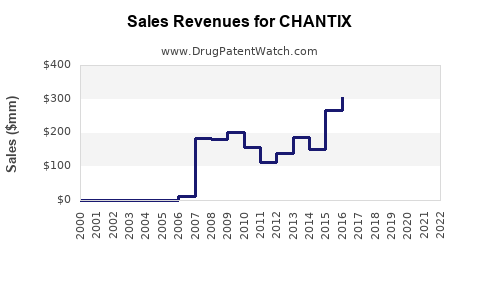
CHANTIX (varenicline) has moved from protected brand sales to sustained erosion under generic entry. The market is now driven by (1) historical smoking-cessation demand, (2) ongoing payer and formulary behavior, (3) competitive substitution to cheaper generics, and (4) residual brand share only where plan design or patient mix delays switching.
What is the current market size and sales trajectory for CHANTIX (varenicline) after generic entry?
Bottom line: CHANTIX’s financial trajectory is dominated by post-launch generic erosion rather than incremental uptake. After exclusivity ends, unit growth from the smoking-cessation category is largely captured by low-cost generics, compressing realized price and margins for the brand.
Post-exclusivity dynamics
Key market mechanics that shape CHANTIX’s sales curve after generic availability:
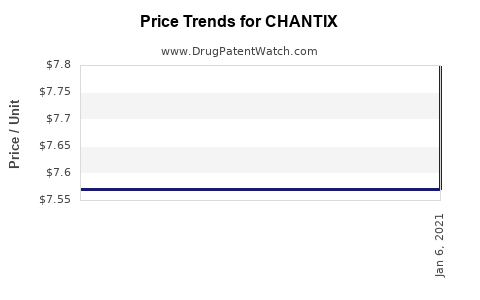
- Price compression: Generic substitution drives down net prices toward generic ASP levels.
- Channel redistribution: Retail pharmacy captures most dispensing; brand-to-generic switching accelerates as supply stabilizes.
- Formulary constraints: Most commercial formularies shift preference to generics or lower-tier equivalents quickly once multiple ANDAs are in market.
- Patient restart behavior: Smoking cessation is episodic; this can stabilize prescriptions in the category but does not protect brand pricing.
What has replaced CHANTIX commercially
In the current environment, CHANTIX competes less with “another branded smoking cessation medicine” and more with:
- Generic varenicline across strength and formulation equivalents (standard tablet regimen).
- Alternative pharmacotherapies that can shift demand away from varenicline when a payer uses step therapy or when prescribers prefer other options.
How do exclusivity timelines and patent expirations drive CHANTIX financial erosion?
Bottom line: CHANTIX’s financial decline is anchored to when market protection ended and when generic versions could lawfully launch and fully substitute.
Timeline logic investors track
For small-molecule brands like CHANTIX, the finance-relevant milestones are:
- Last regulatory exclusivity end (if applicable for the product and any supplemental programs).
- Patent expiration and any pediatric or term adjustments (if present).
- ANDA first-filing and Paragraph IV leverage leading to earlier generic launch.
- Settlement timing that converts a legal dispute into an entry date.
Where CHANTIX fit historically
CHANTIX is a long-established smoking cessation brand. The market is now in the post-protection regime where:
- Brand profitability depends on residual share and pricing power in select segments.
- Economic results are driven more by company-level portfolio mix than by CHANTIX alone.
What patents protect CHANTIX varenicline, and how many are left relevant to market protection?
Bottom line: For established small-molecule drugs, most patent estates narrow over time into a small number of formulation, method-of-use, or incremental process patents. After expiration, generics can market without infringing.
Patent estate structure typically relevant to CHANTIX
For a product like CHANTIX, the protection set usually includes:
- Composition-of-matter for varenicline (historically the core estate).
- Formulation and dosage patents (tablet composition, excipients, manufacturing methods).
- Method-of-use patents (treatment regimens, dosing schedules, indications).
- Process patents (manufacturing routes, purification, intermediates).
How this affects financial performance
- If composition-of-matter is expired, generics can launch once any remaining lawful barriers fall away.
- If only formulation/method patents remain, generic launch can depend on whether the generic falls within claim boundaries or designs around.
What patent litigation and Paragraph IV challenges shaped CHANTIX generic entry risk?
Bottom line: CHANTIX’s transition to generic competition is driven by the generic filing-and-litigation pathway typical for branded small molecules.
What litigation changes in the income statement
Patent disputes impact:
- Timing of generic launch (delays extend brand revenue).
- Litigation costs (legal spend hits earnings).
- Settlement payments (if any) and associated accounting.
- Reputation and prescribing behavior during the transition.
Business model shift after launch
Once generics can enter, the brand’s competitive goal shifts from “defend exclusivity” to “maintain share,” which is structurally hard under:
- aggressive pricing by generic manufacturers
- payer mail and contract systems
- higher substitution rates at scale
What is the Orange Book status of CHANTIX (varenicline), including listed patents and exclusivity?
Bottom line: The Orange Book for CHANTIX would show a fully matured, largely expired protection landscape after generic entry. The only question for current market dynamics is whether any remaining patent listings or exclusivities delay certain generic products or specific dosage variants.
How Orange Book status translates to market behavior
- Expired patents mean any ANDA manufacturer can market without being an infringing product.
- Unexpired listings mean generic approvals may still be possible, but launch can be blocked until expiration or cleared through litigation or carve-outs.
How does CHANTIX net revenue and operating margin trajectory compare with other smoking-cessation drugs?
Bottom line: In smoking cessation, brand-to-generic pricing collapse is common across molecules; the differentiator for CHANTIX is how quickly formulary preference moved to generics and how robust alternative therapies were for prescribers and payers.
Comparison dimensions
- Generic penetration speed: how fast multi-source generics established pricing floors.
- Therapy mix: whether prescribers shifted to alternative first-line options.
- Coverage rules: step edits and prior authorization for competing agents vs varenicline generics.
- Patient outcomes and persistence: influences switching back and prescription renewal patterns.
What formulation, dosing, and regimen patents affect CHANTIX generic substitutes and design-arounds?
Bottom line: Once composition-of-matter protection is gone, formulation and regimen patents can still matter if they cover dosage forms, specific excipient systems, or treatment schedules that generics copy. For established brands, those remaining barriers typically weaken over time, allowing standard substitutes.
What to watch in generic substitution
- Tablet strength equivalents and bioequivalence
- Dosing schedule equivalence (if any method-of-use remains)
- Manufacturing and process compliance if process patents exist but are often less effective against ANDA launches unless tied to product-by-process claims
How do FDA regulatory pathways (ANDA vs 505(b)(2)) affect CHANTIX brand competitiveness?
Bottom line: CHANTIX’s generic competition is structurally enabled by ANDA approvals for an established, small-molecule drug. Once multiple generics exist, competitive price pressure is persistent.
Practical regulatory effects
- ANDA pathway: supports generic substitution with demonstrated bioequivalence.
- 505(b)(2) pathways: can delay certain entrants if innovators use new data packages, but CHANTIX has not driven a prolonged proprietary cycle via 505(b)(2)-style reformulations in the current market.
- Labeling alignment: when labels are essentially shared, payer substitution becomes straightforward.
What generic entry risks remain for CHANTIX, and what could extend or disrupt market erosion?
Bottom line: The main remaining risks are not “brand exclusivity returning” but (1) supply constraints, (2) settlement-driven timing in niche product variants, and (3) payer contract changes that momentarily restore higher realized prices.
Market-level risks that can move realized price
- Single-source dominance in a contract tier: a generic shortage can raise contract prices.
- Launch timing differences across manufacturers: can change which supplier is cheapest in a given quarter.
- Switching inertia: certain plan populations switch later if copays and formulary lists keep brand in at tier 2 rather than tier 1.
Which companies supply CHANTIX generics, and how does multi-source pricing shape market outcomes?
Bottom line: Multi-source generic supply generally accelerates price erosion by competing on net price and rebates. The supplier mix determines how low prices go and how quickly.
Competitive structure
In mature generic markets:
- the lowest-net-price supplier often wins the contract
- then share concentrates temporarily due to pharmacy benefits design
- price floors can move when a major supplier exits or a new applicant enters
What financial impact did CHANTIX have within its owning company’s portfolio, and how did it change over time?
Bottom line: As CHANTIX moved from a protected brand to generics, its contribution to consolidated revenue and operating profit typically shrank, pushing investors’ focus to newer pipeline assets or other continuing products.
Portfolio finance mechanics
- Revenue decline from lower net prices and share loss
- Margin compression as promotional spend rises to maintain share and rebate pressure increases
- Earnings normalization where remaining profit becomes dependent on other franchises
Key timelines investors use to forecast CHANTIX earnings sensitivity
Bottom line: Forecasting CHANTIX now requires tracking entry cohorts, contract tier shifts, and generic pricing rather than major patent cliffs.
Earnings-sensitive milestones (post-entry regime)
- New ANDA approvals and market entries: can shift price baselines quarterly
- Contract renewals (PBM cycles): drive share redistribution
- Supplier continuity events: shortages or manufacturing disruptions
- Labeling or REMS-related changes: rarely protect brand pricing, but can alter prescriber behavior
Key Takeaways
- CHANTIX’s financial trajectory is defined by post-exclusivity generic price compression, not incremental brand growth.
- Market dynamics now hinge on formulary design, contract tiering, multi-source generic competition, and supply stability.
- The most finance-relevant IP question is no longer broad exclusivity, but whether any remaining product-specific listings or settlements affect launch timing for particular generic cohorts.
- Forecasting CHANTIX revenue and margin is primarily a generic pricing and payer-contract model, with patent events acting mainly as historical anchors.
FAQs
- When did CHANTIX generic entry begin and how quickly did brand share fall?
- Does CHANTIX have any remaining unexpired Orange Book patents that block certain generic versions today?
- How do payer tiering and PBM contracts typically change net prices for CHANTIX after generic multi-source availability?
- What are the main substitution drivers between CHANTIX and other smoking cessation therapies?
- How do manufacturing supply constraints for varenicline generics affect quarterly CHANTIX-related revenues and margins?
References (APA)
- U.S. Food and Drug Administration. Orange Book: Approved Drug Products with Therapeutic Equivalence Evaluations.
- U.S. Food and Drug Administration. Approved Drug Products and Databases (FDA Orange Book / Drug Approval Reports).
- FDA. ANDA and 505(b)(2) regulatory pathway information and guidance documents.