Last updated: August 12, 2026
CellCept, Roche’s brand of mycophenolate mofetil, is a mature transplant immunosuppressant with stable clinical demand but limited commercial protection. Its core U.S. patent protection expired before or around the launch of generic products in 2008, triggering substantial price erosion and a long-term decline in branded sales. The product remains clinically important in kidney, heart, and liver transplantation, but its revenue profile is now driven by generic-volume demand rather than brand exclusivity.
What is CellCept and how does it generate revenue?
CellCept contains mycophenolate mofetil, the prodrug of mycophenolic acid. It inhibits inosine monophosphate dehydrogenase and suppresses lymphocyte proliferation. The FDA approved CellCept in 1995 for prophylaxis of organ rejection in kidney transplant recipients and later expanded its labeling to heart and liver transplantation.[1]
Roche commercializes CellCept through Genentech and affiliated entities. The product is available in:
- 250 mg capsules
- 500 mg tablets
- Oral suspension
- Intravenous formulation for patients unable to take oral therapy
CellCept is generally used with a calcineurin inhibitor, such as tacrolimus or cyclosporine, and corticosteroids. The commercial market is therefore linked to transplant volume, long-term graft survival, treatment protocols, and generic procurement prices.
The product’s demand has several durable characteristics:
- Transplant recipients often require lifelong immunosuppression.
- Mycophenolate is embedded in established treatment protocols.
- Switching is clinically possible but requires monitoring.
- Hospitals and payers favor lower-cost generic products.
- The active ingredient has broad use across transplant centers worldwide.
How has CellCept’s financial trajectory changed?
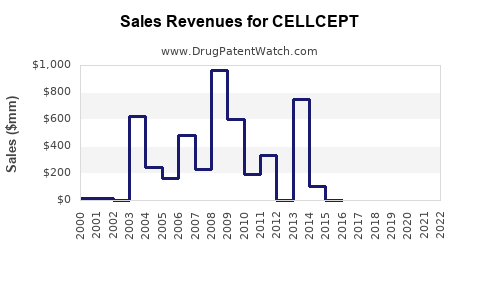
CellCept was a multibillion-dollar or near-billion-dollar annual product during its protected commercial period, depending on the reporting year and currency. Roche annual reports show a sustained decline after generic competition began. Reported sales fell from approximately CHF 1.3 billion around the late 2000s to well below CHF 500 million by the late 2010s.[2-6]
| Period |
Commercial position |
Financial effect |
| 1995-2007 |
Branded transplant standard with substantial protection |
High-margin growth and peak sales |
| 2008-2012 |
Generic mycophenolate mofetil enters major markets |
Rapid price and market-share erosion |
| 2013-2018 |
Mature generic market |
Continued decline in branded revenue |
| 2019 onward |
Legacy brand with limited exclusivity |
Lower and less strategically important sales |
| Current market |
Generic-dominated supply base |
Stable unit demand but limited brand pricing power |
Roche increasingly stopped presenting CellCept as a separately material growth product in its corporate reporting. That change reflects portfolio materiality rather than the disappearance of clinical use. The product continues to generate revenue, but it is no longer comparable with Roche’s growth assets in oncology, immunology, ophthalmology, or neuroscience.
The financial trajectory follows a standard small-molecule loss-of-exclusivity pattern:
- Prescription volume remains relatively resilient.
- Average selling prices decline.
- Generic substitution increases.
- Brand procurement contracts become more selective.
- Manufacturing and regulatory costs become more important relative to revenue.
- Revenue becomes concentrated in markets where physician familiarity, supply reliability, or reimbursement rules support branded use.
When did CellCept lose exclusivity?
CellCept’s principal U.S. compound and formulation protection expired before generic products achieved broad market access. Generic mycophenolate mofetil products were approved in the United States in 2008, including products from manufacturers such as Teva, Mylan, and other abbreviated new drug application sponsors.[7]
The principal patent historically associated with CellCept was U.S. Patent No. 5,225,403, covering mycophenolate mofetil and related pharmaceutical applications. The relevant exclusivity period ended in the late 2000s after patent-term calculations and regulatory exclusivity were applied.
| Protection category |
CellCept position |
| Active ingredient |
Mycophenolate mofetil is an established small molecule |
| U.S. compound protection |
Expired before broad generic entry |
| U.S. regulatory exclusivity |
Expired |
| Formulation protection |
Historic protection expired or became commercially weak |
| Pediatric exclusivity |
No current commercial impact |
| Biosimilar exclusivity |
Not applicable |
| Current brand moat |
Clinical familiarity, supply, contracts, and physician inertia |
Patent expiry did not eliminate the product’s value. It changed the basis of competition from legal exclusivity to manufacturing scale, quality, availability, and contracting.
What patents protect CellCept and its formulations?
The historical CellCept patent estate centered on the morpholinoethyl ester prodrug of mycophenolic acid and pharmaceutical formulations. The principal commercial claims covered:
- Mycophenolate mofetil as an active pharmaceutical ingredient
- Oral dosage forms
- Pharmaceutical compositions containing the compound
- Methods for preventing organ rejection
- Use in transplant recipients
The product’s clinical label also created an important distinction between CellCept and Myfortic. Myfortic contains enteric-coated mycophenolic acid rather than mycophenolate mofetil. It was developed to address gastrointestinal tolerability and release characteristics. CellCept and Myfortic are pharmacologically related but are not automatically interchangeable on a milligram-for-milligram basis.[8]
Formulation patents and lifecycle management
Roche’s lifecycle strategy relied on more than the original compound patent. It included:
- Tablets and capsules for chronic oral use
- Oral suspension for patients with swallowing limitations
- Intravenous administration for temporary oral intolerance
- Related mycophenolic acid formulations, including Myfortic
- Label-based transplant indications and dosing protocols
These measures extended market reach but did not preserve a durable monopoly after generic mycophenolate mofetil became available. Formulation differentiation was clinically relevant but commercially weaker than compound protection.
What is the Orange Book status of CellCept?
CellCept is an FDA-approved prescription drug listed in the Orange Book under mycophenolate mofetil. Its historical patents and exclusivity listings are no longer a meaningful barrier to abbreviated new drug application competition. Generic versions have been approved for the capsule, tablet, oral suspension, and injectable presentations, subject to product-specific approval requirements.[7]
The current Orange Book position supports the following commercial conclusions:
- CellCept does not have an active U.S. monopoly.
- Generic substitution is established.
- A new generic entrant generally faces regulatory and commercial barriers rather than fundamental patent barriers.
- Brand value depends on sourcing, distribution, procurement agreements, and physician preference.
A generic applicant historically could use the ANDA pathway because mycophenolate mofetil is a small molecule with an established safety and efficacy record. The relevant challenge was therefore a Paragraph IV and abbreviated-approval issue during the protected period, not a biosimilar pathway.
Which companies challenged CellCept, and what was the Paragraph IV risk?
Generic companies challenged the commercial protection surrounding CellCept as the relevant patents approached expiry. Public FDA approval records identify multiple generic sponsors for mycophenolate mofetil products, including Teva and Mylan-related entities.[7]
The principal Paragraph IV risk was straightforward: an ANDA applicant could assert that the listed patent was invalid, unenforceable, or not infringed. Once the patent barrier was removed or neutralized, multiple generic manufacturers could enter a market with limited technical differentiation.
For Roche, the economic exposure was high because:
- CellCept was used chronically.
- Transplant centers could convert large patient populations.
- Generic substitution did not require a new therapeutic mechanism.
- Payers had a strong incentive to prefer lower-cost products.
- Tacrolimus-based regimens made mycophenolate a component of a broader, standardized protocol.
The launch of multiple generic suppliers reduced the value of any single generic entrant’s exclusivity and accelerated price competition.
What generic entry risks exist for CellCept?
Generic entry risk is now realized rather than prospective in the United States. The principal risks are continued erosion of brand volume and price, supply substitution, and procurement-driven conversion.
Generic competition by dosage form
| Dosage form |
Generic competition |
Commercial implication |
| 250 mg capsule |
Established |
High substitution risk |
| 500 mg tablet |
Established |
Core volume segment with strong price pressure |
| Oral suspension |
Available from generic suppliers |
Smaller but clinically useful segment |
| Intravenous formulation |
More specialized |
Manufacturing and hospital-contract barriers matter more |
Generic manufacturers compete on:
- FDA compliance
- Contract manufacturing capacity
- Batch reliability
- Hospital and specialty-pharmacy contracts
- Wholesaler access
- Pricing
- Product availability during supply disruptions
The most important remaining barrier is operational. Manufacturing mycophenolate mofetil is less technically difficult than producing a biologic, but validated production, contamination controls, supply continuity, and regulatory compliance remain essential for transplant products.
Is there a biosimilar risk for CellCept?
CellCept does not face biosimilar competition because mycophenolate mofetil is a chemically synthesized small molecule, not a biologic. The applicable competitive pathway is the ANDA generic pathway under the Federal Food, Drug, and Cosmetic Act.
This distinction matters for market analysis:
- No reference-product biologic exclusivity applies.
- No biosimilar interchangeability designation is required.
- Generic substitution can occur through established state pharmacy rules.
- Competitive entry costs are generally lower than for monoclonal antibodies.
- Price erosion is typically faster once multiple ANDA sponsors enter.
What litigation and settlement agreements affected CellCept?
The central litigation risk concerned patent challenges associated with generic approval and launch timing. Public company disclosures and FDA records show that the product moved through the standard loss-of-exclusivity process, with generic approvals beginning in 2008.[2,7]
CellCept is not currently known as a major active U.S. patent-litigation asset. Its significant litigation value was concentrated in the pre-generic period. Once core patents expired and generic approvals became widespread, litigation ceased to be the primary determinant of market share.
Settlement economics, where present in the generic-entry process, would have affected the timing of launch rather than the long-term outcome. The eventual market structure confirms that generic entry was not permanently blocked.
How does CellCept compare with Myfortic and other transplant drugs?
| Product |
Active ingredient |
Competition |
Commercial position |
| CellCept |
Mycophenolate mofetil |
Multiple generics |
Mature, brand-eroded product |
| Myfortic |
Enteric-coated mycophenolic acid |
Generic competition in several markets |
Differentiated formulation, limited pricing power |
| Prograf |
Tacrolimus |
Generic tacrolimus |
Major transplant drug with broad use |
| Neoral |
Cyclosporine |
Generic cyclosporine |
Older calcineurin inhibitor |
| Prednisone |
Corticosteroid |
Extensive generic competition |
Low-cost background therapy |
CellCept’s most important competitive relationship is with tacrolimus-based transplant regimens, not direct replacement by a single alternative. Transplant physicians commonly combine agents to balance rejection prevention, nephrotoxicity, infection risk, and tolerability.
Myfortic offers a formulation alternative for selected patients, but it does not recreate the exclusivity profile CellCept had before generic entry. The broader transplant market is protocol-driven, and substitution decisions depend on the organ transplanted, patient history, adverse events, and center-level practice.
What is the geographic coverage of CellCept’s patent estate?
CellCept’s patent estate was jurisdiction-specific. Patent expiry and generic entry occurred at different times across the United States, Europe, Japan, and other markets. The economic effect was greatest in countries with:
- High transplant procedure volumes
- Strong generic substitution policies
- Centralized hospital purchasing
- Patent systems that permitted early generic preparation
- Reimbursement pressure on chronic medicines
The United States was a major source of revenue erosion after generic entry. European markets also experienced substantial generic substitution, although national reimbursement systems and patent-term adjustments created different timing by country.
In emerging markets, branded CellCept can retain a larger role when regulatory approval, physician trust, supply reliability, or local substitution rules limit generic penetration. That does not restore the original global pricing structure.
How strong is the CellCept patent estate today?
The current patent estate is commercially weak because the key protection has expired and generic competition is established. A practical assessment is:
| Factor |
Assessment |
| Core compound patent |
Expired |
| Formulation protection |
Expired or limited |
| Method-of-use protection |
Limited commercial leverage |
| Orange Book blocking power |
Low |
| Generic launch barrier |
Low to moderate |
| Manufacturing complexity |
Moderate |
| Clinical switching barrier |
Moderate |
| Brand pricing power |
Low |
| Long-term revenue growth potential |
Low |
The strongest remaining assets are operational and commercial rather than legal. Roche can preserve residual brand demand through product quality, supply continuity, physician familiarity, and institutional relationships. Those advantages support a legacy franchise but do not support premium pricing against established generics.
What generic launch scenarios remain?
The U.S. market is already genericized, so future scenarios relate to market structure rather than initial entry:
- Stable generic commoditization: Unit demand remains steady while prices decline gradually.
- Supplier consolidation: Fewer manufacturers remain, increasing the value of reliable capacity.
- Shortage-driven brand recovery: Temporary generic shortages could increase demand for CellCept, but such gains would likely be episodic.
- Protocol-driven substitution: Transplant centers may move patients toward tacrolimus and mycophenolate combinations while retaining generic mycophenolate.
- International price convergence: Additional markets may experience the same brand erosion seen in the United States.
The principal downside risk is continued reduction in branded revenue. The principal upside is limited to supply disruptions, niche formulations, and markets where brand procurement remains strong.
Key Takeaways
- CellCept is Roche’s branded mycophenolate mofetil product for transplant immunosuppression.
- FDA approval began in 1995, with later kidney, heart, and liver transplant indications.
- Core U.S. patent protection expired before broad generic entry in 2008.
- Generic mycophenolate mofetil has eliminated CellCept’s U.S. monopoly.
- Roche’s reported CellCept revenue declined from roughly CHF 1.3 billion around the late 2000s to below CHF 500 million by the late 2010s.
- CellCept remains clinically relevant because transplantation requires chronic immunosuppression.
- The product has no biosimilar risk because it is a small molecule.
- Current competitive strength comes from supply reliability and brand familiarity, not patents.
- Myfortic provides formulation differentiation but does not restore CellCept-level exclusivity.
- Future market growth is limited; the franchise is primarily a mature, cash-generating legacy asset.
FAQs
Is CellCept still under patent protection?
No material U.S. patent protection blocks generic mycophenolate mofetil entry. The core protection expired before generic products were approved in 2008.
Is generic mycophenolate mofetil interchangeable with CellCept?
FDA-approved generic products are therapeutically equivalent to the corresponding CellCept dosage forms when used according to approved labeling. Substitution remains subject to state pharmacy law and prescriber or payer policies.
Does CellCept have orphan-drug exclusivity?
CellCept’s commercial position does not depend on current orphan-drug exclusivity. Its main transplant indications have long been subject to generic competition.
Can Roche raise CellCept prices after a generic shortage?
A temporary shortage can increase brand demand, but permanent pricing power is unlikely because multiple generic suppliers and therapeutic alternatives remain available.
What is the investment outlook for CellCept?
CellCept is a mature, declining branded asset. Its investment relevance is tied to residual cash flow, supply resilience, and portfolio management rather than patent-protected growth.
References
- U.S. Food and Drug Administration. (2024). CellCept (mycophenolate mofetil) prescribing information.
- Roche Holding AG. (2008). Annual report 2008.
- Roche Holding AG. (2010). Annual report 2010.
- Roche Holding AG. (2012). Annual report 2012.
- Roche Holding AG. (2015). Annual report 2015.
- Roche Holding AG. (2018). Annual report 2018.
- U.S. Food and Drug Administration. (2024). Drugs@FDA: CellCept and generic mycophenolate mofetil approval records.
- U.S. Food and Drug Administration. (2024). Myfortic (mycophenolic acid) prescribing information.