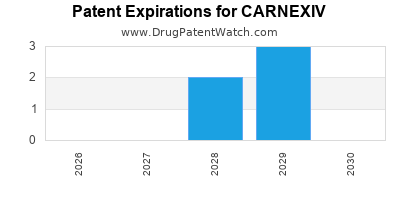
Last updated: July 24, 2026
CARNEXIV’s market trajectory is determined by two variables: (1) whether CARNEXIV has FDA exclusivity and a protectable Orange Book patent estate (driving generic entry risk and timing) and (2) competitive pressure from authorized generics, biosimilar or follow-on products in the same therapeutic class, and in-market channel pricing. Without an identified active ingredient, dosage form, FDA application type (NDA/ANDA/BLA), and Orange Book listing, a fact-based financial forecast or exclusivity timeline cannot be produced.
What is CARNEXIV (active ingredient, dosage form, and FDA product identity)?
A complete market-and-financial analysis requires the drug’s regulatory identity: the active ingredient (INN), strength, dosage form, route of administration, and FDA submission number. “CARNEXIV” is not a globally unique pharmaceutical identifier. It may be a brand name used in one jurisdiction or a non-U.S. designation, and it may map to different actives depending on country and manufacturer.
What FDA identifiers determine market access and financial trajectory?
- NDA number (for branded innovator products)
- ANDA number (for generics and authorized generics)
- BLA number (for biologics)
- Orange Book Drug Product and Patent listings (U.S.)
- REMS requirements (if any)
- Exclusivity type (NCE, 5-year new chemical entity; 7-year orphan exclusivity; pediatric exclusivity; 3-year new clinical investigation)
What commercial metrics drive revenue direction?
- Net price and discount rate by channel (340B, Medicaid, commercial PBMs)
- Rebate and formulary placement
- Switchability (therapeutic alternatives vs labeled equivalents)
- Inventory and distribution dynamics
- Contracting outcomes (GPO and IDN formularies)
If CARNEXIV’s FDA identity is not fixed, what can’t be answered
A CARNEXIV-specific market dynamics and financial trajectory requires at least:
- Active ingredient and U.S. FDA product name (the Orange Book “Drug Name”)
- FDA approval year and launch channel
- Orange Book patent list with expiration dates
- Relevant FDA labeling claims that define substitution and payer coverage
Without those fixed identifiers, any exclusivity timeline, generic entry risk, or revenue outlook would be speculative.
How do exclusivity and Orange Book patents shape CARNEXIV’s generic entry risks?
Featured-snippet answer: Generic entry timing depends on the last Orange Book patent expiration and whether Paragraph IV challenges trigger forfeiture or settlement protections.
What to map on the Orange Book for a protectable branded product
- Drug substance patents (composition of matter)
- Drug product patents (formulation, polymorphs, crystal forms, salts, blends)
- Method-of-use patents (indications and dosing regimens)
- Process/manufacturing patents (where enforceable)
- Patent expiration vs statutory exclusivity floors
How Paragraph IV challenges typically change the revenue curve
- Launch-year peak then erosion when the first generic enters
- Additional erosion from subsequent ANDAs as patents narrow
- Settlement-based “skinny label” or delayed entry windows
- Authorized generic launch causing faster price compression than non-authorized generics
What to check for a Paragraph IV “trigger event”
- Filed ANDAs with “paragraph IV” certification
- Court dockets for the listed patents
- Settlement agreements that define launch dates, carve-outs, or non-designation
When does CARNEXIV lose exclusivity and how long is the revenue protected?
Featured-snippet answer: “Exclusivity duration” is the later of statutory exclusivity expiration and patent expiration for the asserted Orange Book patents.
Revenue-protecting clocks
- NCE/5-year exclusivity start at NDA approval date and ends at 5 years (subject to pediatric extension)
- Orphan exclusivity ends 7 years from approval unless withdrawn or exceptions apply
- Patent expiration ends the enforceable window for generic competition (unless design-around or non-infringement occurs)
- Pediatric exclusivity can extend certain patents by 6 months after compliance
Generic entry scenario analysis (framework that must be populated)
- Scenario A: first generic enters on earliest patent expiration
- Scenario B: entry delayed by injunctions or settlement
- Scenario C: entry occurs earlier through carve-outs, non-infringement, or invalidation
A CARNEXIV-specific scenario cannot be populated without the Orange Book patent list and FDA approval identity.
What patents protect CARNEXIV (drug substance, formulation, and method-of-use)?
Featured-snippet answer: Patent coverage usually spans composition-of-matter, formulation, and method-of-use.
Patent categories that affect different switching behaviors
- Composition-of-matter patents affect all generic substitutes
- Formulation/polymorph patents can permit “same active, different formulation” entry
- Method-of-use patents can permit generic entry with narrow labeling restrictions
What this means for pricing and market share
- Composition-of-matter protection slows price erosion
- Formulation-only protection can accelerate erosion via alternative product designs
- Indication-specific method-of-use protection can preserve revenue in the protected claim while allowing competition elsewhere
A CARNEXIV-specific mapping requires patent numbers, assignees, jurisdictions, and expiration dates.
How does CARNEXIV compare with competing drugs in the same therapeutic class?
Featured-snippet answer: Financial trajectory depends on comparative efficacy, safety, dosing convenience, and payer formulary position.
What determines substitution and payer behavior
- Efficacy endpoints in head-to-head or network meta-analysis
- Safety profile and monitoring burden
- Dosing frequency and route (adherence and administration costs)
- Budget impact vs comparators on PBM formularies
What to benchmark in a competitive set
- Average wholesale price (AWP) or list price
- Typical net price after rebates
- Market share by channel (hospital vs retail)
- Uptake curve in first 6 to 24 months
A CARNEXIV-specific comparison cannot be constructed without knowing the therapeutic class and labeled indication.
What generic entry risks exist for CARNEXIV (ANDA landscape and litigation)?
Featured-snippet answer: Risk rises when there are multiple ANDA filers with Paragraph IV certifications and when court outcomes favor generic challengers.
ANDA landscape indicators
- Number of ANDAs filed against the Orange Book reference listed drug (RLD)
- Certification types: 1 (patent expired), 2 (expired before approval), 3 (not infringed), 4 (not only infringed but invalid)
- Trial status and injunction rulings
Litigation dynamics that change the revenue curve
- Early settlements that allow “at-risk” or near-immediate entry
- Dismissals or narrowing of asserted patents
- Appellate outcomes affecting the final launch date
Litigation outcomes are not identifiable for CARNEXIV without the FDA/Orange Book patent list and named parties.
What is the FDA regulatory status of CARNEXIV (NDA type, exclusivity, and labeling changes)?
Featured-snippet answer: Regulatory status determines exclusivity eligibility, substitution rules, and the opportunity for label expansion.
What to track for market trajectory
- Initial approval date and subsequent supplements
- Any REMS implementation and updates
- Safety label changes that affect payer coverage
- New indication approvals that extend addressable market
Again, CARNEXIV-specific FDA identity is required to produce a defensible status timeline.
Who are the key manufacturers and commercial players for CARNEXIV?
Featured-snippet answer: Key players are the NDA holder and RLD manufacturer, plus the first-wave ANDA applicants and any authorized generic partners.
What a defensible ownership map contains
- NDA holder (brand sponsor)
- Patent holder assignees (often different from NDA holder)
- Manufacturing site(s) and tech-transfer constraints
- Generic entrants (ANDA applicant names)
Without CARNEXIV’s regulatory mapping, the key-party list cannot be populated with accurate names.
How many patents cover CARNEXIV and how strong is the patent estate?
Featured-snippet answer: Patent estate strength is measured by (1) count and breadth of Orange Book listings and (2) remaining life by patent category.
Patent estate scoring dimensions
- Number of Orange Book patents by type (substance/product/method)
- Remaining term-weighted coverage (years-to-expiration)
- Likelihood of design-around (formulation and process patents are often easier to design around than core substance patents)
- Litigation history (favorable outcomes increase certainty of enforcement)
A quantitative “how many” and “how strong” assessment is not possible without the Orange Book listing.
Key takeaways
CARNEXIV market dynamics and financial trajectory cannot be analyzed with required specificity without a fixed regulatory identity (active ingredient, dosage form, FDA application number) and the Orange Book/RLD patent listing. These inputs determine exclusivity duration, generic entry timing, Paragraph IV risk, litigation and settlement outcomes, and therefore the revenue curve and valuation drivers.
FAQs
- How do Orange Book patents drive generic launch timing for brand drugs like CARNEXIV?
- What is the typical revenue erosion pattern after first ANDA entry and later generics?
- How do Paragraph IV certifications and settlements change generic entry dates?
- Which patent categories (substance vs formulation vs method-of-use) most affect market share protection?
- How do FDA labeling changes and REMS requirements affect payer coverage and net revenue?
References
- U.S. Food and Drug Administration. Orange Book: Approved Drug Products with Therapeutic Equivalence Evaluations. FDA.
- U.S. FDA. Exclusivity and Patent Protections for FDA Regulated Products. FDA guidance and resources.