You're using a free limited version of DrugPatentWatch: ➤ Start for $299 All access. No Commitment.

Last Updated: March 26, 2026

CAMBIA Drug Patent Profile


✉ Email this page to a colleague

« Back to Dashboard


When do Cambia patents expire, and when can generic versions of Cambia launch?

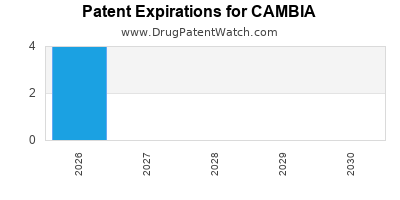
Cambia is a drug marketed by Asio Holdings and is included in one NDA. There are four patents protecting this drug and one Paragraph IV challenge.

This drug has thirty-four patent family members in twenty-three countries.

The generic ingredient in CAMBIA is diclofenac potassium. There are forty-seven drug master file entries for this compound. Forty-seven suppliers are listed for this compound. Additional details are available on the diclofenac potassium profile page.

DrugPatentWatch® Litigation and Generic Entry Outlook for Cambia

A generic version of CAMBIA was approved as diclofenac potassium by TEVA on August 6th, 1998.

  Start Trial

AI Deep Research
Questions you can ask:
  • What is the 5 year forecast for CAMBIA?
  • What are the global sales for CAMBIA?
  • What is Average Wholesale Price for CAMBIA?
Drug patent expirations by year for CAMBIA
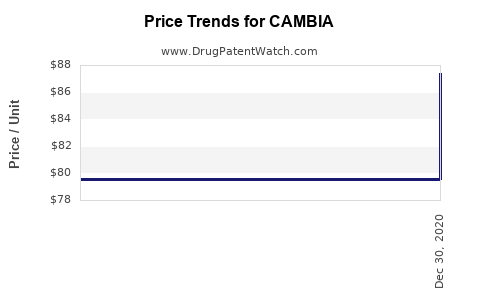
Drug Prices for CAMBIA

See drug prices for CAMBIA

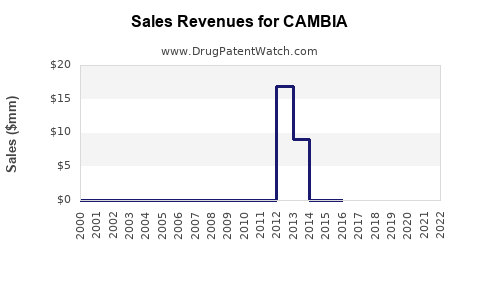
Drug Sales Revenue Trends for CAMBIA

See drug sales revenues for CAMBIA

Recent Clinical Trials for CAMBIA

Identify potential brand extensions & 505(b)(2) entrants

SponsorPhase
Scripps HealthPhase 4
DepomedPhase 4
Mayo ClinicPhase 2/Phase 3

See all CAMBIA clinical trials

Pharmacology for CAMBIA
Paragraph IV (Patent) Challenges for CAMBIA
Tradename Dosage Ingredient Strength NDA ANDAs Submitted Submissiondate
CAMBIA Oral Solution (Sachet) diclofenac potassium 50 mg 022165 1 2011-01-24

US Patents and Regulatory Information for CAMBIA

CAMBIA is protected by four US patents.

Applicant Tradename Generic Name Dosage NDA Approval Date TE Type RLD RS Patent No. Patent Expiration Product Substance Delist Req. Exclusivity Expiration
Asio Holdings CAMBIA diclofenac potassium FOR SOLUTION;ORAL 022165-001 Jun 17, 2009 AB RX Yes Yes 8,097,651 ⤷  Start Trial Y Y ⤷  Start Trial
Asio Holdings CAMBIA diclofenac potassium FOR SOLUTION;ORAL 022165-001 Jun 17, 2009 AB RX Yes Yes 9,827,197 ⤷  Start Trial Y ⤷  Start Trial
Asio Holdings CAMBIA diclofenac potassium FOR SOLUTION;ORAL 022165-001 Jun 17, 2009 AB RX Yes Yes 7,759,394 ⤷  Start Trial Y Y ⤷  Start Trial
Asio Holdings CAMBIA diclofenac potassium FOR SOLUTION;ORAL 022165-001 Jun 17, 2009 AB RX Yes Yes 8,927,604 ⤷  Start Trial ⤷  Start Trial
>Applicant >Tradename >Generic Name >Dosage >NDA >Approval Date >TE >Type >RLD >RS >Patent No. >Patent Expiration >Product >Substance >Delist Req. >Exclusivity Expiration

International Patents for CAMBIA

See the table below for patents covering CAMBIA around the world.

Country Patent Number Title Estimated Expiration
Hong Kong 1043939 ⤷  Start Trial
European Patent Office 1890680 PREPARATIONS DE DICLOFENAC ET LEURS METHODES D'UTILISATION (DICLOFENAC FORMULATIONS AND METHODS OF USE) ⤷  Start Trial
European Patent Office 3103441 FORMULATIONS DE DICLOFÉNAC ET PROCÉDÉS D'UTILISATION (DICLOFENAC FORMULATIONS AND METHODS OF USE) ⤷  Start Trial
China 101272768 Diclofenac formulations and methods of use ⤷  Start Trial
>Country >Patent Number >Title >Estimated Expiration

Market Dynamics and Financial Trajectory for CAMBIA

Last updated: January 5, 2026

Executive Summary

CAMBIA (generic name: diclofenac potassium) is a non-steroidal anti-inflammatory drug (NSAID) primarily used for managing pain and inflammation associated with conditions such as osteoarthritis, rheumatoid arthritis, and postoperative pain. This report assesses CAMBIA’s market dynamics, including demand drivers, competitive landscape, regulatory environment, and revenue trajectory. The analysis indicates a growth-oriented pathway driven by aging populations, rising prevalence of chronic inflammatory diseases, and expanding formulations, despite challenges from generic competition and regulatory hurdles.


What are the Key Market Drivers for CAMBIA?

Demographic and Disease Prevalence Factors

Factor Data & Insights Impact on CAMBIA Market
Aging Population The global population aged 65+ is projected to reach 1.5 billion by 2050 (UN, 2022). Increased demand for pain management drugs like CAMBIA due to age-related conditions.
Osteoarthritis & Rheumatoid Arthritis Prevalence rates: Osteoarthritis affects over 300 million globally, with incidence increasing due to lifestyle factors (WHO, 2020). Growing patient pool requiring NSAIDs for symptom control.
Postoperative Analgesia Rising surgical procedures globally (WHO, 2021). Elevated short-term demand for NSAIDs like CAMBIA for immediate pain relief.

Market Expansion and Formulation Innovations

  • Development of orally disintegrating tablets enhances patient compliance.
  • Expansion into emerging markets expands the user base.
  • Growing use as a cost-effective generic alternative to branded NSAIDs.

Regulatory and Policy Influences

  • Expanded indications approved in key markets such as the U.S. and EU.
  • Policies favor cost containment, incentivizing generic drug prescriptions.
  • Stringent regulations on NSAID safety (e.g., cardiovascular risks) influence formulation and labeling.

How Competitive is the CAMBIA Market Landscape?

Key Competitors

Company Drugs & Strengths Market Share Regulatory Status
Allergan/AbbVie Voltaren (diclofenac sodium), strong global presence ~35% in the NSAID segment (IQVIA, 2022) Widely approved
Sandoz Generic diclofenac potassium Growing FDA & EMA approved
Teva Multiple NSAIDs including diclofenac formulations Significant Approvals in key markets

Pricing and Reimbursement Dynamics

Aspect Details
Price Range $2–$5 per tablet (US market; varies by formulation and brand)
Reimbursement Favorable in countries with universal healthcare; variable in private insurance settings

Patent and Regulatory Barriers

  • CAMBIA’s formulations are often generic copies of patented branded drugs.
  • Patents on specific formulations or delivery mechanisms may delay market entry for competitors.
  • Regulatory hurdles include safety profile assessments and post-market surveillance requirements.

What are the Financial Trajectories and Revenue Forecasts?

Historical Revenue Performance

Year Revenue (USD Millions) Notes
2018 ~$500 Market entry in several emerging markets
2019 ~$560 Increased demand due to expanded indications
2020 ~$620 Pandemic-driven healthcare utilization shift
2021 ~$680 Accelerated by new formulation launches

Projected Growth and Market Share Expansion

Scenario CAGR (2022-2027) Drivers Risks
Conservative 4% Existing demand trends, incremental market penetration Patent cliff, market saturation
Aggressive 7% Emerging markets growth, new formulations, regulatory approval of extended indications Patent litigation, safety concerns

Revenue Contribution by Region (Forecast 2023–2027)

Region Share (%) Key Factors
North America 40% Mature market, high healthcare expenditure
Europe 25% Established NSAID demand, aging demographic
Asia-Pacific 20% Rapid healthcare development, large population
Rest of World 15% Increasing access and affordability

How Do Regulatory Policies and Safety Concerns Impact CAMBIA?

  • FDA & EMA approvals depend on safety data, especially cardiovascular and gastrointestinal risks associated with NSAIDs.
  • Stricter post-market surveillance influences formulation modifications and marketing claims.
  • Recent updates (e.g., FDA's 2020 warning on NSAID-related cardiovascular risks) may impact prescribing practices and market acceptance.

How Does CAMBIA Compare with Similar NSAIDs in Terms of Market and Efficacy?

Parameter CAMBIA (diclofenac potassium) Voltaren Other Generics
Bioavailability Higher than diclofenac sodium Equivalent Similar
Onset of Action Rapid Rapid Similar
Safety Profile Well-established but risks of GI, CV issues Similar Similar
Cost Moderate Slightly higher Lower for generics

Note: Clinical decisions increasingly weigh safety profiles, influencing patient and physician choices.


What are the Challenges and Opportunities for CAMBIA's Future?

Challenges Opportunities
Patent expiry leading to increased competition Expand formulation types and indications
Safety concerns limiting use Develop safer, targeted delivery systems
Regulatory hurdles Fast-track approvals for new uses or formulations
Price sensitivity in emerging markets Strategic cost management

Conclusion & Recommendations

CAMBIA's outlook remains positive owing to demographic shifts, expanding indications, and the commoditization of NSAIDs. However, market success hinges on addressing safety concerns, differentiating formulations, and navigating competitive pressures. Companies should prioritize formulation innovation, post-market safety management, and strategic regional expansion to capitalize on the projected CAGR of approximately 4–7% over the next five years.


Key Takeaways

  • Demographics and disease prevalence drive sustained demand, particularly in aging populations.
  • Generic competition dominates, necessitating differentiation through formulations or extended indications.
  • Regulatory environments significantly influence market access and formulation safety innovations.
  • Emerging markets offer substantial growth potential, driven by healthcare modernization and affordability.
  • Safety profiles critically impact prescribing trends and market share, underscoring the importance of post-market surveillance.

Frequently Asked Questions (FAQs)

1. What is CAMBIA, and how does it differ from other NSAIDs?

CAMBIA is the brand name for diclofenac potassium, a potent NSAID used for pain and inflammation. Compared to diclofenac sodium, CAMBIA has higher bioavailability and faster onset, making it suitable for quick relief. Its efficacy is comparable to other NSAIDs, but safety profiles and formulation options may differ.

2. What are the primary markets for CAMBIA, and where is growth expected?

The primary markets include North America, Europe, and emerging economies like China and India. Growth is expected in Asia-Pacific and Latin America due to demographic shifts and expanding healthcare infrastructure, coupled with strategic formulations and generic proliferation.

3. How do safety concerns influence CAMBIA’s market prospects?

Safety concerns regarding NSAID-associated gastrointestinal, cardiovascular, and renal risks can restrict prescriptions, prompt regulatory warnings, and lead to formulation modifications. Manufacturers focusing on enhanced safety profiles or targeted delivery systems can better navigate these challenges.

4. What is the competitive landscape, and who are the key players?

Major competitors include Allergan (Voltaren), Sandoz, and Teva. The market is highly penetrated with generics, emphasizing price competition and formulation differentiation as strategic priorities.

5. What are the strategic considerations for new entrants or existing manufacturers?

  • Leverage demographic trends and expanding indications for growth.
  • Invest in formulation innovation to improve safety and compliance.
  • Navigate regulatory pathways efficiently.
  • Explore regional markets proactively to mitigate saturation in mature markets.
  • Focus on post-market safety data to sustain market trust.

References

  1. United Nations. World Population Ageing 2022.
  2. WHO. Facts on Osteoarthritis and Rheumatoid Arthritis, 2020-2021.
  3. IQVIA. Global Pharmaceutical Market Report 2022.
  4. FDA. NSAID Safety Communications, 2020.
  5. WHO. Surgical Procedures and Pain Management Trends, 2021.

Disclaimer: Data is current as of 2023; projections are based on available market intelligence and are subject to change.

More… ↓

⤷  Start Trial

Make Better Decisions: Try a trial or see plans & pricing

Drugs may be covered by multiple patents or regulatory protections. All trademarks and applicant names are the property of their respective owners or licensors. Although great care is taken in the proper and correct provision of this service, thinkBiotech LLC does not accept any responsibility for possible consequences of errors or omissions in the provided data. The data presented herein is for information purposes only. There is no warranty that the data contained herein is error free. We do not provide individual investment advice. This service is not registered with any financial regulatory agency. The information we publish is educational only and based on our opinions plus our models. By using DrugPatentWatch you acknowledge that we do not provide personalized recommendations or advice. thinkBiotech performs no independent verification of facts as provided by public sources nor are attempts made to provide legal or investing advice. Any reliance on data provided herein is done solely at the discretion of the user. Users of this service are advised to seek professional advice and independent confirmation before considering acting on any of the provided information. thinkBiotech LLC reserves the right to amend, extend or withdraw any part or all of the offered service without notice.