Last Updated: August 9, 2026

CABENUVA KIT Drug Patent Profile


✉ Email this page to a colleague

« Back to Dashboard


When do Cabenuva Kit patents expire, and what generic alternatives are available?

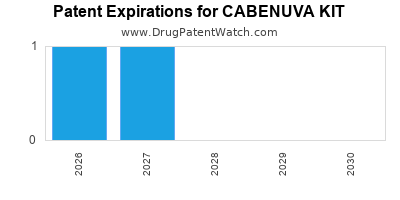
Cabenuva Kit is a drug marketed by Viiv Hlthcare and is included in one NDA. There are ten patents protecting this drug.

This drug has three hundred and two patent family members in forty-six countries.

The generic ingredient in CABENUVA KIT is cabotegravir; rilpivirine. One supplier is listed for this compound. Additional details are available on the cabotegravir; rilpivirine profile page.

DrugPatentWatch® Generic Entry Outlook for Cabenuva Kit

Cabenuva Kit was eligible for patent challenges on January 21, 2025.

By analyzing the patents and regulatory protections it appears that the earliest date for generic entry will be April 13, 2032. This may change due to patent challenges or generic licensing.

There have been four patent litigation cases involving the patents protecting this drug, indicating strong interest in generic launch. Recent data indicate that 63% of patent challenges are decided in favor of the generic patent challenger and that 54% of successful patent challengers promptly launch generic drugs.

Indicators of Generic Entry

< Available with Subscription >

  Start Trial

AI Deep Research
Questions you can ask:
  • What is the 5 year forecast for CABENUVA KIT?
  • What are the global sales for CABENUVA KIT?
  • What is Average Wholesale Price for CABENUVA KIT?
Summary for CABENUVA KIT
DrugPatentWatch® Estimated Loss of Exclusivity (LOE) Date for CABENUVA KIT
Generic Entry Date for CABENUVA KIT*:
Constraining patent/regulatory exclusivity:
NDA:
Dosage:

SUSPENSION, EXTENDED RELEASE;INTRAMUSCULAR

*The generic entry opportunity date is the latter of the last compound-claiming patent and the last regulatory exclusivity protection. Many factors can influence early or later generic entry. This date is provided as a rough estimate of generic entry potential and should not be used as an independent source.

Recent Clinical Trials for CABENUVA KIT

Identify potential brand extensions & 505(b)(2) entrants

SponsorPhase
Allegheny Singer Research Institute (also known as Allegheny Health Network Research Institute)Phase 3
ViiV HealthcarePhase 4

See all CABENUVA KIT clinical trials

US Patents and Regulatory Information for CABENUVA KIT

CABENUVA KIT is protected by ten US patents and one FDA Regulatory Exclusivity.

Based on analysis by DrugPatentWatch, the earliest date for a generic version of CABENUVA KIT is ⤷  Start Trial.

This potential generic entry date is based on patent 11,389,448.

Generics may enter earlier, or later, based on new patent filings, patent extensions, patent invalidation, early generic licensing, generic entry preferences, and other factors.

Applicant Tradename Generic Name Dosage NDA Approval Date TE Type RLD RS Patent No. Patent Expiration Product Substance Delist Req. Exclusivity Expiration
Viiv Hlthcare CABENUVA KIT cabotegravir; rilpivirine SUSPENSION, EXTENDED RELEASE;INTRAMUSCULAR 212888-001 Jan 21, 2021 RX Yes No 12,178,815 ⤷  Start Trial ⤷  Start Trial
Viiv Hlthcare CABENUVA KIT cabotegravir; rilpivirine SUSPENSION, EXTENDED RELEASE;INTRAMUSCULAR 212888-002 Jan 21, 2021 RX Yes Yes 12,636,286 ⤷  Start Trial ⤷  Start Trial
Viiv Hlthcare CABENUVA KIT cabotegravir; rilpivirine SUSPENSION, EXTENDED RELEASE;INTRAMUSCULAR 212888-001 Jan 21, 2021 RX Yes No 12,636,286 ⤷  Start Trial ⤷  Start Trial
Viiv Hlthcare CABENUVA KIT cabotegravir; rilpivirine SUSPENSION, EXTENDED RELEASE;INTRAMUSCULAR 212888-001 Jan 21, 2021 RX Yes No 11,224,597 ⤷  Start Trial Y ⤷  Start Trial
Viiv Hlthcare CABENUVA KIT cabotegravir; rilpivirine SUSPENSION, EXTENDED RELEASE;INTRAMUSCULAR 212888-002 Jan 21, 2021 RX Yes Yes 12,178,815 ⤷  Start Trial ⤷  Start Trial
Viiv Hlthcare CABENUVA KIT cabotegravir; rilpivirine SUSPENSION, EXTENDED RELEASE;INTRAMUSCULAR 212888-002 Jan 21, 2021 RX Yes Yes 10,927,129 ⤷  Start Trial Y Y ⤷  Start Trial
Viiv Hlthcare CABENUVA KIT cabotegravir; rilpivirine SUSPENSION, EXTENDED RELEASE;INTRAMUSCULAR 212888-001 Jan 21, 2021 RX Yes No 12,636,285 ⤷  Start Trial ⤷  Start Trial
>Applicant >Tradename >Generic Name >Dosage >NDA >Approval Date >TE >Type >RLD >RS >Patent No. >Patent Expiration >Product >Substance >Delist Req. >Exclusivity Expiration

Expired US Patents for CABENUVA KIT

Applicant Tradename Generic Name Dosage NDA Approval Date Patent No. Patent Expiration
Viiv Hlthcare CABENUVA KIT cabotegravir; rilpivirine SUSPENSION, EXTENDED RELEASE;INTRAMUSCULAR 212888-002 Jan 21, 2021 7,125,879 ⤷  Start Trial
Viiv Hlthcare CABENUVA KIT cabotegravir; rilpivirine SUSPENSION, EXTENDED RELEASE;INTRAMUSCULAR 212888-002 Jan 21, 2021 10,927,129 ⤷  Start Trial
Viiv Hlthcare CABENUVA KIT cabotegravir; rilpivirine SUSPENSION, EXTENDED RELEASE;INTRAMUSCULAR 212888-001 Jan 21, 2021 10,927,129 ⤷  Start Trial
Viiv Hlthcare CABENUVA KIT cabotegravir; rilpivirine SUSPENSION, EXTENDED RELEASE;INTRAMUSCULAR 212888-001 Jan 21, 2021 7,125,879 ⤷  Start Trial
Viiv Hlthcare CABENUVA KIT cabotegravir; rilpivirine SUSPENSION, EXTENDED RELEASE;INTRAMUSCULAR 212888-002 Jan 21, 2021 8,080,551 ⤷  Start Trial
Viiv Hlthcare CABENUVA KIT cabotegravir; rilpivirine SUSPENSION, EXTENDED RELEASE;INTRAMUSCULAR 212888-001 Jan 21, 2021 8,080,551 ⤷  Start Trial
Viiv Hlthcare CABENUVA KIT cabotegravir; rilpivirine SUSPENSION, EXTENDED RELEASE;INTRAMUSCULAR 212888-001 Jan 21, 2021 6,838,464 ⤷  Start Trial
>Applicant >Tradename >Generic Name >Dosage >NDA >Approval Date >Patent No. >Patent Expiration

International Patents for CABENUVA KIT

When does loss-of-exclusivity occur for CABENUVA KIT?

Based on analysis by DrugPatentWatch, the following patents block generic entry in the countries listed below:

Australia

Patent: 12241726
Estimated Expiration: ⤷  Start Trial

Brazil

Patent: 2013026363
Estimated Expiration: ⤷  Start Trial

Canada

Patent: 32410
Estimated Expiration: ⤷  Start Trial

China

Patent: 3764117
Estimated Expiration: ⤷  Start Trial

Patent: 8210469
Estimated Expiration: ⤷  Start Trial

Croatia

Patent: 0201241
Estimated Expiration: ⤷  Start Trial

Cyprus

Patent: 23434
Estimated Expiration: ⤷  Start Trial

Denmark

Patent: 96848
Estimated Expiration: ⤷  Start Trial

European Patent Office

Patent: 96848
Estimated Expiration: ⤷  Start Trial

Patent: 99860
Estimated Expiration: ⤷  Start Trial

Patent: 63243
Estimated Expiration: ⤷  Start Trial

Hong Kong

Patent: 57447
Estimated Expiration: ⤷  Start Trial

Hungary

Patent: 50970
Estimated Expiration: ⤷  Start Trial

Japan

Patent: 61593
Estimated Expiration: ⤷  Start Trial

Patent: 14515021
Estimated Expiration: ⤷  Start Trial

Lithuania

Patent: 96848
Estimated Expiration: ⤷  Start Trial

Mexico

Patent: 2344
Estimated Expiration: ⤷  Start Trial

Patent: 13011985
Estimated Expiration: ⤷  Start Trial

Poland

Patent: 96848
Estimated Expiration: ⤷  Start Trial

Portugal

Patent: 96848
Estimated Expiration: ⤷  Start Trial

Russian Federation

Patent: 43062
Estimated Expiration: ⤷  Start Trial

Patent: 13150803
Estimated Expiration: ⤷  Start Trial

San Marino

Patent: 02000504
Estimated Expiration: ⤷  Start Trial

Serbia

Patent: 651
Estimated Expiration: ⤷  Start Trial

Slovenia

Patent: 96848
Estimated Expiration: ⤷  Start Trial

Spain

Patent: 23805
Estimated Expiration: ⤷  Start Trial

Patent: 37398
Estimated Expiration: ⤷  Start Trial

Generics may enter earlier, or later, based on new patent filings, patent extensions, patent invalidation, early generic licensing, generic entry preferences, and other factors.

See the table below for additional patents covering CABENUVA KIT around the world.

Country Patent Number Title Estimated Expiration
Austria E516026 ⤷  Start Trial
Australia 2006239177 Polycyclic carbamoylpyridone derivative having HIV integrase inhibitory activity ⤷  Start Trial
Australia 2006307101 Polycyclic carbamoylpyridone derivative having inhibitory activity on HIV integrase ⤷  Start Trial
Brazil PI0610030 composto, processo para a preparação de um composto, método de tratamento de uma infecção por hiv em um humano, uso de um composto, e, composição farmacêutica ⤷  Start Trial
Brazil PI0617842 composto ou um sal farmaceuticamente aceitável ou um solvato do mesmo, e, composição farmacêutica ⤷  Start Trial
Canada 2606282 DERIVE POLYCYCLIQUE DE LA CARBAMOYLPYRIDONE A ACTIVITE INHIBITRICE SUR L'INTEGRASE DU VIH (POLYCYCLIC CARBAMOYLPYRIDONE DERIVATIVE HAVING HIV INTEGRASEINHIBITORY ACTIVITY) ⤷  Start Trial
Canada 2626956 DERIVE DE CARBAMOYLPYRIDONE POLYCYCLIQUE AYANT UNE ACTIVITE D'INHIBITION SUR L'INTEGRASE DU VIH (POLYCYCLIC CARBAMOYLPYRIDONE DERIVATIVE HAVING INHIBITORY ACTIVITY ON HIV INTEGRASE) ⤷  Start Trial
>Country >Patent Number >Title >Estimated Expiration

Supplementary Protection Certificates for CABENUVA KIT

Patent Number Supplementary Protection Certificate SPC Country SPC Expiration SPC Description
1419152 C300529 Netherlands ⤷  Start Trial PRODUCT NAME: RILPIVIRINE, DESGEWENST IN DE VORM VAN EEN FARMACEUTISCH AANVAARDBAAR ADDITIEZOUT, IN HET BIJZONDER HET HYDROCHLORIDEZOUT; REGISTRATION NO/DATE: EU/1/11/736/001 20111128
1419152 C300532 Netherlands ⤷  Start Trial PRODUCT NAME: EEN COMBINATIE VAN RILPIVIRINE EN ELKE DOOR HET BASISOCTROOI BESCHERMDE THERAPEUTISCH EQUIVALENTE VORM DAARVAN,; REGISTRATION NO/DATE: EU/1/11/737/001-002 20111128
1419152 PA2012008 Lithuania ⤷  Start Trial PRODUCT NAME: RILPIVIRINUM; REGISTRATION NO/DATE: EU/1/11/736/001 20111128
1419152 PA2012009 Lithuania ⤷  Start Trial PRODUCT NAME: EMTRICITABINUM + RILPIVIRINUM + TENOFOVIRUM DISOPROXILUM; REGISTRATION NO/DATE: EU/1/11/737/001, 2011 11 28 EU/1/11/737/002 20111128
1419152 CA 2012 00021 Denmark ⤷  Start Trial
1419152 CA 2012 00019 Denmark ⤷  Start Trial
1419152 92001 Luxembourg ⤷  Start Trial 92001, EXPIRES: 20261128
>Patent Number >Supplementary Protection Certificate >SPC Country >SPC Expiration >SPC Description

CABENUVA KIT (cabotegravir/rilpivirine) market dynamics and financial trajectory: revenue drivers, pricing/market access, competitive pressure, and exclusivity-to-generic risk

Last updated: July 28, 2026

CABENUVA Kit is a long-acting injectable HIV regimen competing in the “maintenance” segment against oral ART and other long-acting injectables. The near-term financial trajectory is driven by (1) uptake in treatment-experienced and select treatment-naïve patients under label constraints, (2) payer coverage and site-of-care economics for office-based administration, and (3) retention benefits from injection-based adherence versus oral regimens. The risk profile is shaped by pending patent/prosecution outcomes and the strength of any generic or biosimilar-like long-acting entry barriers, alongside payer preference shifts toward competing long-acting products.


What is the CABENUVA Kit revenue model and what drives sales growth?

Featured snippet answer: CABENUVA revenue is generated primarily through biopharmaceutical product sales of the kit (cabotegravir + rilpivirine) for intramuscular maintenance therapy, with commercial performance tied to patient conversions from oral ART and retention through scheduled injections.

How CABENUVA is sold (kit structure, dosing cadence, and billing economics)

  • Regimen format: combination of cabotegravir (integrase inhibitor) and rilpivirine (NNRTI) supplied as a kit for initiation/maintenance administration.
  • Administration cadence: maintenance dosing is monthly or every 2 months depending on the established dosing schedule for the patient.
  • Key revenue lever: number of patients on treatment at each injection date. A single missed visit reduces kit utilization; a resumption increases it.

Patient conversion is the core growth engine

CABENUVA commercial growth is typically paced by:

  1. Eligibility filters in label and practice guidelines (viral suppression and regimen history for many conversions).
  2. Switch programs and clinic workflows (patient identification, initiation logistics, injection training, prior authorization).
  3. Switch success and retention (tolerability, adherence to visit schedules, and management of injection-site reactions).

Retention is a financial stabilizer

  • Unlike oral regimens where adherence can drift silently, injection-based persistence creates a measurable treatment cadence.
  • Retention economics are sensitive to clinic throughput, scheduling reliability, and payer authorization cadence for repeat kits.

Site-of-care economics affect net revenue

  • Cabinet-level billing is influenced by the administration setting: physician office vs. infusion center vs. hospital outpatient.
  • Payers may prefer specific sites or utilization controls. Even when drug cost is accepted, administrative payment rules affect uptake.

When does CABENUVA face exclusivity or generic entry risk?

Featured snippet answer: CABENUVA’s ability to sustain premium pricing depends on the remaining life of composition-of-matter and method/formulation patents and any regulatory or patent-exhaustion events that could enable an abbreviated pathway. Long-acting injectable products face added practical barriers for generic substitutes, but patent expiration remains the decisive factor.

Exclusivity and patent timeline: what matters for launch risk

For a long-acting combo product, generic entry risk typically arrives through:

  • Patent expiration (composition, formulation, and delivery method).
  • Paragraph IV certifications (if any generic submits an ANDA-type application).
  • Litigation and settlements that can delay entry via negotiated “carve-out” or stipulated final approval dates.

What to model financially

  • Use a staged ramp-down/ramp-up curve rather than a single “expiration date” cliff:
    • Early generic launch can be limited by pharmacy network, prior auth, and physician preference.
    • Share change accelerates after payer policies shift and clinics gain comfort with alternative products.

What patents protect CABENUVA Kit and how strong is the estate?

Featured snippet answer: CABENUVA is protected by a layered patent estate covering cabotegravir and rilpivirine compositions and combination uses, plus long-acting formulation and administration-related claims. The estate strength is determined by how many granted, unexpired patents remain across those categories in key markets.

Patent estate components that matter commercially

A defensible long-acting injectable patent stack usually includes:

  • Composition-of-matter for each active ingredient and the combination.
  • Formulation patents addressing the long-acting release system, particle/crystalline form, excipients, and stability.
  • Method-of-use patents tied to dosing regimens (monthly vs. every 2 months), patient populations, and switch protocols.

Why formulation and dosing claims affect generic viability

Even if a generic has compatible actives, it often must match:

  • release kinetics,
  • particle attributes or solid-state form (if claimed),
  • stability and shelf life,
  • injection technique and handling instructions (if claimed as a method).

What generic launch scenarios and Paragraph IV risks exist for CABENUVA?

Featured snippet answer: Launch risk concentrates on markets where an abbreviated pathway is available and where patent coverage is thinner or less litigated. The most credible path for a substitute is a near-term patent loss or settlement that permits regulatory approval despite remaining formulation or use claims.

How to scenario-plan for financial exposure

Model three entry scenarios:

  1. Delayed entry (post-litigation or post-expiration) that limits first generic volume.
  2. Early entry with narrow coverage (limited dosing interval alignment or partial label).
  3. Full-label switch after additional litigation outcomes or if remaining patents are invalidated or no longer asserted.

Market adoption hurdles that change the revenue impact

  • Clinics may require evidence on injection-site tolerability and therapeutic equivalence.
  • Payers may impose step therapy or prefer the branded regimen for convenience and known persistence.

How does CABENUVA compare with other long-acting HIV injectables on market dynamics?

Featured snippet answer: CABENUVA competes against long-acting regimens that offer similar injection cadence. Differentiation is mostly driven by clinical positioning, initiation approach, ease of switching, payer contracts, and persistence outcomes.

Key comparison dimensions that affect share

  • Injection cadence flexibility: monthly vs. every-2-month options.
  • Patient eligibility constraints: prior viral suppression requirements and regimen history limits.
  • Initiation protocol complexity: whether initiation can be done in a way that reduces clinic burden.
  • Payer contracting: formulary placement and preferred specialty pharmacy vs. buy-and-bill terms.
  • Clinic workflow: staff training, scheduling, inventory management, and prior authorization time.

What is the Orange Book status of CABENUVA Kit and how should investors interpret it?

Featured snippet answer: Orange Book listings identify associated approved drug products and patents (with expiration dates) that can enable a Paragraph IV challenge. Interpreting Orange Book requires mapping listed patents to kit components and the specific dosage forms (and identifying which are still in force).

How Orange Book listings translate into financial risk

  • Number of listed patents correlates with higher litigation probability.
  • Remaining life (years/months until expiration) determines how soon generic challenges can be filed and how quickly settlement can lead to launch.

How to use the Orange Book to build a launch model

  • Create a master table of:
    • patent numbers,
    • listed expiration dates,
    • status (granted vs. disclaimed vs. expired),
    • asserted claim type (composition, method of use, etc.),
    • jurisdictions targeted by litigation (US vs. foreign).

What FDA regulatory milestones matter for CABENUVA’s financial trajectory?

Featured snippet answer: FDA label expansions, pathway decisions, and supplemental approvals that broaden eligible populations drive measurable market expansion by enabling more patient eligibility.

Milestones that influence adoption and reimbursement

  • Label expansions for treatment populations or dosing schedules can increase the addressable patient base.
  • Safety updates can influence payer comfort and clinician adoption.
  • Manufacturing or supply stability affects continuity of therapy, which directly impacts persistence.

What pricing, payer contracting, and reimbursement dynamics affect CABENUVA net sales?

Featured snippet answer: Net sales for CABENUVA are shaped by gross-to-net discounts driven by payer mix, utilization management, patient assistance, and contractual rebates tied to formularies and buy-and-bill models.

Mix effects that move quarterly revenue

  • Commercial share vs. Medicaid/managed care mix.
  • Geographies with differing HIV clinic density and payer aggressiveness.
  • Urban specialty clinics vs. broader community adoption.

Buy-and-bill and administration reimbursement can gate utilization

  • Even when the drug is covered, administration rules (coding, reimbursement rates, prior authorization) can limit clinic willingness to switch stable patients.

How does manufacturing and supply chain risk impact CABENUVA financials?

Featured snippet answer: Supply constraints lead to missed injection visits, which reduces kit utilization and can increase discontinuations or delays in switching.

Supply planning variables

  • Capacity of sterile manufacturing and long-acting formulation handling.
  • Cold-chain requirements and logistics (if applicable).
  • Forecasting accuracy tied to injection schedules.

Financial impact pathway

  • Short supply causes:
    • missed doses,
    • rescheduling,
    • patient churn risk,
    • delayed switch conversions,
    • revenue volatility in quarters.

What litigation and settlement events affect CABENUVA’s competitive timeline?

Featured snippet answer: Patent litigation determines whether potential entrants can obtain approval and launch at specific times. Settlements often convert uncertainty into a scheduled delay.

What to monitor in competition timelines

  • Patent infringement filings and claim construction outcomes.
  • Appellate decisions or stays.
  • Consent judgments or settlement-triggered stipulated dates that affect first launch.

Key financial trajectory indicators to track for CABENUVA KIT

Featured snippet answer: The most decision-useful indicators are patient counts on treatment, persistence/retention, injection cadence mix (monthly vs. every 2 months), payer coverage depth, and forecasted switch volumes.

Metrics investors and license partners monitor

  • Patients on therapy (or kit-treated population proxy).
  • Quarterly injection cycles delivered vs. scheduled.
  • Net revenue per treated patient after rebates and patient assistance.
  • Geographic mix and payer channel mix.
  • Inventory and distribution metrics that signal supply stability.
  • Share changes vs. competing long-acting HIV regimens.

How to connect these to revenue

  • Revenue ≈ (treated patient count) × (average dosing interval realized) × (net price per kit after rebates).
  • Risk events:
    • label constraints or safety actions reduce eligible conversions,
    • supply disruptions reduce delivered dosing cycles,
    • patent challenges affect future competitive pricing.

Key Takeaways

  • CABENUVA’s market dynamics are driven by conversion from oral ART and the persistence advantage of scheduled long-acting injections.
  • Financial trajectory depends on treated-patient count growth, retention, and net price stability under payer contracting and site-of-care economics.
  • Exclusivity and patent life are the primary determinants of credible generic entry timing, with formulation and dosing claims raising practical barriers.
  • Competition risk centers on long-acting HIV alternatives with overlapping patient eligibility, plus payer preference shifts.
  • Operational execution (supply, clinic workflow, prior authorization speed) directly affects quarter-to-quarter kit utilization.

FAQs

  1. How do monthly versus every-2-month CABENUVA dosing choices affect revenue per patient?
  2. What payer utilization management patterns most limit CABENUVA switching from oral ART?
  3. How do supply interruptions translate into persistence loss and revenue volatility for long-acting HIV therapies?
  4. What patent claim categories (composition, formulation, method of use) most influence generic launch feasibility for CABENUVA?
  5. How does clinic workflow capacity (injection scheduling and buy-and-bill administration) influence CABENUVA adoption curves?

References

  1. FDA. Orange Book: Approved Drug Products with Therapeutic Equivalence Evaluations. U.S. Food and Drug Administration.
  2. FDA. CABENUVA prescribing information and label history. U.S. Food and Drug Administration.
  3. FDA. Drug Approval Reports and supplemental approval records for CABENUVA. U.S. Food and Drug Administration.

More… ↓

⤷  Start Trial

Make Better Decisions: Try a trial or see plans & pricing

Drugs may be covered by multiple patents or regulatory protections. All trademarks and applicant names are the property of their respective owners or licensors. Although great care is taken in the proper and correct provision of this service, thinkBiotech LLC does not accept any responsibility for possible consequences of errors or omissions in the provided data. The data presented herein is for information purposes only. There is no warranty that the data contained herein is error free. We do not provide individual investment advice. This service is not registered with any financial regulatory agency. The information we publish is educational only and based on our opinions plus our models. By using DrugPatentWatch you acknowledge that we do not provide personalized recommendations or advice. thinkBiotech performs no independent verification of facts as provided by public sources nor are attempts made to provide legal or investing advice. Any reliance on data provided herein is done solely at the discretion of the user. Users of this service are advised to seek professional advice and independent confirmation before considering acting on any of the provided information. thinkBiotech LLC reserves the right to amend, extend or withdraw any part or all of the offered service without notice.