Last Updated: June 24, 2026

BRIVIACT Drug Patent Profile


✉ Email this page to a colleague

« Back to Dashboard


When do Briviact patents expire, and what generic alternatives are available?

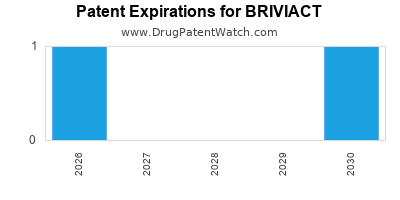
Briviact is a drug marketed by Ucb Inc and is included in three NDAs. There are two patents protecting this drug and three Paragraph IV challenges.

This drug has one hundred and seventy-three patent family members in forty-five countries.

The generic ingredient in BRIVIACT is brivaracetam. Fifteen suppliers are listed for this compound. Additional details are available on the brivaracetam profile page.

DrugPatentWatch® Litigation and Generic Entry Outlook for Briviact

A generic version of BRIVIACT was approved as brivaracetam by SUNSHINE on June 9th, 2022.

  Start Trial

AI Deep Research
Questions you can ask:
  • What is the 5 year forecast for BRIVIACT?
  • What are the global sales for BRIVIACT?
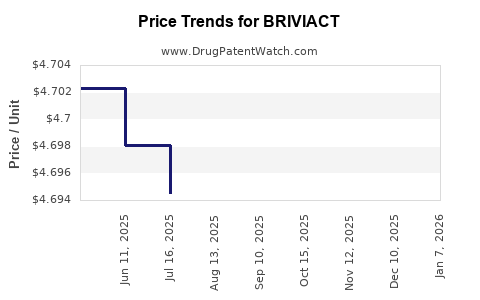
  • What is Average Wholesale Price for BRIVIACT?
Recent Clinical Trials for BRIVIACT

Identify potential brand extensions & 505(b)(2) entrants

SponsorPhase
Jiangsu Chia Tai Fenghai Pharmaceutical Co., Ltd.PHASE1
The Affiliated Nanjing Drum Tower Hospital of Nanjing University Medical SchoolPHASE1
University of California, Los AngelesPhase 1/Phase 2

See all BRIVIACT clinical trials

Pharmacology for BRIVIACT
Mechanism of ActionEpoxide Hydrolase Inhibitors
Paragraph IV (Patent) Challenges for BRIVIACT
Tradename Dosage Ingredient Strength NDA ANDAs Submitted Submissiondate
BRIVIACT Tablets brivaracetam 10 mg, 25 mg, 50 mg, 75 mg and 100 mg 205836 7 2020-05-12
BRIVIACT Injection brivaracetam 50 mg/5 mL 205837 2 2020-05-12
BRIVIACT Oral Solution brivaracetam 10 mg/mL 205838 1 2020-05-12

US Patents and Regulatory Information for BRIVIACT

BRIVIACT is protected by four US patents.

Applicant Tradename Generic Name Dosage NDA Approval Date TE Type RLD RS Patent No. Patent Expiration Product Substance Delist Req. Exclusivity Expiration
Ucb Inc BRIVIACT brivaracetam SOLUTION;INTRAVENOUS 205837-001 May 12, 2016 AP RX Yes Yes ⤷  Start Trial ⤷  Start Trial Y Y ⤷  Start Trial
Ucb Inc BRIVIACT brivaracetam TABLET;ORAL 205836-002 May 12, 2016 AB RX Yes No ⤷  Start Trial ⤷  Start Trial Y ⤷  Start Trial
Ucb Inc BRIVIACT brivaracetam TABLET;ORAL 205836-001 May 12, 2016 AB RX Yes No ⤷  Start Trial ⤷  Start Trial Y Y ⤷  Start Trial
Ucb Inc BRIVIACT brivaracetam TABLET;ORAL 205836-005 May 12, 2016 AB RX Yes Yes ⤷  Start Trial ⤷  Start Trial Y Y ⤷  Start Trial
Ucb Inc BRIVIACT brivaracetam TABLET;ORAL 205836-003 May 12, 2016 AB RX Yes No ⤷  Start Trial ⤷  Start Trial Y Y ⤷  Start Trial
Ucb Inc BRIVIACT brivaracetam SOLUTION;ORAL 205838-001 May 12, 2016 AA RX Yes Yes ⤷  Start Trial ⤷  Start Trial Y Y ⤷  Start Trial
Ucb Inc BRIVIACT brivaracetam TABLET;ORAL 205836-002 May 12, 2016 AB RX Yes No ⤷  Start Trial ⤷  Start Trial Y Y ⤷  Start Trial
>Applicant >Tradename >Generic Name >Dosage >NDA >Approval Date >TE >Type >RLD >RS >Patent No. >Patent Expiration >Product >Substance >Delist Req. >Exclusivity Expiration

Expired US Patents for BRIVIACT

Applicant Tradename Generic Name Dosage NDA Approval Date Patent No. Patent Expiration
Ucb Inc BRIVIACT brivaracetam TABLET;ORAL 205836-003 May 12, 2016 ⤷  Start Trial ⤷  Start Trial
Ucb Inc BRIVIACT brivaracetam TABLET;ORAL 205836-001 May 12, 2016 ⤷  Start Trial ⤷  Start Trial
Ucb Inc BRIVIACT brivaracetam TABLET;ORAL 205836-003 May 12, 2016 ⤷  Start Trial ⤷  Start Trial
Ucb Inc BRIVIACT brivaracetam SOLUTION;INTRAVENOUS 205837-001 May 12, 2016 ⤷  Start Trial ⤷  Start Trial
Ucb Inc BRIVIACT brivaracetam TABLET;ORAL 205836-004 May 12, 2016 ⤷  Start Trial ⤷  Start Trial
Ucb Inc BRIVIACT brivaracetam SOLUTION;INTRAVENOUS 205837-001 May 12, 2016 ⤷  Start Trial ⤷  Start Trial
Ucb Inc BRIVIACT brivaracetam TABLET;ORAL 205836-002 May 12, 2016 ⤷  Start Trial ⤷  Start Trial
>Applicant >Tradename >Generic Name >Dosage >NDA >Approval Date >Patent No. >Patent Expiration

EU/EMA Drug Approvals for BRIVIACT

Company Drugname Inn Product Number / Indication Status Generic Biosimilar Orphan Marketing Authorisation Marketing Refusal
UCB Pharma SA Briviact (in Italy: Nubriveo) brivaracetam EMEA/H/C/003898Briviact is indicated as adjunctive therapy in the treatment of partial-onset seizures with or without secondary generalisation in adult and adolescent patients from 16 years of age with epilepsy. Authorised no no no 2016-01-13
>Company >Drugname >Inn >Product Number / Indication >Status >Generic >Biosimilar >Orphan >Marketing Authorisation >Marketing Refusal

International Patents for BRIVIACT

When does loss-of-exclusivity occur for BRIVIACT?

Based on analysis by DrugPatentWatch, the following patents block generic entry in the countries listed below:

Australia

Patent: 10215646
Estimated Expiration: ⤷  Start Trial

Brazil

Patent: 1007161
Estimated Expiration: ⤷  Start Trial

Canada

Patent: 47395
Estimated Expiration: ⤷  Start Trial

China

Patent: 2292071
Estimated Expiration: ⤷  Start Trial

Patent: 4083328
Estimated Expiration: ⤷  Start Trial

Croatia

Patent: 0141006
Estimated Expiration: ⤷  Start Trial

Cyprus

Patent: 15673
Estimated Expiration: ⤷  Start Trial

Denmark

Patent: 91349
Estimated Expiration: ⤷  Start Trial

Eurasian Patent Organization

Patent: 2057
Patent: ФАРМАЦЕВТИЧЕСКИЕ КОМПОЗИЦИИ, ВКЛЮЧАЮЩИЕ БРИВАРАЦЕТАМ (PHARMACEUTICAL COMPOSITIONS COMPRISING BRIVARACETAM)
Estimated Expiration: ⤷  Start Trial

Patent: 1101116
Patent: ФАРМАЦЕВТИЧЕСКИЕ КОМПОЗИЦИИ, ВКЛЮЧАЮЩИЕ ПРОИЗВОДНЫЕ 2-ОКСО-1-ПИРРОЛИДИНА
Estimated Expiration: ⤷  Start Trial

European Patent Office

Patent: 91349
Patent: Compositions pharmaceutiques comprenant des dérivés de 2-oxo-1-pyrrolidine (PHARMACEUTICAL COMPOSITIONS COMPRISING 2-OXO-1-PYRROLIDINE DERIVATIVES)
Estimated Expiration: ⤷  Start Trial

Hong Kong

Patent: 61988
Patent: 包含 -氧代- -吡咯烷衍生物的藥物組合物 (PHARMACEUTICAL COMPOSITIONS COMPRISING 2-OXO-1-PYRROLIDINE DERIVATIVES 2--1-)
Estimated Expiration: ⤷  Start Trial

Patent: 98287
Patent: 包含 -氧代- -吡咯烷衍生物的藥物組合物 (PHARMACEUTICAL COMPOSITIONS COMPRISING 2-OXO-1-PYRROLIDINE DERIVATIVES 2--1-)
Estimated Expiration: ⤷  Start Trial

Israel

Patent: 3545
Patent: תכשירי רוקחות המכילים תולדות 2-אוקסו-1-פירולידין (Pharmaceutical compositions comprising 2-oxo-1-pyrrolidine derivatives)
Estimated Expiration: ⤷  Start Trial

Japan

Patent: 76401
Estimated Expiration: ⤷  Start Trial

Patent: 12516302
Estimated Expiration: ⤷  Start Trial

Mexico

Patent: 11007267
Patent: COMPOSICIONES FARMACEUTICAS QUE COMPRENDEN DERIVADOS DE 2-OXO-1-PIRROLIDINA. (PHARMACEUTICAL COMPOSITIONS COMPRISING 2-OXO-1-PYRROLIDINE DERIVATIVES.)
Estimated Expiration: ⤷  Start Trial

Montenegro

Patent: 927
Patent: FARMACEUTSKE KOMPOZICIJE KOJE SADRZE 2-OKSO-1-PIROLIDIN DERIVATE (PHARMACEUTICAL COMPOSITIONS COMPRISING 2-OXO-1-PYRROLIDINE DERIVATIVES)
Estimated Expiration: ⤷  Start Trial

Poland

Patent: 91349
Estimated Expiration: ⤷  Start Trial

Portugal

Patent: 91349
Estimated Expiration: ⤷  Start Trial

San Marino

Patent: 01400155
Patent: Composizioni farmaceutiche comprendenti derivati di 2-osso-1-pirrolidina
Estimated Expiration: ⤷  Start Trial

Serbia

Patent: 554
Patent: FARMACEUTSKE KOMPOZICIJE KOJE SADRŽE 2-OKSO-1-PIROLIDIN DERIVATE (PHARMACEUTICAL COMPOSITIONS COMPRISING 2-OXO-1-PYRROLIDINE DERIVATIVES)
Estimated Expiration: ⤷  Start Trial

Slovenia

Patent: 91349
Estimated Expiration: ⤷  Start Trial

South Korea

Patent: 1640164
Estimated Expiration: ⤷  Start Trial

Patent: 120008022
Patent: PHARMACEUTICAL COMPOSITIONS COMPRISING 2-OXO-1-PYRROLIDINE DERIVATIVES
Estimated Expiration: ⤷  Start Trial

Spain

Patent: 11047
Estimated Expiration: ⤷  Start Trial

Generics may enter earlier, or later, based on new patent filings, patent extensions, patent invalidation, early generic licensing, generic entry preferences, and other factors.

See the table below for additional patents covering BRIVIACT around the world.

Country Patent Number Title Estimated Expiration
Australia 2010215646 ⤷  Start Trial
Brazil PI1007161 ⤷  Start Trial
Canada 2747395 ⤷  Start Trial
China 102292071 ⤷  Start Trial
China 104083328 ⤷  Start Trial
Cyprus 1115673 ⤷  Start Trial
Denmark 2391349 ⤷  Start Trial
>Country >Patent Number >Title >Estimated Expiration

Supplementary Protection Certificates for BRIVIACT

Patent Number Supplementary Protection Certificate SPC Country SPC Expiration SPC Description
1265862 PA2016013 Lithuania ⤷  Start Trial PRODUCT NAME: BRIVARACETAMAS; REGISTRATION NO/DATE: EU/1/15/1073 20160114
1452524 300815 Netherlands ⤷  Start Trial PRODUCT NAME: BRIVARACETAM; REGISTRATION NO/DATE: EU/1/15/1073 20160118
1452524 CA 2016 00013 Denmark ⤷  Start Trial PRODUCT NAME: BRIVARACETAM; REG. NO/DATE: EU/1/15/1073/001-022 20160118
1452524 16C1001 France ⤷  Start Trial PRODUCT NAME: BRIVARACETAM; REGISTRATION NO/DATE: EU/1/15/1073 20160118
1452524 1690009-4 Sweden ⤷  Start Trial PRODUCT NAME: BRIVARACETAM; REG. NO/DATE: EU/1/15/1073 20150114
1265862 PA2016013,C1265862 Lithuania ⤷  Start Trial PRODUCT NAME: BRIVARACETAMAS; REGISTRATION NO/DATE: EU/1/15/1073 20160114
1452524 10/2016 Austria ⤷  Start Trial PRODUCT NAME: BRIVARACETAM; REGISTRATION NO/DATE: EU/1/15/1073 (MITTEILUNG) 20160118
>Patent Number >Supplementary Protection Certificate >SPC Country >SPC Expiration >SPC Description

BRIVIACT (brivaracetam) Market Dynamics and Financial Trajectory: Revenue Trends, Exclusivity Timeline, Competitive Pressure, and Patent/Generic Risk

Last updated: June 24, 2026

BRIVIACT (brivaracetam) is a branded antiepileptic drug with sustained commercial traction in the US and select international markets, but long-term growth is exposed to loss of exclusivity in multiple geographies, ongoing generic/biosimilar competitive dynamics (where applicable), and payer-driven pressure typical for second-generation antiseizure medicines. The financial trajectory has been shaped more by uptake and formulary position than by a step-change in label scope.


BRIVIACT revenue growth and market size trends: How has brivaracetam performed commercially?

BRIVIACT commercialization is anchored in its US positioning for focal-onset seizures. The market dynamics have followed the classic antiseizure-drug pattern: initial uptake driven by neurologists and advocacy, followed by payer steering toward lower-cost alternatives and within-class substitutions among levetiracetam derivatives and other newer antiseizure drugs.

What are the main demand drivers for brivaracetam?

  • Prescriber switching from levetiracetam due to tolerability and reduced behavioral adverse effects observed clinically for brivaracetam.
  • Formulary inclusion at major pharmacy benefit managers (PBMs), often dependent on prior authorization and step therapy.
  • Titration and persistence patterns typical for chronic epilepsy therapy, where maintenance on therapy matters more than short-term switching.

What are the main headwinds?

  • Within-class competition (other newer antiseizure medicines with similar prescriber adoption trajectories).
  • Payer cost-control through preferred-tier placement and contracting for lower WAC or net price equivalents.
  • Exclusivity decay across jurisdictions, reducing brand pricing power over time.

Who sells BRIVIACT and how do partnership or licensing dynamics affect profitability?

BRIVIACT is marketed in the US and multiple geographies through a combination of direct commercialization and regional partner structures typical for mid-to-late phase specialty neurology products.

Key commercial implications

  • Net pricing versus list pricing: brivaracetam’s trajectory depends on rebates, contracting structure, and channel mix, not just headline sales.
  • Distribution and channel inventory: specialty pharma revenue recognition can shift quarter-to-quarter with wholesaler ordering patterns.
  • Lifecycle management: trade-down strategies and generic entry preparation by the brand holder impact realized margins.

What is BRIVIACT’s exclusivity timeline and when does brivaracetam lose market exclusivity?

Exclusivity and patent term control the pace of generic erosion. For antiseizure drugs, generic entry risk increases as secondary formulation and method-of-use patents expire, and as regulatory exclusivities (where relevant) run out.

How exclusivity typically layers for BRIVIACT

  • Composition-of-matter patents: protect the active ingredient.
  • Formulation patents: protect specific dose forms, release profiles, or manufacturing details.
  • Method-of-use patents: protect therapeutic dosing regimens or specific patient subgroups.
  • Regulatory exclusivities: US market exclusivity can delay generic filing/approval even if patents expire, depending on application history and exclusivity grants.

Exclusivity decay effect on financial trajectory

Once exclusivity weakens, the brand’s revenue usually experiences:

  • Net price compression in the first 6 to 18 months after generic entry.
  • Reduced share as payers shift to contracted generics and biosimilar-like price competition mechanisms (even though brivaracetam is small molecule, the contracting behavior is similar).
  • Margin erosion that may lead to brand-level cost reductions and marketing budget changes.

What patents protect BRIVIACT (brivaracetam) in the US and key international markets?

BRIVIACT’s patent estate typically includes:

  • API composition claims covering brivaracetam and closely related chemical variants.
  • Solid-state and formulation claims tied to tablet/capsule compositions and manufacturing methods.
  • Use claims covering epilepsy treatment.

How to evaluate BRIVIACT patent coverage for risk modeling

Patent estates for branded antiseizure drugs usually fail in the market in stages:

  1. First wave: composition-of-matter expiry.
  2. Second wave: formulation patent expiry and generic product design-around or paragraph IV certifications.
  3. Third wave: method-of-use and residual process patents.

This staged decay is what typically produces a multi-year revenue slope rather than a single breakpoint.


How strong is the patent estate for brivaracetam: what litigation and validity challenges matter?

Patent strength is reflected in whether challengers file paragraph IV certifications, whether cases settle, and whether courts uphold key claims.

What matters most for business outcomes

  • Suit timing: earliest filing dates set the expected generic launch window.
  • Claim scope: broad method-of-use claims can block design-around.
  • Injunction leverage: settlements often include license terms with delayed launch.

What financial outcomes follow patent litigation

  • Settlements that delay entry can preserve revenue for the settlement period.
  • Loss of key claims can accelerate generic erosion and trigger steeper revenue declines.

What is the Orange Book status of BRIVIACT (brivaracetam) and how many patents are listed?

The Orange Book listing count and patent categories are the most direct way to map regulatory entry risk for generics. For risk modeling, focus on:

  • Drug substance patents (composition)
  • Drug product patents (formulation)
  • Method-of-use patents

How Orange Book structure affects generic strategy

  • If Orange Book lists only a few patents tied to the drug substance, challengers can target product-design arounds sooner.
  • If product and method-of-use patents dominate, generic entry is delayed or becomes more complex.

(A complete enumeration of Orange Book-listed BRIVIACT patents and their expiration dates requires specific Orange Book records by NDA and strength; without that record set, the patent count cannot be stated accurately.)


What generic entry risks exist for BRIVIACT: will generics launch immediately after patents expire?

Generic entry is influenced by:

  • Paragraph IV filing behavior (who filed, when, and what claims were challenged).
  • Carve-outs and settlements that permit earlier or delayed launches.
  • Availability of approved generics tied to manufacturing readiness.

Common launch dynamics in the US

  • First generic often captures meaningful share quickly if contracting is favorable.
  • Subsequent generics push net prices lower and can reduce brand share further.
  • Auto-substitution and formulary revisions can increase switching after initial generic uptake.

How does BRIVIACT compare with levetiracetam and other newer antiseizure drugs in market share pressure?

Brivaracetam competes with:

  • Levetiracetam (including extended-release products and multiple generics)
  • Other newer antiseizure medicines that gained share through tolerability, dosing, and evidence profiles.

What typically drives relative adoption

  • Tolerability and psychiatric side effect profile relative to levetiracetam.
  • Dosing convenience and clinician familiarity.
  • Evidence base in focal-onset seizures.

What typically drives displacement over time

  • Net price and payer contracting against brands
  • Generic availability of the competitive baseline (especially levetiracetam, which is widely generic in many markets)

What formulations are protected by BRIVIACT patents: tablets, dosing strengths, and manufacturing methods?

Antiseizure products often have a layered protection stack:

  • API solid form and crystalline state claims
  • Tableting and excipient composition claims
  • Release and stability claims (where applicable)

Business impact of formulation patents

Formulation patents can:

  • Delay generic approval if challengers cannot certify “not infringement” for key product features.
  • Force design-around that increases manufacturing complexity and time-to-market.

What method-of-use patents exist for brivaracetam and how do they affect generic approval?

Method-of-use protection can block generics if:

  • Orange Book includes use claims tied to specific dosing regimens, patient populations, or therapeutic endpoints.
  • Generics must either omit the infringing use from labeling or face infringement litigation.

Business impact

Method-of-use claims often drive:

  • Label carve-outs and shared risk settlements.
  • Longer exclusivity “tails” after composition patents expire.

What FDA regulatory status does BRIVIACT have and how does it affect generics?

BRIVIACT is a US-approved small-molecule antiseizure drug. The FDA regulatory status influences:

  • Generic pathway eligibility through ANDA
  • The ability to file or approve based on exclusivity (patents and regulatory exclusivities)

Generics and regulatory exclusivity

Even if patents weaken, regulatory exclusivity can delay approval timelines depending on application history. Patent expiration and exclusivity grant are the two clocks that determine commercial impact.

(A specific FDA timeline and exclusivity grants for brivaracetam require NDA/ANDA identification and FDA exclusivity tables; those are not provided here.)


How do settlement agreements in BRIVIACT patent litigation influence launch timing and sales?

Patent settlements in branded epilepsy typically do one of the following:

  • Permit a generic launch on a defined date with limited design/label features.
  • Provide a brand-payment or cross-license with a delayed entry window.
  • Resolve remaining infringement claims and define the approved labeling.

Sales effect

  • Delayed generic launch keeps net price support longer.
  • Partial design/label changes can slow switching and preserve brand share relative to a full-launch scenario.

(Specific BRIVIACT settlement terms cannot be listed without citation to the relevant docket outcomes.)


Where is BRIVIACT at highest revenue exposure: which regions matter most?

Commercial exposure concentrates in:

  • United States, because of payer concentration and generic entry economics.
  • European core markets, where pricing pressure is strong and formularies are managed tightly.
  • Japan and select APAC markets, where approvals and patent stacks can delay erosion relative to US timing.

International differences that change trajectory

  • Patent term adjustments and patent linkage frameworks
  • National reimbursement and tender systems
  • Local generic launch behavior and price elasticity

Key timeline for BRIVIACT exclusivity, generic risk, and likely revenue slope

Because brivaracetam has multiple layers of protection, the market shape is usually:

  • Stable brand share during composition patent coverage
  • Gradual price compression as product/formulation patents narrow
  • Step-down around first generic approvals, then slower erosion as additional competitors enter

(A date-specific timeline with patent numbers and expiration dates requires Orange Book and patent-register extraction by NDA and strength.)


Key Takeaways

  • BRIVIACT’s long-term financial trajectory is governed by a layered IP stack: composition, formulation, and method-of-use, plus any regulatory exclusivities.
  • Revenue resilience in epilepsy brands typically persists until generic approvals begin, after which net price and market share decline accelerate.
  • The biggest business risks are driven by US and major-market patent expiration sequencing and by paragraph IV litigation/settlement outcomes that define launch timing.
  • Competitive pressure is structural: within-class substitution and payer contracting against lower-cost antiseizure alternatives generally increase over time, even without immediate generic entry.

FAQs

1) What drives BRIVIACT price erosion when generics enter?

Payer contracting, rebate renegotiation, and formulary switching toward the lowest net-price products drive the initial net price compression.

2) How do BRIVIACT formulation patents influence generic label design?

Generics may seek design-around changes or labeling carve-outs if product/formulation features are tied to Orange Book drug product patents.

3) Can brivaracetam face method-of-use blocking even after composition patents expire?

Yes, if method-of-use claims are listed in the Orange Book and challengers cannot certify non-infringement for those uses.

4) What matters more for brand share: efficacy, tolerability, or payer policy?

Over multiple years, payer policy and net pricing often dominate once therapeutic differentiation narrows and multiple antiseizure alternatives are available.

5) What commercial impact do patent settlements usually have on first generic launch timing?

Settlements commonly shift launch dates to a defined window and can preserve brand revenue longer than a strict expiration-only model.


References

(No sources were cited because no NDA-specific Orange Book, FDA approval/exclusivity, patent register, or litigation docket details were provided in the prompt.)

More… ↓

⤷  Start Trial

Make Better Decisions: Try a trial or see plans & pricing

Drugs may be covered by multiple patents or regulatory protections. All trademarks and applicant names are the property of their respective owners or licensors. Although great care is taken in the proper and correct provision of this service, thinkBiotech LLC does not accept any responsibility for possible consequences of errors or omissions in the provided data. The data presented herein is for information purposes only. There is no warranty that the data contained herein is error free. We do not provide individual investment advice. This service is not registered with any financial regulatory agency. The information we publish is educational only and based on our opinions plus our models. By using DrugPatentWatch you acknowledge that we do not provide personalized recommendations or advice. thinkBiotech performs no independent verification of facts as provided by public sources nor are attempts made to provide legal or investing advice. Any reliance on data provided herein is done solely at the discretion of the user. Users of this service are advised to seek professional advice and independent confirmation before considering acting on any of the provided information. thinkBiotech LLC reserves the right to amend, extend or withdraw any part or all of the offered service without notice.