Last updated: August 2, 2026
Brisdelle is the first and only FDA-approved nonhormonal prescription product specifically indicated for moderate-to-severe vasomotor symptoms associated with menopause. Its active ingredient is paroxetine mesylate, administered as a 7.5 mg capsule. The product occupies a narrow segment between hormone therapy, generic nonhormonal alternatives, and newer neurokinin-3 receptor antagonists.
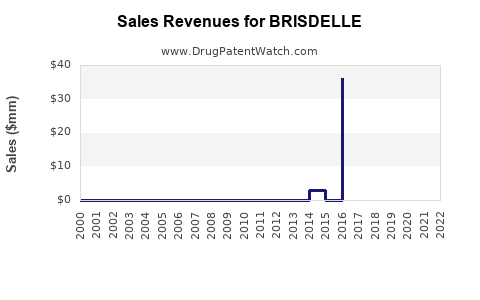
Brisdelle has limited public financial disclosure because its commercial owner, Sebela Pharmaceuticals, is privately held. Public sources do not provide audited Brisdelle revenue, prescription volume, profitability, or current market share. Its commercial trajectory is therefore best assessed through FDA labeling, competitive entry, payer dynamics, patent status, and the size of the menopausal vasomotor-symptom market.
What is Brisdelle and what is it approved to treat?
Brisdelle is paroxetine mesylate 7.5 mg administered once daily at bedtime. The FDA approved it on June 28, 2013, under NDA 204516 for the treatment of moderate-to-severe vasomotor symptoms associated with menopause. It is marketed as a nonhormonal treatment for hot flashes and night sweats. [1]
Unlike antidepressant formulations of paroxetine, Brisdelle is not approved for depression, anxiety, obsessive-compulsive disorder, panic disorder, or other psychiatric conditions. The product label specifically warns against substituting Brisdelle for paroxetine products approved for psychiatric indications. [1]
The FDA approval was based on randomized clinical trials showing reductions in weekly vasomotor-symptom frequency compared with placebo. The product does not contain estrogen or progestin, which allows it to target women who avoid or cannot use hormone therapy.
What is the active ingredient in Brisdelle?
Brisdelle contains paroxetine mesylate, a selective serotonin reuptake inhibitor. The 7.5 mg dose is substantially lower than typical psychiatric doses of paroxetine hydrochloride or paroxetine mesylate.
The low dose supports its positioning as a menopause treatment rather than an antidepressant. The label still includes SSRI-related warnings, including suicidal thoughts and behaviors, serotonin syndrome, discontinuation symptoms, bleeding risk, hyponatremia, and drug interactions. [1]
How large is the market for Brisdelle?
The addressable market is large in population terms but fragmented by treatment choice. Menopausal vasomotor symptoms affect a substantial share of women during the menopausal transition. Commercial demand is divided among:
- Systemic hormone therapy
- Local vaginal estrogen and other local therapies, which generally do not treat hot flashes
- Generic SSRIs and SNRIs used off-label
- Gabapentin and pregabalin
- Clonidine
- Fezolinetant, marketed as Veozah by Astellas
- Brisdelle
- Lifestyle measures and no prescription treatment
Brisdelle competes against lower-cost generic paroxetine and other generic antidepressants used off-label. Its principal commercial advantage is the FDA-approved indication and the 7.5 mg dose. Its principal disadvantage is that generic alternatives are often available at materially lower prices.
The market has expanded with greater clinical attention to nonhormonal treatment. Astellas’s FDA approval of Veozah in May 2023 created a branded nonhormonal competitor with a distinct mechanism. Veozah acts on neurokinin B signaling through the neurokinin-3 receptor and requires liver monitoring under its prescribing information. [2]
How does Brisdelle compare with Veozah and generic paroxetine?
| Product |
Active ingredient |
FDA indication |
Mechanism |
Main commercial position |
| Brisdelle |
Paroxetine mesylate 7.5 mg |
Moderate-to-severe menopausal vasomotor symptoms |
SSRI |
Established branded nonhormonal option |
| Veozah |
Fezolinetant |
Moderate-to-severe menopausal vasomotor symptoms |
Neurokinin-3 receptor antagonist |
Newer branded mechanism with premium pricing potential |
| Generic paroxetine |
Paroxetine salts and doses vary |
Psychiatric indications; menopause use may be off-label |
SSRI |
Low-cost substitute |
| Venlafaxine and other SNRIs |
Various |
Primarily psychiatric indications; menopause use often off-label |
Serotonin-norepinephrine reuptake inhibition |
Common generic alternative |
| Gabapentin |
Gabapentin |
Neuropathic pain and seizures; menopause use often off-label |
Calcium-channel modulation |
Low-cost alternative with tolerability limits |
Brisdelle has a stronger regulatory positioning than off-label generics but weaker economic differentiation. Veozah offers mechanism-based differentiation but has a higher monitoring burden and faces its own payer-access challenges.
What is the FDA regulatory status of Brisdelle?
Brisdelle remains an FDA-approved prescription product under NDA 204516. The product is not a biologic and does not face biosimilar competition. It is a small-molecule drug that can be challenged through the ANDA pathway.
The FDA-approved indication is narrow. Brisdelle is not approved for general psychiatric treatment, and the product label does not support use as a replacement for higher-dose paroxetine products. The FDA labeling also contains a boxed warning concerning increased risk of suicidal thoughts and behaviors in pediatric and young adult patients taking antidepressants, although Brisdelle is used primarily in postmenopausal women. [1]
Does Brisdelle have pediatric or pregnancy-related market exposure?
No meaningful pediatric commercial opportunity exists under the approved indication. Brisdelle is intended for menopausal vasomotor symptoms, and its label includes pregnancy-related warnings associated with paroxetine exposure. [1]
What patents protect Brisdelle?
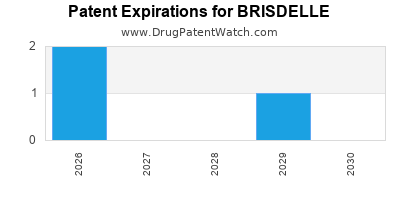
Brisdelle’s patent protection is associated with low-dose paroxetine formulations and the use of paroxetine for menopausal vasomotor symptoms. The relevant patent estate must be reviewed through the FDA Orange Book and the underlying U.S. Patent and Trademark Office records because listed patents, expiration dates, pediatric extensions, terminal disclaimers, and regulatory exclusivity can change the timing of generic entry. [3]
Public patent databases have associated Brisdelle with patents covering paroxetine formulations and methods of treating vasomotor symptoms. Patent scope is more important than the number of listed patents. A formulation patent can create a separate barrier from a method-of-use patent, but the practical strength of a method patent depends on the ANDA applicant’s proposed labeling and the enforceability of the asserted claims.
The product’s earliest commercial protection has largely matured relative to newer branded menopause products. Brisdelle therefore faces greater long-term exposure to generic substitution than Veozah, which entered the market in 2023 with newer composition-of-matter and method-of-use protection.
What is the Orange Book status of Brisdelle?
Brisdelle is listed in the FDA Orange Book as a prescription product approved under NDA 204516. Orange Book entries are the controlling source for listed patents and regulatory exclusivity associated with the approved product. [3]
The Orange Book should be distinguished from commercial patent databases. Commercial databases may include continuation patents, expired patents, or patents that do not block an ANDA launch for the approved product. A transaction, litigation, or launch analysis should use the current Orange Book entry together with USPTO records and FDA Paragraph IV notices.
When does Brisdelle lose exclusivity?
Brisdelle’s five-year new chemical entity exclusivity expired in 2018, based on its 2013 approval. That exclusivity period prevented the FDA from accepting an ANDA referencing Brisdelle during the statutory NCE period, subject to the regulatory framework applicable to the product. [4]
Patent expiry is separate from FDA regulatory exclusivity. A patent may extend beyond the NCE period, while a generic applicant may challenge the patent before its expiration through a Paragraph IV certification.
The practical generic-entry date depends on:
- The current Orange Book patent list
- Paragraph IV litigation
- A 30-month FDA approval stay, if triggered
- Any settlement agreement
- The generic applicant’s proposed label
- Possible pediatric exclusivity or other statutory extensions
No reliable public record establishes a single definitive generic launch date without a current review of FDA ANDA approvals, Orange Book entries, court dockets, and settlement terms.
Are there Paragraph IV challenges to Brisdelle?
A Paragraph IV challenge occurs when an ANDA applicant certifies that an Orange Book-listed patent is invalid, unenforceable, or will not be infringed by the proposed generic product. The certification can trigger patent litigation by the branded sponsor.
Publicly available sources do not establish a complete, current list of all Brisdelle Paragraph IV certifications, litigation outcomes, or settlement agreements. A definitive litigation assessment requires contemporaneous review of FDA Paragraph IV notifications, PACER, district-court dockets, and the Orange Book.
The commercial risk remains significant because the product is a small-molecule capsule with a generic-friendly dosage form. The principal uncertainty is not whether the formulation can be copied technologically. It is whether listed patents, labeling restrictions, or litigation settlements delay approval or launch.
What formulation patents protect Brisdelle?
Brisdelle’s formulation value comes from the low-dose 7.5 mg paroxetine mesylate capsule and its associated release and dosing characteristics. Formulation claims can be commercially relevant where they distinguish the product from higher-dose paroxetine products or require a particular pharmaceutical composition.
A generic applicant may seek approval with a formulation that avoids asserted claims. The FDA’s approval process and patent litigation therefore operate separately. FDA approval does not resolve patent infringement, and patent expiry does not guarantee immediate commercial substitution if the generic lacks approval or faces a settlement restriction.
What method-of-use patents protect Brisdelle?
Method-of-use protection can cover the use of paroxetine to treat menopausal vasomotor symptoms. Under the ANDA framework, a generic applicant may use a section viii statement to omit a patented indication from its labeling if the product retains other nonpatented uses. [4]
This creates a central risk for Brisdelle. The generic may enter with a label that omits the menopause indication while physicians still prescribe the product off-label. Such a launch can weaken the branded product’s market position even if the branded method-of-use patent remains in force.
Which companies are challenging Brisdelle?
The principal competitive threat comes from generic manufacturers capable of filing ANDAs for paroxetine mesylate 7.5 mg capsules. The relevant competitive set can include large generic companies such as Teva, Mylan/Viatris, Amneal, Lupin, Zydus, and other FDA-approved ANDA sponsors, depending on actual filings and approvals.
No complete, current public source identifies every company with an approved or pending ANDA for Brisdelle. Generic competition should be tracked through FDA approval announcements, Drugs@FDA, the Orange Book, and commercial prescription-data services.
Veozah adds branded competition but does not challenge Brisdelle through the ANDA pathway. Its commercial effect is therapeutic substitution rather than generic erosion.
What is Brisdelle’s financial trajectory?
Public financial data for Brisdelle are limited. Sebela Pharmaceuticals is privately held and does not provide the level of product-specific revenue disclosure available from publicly traded pharmaceutical companies. Brisdelle sales, gross margin, prescription volume, and contribution profit are not reliably reported in public SEC filings.
The likely financial trajectory has four phases:
| Period |
Commercial condition |
Financial implication |
| 2013-2018 |
NCE exclusivity and branded launch |
Higher protection but limited category awareness |
| 2019-2022 |
Mature branded product with generic off-label competition |
Pricing and reimbursement pressure |
| 2023 onward |
Veozah launch expands branded nonhormonal competition |
Greater share-of-voice and payer pressure |
| Post-generic entry |
Potential authorized or independent generic substitution |
Sharp unit-price and market-share risk |
Brisdelle’s revenue exposure is likely concentrated in the U.S. because the brand’s principal regulatory and commercial identity is tied to the FDA-approved menopause indication. International revenue potential is limited unless the product has separate country approvals, local commercialization partners, or licensing arrangements.
What licensing deals affect Brisdelle?
Brisdelle was developed and initially commercialized by Noven Pharmaceuticals. Sebela Pharmaceuticals later became associated with the brand through its women’s-health portfolio. Public sources do not establish a current, comprehensive schedule of royalties, milestone obligations, territory rights, or license economics for Brisdelle.
Any valuation of the product should separate:
- Product-level net sales
- Gross-to-net deductions
- Royalty obligations
- Manufacturing costs
- Promotional spending
- Litigation reserves
- Remaining patent life
- Generic-entry probability
Without audited product-level figures, Brisdelle should be valued as a mature branded specialty product with asymmetric downside from generic entry rather than as a growth-stage asset.
How strong is the Brisdelle patent estate?
The estate is commercially useful but structurally vulnerable. Brisdelle has regulatory differentiation, a recognized brand, and potentially relevant formulation and method-of-use patents. It lacks the broad protection typically associated with a new chemical entity because paroxetine itself is an established molecule with extensive prior art.
Patent strength is moderated by:
- The narrow approved indication
- The availability of generic paroxetine
- Potential section viii labeling strategies
- The small-molecule capsule dosage form
- The passage of NCE exclusivity
- The possibility of generic substitution before or near final patent expiry
Its strongest defense is likely a valid, enforceable claim that directly covers the 7.5 mg formulation or the approved menopause use and cannot be avoided through label carving. Its weaker defense is a method patent that a generic can omit from labeling.
What generic launch risks exist for Brisdelle?
The primary launch scenarios are:
Scenario 1: Delayed generic entry
Patent litigation or a settlement agreement delays launch. Brisdelle retains branded pricing for a longer period, although payer pressure can still reduce net sales.
Scenario 2: At-risk generic launch
A generic launches before final patent resolution. This can rapidly reduce branded volume and create damages exposure if the patent holder later prevails.
Scenario 3: Section viii generic entry
A generic enters with a label that omits the menopause indication. Physicians may still prescribe it off-label, producing substantial substitution without direct label competition.
Scenario 4: Authorized generic
The brand owner or a partner launches an authorized generic, preserving some manufacturing economics while limiting independent generic erosion.
The section viii scenario is particularly relevant because paroxetine has established off-label use in vasomotor symptoms and generic manufacturers can compete on price.
Key Takeaways
- Brisdelle is FDA-approved paroxetine mesylate 7.5 mg for moderate-to-severe menopausal vasomotor symptoms.
- Its NCE exclusivity expired in 2018.
- The product competes with generic SSRIs, SNRIs, gabapentin, hormone therapy, and Veozah.
- Brisdelle is a small-molecule drug and has no biosimilar risk.
- Its economic protection depends on Orange Book patents, formulation claims, method-of-use claims, and litigation outcomes.
- Public product-specific revenue and profit data are not available from the privately held commercial owner.
- The principal financial risk is generic entry, including a section viii launch that omits the menopause indication.
- Brisdelle’s brand value is supported by its FDA-approved indication but constrained by the low cost and broad availability of generic paroxetine.
FAQs
Is Brisdelle the same as Paxil?
Brisdelle and Paxil contain paroxetine-related active ingredients, but they are different branded products with different strengths, indications, and labeling. Brisdelle is approved for menopausal vasomotor symptoms, while Paxil products are approved for psychiatric indications.
Can generic paroxetine replace Brisdelle?
Generic paroxetine may be prescribed off-label for menopausal symptoms, but it is not automatically equivalent in labeling, strength, or regulatory indication to Brisdelle 7.5 mg.
Does Brisdelle have biosimilar competition?
No. Brisdelle is a small-molecule drug, so potential competitors are generics approved through the ANDA pathway rather than biosimilars.
Is Brisdelle more commercially protected than Veozah?
No. Brisdelle has an earlier approval date and an older active ingredient. Veozah entered later with a newer mechanism and potentially longer remaining patent protection, although its pricing, liver-monitoring requirements, and payer access affect commercial performance.
What is the largest threat to Brisdelle sales?
The largest threat is low-cost generic substitution, especially a generic paroxetine product that enters with a section viii label excluding the menopause indication but is prescribed off-label.
References
- U.S. Food and Drug Administration. (2023). Brisdelle (paroxetine mesylate) capsules, prescribing information.
- U.S. Food and Drug Administration. (2023). Veozah (fezolinetant) tablets, prescribing information.
- U.S. Food and Drug Administration. (2024). Approved drug products with therapeutic equivalence evaluations: Orange Book.
- U.S. Food and Drug Administration. (2024). Abbreviated new drug application approvals and patent certifications.