Last Updated: August 7, 2026

BREO ELLIpta Drug Patent Profile


✉ Email this page to a colleague

« Back to Dashboard


When do Breo Ellipta patents expire, and what generic alternatives are available?

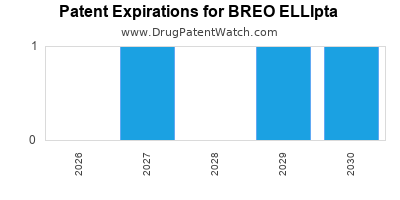
Breo Ellipta is a drug marketed by Glaxo Grp Ltd and is included in one NDA. There are four patents protecting this drug and one Paragraph IV challenge.

This drug has one hundred and thirty-five patent family members in twenty-nine countries.

The generic ingredient in BREO ELLIPTA is fluticasone furoate; vilanterol trifenatate. There are twenty-nine drug master file entries for this compound. Two suppliers are listed for this compound. Additional details are available on the fluticasone furoate; vilanterol trifenatate profile page.

DrugPatentWatch® Generic Entry Outlook for Breo Ellipta

Breo Ellipta was eligible for patent challenges on May 10, 2017.

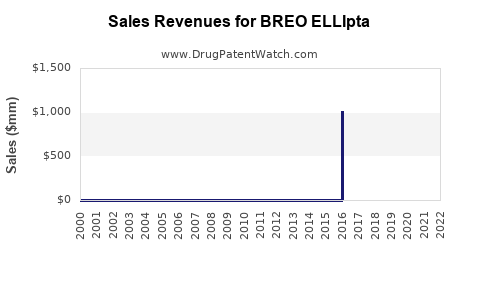
Annual sales in 2022 were $2.0bn, indicating a strong incentive for generic entry (peak sales were $2.8bn in 2021).

There have been six patent litigation cases involving the patents protecting this drug, indicating strong interest in generic launch. Recent data indicate that 63% of patent challenges are decided in favor of the generic patent challenger and that 54% of successful patent challengers promptly launch generic drugs.

Indicators of Generic Entry

< Available with Subscription >

  Start Trial

AI Deep Research
Questions you can ask:
  • What is the 5 year forecast for BREO ELLIpta?
  • What are the global sales for BREO ELLIpta?
  • What is Average Wholesale Price for BREO ELLIpta?
Recent Clinical Trials for BREO ELLIpta

Identify potential brand extensions & 505(b)(2) entrants

SponsorPhase
University of Alabama at BirminghamPHASE2
GlaxoSmithKlinePHASE4
University of Tennessee Graduate School of MedicinePHASE4

See all BREO ELLIpta clinical trials

Paragraph IV (Patent) Challenges for BREO ELLIPTA
Tradename Dosage Ingredient Strength NDA ANDAs Submitted Submissiondate
BREO ELLIPTA Powder for Inhalation fluticasone furoate; vilanterol trifenatate 100 mcg/25 mcg 204275 1 2025-06-16

US Patents and Regulatory Information for BREO ELLIpta

BREO ELLIpta is protected by four US patents and three FDA Regulatory Exclusivities.

Applicant Tradename Generic Name Dosage NDA Approval Date TE Type RLD RS Patent No. Patent Expiration Product Substance Delist Req. Exclusivity Expiration
Glaxo Grp Ltd BREO ELLIPTA fluticasone furoate; vilanterol trifenatate POWDER;INHALATION 204275-003 May 12, 2023 RX Yes Yes ⤷  Start Trial ⤷  Start Trial Y ⤷  Start Trial
Glaxo Grp Ltd BREO ELLIPTA fluticasone furoate; vilanterol trifenatate POWDER;INHALATION 204275-001 May 10, 2013 RX Yes Yes ⤷  Start Trial ⤷  Start Trial Y ⤷  Start Trial
Glaxo Grp Ltd BREO ELLIPTA fluticasone furoate; vilanterol trifenatate POWDER;INHALATION 204275-003 May 12, 2023 RX Yes Yes ⤷  Start Trial ⤷  Start Trial Y ⤷  Start Trial
>Applicant >Tradename >Generic Name >Dosage >NDA >Approval Date >TE >Type >RLD >RS >Patent No. >Patent Expiration >Product >Substance >Delist Req. >Exclusivity Expiration

Expired US Patents for BREO ELLIpta

Applicant Tradename Generic Name Dosage NDA Approval Date Patent No. Patent Expiration
Glaxo Grp Ltd BREO ELLIPTA fluticasone furoate; vilanterol trifenatate POWDER;INHALATION 204275-001 May 10, 2013 ⤷  Start Trial ⤷  Start Trial
Glaxo Grp Ltd BREO ELLIPTA fluticasone furoate; vilanterol trifenatate POWDER;INHALATION 204275-002 Apr 30, 2015 ⤷  Start Trial ⤷  Start Trial
>Applicant >Tradename >Generic Name >Dosage >NDA >Approval Date >Patent No. >Patent Expiration

International Patents for BREO ELLIpta

When does loss-of-exclusivity occur for BREO ELLIpta?

Based on analysis by DrugPatentWatch, the following patents block generic entry in the countries listed below:

Croatia

Patent: 0191257
Estimated Expiration: ⤷  Start Trial

Patent: 0241000
Estimated Expiration: ⤷  Start Trial

Cyprus

Patent: 21914
Estimated Expiration: ⤷  Start Trial

Denmark

Patent: 00950
Estimated Expiration: ⤷  Start Trial

Patent: 78169
Estimated Expiration: ⤷  Start Trial

European Patent Office

Patent: 00950
Estimated Expiration: ⤷  Start Trial

Patent: 78169
Estimated Expiration: ⤷  Start Trial

Patent: 03231
Estimated Expiration: ⤷  Start Trial

Patent: 78502
Estimated Expiration: ⤷  Start Trial

Finland

Patent: 78169
Estimated Expiration: ⤷  Start Trial

Hungary

Patent: 45917
Estimated Expiration: ⤷  Start Trial

Patent: 67290
Estimated Expiration: ⤷  Start Trial

Japan

Patent: 09985
Estimated Expiration: ⤷  Start Trial

Patent: 12518663
Estimated Expiration: ⤷  Start Trial

Lithuania

Patent: 00950
Estimated Expiration: ⤷  Start Trial

Patent: 78169
Estimated Expiration: ⤷  Start Trial

Poland

Patent: 00950
Estimated Expiration: ⤷  Start Trial

Patent: 78169
Estimated Expiration: ⤷  Start Trial

Portugal

Patent: 00950
Estimated Expiration: ⤷  Start Trial

Patent: 78169
Estimated Expiration: ⤷  Start Trial

Slovenia

Patent: 00950
Estimated Expiration: ⤷  Start Trial

Patent: 78169
Estimated Expiration: ⤷  Start Trial

Spain

Patent: 39352
Estimated Expiration: ⤷  Start Trial

Patent: 94042
Estimated Expiration: ⤷  Start Trial

Generics may enter earlier, or later, based on new patent filings, patent extensions, patent invalidation, early generic licensing, generic entry preferences, and other factors.

See the table below for additional patents covering BREO ELLIpta around the world.

Country Patent Number Title Estimated Expiration
Cyprus 1121914 ⤷  Start Trial
Denmark 2400950 ⤷  Start Trial
Denmark 3578169 ⤷  Start Trial
>Country >Patent Number >Title >Estimated Expiration

Breo Ellipta (fluticasone furoate/vilanterol) Market Dynamics and Financial Trajectory: Exclusivity, Patent/Litigation Risk, and Revenue Outlook

Last updated: July 30, 2026

Breo Ellipta is the leading fluticasone furoate/long-acting beta agonist (LABA) inhaled combination for COPD and is a key GSK respiratory franchise driver alongside Trelegy Ellipta. The financial trajectory is shaped by (1) patent and exclusivity timing across U.S. and select ex-U.S. markets, (2) payer and formulary pressure from Trelegy and other triple-therapy entrants, (3) litigation outcomes that can accelerate generic or “authorized” supply timelines, and (4) inhalation device demand and manufacturing capacity constraints that affect near-term share stability.


How big is the Breo Ellipta market and what drives demand for fluticasone furoate/vilanterol?

Answer: Breo Ellipta’s demand is driven by COPD maintenance prescribing patterns (especially where triple therapy is not yet adopted), established inhaler familiarity, strong brand position in the fluticasone furoate LABA class, and payer coverage that often uses step therapy to defer triple therapy. In the U.S., formulary design and utilization-management strategies determine whether Breo maintains share versus Trelegy (triple) and versus competitor dual therapies (LABA/LAMA and ICS/LABA).

COPD versus asthma mix: why indication mix matters

Breo is approved for:

  • COPD (maintenance treatment to reduce exacerbations)
  • Asthma (maintenance treatment in patients whose disease is not adequately controlled)

For financial trajectory, the COPD channel is typically the steadier revenue base because many payers support dual-therapy options to manage costs and reduce step-up events. The asthma segment is more sensitive to guideline changes and payer criteria that can favor triple or alternative controller strategies.

What product characteristics sustain unit economics?

Key demand supports:

  • Once-daily dosing (device convenience)
  • Ellipta platform familiarity (prescriber and patient workflow)
  • Relatively entrenched placement in inhaler formularies as a default ICS/LABA dual option in many managed-care contracts

Revenue headwinds usually come from:

  • Shifts to triple therapy (ICS/LABA/LAMA) where clinical guidelines and payer policies support step-up earlier
  • Competitive substitution among ICS/LABA molecules and device formats
  • Any supply disruptions tied to inhaler manufacturing yields or component constraints

How does Breo Ellipta compare with Trelegy Ellipta and other COPD controllers in market share dynamics?

Answer: Trelegy Ellipta generally has a structural advantage because it is triple therapy, and many payers and prescribers treat triple therapy as the preferred step-up endpoint for uncontrolled COPD. Breo competes most directly with Trelegy in patients who are not escalated to triple therapy and with other dual therapies where payers restrict costs.

Competitive set that matters in managed care

In COPD and asthma controller markets, Breo faces competition from:

  • Triple therapy: Trelegy Ellipta (GSK)
  • ICS/LABA alternatives (molecule and device competition)
  • LABA/LAMA dual therapy where ICS use is managed more tightly
  • Generic substitution pressure once brand exclusivity ends for key formulation and method-of-use patents

Net effect on financial trajectory

When payers narrow criteria for ICS/LABA and encourage triple therapy earlier, Breo’s revenue growth slows and can turn negative even absent generic entry. When triple-therapy adoption is limited by coverage or step therapy, Breo can hold share longer.


What is the Orange Book status of Breo Ellipta, and how many key patents protect fluticasone furoate/vilanterol?

Answer: Breo Ellipta’s exclusivity and patent coverage are anchored in GSK’s fluticasone furoate/vilanterol portfolio and formulation/device-related IP typical for inhaled combinations. The Orange Book status governs the generic entry pathway in the U.S. through Section 505(b)(2)/ANDA and, most importantly, through Paragraph IV certifications against listed patents.

Patent coverage categories investors track for inhaled combinations

For Breo-style combinations, the Orange Book listing typically includes:

  • Composition/formulation patents (particle engineering, solubilization, and excipient systems)
  • Method-of-use patents (maintenance dosing regimens, exacerbation reduction claims)
  • Device-related patents (often more enforceable when coupled to specific inhaler mechanics or content uniformity methods)
  • Polymorph/hydrate/salt form patents where applicable to active ingredients or intermediates

(Orange Book patent lists and expiration schedules are the controlling inputs for launch timing risk; those should be reconciled with any relevant litigation outcomes when available.)


When does Breo Ellipta lose exclusivity in the U.S., and what does the timeline imply for generic entry risks?

Answer: Breo Ellipta’s U.S. generic entry risk is tied to the expiration dates of Orange Book-listed patents and to the outcome of any Paragraph IV litigation. Even when primary compound protection ends, later-expiring formulation or method-of-use patents can delay launch.

Launch timing mechanics for generics

Generic entry is typically accelerated when:

  • A Paragraph IV challenger wins or secures a settlement that permits launch before all listed patents expire
  • Litigation reaches judgment or settlement resolves the remaining patent list
  • Patent list is narrowed through carve-outs or dismissals
  • Exclusivity triggers (like pediatric exclusivity or other regulatory exclusivities) are exhausted or not applicable

For inhalers, the risk is not only legal. Even after FDA approval, device equivalency, formulation content uniformity, and manufacturing scale can constrain launch volumes and slow revenue impact.


Which companies are likely challenging Breo Ellipta with Paragraph IV ANDAs, and what outcomes affect launch timing?

Answer: Paragraph IV challengers for inhaled combinations depend on the specific Orange Book patent list and the legal posture at the time of filing. Launch timing in the U.S. hinges on whether challengers secure favorable judgments or settlements.

Litigation outcome pathways that change the revenue curve

Track these signals:

  • Court decisions on validity and infringement for key listed patents
  • Settlement agreements that fix a launch date and define “carve-out” scope
  • Injunction rulings affecting approval versus commercial marketing
  • Dismissals or narrowing of claims that reduce remaining patent exposure

What patent litigation affects Breo Ellipta revenue, and how do settlements typically work for inhaled combination products?

Answer: For brand inhalers, the most revenue-relevant legal events are settlements that specify:

  • the effective launch date for the generic/biosubstitute
  • the scope of products allowed (strengths, dosage forms)
  • whether an authorized generic is permitted
  • whether certain patents remain carved out

Common settlement economics that matter to financial trajectory

When settlements occur, they usually:

  • reduce uncertainty for investors and payers by fixing launch timing
  • accelerate price erosion after launch because multiple entrants often follow once the first legal barrier falls
  • change reimbursement leverage as formularies reprice when FDA-approved lower-cost products become available

What formulations are protected for Breo Ellipta, and what does that mean for generic switching?

Answer: Formulation IP and method-of-use IP drive switching risk for Breo. If claims cover specific excipient systems, aerosol performance properties, or drug delivery characteristics, generic entrants may face longer regulatory or legal timelines.

Why inhaler performance patents are commercially relevant

Even when a generic can match active ingredients and dose label, if patent claims target:

  • delivery rate or aerodynamic particle size distributions
  • device actuation and content uniformity methods
  • stability or reconstitution-like equivalency parameters

…then breach risk persists through litigation.


How does Breo Ellipta’s FDA status affect revenue durability and substitution speed?

Answer: FDA-approved status is already established for Breo as a marketed combination inhaler. The regulatory impact on financial trajectory mainly comes from:

  • new ANDA approvals of generic versions post-patent resolution
  • potential device or label updates that affect interchangeability
  • any regulatory actions affecting quality or manufacturing

Interchangeability and pharmacy substitution

For revenue durability, the practical issue is pharmacy substitution:

  • once a generic is approved and priced, PBM formularies can reorder coverage quickly
  • if multiple strengths enter simultaneously, competitive price compression is faster

How does manufacturing and supply stability influence Breo Ellipta financial performance?

Answer: Inhaler brands can experience revenue volatility from supply constraints even without legal shocks. Any manufacturing disruptions that affect fill-finish yields, device assembly, or component availability can temporarily reduce in-market availability, enabling share loss to competitors and delaying recovery.

Metrics to track

  • FDA drug shortages notifications and impact durations
  • fill-finish batch failures or component lead-time issues
  • distribution continuity by geography

Even a short supply shock can shift patients to other controllers, and those switches can persist after supply normalizes due to payer inertia and inhaler “set-and-forget” prescribing.


How does Breo Ellipta pricing and payer contracting affect net revenue trajectory?

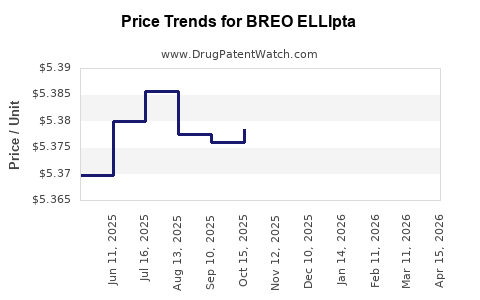
Answer: Breo’s net revenue is shaped by rebate pressure, gross-to-net dynamics, and PBM contracting strategies. When competitors (especially triple therapy or generics-in-waiting) gain leverage, net price can compress faster than gross list price suggests.

What drives gross-to-net compression

  • formulary placement changes
  • higher rebate rates to maintain tier status
  • increased utilization by patients with broad access versus restricted access
  • category growth versus share shifts

For inhaled respiratory drugs, category growth can mask brand share erosion. Conversely, a modest COPD contraction can amplify net price pressure.


What is the financial trajectory for Breo Ellipta in the context of GSK respiratory performance?

Answer: Breo is part of GSK’s broader respiratory revenue engine, which also includes Trelegy Ellipta. Financial trajectory for Breo depends on whether Trelegy cannibalizes dual-therapy growth or whether payers maintain dual-therapy coverage.

Key observation for modeling revenue

  • If Trelegy continues taking share, Breo growth tends to slow even absent generic competition.
  • If COPD cohorts remain on dual therapy due to coverage criteria or clinical pacing, Breo can hold more stable revenue longer.

What generic entry scenarios should investors model for Breo Ellipta?

Answer: The highest-probability generic revenue risk is staged: first, a single authorized or paragraph-IV-driven product launch at one strength, followed by multi-product entry once additional patent paths clear and manufacturing scales. The second risk is price compression from multiple competitors in the ICS/LABA category.

Scenario framework tied to patent and litigation events

Model these scenarios:

  1. Delayed generic entry: remaining listed patents hold; revenue declines mainly from share pressure to Trelegy.
  2. Single-launch early erosion: one entrant launches at a subset of strengths; Breo net revenue declines with retention volatility.
  3. Multi-entrant acceleration: multiple ANDAs launch after coordinated resolution; rapid rebate pressure and PBM tier moves.
  4. Authorized generic adds immediate pressure: if settlement allows authorized supply, price drops can be sharper even if legal clarity exists only for part of the list.

Which geographies present the highest incremental IP and commercial risk for Breo Ellipta?

Answer: The U.S. typically presents the sharpest timeline risk due to Orange Book-driven ANDA pathways. Ex-U.S. risk depends on national patent term adjustments, local enforcement, and local regulatory approval pathways.

Priority geography ranking for diligence

Investors typically prioritize:

  • U.S.
  • EU5 (Germany, France, Italy, Spain, UK if applicable by timeframe)
  • Canada
  • Japan
  • Australia because they cover major respiratory spend and tend to have faster generic uptake once legal barriers fall.

How strong is the Breo Ellipta patent estate versus likely generic strategies?

Answer: For inhaled combinations, patent strength is less about the earliest compound claim and more about the later-expiring formulation and method-of-use patents that define infringement and delay. Generic strategies typically try to design around formulation or challenge method-of-use claims to reduce infringement exposure.

Practical litigation posture indicators

Track:

  • which specific listed patents survive motions to dismiss
  • claim construction outcomes for delivery or formulation performance parameters
  • injunction/appeal timelines that extend final resolution

Key Takeaways

  • Breo Ellipta’s revenue outlook is governed by the interaction of (1) patent and litigation timelines in the U.S. and (2) ongoing share shifts toward Trelegy Ellipta and other COPD controllers.
  • Generic launch risk follows the Paragraph IV settlement or court-judgment pattern. Inhaler formulation and method-of-use patents can extend brand protection beyond the first obvious expiration milestones.
  • Even without legal triggers, payer contracting, rebate pressure, and step therapy behavior can produce steady erosion that looks like “pre-generic decline.”
  • The most revenue-relevant risk moments are settlements that fix launch dates and any manufacturing/supply disruptions that accelerate patient switching.

FAQs

  1. What is the most common reason Breo Ellipta loses formulary position before generic entry?
  2. How do settlement carve-outs for specific inhaler strengths change the commercial impact of generic competition?
  3. Do asthma and COPD indication differences alter Breo Ellipta’s risk profile for payer switching?
  4. Which patent categories for inhaled fluticasone furoate/vilanterol most often determine infringement outcomes?
  5. How should investors model gross-to-net changes for Breo Ellipta after the first generic launch?

References

  1. U.S. Food and Drug Administration. Orange Book: Approved Drug Products with Therapeutic Equivalence Evaluations. FDA. https://www.accessdata.fda.gov/scripts/cder/daf/
  2. U.S. Food and Drug Administration. Drug Shortages. FDA. https://www.accessdata.fda.gov/scripts/drugshortages/

More… ↓

⤷  Start Trial

Make Better Decisions: Try a trial or see plans & pricing

Drugs may be covered by multiple patents or regulatory protections. All trademarks and applicant names are the property of their respective owners or licensors. Although great care is taken in the proper and correct provision of this service, thinkBiotech LLC does not accept any responsibility for possible consequences of errors or omissions in the provided data. The data presented herein is for information purposes only. There is no warranty that the data contained herein is error free. We do not provide individual investment advice. This service is not registered with any financial regulatory agency. The information we publish is educational only and based on our opinions plus our models. By using DrugPatentWatch you acknowledge that we do not provide personalized recommendations or advice. thinkBiotech performs no independent verification of facts as provided by public sources nor are attempts made to provide legal or investing advice. Any reliance on data provided herein is done solely at the discretion of the user. Users of this service are advised to seek professional advice and independent confirmation before considering acting on any of the provided information. thinkBiotech LLC reserves the right to amend, extend or withdraw any part or all of the offered service without notice.