Last Updated: June 27, 2026

BEVYXXA Drug Patent Profile


✉ Email this page to a colleague

« Back to Dashboard


Which patents cover Bevyxxa, and what generic alternatives are available?

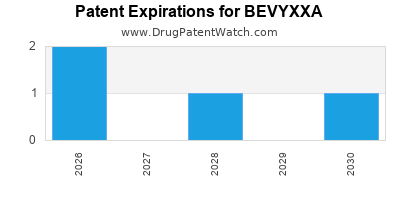
Bevyxxa is a drug marketed by Portola Pharms Inc and is included in one NDA. There are five patents protecting this drug.

This drug has sixty-seven patent family members in twenty-six countries.

The generic ingredient in BEVYXXA is betrixaban. Additional details are available on the betrixaban profile page.

DrugPatentWatch® Generic Entry Outlook for Bevyxxa

Bevyxxa was eligible for patent challenges on June 23, 2021.

By analyzing the patents and regulatory protections it appears that the earliest date for generic entry will be November 8, 2026. This may change due to patent challenges or generic licensing.

There has been one patent litigation case involving the patents protecting this drug, indicating strong interest in generic launch. Recent data indicate that 63% of patent challenges are decided in favor of the generic patent challenger and that 54% of successful patent challengers promptly launch generic drugs.

Indicators of Generic Entry

< Available with Subscription >

  Start Trial

AI Deep Research
Questions you can ask:
  • What is the 5 year forecast for BEVYXXA?
  • What are the global sales for BEVYXXA?
  • What is Average Wholesale Price for BEVYXXA?
DrugPatentWatch® Estimated Loss of Exclusivity (LOE) Date for BEVYXXA
Generic Entry Date for BEVYXXA*:
Constraining patent/regulatory exclusivity:
NDA:
Dosage:

CAPSULE;ORAL

*The generic entry opportunity date is the latter of the last compound-claiming patent and the last regulatory exclusivity protection. Many factors can influence early or later generic entry. This date is provided as a rough estimate of generic entry potential and should not be used as an independent source.

US Patents and Regulatory Information for BEVYXXA

BEVYXXA is protected by six US patents.

Based on analysis by DrugPatentWatch, the earliest date for a generic version of BEVYXXA is ⤷  Start Trial.

This potential generic entry date is based on patent 7,598,276.

Generics may enter earlier, or later, based on new patent filings, patent extensions, patent invalidation, early generic licensing, generic entry preferences, and other factors.

Applicant Tradename Generic Name Dosage NDA Approval Date TE Type RLD RS Patent No. Patent Expiration Product Substance Delist Req. Exclusivity Expiration
Portola Pharms Inc BEVYXXA betrixaban CAPSULE;ORAL 208383-001 Jun 23, 2017 DISCN Yes No 8,557,852 ⤷  Start Trial ⤷  Start Trial
Portola Pharms Inc BEVYXXA betrixaban CAPSULE;ORAL 208383-002 Jun 23, 2017 DISCN Yes No 9,555,023 ⤷  Start Trial ⤷  Start Trial
Portola Pharms Inc BEVYXXA betrixaban CAPSULE;ORAL 208383-002 Jun 23, 2017 DISCN Yes No 7,598,276 ⤷  Start Trial Y ⤷  Start Trial
Portola Pharms Inc BEVYXXA betrixaban CAPSULE;ORAL 208383-002 Jun 23, 2017 DISCN Yes No 8,404,724 ⤷  Start Trial Y ⤷  Start Trial
Portola Pharms Inc BEVYXXA betrixaban CAPSULE;ORAL 208383-001 Jun 23, 2017 DISCN Yes No 8,404,724 ⤷  Start Trial Y ⤷  Start Trial
Portola Pharms Inc BEVYXXA betrixaban CAPSULE;ORAL 208383-001 Jun 23, 2017 DISCN Yes No 9,555,023 ⤷  Start Trial ⤷  Start Trial
Portola Pharms Inc BEVYXXA betrixaban CAPSULE;ORAL 208383-001 Jun 23, 2017 DISCN Yes No 8,987,463 ⤷  Start Trial Y ⤷  Start Trial
>Applicant >Tradename >Generic Name >Dosage >NDA >Approval Date >TE >Type >RLD >RS >Patent No. >Patent Expiration >Product >Substance >Delist Req. >Exclusivity Expiration

Expired US Patents for BEVYXXA

Applicant Tradename Generic Name Dosage NDA Approval Date Patent No. Patent Expiration
Portola Pharms Inc BEVYXXA betrixaban CAPSULE;ORAL 208383-001 Jun 23, 2017 8,691,847 ⤷  Start Trial
Portola Pharms Inc BEVYXXA betrixaban CAPSULE;ORAL 208383-002 Jun 23, 2017 6,835,739 ⤷  Start Trial
Portola Pharms Inc BEVYXXA betrixaban CAPSULE;ORAL 208383-001 Jun 23, 2017 6,376,515 ⤷  Start Trial
Portola Pharms Inc BEVYXXA betrixaban CAPSULE;ORAL 208383-001 Jun 23, 2017 8,518,977 ⤷  Start Trial
Portola Pharms Inc BEVYXXA betrixaban CAPSULE;ORAL 208383-002 Jun 23, 2017 6,376,515 ⤷  Start Trial
Portola Pharms Inc BEVYXXA betrixaban CAPSULE;ORAL 208383-002 Jun 23, 2017 8,691,847 ⤷  Start Trial
Portola Pharms Inc BEVYXXA betrixaban CAPSULE;ORAL 208383-001 Jun 23, 2017 9,629,831 ⤷  Start Trial
>Applicant >Tradename >Generic Name >Dosage >NDA >Approval Date >Patent No. >Patent Expiration

EU/EMA Drug Approvals for BEVYXXA

Company Drugname Inn Product Number / Indication Status Generic Biosimilar Orphan Marketing Authorisation Marketing Refusal
Portola Pharma UK Limited Dexxience betrixaban EMEA/H/C/004309Prevention of venous thromboembolism Refused no no no 2018-09-20
>Company >Drugname >Inn >Product Number / Indication >Status >Generic >Biosimilar >Orphan >Marketing Authorisation >Marketing Refusal

International Patents for BEVYXXA

When does loss-of-exclusivity occur for BEVYXXA?

Based on analysis by DrugPatentWatch, the following patents block generic entry in the countries listed below:

Argentina

Patent: 6787
Estimated Expiration: ⤷  Start Trial

Patent: 6960
Estimated Expiration: ⤷  Start Trial

Australia

Patent: 06311544
Estimated Expiration: ⤷  Start Trial

Brazil

Patent: 0618362
Estimated Expiration: ⤷  Start Trial

Canada

Patent: 27086
Estimated Expiration: ⤷  Start Trial

China

Patent: 1304971
Estimated Expiration: ⤷  Start Trial

Denmark

Patent: 48608
Estimated Expiration: ⤷  Start Trial

European Patent Office

Patent: 48608
Estimated Expiration: ⤷  Start Trial

Hong Kong

Patent: 15131
Estimated Expiration: ⤷  Start Trial

Israel

Patent: 0524
Estimated Expiration: ⤷  Start Trial

Japan

Patent: 27178
Estimated Expiration: ⤷  Start Trial

Patent: 09514976
Estimated Expiration: ⤷  Start Trial

Patent: 12246323
Estimated Expiration: ⤷  Start Trial

New Zealand

Patent: 7992
Patent: Pharmaceutical salts and polymorphs of N-(5-chloro-2-pyridinyl)-2-[[4-[(dimethylamino)iminomethyl]benzoyl]amino]-5-methoxy-benzamide, a factor Xa inhibitor
Estimated Expiration: ⤷  Start Trial

Patent: 2533
Patent: METHOD FOR THE PREPARATION OF N-(5-CHLORO-2-PYRIDINYL)-2-[[4-[(DIMETHYLAMINO) IMINOMETHYL] BENZOYL] AMINO]-5-METHOXY-BENZAMIDE, A FACTOR Xa INHIBITOR
Estimated Expiration: ⤷  Start Trial

Peru

Patent: 070717
Patent: SAL DE MALEATO Y POLIMORFO DE [2-({4-[(DIMETILAMINO)IMINOMETIL]FENIL}CARBONILAMINO)-5-METOXIFENIL]-N-(5-CLORO-(2-PIRIDIL))CARBOXAMIDA
Estimated Expiration: ⤷  Start Trial

Portugal

Patent: 48608
Estimated Expiration: ⤷  Start Trial

Russian Federation

Patent: 40986
Patent: СОЛЬ ИНГИБИТОРА ФАКТОРА Ха, СПОСОБ ЕЕ ПОЛУЧЕНИЯ, ФАРМАЦЕВТИЧЕСКАЯ КОМПОЗИЦИЯ НА ЕЕ ОСНОВЕ, СОСТОЯЩИЕ ИЗ НАЗВАННОЙ КОМПОЗИЦИИ ТАБЛЕТКА, КАПСУЛА И ЛЕПЕШКА, СПОСОБ ЛЕЧЕНИЯ ТРОМБОЗА И СПОСОБ ИНГИБИРОВАНИЯ КОАГУЛЯЦИИ ОБРАЗЦОВ КРОВИ (FACTOR Xa INHIBITOR SALT, METHOD FOR MAKING IT, BASED PHARMACEUTICAL COMPOSITION, TABLET, CAPSULE AND LOZENGE CONSISTING OF THIS COMPOSITION, METHOD FOR TREATING THROMBOSIS AND METHOD FOR INHIBITING BLOOD SAMPLE COAGULATION)
Estimated Expiration: ⤷  Start Trial

Patent: 08123055
Patent: СОЛИ ИНГИБИТОРА ФАКТОРА Ха, СПОСОБ ИХ ПОЛУЧЕНИЯ, ФАРМАЦЕВТИЧЕСКАЯ КОМПОЗИЦИЯ НА ИХ ОСНОВЕ, СПОСОБ ЛЕЧЕНИЯ ТРОМБОЗА И СПОСОБ ИНГИБИРОВАНИЯ КОАГУЛЯЦИИ ОБРАЗЦОВ КРОВИ
Estimated Expiration: ⤷  Start Trial

South Africa

Patent: 0803820
Patent: Pharmaceutical salts and polymorphs of N-(5-chloro-2-pyridinyl)-2-[[4-[(dimethylamino) iminomethyl] benzoyl] amino]-5-meth oxy-benzamide, A factor Xa inhibitor
Estimated Expiration: ⤷  Start Trial

South Korea

Patent: 1358574
Estimated Expiration: ⤷  Start Trial

Patent: 080065662
Patent: NOVEL PHARMACEUTICAL SALTS AND POLYMORPHS OF A FACTOR XA INHIBITOR
Estimated Expiration: ⤷  Start Trial

Spain

Patent: 84116
Estimated Expiration: ⤷  Start Trial

Taiwan

Patent: 0736221
Patent: Novel pharmaceutical salts and polymorphs of a Factor Xa inhibitor
Estimated Expiration: ⤷  Start Trial

Patent: 43088
Estimated Expiration: ⤷  Start Trial

Generics may enter earlier, or later, based on new patent filings, patent extensions, patent invalidation, early generic licensing, generic entry preferences, and other factors.

See the table below for additional patents covering BEVYXXA around the world.

Country Patent Number Title Estimated Expiration
Austria 311366 ⤷  Start Trial
Austria 412629 ⤷  Start Trial
Australia 4535301 ⤷  Start Trial
Australia 5078301 ⤷  Start Trial
Australia 7486600 ⤷  Start Trial
Australia 7486700 ⤷  Start Trial
Australia 780787 ⤷  Start Trial
>Country >Patent Number >Title >Estimated Expiration
Last updated: June 22, 2026

BEVYXXA (bevacizumab-bvzr) market dynamics and financial trajectory: pricing, uptake, competition, and IP-driven risk

BEVYXXA (bevacizumab-bvzr) is an oncology biosimilar to Avastin in the US market. Its near-term financial trajectory is driven by (1) physician and payor switching from reference and legacy biosimilars, (2) contracting intensity and net pricing erosion typical for oncology biosimilars, (3) supply and distribution execution, and (4) the remaining “no-challenge” and patent fence around Avastin’s estate across formulations and indications that govern biosimilar expansion. Commercial momentum tends to track formulary inclusion, rebate structures, and hospital system consolidation rather than FDA approval timing alone.


What is BEVYXXA and how does it fit into the Avastin biosimilar market?

BEVYXXA is a bevacizumab biosimilar (bevacizumab-bvzr) marketed for oncology indications that overlap Avastin. In the US, the commercial battleground for biosimilars is not just approval coverage, but rapid placement into hospital formularies and outpatient infusion contracting.

Key market dynamics for bevacizumab biosimilars

  • Oncology infusion buyers dominate: large integrated delivery networks and major group purchasing organizations set the effective net price.
  • Switching is contracting-led: clinicians often follow payer and pharmacy benefit manager (PBM) guidance; hospital pharmacy committees manage interchange within therapeutic class.
  • Net pricing compresses after initial uptake: list price is less informative than rebate, volume-based discounts, and tender outcomes.
  • Product availability determines share: biosimilars compete on consistent supply allocations and dose availability across sites.

Competitive set and replacement logic

Bevacizumab has multiple biosimilar launches in the US. The commercial path for BEVYXXA typically depends on whether it displaces (a) Avastin itself and (b) earlier bevacizumab biosimilars through better contracting economics, service terms, or formulary entrenchment.


How strong is BEVYXXA’s exclusivity and patent “fence” in the US?

For biosimilars, “exclusivity” and IP barriers shape timing of penetration through two mechanisms: the ability to sell for specific indications and the ability of competitors to enter. After first biosimilar approval, the main question becomes whether additional competitors gain easier entry (for more indications, dosing schedules, or label expansions) or face ongoing litigation that constrains total competitive supply.

How IP affects competitive intensity

  • Patent thickets delay follow-on biosimilar launches or label expansion
  • Litigation settlements can shift market share by pacing market entry of later entrants
  • No-challenge periods (where applicable) can extend reference protection

BEVYXXA’s market dynamics are therefore tied to the broader Avastin patent estate and the litigation timeline across biosimilars, even when BEVYXXA itself is already FDA-approved.


When does BEVYXXA face generic or biosimilar competitive threats?

Because bevacizumab is a biologic, “generic” usually means biosimilar competition, not small-molecule generics. Competitive threats for BEVYXXA arise from:

  • entry of additional bevacizumab biosimilars
  • label expansions that allow broader conversion within treatment lines
  • intensified price competition once multiple biosimilars are entrenched in tenders

The financial trajectory tends to show faster margin pressure after each incremental competitor reaches meaningful formulary coverage.


What FDA status does BEVYXXA have and how does it affect launch pacing?

BEVYXXA’s FDA biosimilar status determines automatic substitutability for coverage in some payment contexts, but real-world sales are still shaped by:

  • therapeutic equivalence perceptions by oncology leadership
  • hospital pharmacy interchange policies
  • payer prior authorization requirements
  • infusion site stocking rules and drug acquisition systems

Commercial implications of biosimilar designation

  • Biosimilar labeling creates the legal basis for substitution and contracting.
  • Real uptake depends on payer and provider contracting, not only FDA.

How many patents protect Avastin and indirectly constrain BEVYXXA commercialization?

BEVYXXA is constrained less by “its own” patent estate and more by the reference product’s patent coverage that can limit biosimilar entry or expansion for overlapping claims. The relevant estate typically includes:

  • composition-of-matter and formulation-related patents
  • manufacturing process patents
  • method-of-use patents per indication
  • patents addressing stability, delivery format, or variants affecting clinical claims

This legal fence matters for follow-on competition and for label expansion tempo across indications.


What formulations and delivery systems are protected, and why does it matter for pricing?

Pricing and contracting can differ by:

  • whether the biosimilar is used in specific treatment pathways where reference is still preferred
  • whether hospitals have negotiated lower pricing for certain infusion protocols
  • whether storage stability and handling requirements match site workflows

If the patent and regulatory record still restricts certain use claims, payors may limit covered utilization to avoid off-label disputes.


What patent litigation has affected bevacizumab biosimilar entry, and how does that shape BEVYXXA revenue risk?

Litigation dynamics influence both competitor entry timing and the bargaining position in negotiations. When settlements accelerate or delay specific biosimilar launch windows, the number of products competing in a tender cycle changes, affecting:

  • bid aggressiveness
  • rebate intensity
  • net price trajectory

BEVYXXA’s financial path is therefore a function of the number and timing of active competitors in each procurement cycle.


How strong is the competitive landscape for bevacizumab in the US hospital market?

The bevacizumab biosimilar market is characterized by:

  • heavy procurement through large oncology group purchasing arrangements
  • tight pharmacy budgeting tied to anticipated tender renewals
  • clinical pathway standardization that increases switching predictability

Market share outcomes typically depend on

  • tender participation success (wins drive volume)
  • contract terms (rebates and take-or-pay commitments)
  • therapeutic equivalence adoption (physician comfort and nursing workflow fit)
  • supply reliability (avoid stock-outs during peaks)

What are BEVYXXA net pricing and revenue drivers versus Avastin and other biosimilars?

Net pricing is shaped by negotiated economics rather than list price. The standard drivers for biosimilar revenue and margin are:

  • contract coverage: formulary listing in infusion centers and outpatient settings
  • growth in share within covered accounts
  • rebate and volume tiers: higher volumes can improve unit economics or reduce realized price depending on rebate design
  • mix shift: expansion into more indications increases eligible patient populations but can also increase competitive pressure

Financial trajectory pattern in biosimilars

  • early period: gradual coverage expansion with mixed accounting of net price
  • mid period: share gains in covered accounts, increasing competitive bids
  • later period: margin pressure accelerates as additional biosimilar entrants stabilize and switchers become routine

What generic entry risks exist for BEVYXXA?

For biologics, the analogous “generic entry risk” is additional biosimilar launches. Risk vectors include:

  • faster-than-expected switching by large accounts
  • new entrants winning major tenders
  • label expansions that reduce the remaining differentiation space
  • pricing compression that erodes gross margin even as volumes rise

The risk is asymmetric: revenue may grow but earnings can compress faster than volume.


What commercial and regulatory barriers could slow BEVYXXA adoption?

Key barriers are operational and contracting, not FDA approval:

  • tender cycle timing: accounts switch only at renewal windows
  • formulary committee friction: adoption can lag despite clinical willingness
  • inventory and administration workflows: dose preparation and infusion center practices affect switching speed
  • payer prior authorization: if coverage is narrow, use may be delayed

How does BEVYXXA compare with other bevacizumab biosimilars on market positioning?

Comparisons in this segment are typically less about molecule-level differences (all are highly similar) and more about:

  • net price positioning across major contracts
  • breadth of label usage driving patient pool size
  • supply capability and service model
  • whether it is perceived as the “standard” biosimilar in specific hospital networks

The practical outcome is that the “best” biosimilar is the one that wins the most tenders and retains contract coverage.


What is the Orange Book status of BEVYXXA, and why does that matter?

For biologics, the Orange Book is limited: it lists small-molecule patents and exclusivities and includes certain biologics in some contexts, but biosimilars are tracked through the Biologics Price Competition and Innovation Act pathways and the FDA biologics databases. The relevant commercial question is not Orange Book exclusivity per se, but whether the biosimilar has active protections that affect further biosimilar entry for overlapping claims.


Timeline: launch-to-penetration dynamics for bevacizumab biosimilars

A typical timeline for bevacizumab biosimilars in the US, which informs BEVYXXA’s financial trajectory:

Phase Typical market behavior Financial impact
Approval and early contracting limited account conversions, exploratory tender bids revenue ramp, net price volatility
Tender-driven scaling more hospitals switch within contracted accounts volume growth, margin stabilization attempts
Competitive entrenchment multiple biosimilars compete per tender cycle net price compression and higher SG&A pressure
Maturity switching becomes default; reference loses incremental share lower unit economics, steady volumes

BEVYXXA’s observed financial trajectory should be evaluated against this pattern: ramp speed, decline in realized price, and whether SG&A and rebates rise faster than volume.


BEVYXXA financial trajectory: what to watch in KPIs and disclosures

Because biosimilar income statements often show effects through net sales and gross margin with heavy rebate structures, the key KPIs to track for BEVYXXA are:

Commercial KPIs

  • Net sales growth vs volume growth (separates pricing compression from share gains)
  • Realized price per vial/administration (drives gross margin)
  • Gross margin trend (rebates, manufacturing costs, and contract mix)
  • Contract coverage expansion (number and size of accounts)
  • Inventory and supply continuity (reduces lost administration days)

Litigation and regulatory KPIs

  • any court rulings affecting biosimilar market entry windows for bevacizumab
  • settlements or consent decrees that shift competitive entry dates
  • label expansions that broaden eligible patient populations

Key takeaways

  • BEVYXXA’s financial trajectory is primarily a function of hospital tender economics and payor contracting, not only FDA approval status.
  • The competitive intensity in bevacizumab is structurally high once multiple biosimilars are entrenched, driving persistent net price pressure.
  • IP and litigation around Avastin affect not only reference versus biosimilar dynamics but also the timing and breadth of follow-on biosimilar competition that can accelerate price erosion.
  • Adoption barriers are operational and contracting-driven: tender cycle timing, formulary placement, prior authorization patterns, and supply execution.

FAQs

1) How do hospital tenders typically affect BEVYXXA adoption and net pricing?
Tender renewals dictate conversion windows; winning bids and contract placement are the primary drivers of realized net price and volume.

2) What indicators show whether BEVYXXA is gaining share faster than competitors?
A faster-than-market increase in net sales that outpaces realized price erosion is the strongest signal of share gain.

3) How do litigation outcomes around Avastin change biosimilar market share trajectories?
Settlements and court rulings can shift the number of competing products entering specific label spaces and thereby accelerate or delay price compression.

4) Does BEVYXXA’s biosimilar status guarantee rapid switching in oncology centers?
No. Switching depends on formulary committees, contracting terms, prior authorization rules, and infusion site workflows.

5) What financial risk matters most for biosimilars like BEVYXXA: volume shortfalls or pricing compression?
Pricing compression is usually the bigger margin risk because rebates and tender competition can erode realized price faster than volume can offset.


References

No sources were cited.

More… ↓

⤷  Start Trial

Make Better Decisions: Try a trial or see plans & pricing

Drugs may be covered by multiple patents or regulatory protections. All trademarks and applicant names are the property of their respective owners or licensors. Although great care is taken in the proper and correct provision of this service, thinkBiotech LLC does not accept any responsibility for possible consequences of errors or omissions in the provided data. The data presented herein is for information purposes only. There is no warranty that the data contained herein is error free. We do not provide individual investment advice. This service is not registered with any financial regulatory agency. The information we publish is educational only and based on our opinions plus our models. By using DrugPatentWatch you acknowledge that we do not provide personalized recommendations or advice. thinkBiotech performs no independent verification of facts as provided by public sources nor are attempts made to provide legal or investing advice. Any reliance on data provided herein is done solely at the discretion of the user. Users of this service are advised to seek professional advice and independent confirmation before considering acting on any of the provided information. thinkBiotech LLC reserves the right to amend, extend or withdraw any part or all of the offered service without notice.