You're using a free limited version of DrugPatentWatch: Upgrade for Complete Access

Last Updated: December 12, 2025

BETOPTIC S Drug Patent Profile


✉ Email this page to a colleague

« Back to Dashboard


When do Betoptic S patents expire, and what generic alternatives are available?

Betoptic S is a drug marketed by Novartis and is included in one NDA.

The generic ingredient in BETOPTIC S is betaxolol hydrochloride. There are eleven drug master file entries for this compound. Five suppliers are listed for this compound. Additional details are available on the betaxolol hydrochloride profile page.

AI Deep Research
Questions you can ask:
  • What is the 5 year forecast for BETOPTIC S?
  • What are the global sales for BETOPTIC S?
  • What is Average Wholesale Price for BETOPTIC S?
Summary for BETOPTIC S
Drug patent expirations by year for BETOPTIC S
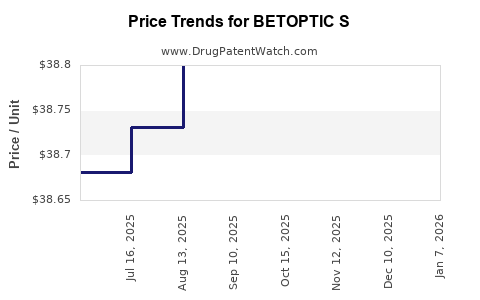
Drug Prices for BETOPTIC S

See drug prices for BETOPTIC S

Recent Clinical Trials for BETOPTIC S

Identify potential brand extensions & 505(b)(2) entrants

SponsorPhase
Alcon ResearchPhase 3

See all BETOPTIC S clinical trials

Pharmacology for BETOPTIC S

US Patents and Regulatory Information for BETOPTIC S

Applicant Tradename Generic Name Dosage NDA Approval Date TE Type RLD RS Patent No. Patent Expiration Product Substance Delist Req. Exclusivity Expiration
Novartis BETOPTIC S betaxolol hydrochloride SUSPENSION/DROPS;OPHTHALMIC 019845-001 Dec 29, 1989 RX Yes Yes ⤷  Get Started Free ⤷  Get Started Free ⤷  Get Started Free
>Applicant >Tradename >Generic Name >Dosage >NDA >Approval Date >TE >Type >RLD >RS >Patent No. >Patent Expiration >Product >Substance >Delist Req. >Exclusivity Expiration

Expired US Patents for BETOPTIC S

Applicant Tradename Generic Name Dosage NDA Approval Date Patent No. Patent Expiration
Novartis BETOPTIC S betaxolol hydrochloride SUSPENSION/DROPS;OPHTHALMIC 019845-001 Dec 29, 1989 4,342,783 ⤷  Get Started Free
Novartis BETOPTIC S betaxolol hydrochloride SUSPENSION/DROPS;OPHTHALMIC 019845-001 Dec 29, 1989 4,911,920*PED ⤷  Get Started Free
>Applicant >Tradename >Generic Name >Dosage >NDA >Approval Date >Patent No. >Patent Expiration

International Patents for BETOPTIC S

See the table below for patents covering BETOPTIC S around the world.

Country Patent Number Title Estimated Expiration
Norway 963130 ⤷  Get Started Free
Australia 4575389 ⤷  Get Started Free
Germany 68913979 ⤷  Get Started Free
Australia 621692 ⤷  Get Started Free
European Patent Office 0741563 ⤷  Get Started Free
Mexico 9603060 COMPOSICIONES PARA EL TRATAMIENTO DE GLAUCOMA QUE COMPRENDEN PILOCARPINA Y UN BETA-BLOQUEADOR. (COMPOSITIONS FOR TREATMENT OF GLAUCOMA COMPRISING PILOCARPINE AND A BETA-BLOCKER.) ⤷  Get Started Free
Israel 92527 Opthalmic pharmaceutical composition for glaucoma therapy ⤷  Get Started Free
>Country >Patent Number >Title >Estimated Expiration

Market Dynamics and Financial Trajectory for BETOPTIC S

Last updated: July 30, 2025


Introduction

BETOPTIC S is a pharmaceutical formulation primarily used for ophthalmic indications, notably glaucoma and ocular hypertension. It combines betaxolol, a selective beta-1 adrenergic receptor blocker, with other active ingredients, often including substances like timolol, to optimize intraocular pressure (IOP) reduction. Understanding the market dynamics and financial trajectory of BETOPTIC S involves analyzing its clinical positioning, competitive landscape, regulatory environment, manufacturing considerations, and market growth prospects.


Pharmaceutical Profile of BETOPTIC S

BETOPTIC S’s core mechanism involves decreasing aqueous humor production, thus lowering IOP, which is critical in managing glaucoma. Its selectivity for beta-1 receptors reduces systemic cardiovascular side effects, offering a favorable safety profile compared to non-selective beta blockers. The formulation’s evidence-based efficacy secures its place as a treatment option for both open-angle and angle-closure glaucoma patients.

The formulation’s patent landscape, exclusivity periods, and formulation innovations influence its market longevity. Moreover, patent expirations or generic equivalents threaten market share but also expand accessibility.


Market Dynamics

1. Clinical Efficacy and Safety Profile

The rising prevalence of glaucoma globally, projected to affect over 110 million people by 2040 according to the WHO [1], propels demand for effective IOP-lowering drugs like BETOPTIC S. Its favorable safety profile makes it suitable for long-term management, which increases patient adherence—a key factor in its ongoing market relevance.

2. Competitive Landscape

BETOPTIC S operates amid a broad spectrum of ophthalmic drugs—prostaglandin analogs (latanoprost, bimatoprost), other beta-blockers (timolol), carbonic anhydrase inhibitors, and increasingly, combination therapies. Proprietary formulations, access to generics, and clinical preference influence its market share.

Major competitors include brand-name drugs with proven efficacy, e.g., Xalatan, and newer modalities such as minimally invasive glaucoma surgeries (MIGS). The rise of combination drops, such as fixed-dose combinations involving betaxolol or timolol, poses both opportunities and threats depending on patent and formulary dynamics.

3. Regulatory Environment and Approvals

Regulatory agencies like the FDA, EMA, and respective regional authorities control approval and market penetration. Data security, clinical trial outcomes, and post-market surveillance influence the drug’s standing. Patent protections in key markets delay generic entry, but expiration timelines—varying regionally—shape future competition.

4. Pricing and Reimbursement

Pricing strategies hinge on healthcare provider preferences, insurance reimbursement policies, and competitive costs. BETOPTIC S’s positioning as a mid-to-high-end product in some markets is driven by perceived efficacy and safety, but price sensitivity among healthcare systems encourages competition and generic substitutions.

5. Manufacturing and Supply Chain Factors

Production quality, cost efficiency, and supply chain integrity impact profitability. Political or geopolitical disruptions can influence manufacturing sites or raw material availability, affecting overall supply stability.


Financial Trajectory Analysis

1. Revenue Trends and Market Penetration

Historically, BETOPTIC S has demonstrated steady revenue streams owing to its established clinical profile. Its revenues are segmented based on regional adoption, with mature markets (e.g., the US, Europe) exhibiting stable but plateauing growth, and emerging markets showing rapid expansion.

In region-specific scenarios, increased awareness campaigns and expanded ophthalmic healthcare infrastructure spurred sales growth, especially in Asia-Pacific countries with rising glaucoma prevalence.

2. Impact of Patent Expirations and Generics

Patent expiry periods—typically 10–15 years post-approval—signal an impending shift toward generic competition. Generic versions significantly erode market share and margins. The strategic launch of biosimilar or improved formulations could buffer declines.

3. Expansion through Portfolio Diversification

Formulation innovations, such as sustained-release gels or combination therapies, offer potential growth avenues. Strategic partnerships or licensing agreements with regional pharmaceutical entities can amplify market reach.

4. R&D and Clinical Trials Pipeline

Ongoing development of newer beta-blocker formulations, combination drugs, and delivery systems influence future revenue streams. Investment in clinical trials for indications beyond glaucoma (e.g., ocular hypertension, neuroprotection) could diversify product utility, reshaping financial outlooks.

5. Regional Market Opportunities

Emerging markets exhibit increased purchasing power and healthcare investment, enabling revenue growth. However, pricing pressures and regulatory hurdles necessitate region-specific strategies. Conversely, saturated markets may experience marginal growth, emphasizing the importance of market penetration tactics.

6. Cost Structure and Profitability

Manufacturing efficiencies, patent management, and strategic marketing correlate to profitability. Companies leveraging economies of scale, especially via generics, can sustain healthy margins despite pricing pressures.


Market Trends and Future Outlook

1. Growth Projections

The global glaucoma therapeutics market is projected to reach USD 5.8 billion by 2027, growing at a CAGR of approximately 4.9% [2]. BETOPTIC S, given its niche positioning, is expected to maintain a substantial segment within this expanding market.

2. Innovation and Differentiation

Developments in sustained-release delivery systems could revolutionize administration compliance, making BETOPTIC S more attractive. Additionally, combination formulations offering multi-mechanistic IOP reduction will influence future sales.

3. Digital and Precision Medicine Integration

Incorporation of digital adherence tools and tailored treatment plans can improve outcomes, aiding product differentiation and potentially boosting revenues.

4. Competitive Strategies

Manufacturers might resort to strategic alliances, patent extensions, or engaging in clinical research collaborations. Price competition will likely persist, demanding a delicate balance between accessibility and profitability.


Key Takeaways

  • Market stability is driven by the rising global prevalence of glaucoma, positioning BETOPTIC S as a sustained treatment option.
  • Patent expiries threaten market share; proactive diversification into combination formulations and sustained-release devices are vital growth strategies.
  • Regional expansion, especially in emerging markets, offers significant revenue opportunities amid increasing ophthalmic healthcare investments.
  • Pricing pressures necessitate efficient manufacturing, potential generic competition, and innovative formulations to maintain profitability.
  • Regulatory policies and clinical evidence continue to shape market access and formulary placement, emphasizing the importance of ongoing clinical research.

FAQs

1. How will patent expiries impact BETOPTIC S’s market share?
Patent expiries typically lead to increased generic competition, which erodes market share and reduces profit margins. Companies can counteract this by developing new formulations, combination therapies, or securing clinical data that extend market exclusivity.

2. What role does regional market expansion play in BETOPTIC S’s financial outlook?
Regional expansion into emerging markets offers considerable growth opportunities due to rising glaucoma prevalence and increasing healthcare access, though pricing and regulatory hurdles must be managed effectively.

3. Are there new formulations of BETOPTIC S in development?
While specific pipeline information depends on proprietary R&D efforts, innovations like sustained-release gels or combination drugs are in development among industry players to enhance compliance and efficacy.

4. How does competition from surgical interventions affect BETOPTIC S’s market?
Advances in minimally invasive glaucoma surgeries (MIGS) and other surgical options can reduce dependence on pharmacological therapy. However, drugs like BETOPTIC S remain essential, especially where surgery is contraindicated or incomplete.

5. What are the key factors influencing the profitability of BETOPTIC S?
Manufacturing efficiency, patent protection, market penetration, pricing strategies, and regulatory environment are primary factors that influence profitability. Ongoing innovation and clinical positioning are equally vital.


References

[1] World Health Organization. "Glaucoma Fact Sheet." 2020.

[2] Grand View Research. "Glaucoma Therapeutics Market Size & Trends." 2022.

More… ↓

⤷  Get Started Free

Make Better Decisions: Try a trial or see plans & pricing

Drugs may be covered by multiple patents or regulatory protections. All trademarks and applicant names are the property of their respective owners or licensors. Although great care is taken in the proper and correct provision of this service, thinkBiotech LLC does not accept any responsibility for possible consequences of errors or omissions in the provided data. The data presented herein is for information purposes only. There is no warranty that the data contained herein is error free. We do not provide individual investment advice. This service is not registered with any financial regulatory agency. The information we publish is educational only and based on our opinions plus our models. By using DrugPatentWatch you acknowledge that we do not provide personalized recommendations or advice. thinkBiotech performs no independent verification of facts as provided by public sources nor are attempts made to provide legal or investing advice. Any reliance on data provided herein is done solely at the discretion of the user. Users of this service are advised to seek professional advice and independent confirmation before considering acting on any of the provided information. thinkBiotech LLC reserves the right to amend, extend or withdraw any part or all of the offered service without notice.