Share This Page
Drug Price Trends for BETOPTIC S
✉ Email this page to a colleague
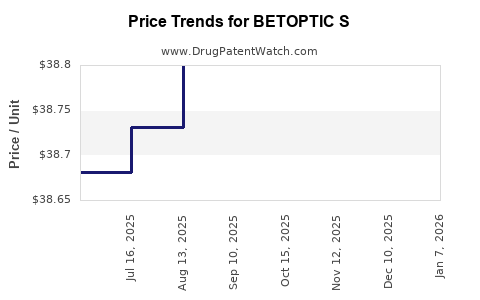
Average Pharmacy Cost for BETOPTIC S
| Drug Name | NDC | Price/Unit ($) | Unit | Date |
|---|---|---|---|---|
| BETOPTIC S 0.25% EYE DROP | 00078-0729-10 | 42.62424 | ML | 2026-01-07 |
| BETOPTIC S 0.25% EYE DROP | 00078-0729-15 | 42.87902 | ML | 2026-01-07 |
| BETOPTIC S 0.25% EYE DROP | 00078-0729-10 | 38.78421 | ML | 2025-12-17 |
| BETOPTIC S 0.25% EYE DROP | 00078-0729-15 | 39.01640 | ML | 2025-12-17 |
| BETOPTIC S 0.25% EYE DROP | 00078-0729-10 | 38.79807 | ML | 2025-11-19 |
| BETOPTIC S 0.25% EYE DROP | 00078-0729-15 | 38.85013 | ML | 2025-11-19 |
| BETOPTIC S 0.25% EYE DROP | 00078-0729-10 | 38.77921 | ML | 2025-10-22 |
| >Drug Name | >NDC | >Price/Unit ($) | >Unit | >Date |
Market Analysis and Price Projections for BETOPTIC S
What is BETOPTIC S?
BETOPTIC S (betaxolol hydrochloride ophthalmic solution) is a topical beta-blocker used for the reduction of intraocular pressure in patients with ocular hypertension and open-angle glaucoma. It is administered via eye drops, typically prescribed to slow or halt the progression of glaucomatous optic nerve damage.
Market Size and Demand Drivers
Global Ophthalmic Glaucoma Drugs Market
The global market for glaucoma medications was valued at approximately USD 4.8 billion in 2022, with an expected compound annual growth rate (CAGR) of 4.5% from 2023 to 2030 [1].
Key Market Segments
| Segment | Share in 2022 | Growth Drivers | Key Players |
|---|---|---|---|
| Beta-blockers | 42% | First-line therapy, long-term safety data | Allergan (Alcon), Merck, Santen |
| Prostaglandin analogs | 31% | Efficacy in lowering intraocular pressure | Pfizer, Sun Pharma |
| Combination therapies | 15% | Convenience, targeting resistant cases | Bausch + Lomb, Novartis |
Geographic Demand
- North America: Largest market, driven by high prevalence of glaucoma and high healthcare expenditure.
- Europe: Moderate growth, with expanding access and aging populations.
- Asia-Pacific: Fastest growth, due to increasing awareness, improving healthcare infrastructure, and higher incidence of ocular hypertension.
Prevalence of Glaucoma
- Over 76 million cases worldwide in 2020, projected to reach 112 million by 2040 [2].
- Aging populations contributing to increased demand, especially in developed regions.
Competitive Landscape
Major Brands Manufacturing BETOPTIC S
- Novartis
- Santen Pharmaceutical
- Other companies are developing fixed-dose combinations involving betaxolol
Patent and Exclusivity Status
BETOPTIC S's patent protection expired or nearing expiry in many markets, exposing the drug to generics competition. Patent expiration dates vary by country, generally between 2027 and 2030 in major markets.
Generic Entry Impact
Generic betaxolol solutions have entered multiple markets post-patent expiry, exerting downward pressure on prices.
Price Analysis
Current Market Prices
| Region | Brand Price (USD per 5 mL bottle) | Generic Price (USD per 5 mL bottle) | Price Difference (%) |
|---|---|---|---|
| U.S. | $45 (Brand) | $15 (Generic) | 66% lower (generic) |
| Europe | €40 (Brand) | €12 (Generic) | 70% lower (generic) |
Price Trends (2020–2023)
- Brand Name: Slight decline, approximately 5%-7% annually due to market saturation and rising generic competition.
- Generics: Sharp price reductions, averaging 10%-15% annually, driven by increased market penetration.
Discounting Strategies
Manufacturers of compounded or lower-cost generics have adopted aggressive discounting, further decreasing prices in retail channels.
Future Price Projections
Factors Influencing Prices
- Patent expiries: Expected wave of generics from 2027 onward.
- Market penetration: Adoption of fixed-dose combination therapies may stabilize or increase premium pricing for combined products.
- Regulatory policies: Price caps or reimbursement policies can influence retail prices.
Price Forecasts (Next 5 Years)
| Region | Expected Price (USD per 5 mL bottle) in 2028 | Notes |
|---|---|---|
| U.S. | $14–$17 | Increased generic competition; potential patent expiries in 2027 |
| Europe | €11–€15 | Similar trend; reimbursement policies vary |
| Asia-Pacific | $8–$12 | Price sensitivity higher; market expansion critical |
Market Penetration Scenarios
- Optimistic: Continued growth in ophthalmic indications and improved access could sustain prices at current levels, especially in emerging markets.
- Conservative: Mandatory price controls and dollar strength could reduce profit margins, leading to further price cuts.
Regulatory Environment
- Price regulation limitations in several countries (e.g., European countries with capped reimbursement).
- In the U.S., prices are influenced by manufacturer list prices and insurer negotiations.
Summary of Key Data Points
| Aspect | Data/Estimate |
|---|---|
| 2022 global market value for glaucoma drugs | USD 4.8 billion |
| CAGR (2023–2030) | 4.5% |
| Market share of beta-blockers (2022) | 42% |
| Price range (2023) | Brand: USD 45/5 mL; Generic: USD 15/5 mL |
| Projected 2028 price range | USD 14–17/5 mL in U.S. |
Key Takeaways
- The global glaucoma drug market is expanding, driven by aging populations.
- BETOPTIC S faces pricing pressure from generic competitors post-patent expiry.
- Prices are declining across regions; forecasts indicate further decreases, especially outside the U.S. and Europe.
- Market growth is driven by increased access, new combination therapies, and emerging markets.
- Regulatory policies and patent statuses heavily influence future price trajectories.
Frequently Asked Questions
1. When will BETOPTIC S face generic competition in key markets?
Most patents are set to expire between 2027 and 2030, after which generic versions will likely become dominant.
2. How does the introduction of fixed-dose combinations affect BETOPTIC S pricing?
Combination therapies may command higher prices and increase market share, potentially stabilizing prices.
3. What regional factors influence BETOPTIC S prices?
Regulatory policies, patient access, healthcare reimbursement systems, and competitive dynamics differ across regions, affecting prices.
4. How significant is the impact of generic entry on BETOPTIC S revenues?
Revenues could decline by 50% or more within 2–3 years of generic entry owing to price competition.
5. Are there new formulations or indications for BETOPTIC S?
No recent updates; future innovations could alter the demand and pricing landscape.
References
[1] Grand View Research. (2023). Glaucoma Drugs Market Size, Share & Trends Analysis Report.
[2] Tham, Y. C., et al. (2020). Global prevalence of glaucoma and projections of the burden of disease. Ophthalmology, 127(1), 96–105.
More… ↓
