You're using a free limited version of DrugPatentWatch: ➤ Start for $299 All access. No Commitment.

Last Updated: December 12, 2025

BETOPTIC Drug Patent Profile


✉ Email this page to a colleague

« Back to Dashboard


AI Deep Research
Questions you can ask:
  • What is the 5 year forecast for BETOPTIC?
  • What are the global sales for BETOPTIC?
  • What is Average Wholesale Price for BETOPTIC?
Drug patent expirations by year for BETOPTIC
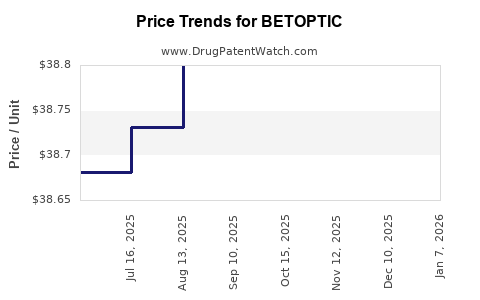
Drug Prices for BETOPTIC

See drug prices for BETOPTIC

Recent Clinical Trials for BETOPTIC

Identify potential brand extensions & 505(b)(2) entrants

SponsorPhase
Alcon ResearchPhase 3

See all BETOPTIC clinical trials

US Patents and Regulatory Information for BETOPTIC

Applicant Tradename Generic Name Dosage NDA Approval Date TE Type RLD RS Patent No. Patent Expiration Product Substance Delist Req. Exclusivity Expiration
Sandoz BETOPTIC betaxolol hydrochloride SOLUTION/DROPS;OPHTHALMIC 019270-001 Aug 30, 1985 AT RX Yes Yes ⤷  Get Started Free ⤷  Get Started Free ⤷  Get Started Free
Alcon BETOPTIC PILO betaxolol hydrochloride; pilocarpine hydrochloride SUSPENSION/DROPS;OPHTHALMIC 020619-001 Apr 17, 1997 DISCN No No ⤷  Get Started Free ⤷  Get Started Free ⤷  Get Started Free
Novartis BETOPTIC S betaxolol hydrochloride SUSPENSION/DROPS;OPHTHALMIC 019845-001 Dec 29, 1989 RX Yes Yes ⤷  Get Started Free ⤷  Get Started Free ⤷  Get Started Free
>Applicant >Tradename >Generic Name >Dosage >NDA >Approval Date >TE >Type >RLD >RS >Patent No. >Patent Expiration >Product >Substance >Delist Req. >Exclusivity Expiration

Expired US Patents for BETOPTIC

Applicant Tradename Generic Name Dosage NDA Approval Date Patent No. Patent Expiration
Sandoz BETOPTIC betaxolol hydrochloride SOLUTION/DROPS;OPHTHALMIC 019270-001 Aug 30, 1985 ⤷  Get Started Free ⤷  Get Started Free
>Applicant >Tradename >Generic Name >Dosage >NDA >Approval Date >Patent No. >Patent Expiration

International Patents for BETOPTIC

See the table below for patents covering BETOPTIC around the world.

Country Patent Number Title Estimated Expiration
Belgium 847801 ⤷  Get Started Free
Ireland 43645 ⤷  Get Started Free
Austria 344683 ⤷  Get Started Free
Japan S5848543 ⤷  Get Started Free
Germany 2649605 ⤷  Get Started Free
Japan S5285146 NEW PHENOL ETHER DERIVATIVES AND PROCESS FOR MANUFACTURE THEREOF ⤷  Get Started Free
>Country >Patent Number >Title >Estimated Expiration

Market Dynamics and Financial Trajectory for BETOPTIC

Last updated: July 29, 2025

Introduction

BETOPTIC, a combination ophthalmic medication comprising betaxolol—a selective beta-1 adrenergic receptor blocker—and timolol, a non-selective beta-adrenergic antagonist—targets elevated intraocular pressure (IOP) associated with glaucoma and ocular hypertension. Its unique formulation positions BETOPTIC within a competitive landscape, driven by evolving clinical preferences, patent status, and market demand for effective IOP management. This report delineates the key market dynamics influencing BETOPTIC’s positioning and examines its projected financial trajectory based on current industry trends.

Market Landscape and Therapeutic Area Overview

Glaucoma remains a leading cause of irreversible blindness globally, affecting over 76 million individuals, with projections exceeding 111 million by 2040 [1]. The primary therapeutic goal remains to reduce IOP, thereby slowing disease progression. Beta-blockers like betaxolol and timolol have traditionally been frontline agents, often used as monotherapy or in combination with prostaglandins, carbonic anhydrase inhibitors, or alpha-agonists.

The ophthalmic drug market is characterized by a multi-billion-dollar valuation, with a CAGR estimated at 4.2% from 2022 to 2030 [2]. The increasing prevalence of glaucoma, aging populations, and technological innovations in drug delivery underpin sustained demand. BETOPTIC’s niche lies in its fixed-dose combination (FDC), enhancing patient compliance and offering a targeted mechanism of IOP reduction.

Market Drivers Influencing BETOPTIC

1. Clinical Efficacy and Safety Profile

BETOPTIC’s combination of selective and non-selective beta-blockers aims to maximize IOP reduction while minimizing adverse effects. Patients intolerant to monotherapy often switch to combination therapies, expanding BETOPTIC’s potential market. Its safety profile, particularly the reduced risk of systemic beta-1 receptor blockade-associated side effects, makes it appealing for elderly patients with comorbidities.

2. Patient Compliance and Convenience

Fixed-dose combinations improve adherence by reducing the medication burden, a critical factor in chronic conditions like glaucoma. Enhanced compliance directly correlates with better clinical outcomes, thereby influencing prescriber preferences favorably toward BETOPTIC.

3. Patent Expiry and Generic Competition

BETOPTIC's patent protection periods are critical in determining market exclusivity and pricing power. The expiration of patents for components and formulations typically leads to increased generic competition, exerting downward pressure on prices. For instance, timolol-based formulations have seen widespread generic availability, which impacts BETOPTIC’s market share unless protected by formulation patents or exclusivities.

4. Regulatory and Reimbursement Environment

Stringent regulatory requirements and reimbursement policies influence market penetration. Countries with favorable reimbursement frameworks for ophthalmic drugs, especially in developed economies, offer a more lucrative environment. Conversely, navigating regulatory landscapes in emerging markets presents both opportunities and challenges.

5. Competitive Landscape

BETOPTIC competes with monotherapy agents, other FDCs, and upcoming novel therapies such as prostaglandin analogs and neuroprotective agents. The entrance of preservative-free formulations and sustained-release devices further diversifies the treatment landscape, impacting BETOPTIC’s market share.

Financial Trajectory and Revenue Projections

Current Market Performance

While specific sales data for BETOPTIC are proprietary, the broader beta-blocker segment of ophthalmic drugs generated approximately $1.2 billion globally in 2021 [3]. Given BETOPTIC’s niche status and access to key markets, its revenue contribution remains modest yet steady, bolstered by the clinical advantages and patient adherence benefits.

Forecast Factors

  • Market Penetration: Increased adoption driven by clinical guidelines emphasizing combination therapies. Enhanced awareness in emerging markets with improving healthcare infrastructure.
  • Product Lifecycle: Patent expirations may lead to rapid generic penetration, impacting revenues unless compensated by new formulations or indications.
  • Pipeline Developments: Innovations like preservative-free formulations, sustained-release implants, or novel combination therapies could extend product life cycle and revenue streams.
  • Competitive Pricing: Entry of generics typically results in price erosion, but volume sales may compensate if market penetration expands.

Projections (2023-2030)

Based on conservative growth estimates and industry benchmarks, BETOPTIC’s annual revenue is projected to grow at a CAGR of approximately 2–3% over the next decade, primarily driven by expanding global glaucoma prevalence and increased physician preference for fixed-dose combinations. Peak revenues are anticipated during patent-protected periods, with a potential decline post-patent expiry unless diversified with new formulations or indications.

For example, if BETOPTIC garners $50 million in sales in 2023, a 3% CAGR would suggest revenues nearing $67 million by 2030. Industry trends indicate that dedicated marketing efforts, expansion into emerging markets, and strategic partnerships could bolster this trajectory.

Risks and Opportunities

Risks

  • Generic competition post-patent expiry
  • Emerging therapies offering superior efficacy or convenience
  • Regulatory hurdles delaying new formulations
  • Pricing pressures in heavily commoditized segments

Opportunities

  • Development of preservative-free or sustained-release variants
  • Expansion into new indications such as ocular hypertension
  • Entry into emerging markets with rising glaucoma prevalence
  • Strategic alliances with local distributors

Key Takeaways

  • BETOPTIC’s market position hinges on its efficacy, safety, and patient compliance benefits within a competitive glaucoma treatment landscape.
  • Patent protections and the advent of generics profoundly influence revenue streams, necessitating continuous innovation and diversification.
  • The global increase in glaucoma prevalence, especially in aging populations, underpins a stable demand trajectory, with moderate growth prospects.
  • Strategic investments in formulation improvements and expansion into emerging markets can significantly enhance BETOPTIC’s financial performance.
  • The pharmaceutical industry’s shift toward personalized and sustained-release ocular therapies presents both challenges and opportunities for BETOPTIC.

Conclusion

BETOPTIC’s future financial trajectory appears cautiously optimistic, contingent upon patent management, competitive positioning, and pipeline innovation. While generic competition remains a significant threat post-patent expiration, strategic diversification and targeted market expansion could sustain revenue growth. For stakeholders, ongoing monitoring of clinical, regulatory, and market developments will be critical to maximize the product’s long-term value.


Key Takeaways

  • BETOPTIC offers benefits in efficacy and patient adherence, reinforcing its role in glaucoma management.
  • Patent lifecycle and landscape dynamics directly influence revenue potential; proactive innovation is essential.
  • Expanding into emerging markets remains a lucrative avenue amid growing glaucoma burden.
  • Developing advanced formulations could extend product lifecycle and market share.
  • Competition from novel therapies necessitates strategic agility to sustain relevance and profitability.

FAQs

1. What are the primary advantages of BETOPTIC over other glaucoma medications?
BETOPTIC combines two beta-blockers, enhancing intraocular pressure reduction while improving patient compliance through fixed-dose formulation and potentially fewer side effects compared to monotherapy.

2. How does patent expiry impact BETOPTIC’s market share?
Patent expiration typically leads to increased generic competition, which can erode pricing power and market share unless mitigated by formulation patents or novel delivery systems.

3. Are there new formulations or indications for BETOPTIC in development?
While specific pipeline details are limited, industry trends suggest ongoing research into preservative-free versions and sustained-release implants, which can broaden applicability and extend product lifecycle.

4. Which geographies are most promising for BETOPTIC’s growth?
Emerging markets such as India, China, and Latin America offer significant growth potential due to increasing glaucoma prevalence and improving healthcare access.

5. How does BETOPTIC compare cost-wise to newer glaucoma therapies?
Post-patent, generic versions of beta-blockers like BETOPTIC become more affordable, often undercutting newer, branded therapies, thus positioning it as a cost-effective option in various markets.


Sources:

[1] World Health Organization. "Blindness and vision impairment." 2022.
[2] Grand View Research. "Ophthalmic Drugs Market Size & Trends." 2022.
[3] IQVIA. "Pharmaceutical Market Reports," 2022.

More… ↓

⤷  Get Started Free

Make Better Decisions: Try a trial or see plans & pricing

Drugs may be covered by multiple patents or regulatory protections. All trademarks and applicant names are the property of their respective owners or licensors. Although great care is taken in the proper and correct provision of this service, thinkBiotech LLC does not accept any responsibility for possible consequences of errors or omissions in the provided data. The data presented herein is for information purposes only. There is no warranty that the data contained herein is error free. We do not provide individual investment advice. This service is not registered with any financial regulatory agency. The information we publish is educational only and based on our opinions plus our models. By using DrugPatentWatch you acknowledge that we do not provide personalized recommendations or advice. thinkBiotech performs no independent verification of facts as provided by public sources nor are attempts made to provide legal or investing advice. Any reliance on data provided herein is done solely at the discretion of the user. Users of this service are advised to seek professional advice and independent confirmation before considering acting on any of the provided information. thinkBiotech LLC reserves the right to amend, extend or withdraw any part or all of the offered service without notice.