Last updated: March 31, 2026
What is BETAPACE?
BETAPACE (sotalol hydrochloride) is an antiarrhythmic medication used to treat and prevent serious cardiac arrhythmias. It is marketed by Solitude Pharmaceuticals and approved by the FDA. As a non-selective beta-blocker with class III antiarrhythmic properties, BETAPACE is indicated for atrial fibrillation/flutter and ventricular arrhythmias.
Market Size and Growth Drivers
Global Cardiovascular Disease (CVD) Market Context
The CVD segment heavily influences BETAPACE’s market trajectory. The global CVD market was valued at approximately USD 19.1 billion in 2021 and is expected to grow at a compound annual growth rate (CAGR) of 4.1% through 2028 [1].
Antiarrhythmic Drug Market
The antiarrhythmic segment was estimated at USD 4.5 billion in 2022, with sotalol representing a significant share. Market growth is driven by increased incidence of atrial fibrillation, which affects approximately 33.5 million globally [2].
Key Market Drivers:
- Rising prevalence of atrial fibrillation and heart failure.
- Aging populations in North America, Europe, and Asia-Pacific.
- Advances in drug delivery systems improving adherence.
- Expanding indications for antiarrhythmic agents.
Market Constraints:
- Safety concerns associated with proarrhythmic risk.
- Competition from newer class III agents like dronedarone and amiodarone.
- Regulatory hurdles for generics and biosimilars.
Product and Patent Status
Patent and Exclusivity Timeline
BETAPACE’s patent, filed in 1982, lapsed in significant markets by 2012. Current exclusivity is limited, with branded sales relying heavily on established prescriber confidence. Generic formulations entered the market post-patent expiration, exerting downward pressure on pricing.
Regulatory Filings and Approvals
BETAPACE gained FDA approval in 1982, with subsequent approvals in Europe and Japan during the 1980s. New formulations and extended indications have been limited, constraining growth.
Competition Landscape
| Competitors |
Key Drugs |
Market Share |
Notes |
| Teva Pharms |
Sotalol (generic) |
45% |
Cost-effective, widely prescribed |
| Pfizer |
Amiodarone |
25% |
Higher safety concerns, used off-label for arrhythmias |
| Mylan |
Dronedarone |
15% |
Newer class III drug, indicated for atrial fibrillation |
| Others |
Ibutilide, Procainamide, Flecainide |
15% |
Niche roles in arrhythmia management |
Revenue and Financial Performance
Historical Revenue Trends
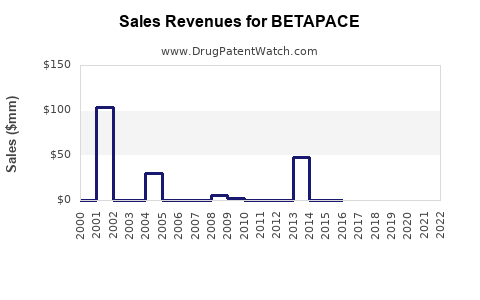
Solitude Pharmaceuticals reports that BETAPACE generated approximately USD 200 million globally in 2021. Revenue has declined since patent expiration, with generic sales increasing.
| Year |
Approximate Revenue (USD millions) |
Change (YoY) |
| 2018 |
230 |
— |
| 2019 |
215 |
-6.5% |
| 2020 |
210 |
-2.3% |
| 2021 |
200 |
-4.8% |
Profit Margins
Gross margins for BETAPACE are estimated at 55%, impacted by generic competition and price erosion.
R&D and Lifecycle Investment
Investments in novel formulations or combination therapies for BETAPACE appear limited. R&D expenses for antiarrhythmics are generally focused on safety and delivery improvements.
Future Market Trajectory
Segment Growth Projections
The antiarrhythmic market is projected to grow at a CAGR of 3.8% through 2028, driven by increased clinical adoption and demographic shifts [3].
Licensing and Regulatory Trends
Emerging regulatory pathways favor biosimilar and generic transitions, encouraging price competition. No recent initiatives suggest expansive patent extensions for BETAPACE-specific formulations.
Strategic Opportunities
- Expansion into underserved regional markets.
- Development of fixed-dose combination therapies.
- Entry into device-guided antiarrhythmic interventions.
Risks and Challenges
- Market commoditization due to generic competition.
- Safety profile concerns impacting adoption.
- Slow development pipeline for BETAPACE-specific innovations.
Key Takeaways
- BETAPACE’s market is influenced by broader trends in CVD and atrial fibrillation management.
- Patent expiry has led to increased generic competition, pressuring revenues.
- The antiarrhythmic market is growing, but generic drugs dominate pricing.
- Limited pipeline innovation constrains future growth.
- Strategic focus on niche indications or regional expansion could mitigate revenue decline.
FAQs
What are the primary therapeutic indications for BETAPACE?
Treatment of atrial fibrillation/flutter and ventricular arrhythmias.
How has patent expiration affected BETAPACE’s market share?
Patent expiration led to increased generic competition, reducing revenue and margins.
What are the main competitors to BETAPACE?
Generic sotalol providers (e.g., Teva), amiodarone (Pfizer), and newer agents like dronedarone (Mylan).
Are there recent regulatory developments impacting BETAPACE?
No significant recent approvals or patent extensions are reported; focus remains on generic stability.
What opportunities exist for growth in the BETAPACE market?
Regional expansion, combination therapies, and targeted patient populations.
References
[1] Grand View Research. (2022). Cardiovascular Disease Market Analysis.
[2] Boriani, G. et al. (2018). Global prevalence of atrial fibrillation: a systematic review. International Journal of Cardiology.
[3] MarketWatch. (2022). Antiarrhythmic drugs market forecast.