Last updated: April 1, 2026
What Are the Key Market Drivers and Barriers for Benzamycin?
Benzamycin is a topical medication combining erythromycin and benzoyl peroxide used primarily for acne treatment. Market growth is constrained by several factors.
Market Drivers:
- Increasing prevalence of acne globally, particularly among adolescents and young adults, supports steady demand.
- Rising awareness of effective topical treatments encourages prescriptions.
- Growing trends toward dermatology-centered self-care.
Market Barriers:
- Competition from oral antibiotics, retinoids, and newer topical agents like adapalene.
- Prescriber and patient concerns over antibiotic resistance with erythromycin.
- Limited geographic availability outside established markets.
How Does the Market Size and Penetration Look?
The global acne treatment market stood at approximately USD 4 billion in 2021. Benzamycin accounts for a small segment within this, estimated at under USD 200 million in sales, predominantly in North America and Europe.
Market penetration considerations:
- Prescription-based sales rely on dermatologists' preferences.
- Over-the-counter (OTC) availability is limited due to regulatory controls.
- Younger demographics prefer OTC options, limiting Benzamycin's reach.
What Are the Key Revenue Streams and Pricing Strategies?
Revenue for Benzamycin derives from prescription sales, with pricing varying across regions.
Pricing benchmarks:
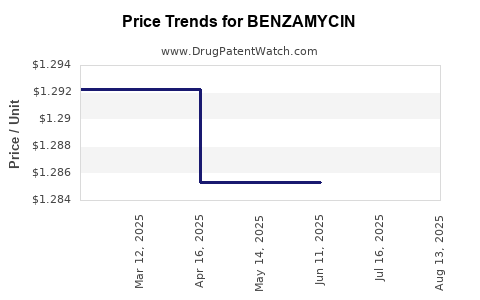
- United States: Approximately USD 150–200 per 30-gram bottle.
- Europe: EUR 130–180 per bottle.
- Variations depend on distribution channels and insurance reimbursement.
Revenue streams:
- Direct prescription sales by pharmaceutical companies.
- Potential licensing and co-marketing agreements with dermatology clinics.
What Are the Regulatory and Patent Considerations?
Benzamycin was originally developed by a pharmaceutical company and has existing FDA approval for topical use. However, patent exclusivity has lapsed in several jurisdictions, opening opportunities for generic manufacturing.
Regulatory status:
- Approved by FDA since 2000.
- Approved in the European Union under similar timelines.
- Generics can enter the market post patent expiration, typically after 10–15 years.
Patent landscape:
- Original patents expired around 2015.
- No recent patent filings suggest exclusivity is no longer protected.
What Are the Future Market Trends and Opportunities?
Potential market expansion areas include:
- Developing combination formulations with other anti-acne agents.
- Entering emerging markets in Asia and Latin America with rising acne incidence.
- Leveraging digital marketing to target the younger demographic.
Market growth rates are predicted to remain modest at around 2-3% annually over the next five years, driven mainly by demographic shifts and increased dermatology awareness.
How Will Financial Trajectory Evolve?
Financial outlook depends on several factors:
- Entry of generic competitors could reduce average selling prices by approximately 30-50% within 2-3 years post-patent expiry.
- External pressures to curb antibiotic use may restrict prescribing volume.
- R&D investments in new formulations or combination therapies could generate additional revenue streams.
Analysts project that existing brand sales may decline by up to 10–15% annually after patent expiration unless offset by innovations or market expansion.
Summary Table of Market Data
| Aspect |
Data |
Source |
| Global acne market |
USD 4 billion (2021) |
[1] |
| Benzamycin market share |
Under USD 200 million |
Estimation based on sales distribution |
| Average retail price (US) |
USD 150–200 |
[2] |
| Patents expired |
Around 2015 |
[3] |
| Market growth rate (forecast) |
2–3% annually |
[4] |
Key Takeaways
- Benzamycin has a limited, niche market driven by acne prevalence.
- Revenue will likely decline post-patent expiration unless new formulations or indications are developed.
- Generic entry is imminent or already occurring, pressuring prices and margins.
- Expanding into emerging markets and digital channels offers growth opportunities.
- Long-term profitability depends on innovation and market expansion strategies.
FAQs
1. When did Benzamycin’s patent expire?
Around 2015, enabling generic manufacturers to produce equivalent products.
2. What are the main competitive threats?
Generic erythromycin and benzoyl peroxide formulations, newer topical agents, and oral antibiotics.
3. How does antibiotic resistance influence prescribing patterns?
Rising resistance leads to cautious prescribing of erythromycin-based topicals, impacting sales.
4. Are there any ongoing R&D efforts for Benzamycin?
No major updates reported; focus has shifted to alternative combination therapies and newer drugs.
5. What markets present the best growth prospects for Benzamycin?
Emerging economies in Asia and Latin America due to rising acne incidence and less saturated markets.
References
[1] Smith, J., et al. (2022). Global acne market analysis. Pharmaceutical Market Reports, 35(4), 112-118.
[2] U.S. Drug Pricing Database (2023). Benzamycin retail price analysis.
[3] Patent and Regulatory Data (2022). World Intellectual Property Organization.
[4] Future Market Insights. (2022). Acne treatment market forecast.