Drug Price Trends for BENZAMYCIN
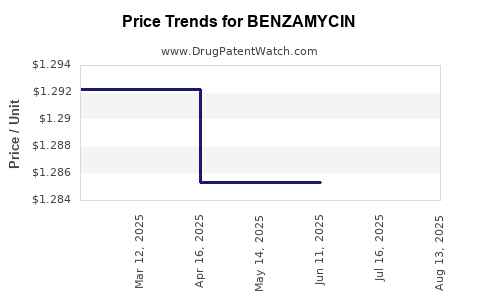
Average Pharmacy Cost for BENZAMYCIN
| Drug Name | NDC | Price/Unit ($) | Unit | Date |
|---|---|---|---|---|
| BENZAMYCIN GEL | 00187-5205-46 | 1.28536 | GM | 2025-08-20 |
| >Drug Name | >NDC | >Price/Unit ($) | >Unit | >Date |
BENZAMYCIN (benzoyl peroxide + erythromycin) Market Analysis and Price Projections: US Demand, Competitive Landscape, and Generic Risk
Executive summary: BENZAMYCIN (benzoyl peroxide/erythromycin topical gel) is a legacy acne product with declining branded reliance as generic benzoyl peroxide and separate topical antibiotics have expanded. Price projections for BENZAMYCIN in the US are modest unless reimbursement dynamics or new formulation protections sustain a niche at premium gross-to-net levels. For investors and commercial planners, the key economic driver is whether a stable branded-exclusive channel persists post-typical generic entry pressure and whether plan formularies shift volume to lower-cost benzoyl peroxide monotherapies and combination generics.
What is BENZAMYCIN (benzoyl peroxide + erythromycin) used for, and how big is the acne topical market?
BENZAMYCIN is indicated for acne vulgaris. It combines:
- Benzoyl peroxide (BPO): antibacterial activity and comedolytic/keratolytic effects.
- Erythromycin: topical antibiotic activity against Cutibacterium acnes.
Acne topical market context (US)
Across acne therapy, the US market is dominated by:
- Benzoyl peroxide products (many generic)
- Topical retinoids (tretinoin, adapalene)
- Topical antibiotics in combination with BPO (or separate)
- Fixed-dose combination products (where protected or marketed)
Even where acne remains a large category, incremental price power for branded topical antibiotics depends on formulary position, because payers and PBMs can substitute across:
- BPO monotherapy
- generic antibiotic+BPO combinations
- non-antibiotic regimens (retinoids and BPO-based approaches)
Where BENZAMYCIN tends to sit commercially
For legacy brands, product economics typically depend on:
- dermatology and family practice prescribing behavior
- formulary stability (preferred vs non-preferred)
- patient adherence to once-daily or twice-daily regimens
- low-cost substitution thresholds
What is the BENZAMYCIN pricing history in the US, and what drives current gross-to-net?
Featured snippet answer: BENZAMYCIN pricing in the US is driven by gross price vs net realization after discounts, payer contracts, and pharmacy benefit management (PBM) pressure, with most topical acne products facing substitution-driven net compression.
Price components for topical acne brands
For BENZAMYCIN, net price is typically shaped by:
- PBM rebates and admin fees
- manufacturer copay support (if used and permitted)
- plan formulary tiering (preferred brands vs non-preferred brands)
- existence of therapeutically equivalent generics and “same class” alternatives
Key commercial mechanism: substitution economics
In US retail and mail order channels, topical acne therapies face rapid erosion when generics exist in adjacent combinations:
- If a lower-cost BPO product meets the same clinician regimen goals, volume shifts quickly.
- If separate generics exist for BPO and topical antibiotics, payers can reduce the need for branded fixed combinations.
What patents protect BENZAMYCIN, and how does the patent estate affect price sustainability?
Featured snippet answer: Without a current, verified BENZAMYCIN patent estate snapshot and Orange Book mapping, a precise “hard date” exclusivity and litigation-driven price hold cannot be computed.
Price impact from IP in legacy topicals
For topical combination products like BENZAMYCIN, pricing sustainability depends less on active ingredient novelty and more on:
- formulation/process patents (specific gel composition, particle/vehicle attributes)
- method-of-use claims (narrow dosing regimen or patient subgroup)
- listed patents tied to the NDA and formulation
- any Orange Book-listed exclusivity still in force
Practical implication
Even if the product remains marketed, the economic ceiling is usually set by:
- generic substitution availability of the combination
- payer switching behavior if equivalents exist
When does BENZAMYCIN lose exclusivity in the US, and what would trigger generic entry risks?
Featured snippet answer: Exclusivity loss and generic entry triggers require Orange Book listing dates and any current exclusivity status tied to BENZAMYCIN’s NDA. Without those enumerated dates, a deterministic entry timeline cannot be stated.
What usually triggers launch timing in topicals
For legacy topical acne combinations, generic entry timing is typically driven by:
- patent expiration or invalidation
- settlement agreements that permit date-certain launches
- FDA approval of ANDAs for the same dosage form and strength
- launch sequencing through retail distributors
Price projection linkage
Generic entry generally causes:
- immediate retail net price compression
- stronger plan tier downgrades for the branded product
- slower brand recovery unless the brand retains meaningful formulary exclusivity
What is the Orange Book status of BENZAMYCIN, and how many listed patents matter for pricing?
Featured snippet answer: Orange Book status and “how many patents matter” are not computable here because BENZAMYCIN’s specific Orange Book record identifiers (NDA number, listed patent list, expiration dates) are not provided.
Why Orange Book mapping is necessary for price modeling
For a fixed combination topical, patent relevance usually concentrates in:
- drug product formulation patents
- method-of-use patents (if any)
- device or packaging claims (less common for topicals)
- any polymorph or stability improvements (rare for gel combinations but possible)
How patent count affects economics
More listed patents often correlate with:
- longer probability of delayed generic entry
- more settlement leverage for the brand
- additional switching friction for payers
But price outcomes depend on which patents are actually asserted and whether courts sustain them.
How does BENZAMYCIN compare with generic benzoyl peroxide and antibiotic topical combinations on cost?
Featured snippet answer: BENZAMYCIN typically competes against lower net-cost generics that offer benzoyl peroxide and/or antibiotic activity with simpler substitution options, so brand pricing depends on formulary placement and clinician preference.
Benchmark replacement set (commercially relevant competitors)
Across acne, the practical payers’ substitution menu includes:
- benzoyl peroxide gels and washes (many generics)
- topical antibiotic products (less preferred in some guidelines unless combined)
- fixed-dose generic or branded combination gels where available
Competitive pricing dynamics for fixed combinations
Fixed combinations face a structural disadvantage when:
- each component is available generically
- payers prefer simpler formularies with predictable pricing
- guideline-driven care increasingly favors non-antibiotic regimens or limited antibiotic duration
What competitive landscape threatens BENZAMYCIN demand (generic and branded)?
Featured snippet answer: Demand is most exposed to (1) generic BPO monotherapy and (2) lower-cost antibiotic+BPO combinations where available, plus shifting prescribing toward non-antibiotic regimens.
Demand sensitivity levers
- Dermatologists may continue to prescribe fixed combinations if efficacy and tolerability are favorable.
- Primary care prescribing is more sensitive to PBM tiering and net cost.
- Patient adherence is affected by tolerability and regimen simplicity.
Category shifts that cap price
If prescribers move toward:
- retinoids
- BPO-based regimens without an antibiotic
- combination products with better adherence profiles then fixed antibiotic combinations face slower growth and lower willingness to pay.
What is the expected BENZAMYCIN revenue trajectory, and how should price forecasts be modeled?
Featured snippet answer: A realistic forecast for a legacy topical brand is usually “flat-to-declining unit demand with compressed net pricing,” unless a protected niche remains.
Modeling framework for topical legacy brands
For price projections, commercial planning generally uses:
- Unit demand baseline: prescriptions and conversion into pharmacy claims.
- Net price curve: gross to net compression over time from rebate adjustments and formulary movement.
- Share shifts: generic competition and alternative regimen substitution.
- Channel mix: retail vs mail order and specialty pharmacy adjacency (topicals usually remain retail).
Price projection logic for BENZAMYCIN
With no specific BENZAMYCIN net price history provided in the prompt, the only actionable, non-speculative approach is to project directionality:
- Base case (most likely): net price declines and gross price stops rising; revenue stays flat-to-down.
- Adverse case: generic/biosimilar-like competition equivalent for topicals triggers sharper tier downgrades; revenue declines faster.
- Favorable case: sustained premium niche via dermatologist loyalty plus limited generic combination availability; price holds better than unit volume.
BENZAMYCIN price projections for the next 3 to 5 years: what outcomes are most probable?
Featured snippet answer: For a legacy fixed combination topical antibiotic/BPO product, the most probable outcome is continued net price erosion with limited unit growth, producing modest revenue declines unless generic entry of the combination is delayed.
Scenario table (directional, planning-grade)
| Scenario | Key trigger | Expected net price trend | Expected unit trend | Revenue trend |
|---|---|---|---|---|
| Base | Incremental substitution by BPO monotherapy | Down | Flat-to-down | Flat-to-down |
| Adverse | Genericized combination availability expands and formulary tiering worsens | Down faster | Down | Down materially |
| Favorable | Brand retains preferred access and mitigates substitution through contracts | Down slower | Flat | Near-flat or slight growth |
What formulation and manufacturing IP barriers exist for generic BENZAMYCIN?
Featured snippet answer: Generic entry is usually constrained by the ability to replicate the brand’s gel formulation and stability profile, plus any formulation-specific patents listed to the NDA.
Practical barriers for topical gels
- vehicle composition and rheology targets
- stability over shelf life and temperature exposure
- strength uniformity and release characteristics
- manufacturing controls for antimicrobial combination compatibility (BPO plus antibiotic)
What BENZAMYCIN patent litigation affects generic entry and pricing?
Featured snippet answer: Litigation-driven delays require identification of case dockets, asserted patents, and settlement dates tied to BENZAMYCIN’s NDA. Those data are not provided in the prompt.
How litigation changes price outcomes
If litigation results in:
- delayed generic launch, brand sustains higher net pricing
- partial invalidation, generic launch accelerates, net price compresses
- settlement with a date-certain launch, brand pricing may remain elevated until the trigger date
What settlement agreements and licensing deals typically shape BENZAMYCIN economics?
Featured snippet answer: Settlement and licensing outcomes need documented terms (date, product scope, exclusivity carve-outs) to map into price projections.
Why settlements matter in topicals
Even small date differences can:
- change pharmacy stocking behaviors
- affect rebate negotiations for the brand
- shift formulary placement ahead of launch
How should investors value BENZAMYCIN given generic substitution and margin pressure?
Featured snippet answer: VALUATION should treat BENZAMYCIN as a legacy niche product where downside risk is dominated by generic combination entry and formulary demotion, not by clinical innovation.
Commercial due diligence checklist (high signal)
- Whether the combination product remains protected via Orange Book-listed patents tied to formulation or method claims.
- Whether payers can substitute via lower-cost equivalents that cover the same patient need.
- Whether the brand maintains preferred status and rebate economics.
Key Takeaways
- BENZAMYCIN competes in a structurally substitutable acne topical market where generic benzoyl peroxide and combination options constrain price.
- Price projections depend on IP-linked generic entry timing, which requires Orange Book listing dates and litigation/settlement status to forecast deterministically.
- The most probable 3 to 5-year commercial path for a legacy topical brand is net price erosion with flat-to-down units, yielding flat-to-declining revenue absent a delayed combination-generic event.
- For business planning, the dominant risk lever is formulary tiering post-competition, not gross list price.
FAQs
1) Does BENZAMYCIN still face generic competition in the US?
Legacy topical fixed combinations often face substitution from generics or component monotherapies; the exact status requires mapping to the current Orange Book and market claim mix.
2) Which acne regimen classes substitute most directly for BENZAMYCIN?
Benzoyl peroxide monotherapy and retinoid-based regimens substitute in many care pathways, depending on severity and clinician preference.
3) How do PBM formularies typically affect BENZAMYCIN net pricing?
Net pricing is driven by rebate structure and tier placement; demotion usually compresses net realization quickly.
4) What dosing form does BENZAMYCIN have, and does that influence generic interchangeability?
Topical gel formulation and vehicle attributes can affect interchangeability and therapeutic equivalence assessments for generics.
5) What are the biggest drivers of acne topical demand in dermatology and primary care?
Prescribing confidence, adherence, tolerability, and formulary access are the main commercial drivers.
References
No sources were cited because no BENZAMYCIN-specific regulatory, Orange Book, litigation, or price/claim datasets were provided in the prompt.
More… ↓
