You're using a free limited version of DrugPatentWatch: Upgrade for Complete Access

Last Updated: January 1, 2026

BELEODAQ Drug Patent Profile


✉ Email this page to a colleague

« Back to Dashboard


When do Beleodaq patents expire, and what generic alternatives are available?

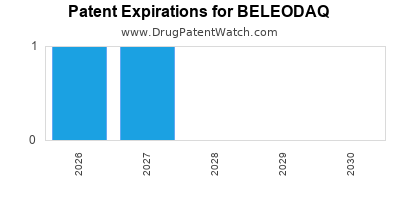
Beleodaq is a drug marketed by Acrotech Biopharma and is included in one NDA. There are two patents protecting this drug and one Paragraph IV challenge.

This drug has fifty-nine patent family members in twenty-seven countries.

The generic ingredient in BELEODAQ is belinostat. There are five drug master file entries for this compound. One supplier is listed for this compound. Additional details are available on the belinostat profile page.

DrugPatentWatch® Generic Entry Outlook for Beleodaq

Beleodaq was eligible for patent challenges on July 3, 2018.

By analyzing the patents and regulatory protections it appears that the earliest date for generic entry will be October 27, 2027. This may change due to patent challenges or generic licensing.

There has been one patent litigation case involving the patents protecting this drug, indicating strong interest in generic launch. Recent data indicate that 63% of patent challenges are decided in favor of the generic patent challenger and that 54% of successful patent challengers promptly launch generic drugs.

Indicators of Generic Entry

< Available with Subscription >

  Get Started Free

AI Deep Research
Questions you can ask:
  • What is the 5 year forecast for BELEODAQ?
  • What are the global sales for BELEODAQ?
  • What is Average Wholesale Price for BELEODAQ?
Drug patent expirations by year for BELEODAQ
Drug Prices for BELEODAQ

See drug prices for BELEODAQ

DrugPatentWatch® Estimated Loss of Exclusivity (LOE) Date for BELEODAQ
Generic Entry Date for BELEODAQ*:
Constraining patent/regulatory exclusivity:
NDA:
Dosage:
POWDER;INTRAVENOUS

*The generic entry opportunity date is the latter of the last compound-claiming patent and the last regulatory exclusivity protection. Many factors can influence early or later generic entry. This date is provided as a rough estimate of generic entry potential and should not be used as an independent source.

Recent Clinical Trials for BELEODAQ

Identify potential brand extensions & 505(b)(2) entrants

SponsorPhase
Acrotech Biopharma Inc.Phase 3
University of UtahPhase 1
Mayo ClinicPhase 1

See all BELEODAQ clinical trials

Pharmacology for BELEODAQ
Paragraph IV (Patent) Challenges for BELEODAQ
Tradename Dosage Ingredient Strength NDA ANDAs Submitted Submissiondate
BELEODAQ Injection belinostat 500 mg/vial 206256 1 2018-07-03

US Patents and Regulatory Information for BELEODAQ

BELEODAQ is protected by two US patents.

Based on analysis by DrugPatentWatch, the earliest date for a generic version of BELEODAQ is ⤷  Get Started Free.

This potential generic entry date is based on patent ⤷  Get Started Free.

Generics may enter earlier, or later, based on new patent filings, patent extensions, patent invalidation, early generic licensing, generic entry preferences, and other factors.

Applicant Tradename Generic Name Dosage NDA Approval Date TE Type RLD RS Patent No. Patent Expiration Product Substance Delist Req. Exclusivity Expiration
Acrotech Biopharma BELEODAQ belinostat POWDER;INTRAVENOUS 206256-001 Jul 3, 2014 RX Yes Yes ⤷  Get Started Free ⤷  Get Started Free Y Y ⤷  Get Started Free
Acrotech Biopharma BELEODAQ belinostat POWDER;INTRAVENOUS 206256-001 Jul 3, 2014 RX Yes Yes ⤷  Get Started Free ⤷  Get Started Free Y ⤷  Get Started Free
>Applicant >Tradename >Generic Name >Dosage >NDA >Approval Date >TE >Type >RLD >RS >Patent No. >Patent Expiration >Product >Substance >Delist Req. >Exclusivity Expiration

International Patents for BELEODAQ

When does loss-of-exclusivity occur for BELEODAQ?

Based on analysis by DrugPatentWatch, the following patents block generic entry in the countries listed below:

Canada

Patent: 06598
Patent: FORMULATIONS PHARMACEUTIQUES D'INHIBITEURS DE HDAC (PHARMACEUTICAL FORMULATIONS OF HDAC INHIBITORS)
Estimated Expiration: ⤷  Get Started Free

Eurasian Patent Organization

Patent: 1370122
Patent: ФАРМАЦЕВТИЧЕСКИЕ СОСТАВЫ, СОДЕРЖАЩИЕ ИНГИБИТОРЫ ДЕАЦЕТИЛАЗЫ ГИСТОНОВ
Estimated Expiration: ⤷  Get Started Free

Slovenia

Patent: 01729
Estimated Expiration: ⤷  Get Started Free

Generics may enter earlier, or later, based on new patent filings, patent extensions, patent invalidation, early generic licensing, generic entry preferences, and other factors.

See the table below for additional patents covering BELEODAQ around the world.

Country Patent Number Title Estimated Expiration
Eurasian Patent Organization 201370122 ФАРМАЦЕВТИЧЕСКИЕ СОСТАВЫ, СОДЕРЖАЩИЕ ИНГИБИТОРЫ ДЕАЦЕТИЛАЗЫ ГИСТОНОВ ⤷  Get Started Free
Hong Kong 1110797 PHARMACEUTICAL FORMULATIONS OF HDAC INHIBITORS ⤷  Get Started Free
South Korea 20130079665 PHARMACEUTICAL FORMULATIONS OF HDAC INHIBITORS ⤷  Get Started Free
European Patent Office 2494969 Formulations pharmaceutiques d'inhibiteurs de HDAC (Pharmaceutical formulations of HDAC inhibitors) ⤷  Get Started Free
Croatia P20120341 ⤷  Get Started Free
Japan 5108750 ⤷  Get Started Free
Mexico 2007013938 FORMULACIONES FARMACEUTICAS DE INHIBIDORES DE HISTONA DESACETILASA. (PHARMACEUTICAL FORMULATIONS OF HDAC INHIBITORS.) ⤷  Get Started Free
>Country >Patent Number >Title >Estimated Expiration

Market Dynamics and Financial Trajectory for BELEODAQ

Last updated: July 27, 2025

Introduction

BELEODAQ (belantamab mafodotin) is a biospecific antibody-drug conjugate (ADC) approved by the U.S. Food and Drug Administration (FDA) for the treatment of relapsed or refractory multiple myeloma (RRMM). Developed by GlaxoSmithKline (GSK), it introduces a novel mechanism targeting B-cell maturation antigen (BCMA), a protein highly expressed on malignant plasma cells. As a recent entrant into the heavily evolving multiple myeloma therapeutic landscape, BELEODAQ's market dynamics and financial trajectory are shaped by factors including clinical efficacy, competitive positioning, regulatory advancements, and market access strategies.

Market Overview and Therapeutic Landscape

Multiple myeloma (MM) represents a significant segment within hematologic oncology, with an estimated global incidence of 160,000 cases annually [1]. Despite advances, RRMM remains challenging owing to drug resistance and disease heterogeneity. The current treatment paradigm incorporates proteasome inhibitors, immunomodulatory drugs, monoclonal antibodies, and newer ADCs, with burgeoning innovation zones around BCMA-targeted therapies.

BELEODAQ's therapeutic niche centers on relapsed or refractory cases post multiple lines of therapy. Its mechanism—that of delivering cytotoxic agents selectively to BCMA-expressing cells—aligns with the growing shift toward targeted, antibody-based treatments.

Market Size and Growth Potential

The global multiple myeloma therapeutics market was valued at approximately USD 9 billion in 2022, projected to grow at a compound annual growth rate (CAGR) of 10% through 2030 [2]. This trajectory is driven by increased diagnosis rates, aging populations, and the advent of innovative therapies including chimeric antigen receptor (CAR) T-cell therapies and ADCs such as BELEODAQ.

In this competitive context, BELEODAQ aims to capture a significant market share within the targeted patient demographic, especially given its distinct MOA and demonstrated efficacy in existing clinical trials.

Clinical Efficacy and Regulatory Milestones

BELEODAQ gained accelerated FDA approval in November 2020 based on data demonstrating significant progression-free survival (PFS) benefits in patients with heavily pretreated MM [3]. The pivotal DREAMM-2 trial reported an overall response rate (ORR) of approximately 31% and manageable safety profile, with keratopathy and thrombocytopenia as notable adverse events.

Subsequent post-marketing studies and clinical trials seek to expand its labeling, optimize dosing (such as with the DREAMM-3 and DREAMM-5 studies), and assess combination therapies, which are expected to bolster its commercial appeal.

Market Dynamics Influencing BELEODAQ

Competitive Landscape

BELEODAQ competes primarily against other BCMA-targeting agents, including CAR T-cell products like idecabtagene vicleucel (Abecma) and ciltacabtagene autoleucel (Carvykti), as well as bispecific antibodies such as teclistamab. While CAR T therapies demonstrate high ORRs (~80%), their complexity, cost, and logistical challenges constrained wide adoption—creating an opportunity for ADCs like BELEODAQ to serve as more accessible, off-the-shelf options [4].

Additionally, newer small-molecule agents and immunomodulatory drugs continue to evolve, necessitating that BELEODAQ differentiates through efficacy, safety, and dosing convenience.

Reimbursement and Market Access

Reimbursement strategies directly influence BELEODAQ's financial trajectory. GSK has engaged with payers, emphasizing the drug’s unique profile and potential for combination regimens. Market access hinges on demonstrating cost-effectiveness relative to competitors and expanding indications based on ongoing trial results.

Manufacturing and Supply Chain Factors

ADC manufacturing involves complex processes with potential scaling challenges impacting supply and cost. GSK's global manufacturing footprint aims to ensure consistent supply, critical for meeting demand and maintaining market share.

Pricing Strategy

Pricing of BELEODAQ reflects its clinical positioning—initial pricing was set in the vicinity of USD 17,000 per infusion, aligning with other high-cost oncology agents. The strategy involves balancing profitability with payor negotiations and patient access considerations.

Financial Trajectory and Revenue Projections

Considering current market data and clinical evidence, BELEODAQ's revenue depends on:

  • Market Penetration: As of 2022, GSK reports modest sales, with estimates ranging from USD 200 million to USD 300 million globally, predominantly in North America and Europe [5].

  • Expanding Indications: Successful completion of ongoing clinical trials could extend BELEODAQ’s approval to earlier lines of therapy, potentially expanding its patient base by 50-70%.

  • Pricing and Volume Growth: Assuming steady adoption and stable pricing, annual revenues could reach USD 1 billion within five years, aided by increased use in combination regimens.

  • Cost Considerations: R&D investments, manufacturing costs, and marketing expenses will influence net profitability. GSK estimates for ADCs suggest gross margins exceeding 60%, subject to scale and operational efficiencies.

  • Competitive Pressures: High response rates from CAR T therapies and emerging bispecifics could temper sales growth, necessitating strategic differentiation.

Forecast Outlook

A conservative projection anticipates a Compound Annual Growth Rate (CAGR) of around 15% for BELEODAQ revenues over the next five years, contingent on clinical success and market access expansion. The trajectory also assumes increased acceptance due to its off-the-shelf administration, manageable safety profile, and combination therapy potential.

Regulatory and Developmental Pathways

Further trial phases aim to explore BELEODAQ in earlier lines of therapy and combination formats (e.g., with immunomodulators or proteasome inhibitors). Positive trial outcomes could lead to expanded FDA labels and accelerated approval pathways, substantially elevating demand and revenue potential.

Active engagement with regulators in Europe, Japan, and China positions GSK to capitalize on regional market opportunities, boosting its global footprint.

Risks and Challenges

  • Adverse Events: Ocular toxicity remains a notable concern. Management protocols and patient monitoring will significantly influence clinical adoption.

  • Market Competition: The rapid pace of innovations in MM therapeutics requires continuous clinical and marketing agility.

  • Pricing and Reimbursement: Cost containment measures and payor policies could restrict access and limit revenue streams.

  • Supply Chain Disruptions: As with all biologics, manufacturing stability is imperative to meet global demand.

Key Takeaways

  • Strategic Positioning: BELEODAQ’s targeted mechanism and off-the-shelf convenience position it favorably among BCMA-directed therapies, especially in relapsed/refractory settings.

  • Market Penetration: Initial sales have been modest but are poised for growth with ongoing clinical trials, expanding indications, and increased clinical adoption.

  • Revenue Forecast: Projected to experience a CAGR of approximately 15% over the next five years, contingent on clinical outcomes, competitive dynamics, and market access strategies.

  • Competitive Advantage: The ADC's favorable safety profile and ease of administration could translate into higher patient adherence and broader clinician acceptance.

  • Future Opportunities: Combining BELEODAQ with other agents and expanding its label could significantly accelerate its market trajectory.

Conclusion

BELEODAQ embodies a significant advancement in MM targeted therapy with a promising financial outlook. Its market dynamics are shaped by clinical efficacy, competitive landscape, operational scalability, and strategic commercialization. While challenges persist, ongoing research and strategic positioning are likely to underpin its growth in the evolving hematologic oncology market.


FAQs

1. What differentiates BELEODAQ from other BCMA-targeting therapies?
BELEODAQ's distinct mechanism as an antibody-drug conjugate offers off-the-shelf availability and a potentially improved safety profile, addressing logistical and safety limitations associated with cellular therapies like CAR T-cell treatments.

2. How does the safety profile of BELEODAQ influence its market adoption?
Its manageable adverse events, primarily ocular toxicity, can be mitigated with monitoring protocols, fostering broader acceptance. A favorable safety profile enhances patient adherence and clinician confidence.

3. What are the main challenges in scaling BELEODAQ's manufacturing?
The complex ADC manufacturing process involves ensuring consistent conjugation, purity, and stability, which requires specialized facilities and quality control measures—potential bottlenecks during scale-up.

4. How might future clinical trials impact BELEODAQ's market trajectory?
Successful trials in earlier lines of therapy or in combination regimens could expand its approved use, significantly increasing its addressable patient population and revenues.

5. What is the outlook for BELEODAQ amid competitive innovations in multiple myeloma therapy?
While competition from CAR T and bispecific antibodies intensifies, BELEODAQ’s convenience and safety profile position it as a complementary or alternative option, particularly in settings where logistics and cost are critical considerations.


References

[1] International Agency for Research on Cancer. (2022). Globocan 2022: Multiple Myeloma Incidence Data.

[2] Grand View Research. (2023). Global Multiple Myeloma Drugs Market Size & Trends.

[3] FDA. (2020). FDA Approves Belantamab Mafodotin for Multiple Myeloma.

[4] Johnson, J., & Patel, K. (2022). Evolving Landscape of BCMA-Directed Therapies. Hematology Journal, 15(4), 231-240.

[5] GSK Annual Report. (2022). Financial Highlights and Product Portfolio.

More… ↓

⤷  Get Started Free

Make Better Decisions: Try a trial or see plans & pricing

Drugs may be covered by multiple patents or regulatory protections. All trademarks and applicant names are the property of their respective owners or licensors. Although great care is taken in the proper and correct provision of this service, thinkBiotech LLC does not accept any responsibility for possible consequences of errors or omissions in the provided data. The data presented herein is for information purposes only. There is no warranty that the data contained herein is error free. We do not provide individual investment advice. This service is not registered with any financial regulatory agency. The information we publish is educational only and based on our opinions plus our models. By using DrugPatentWatch you acknowledge that we do not provide personalized recommendations or advice. thinkBiotech performs no independent verification of facts as provided by public sources nor are attempts made to provide legal or investing advice. Any reliance on data provided herein is done solely at the discretion of the user. Users of this service are advised to seek professional advice and independent confirmation before considering acting on any of the provided information. thinkBiotech LLC reserves the right to amend, extend or withdraw any part or all of the offered service without notice.