You're using a free limited version of DrugPatentWatch: Upgrade for Complete Access

Last Updated: March 26, 2026

AXUMIN Drug Patent Profile


✉ Email this page to a colleague

« Back to Dashboard


Which patents cover Axumin, and what generic alternatives are available?

Axumin is a drug marketed by Blue Earth and is included in one NDA. There are eight patents protecting this drug.

This drug has thirty patent family members in sixteen countries.

The generic ingredient in AXUMIN is fluciclovine f-18. One supplier is listed for this compound. Additional details are available on the fluciclovine f-18 profile page.

DrugPatentWatch® Generic Entry Outlook for Axumin

Axumin was eligible for patent challenges on May 27, 2020.

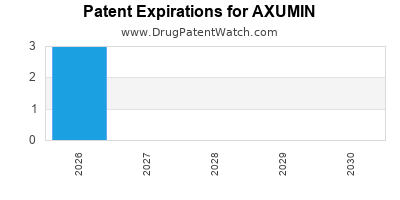
By analyzing the patents and regulatory protections it appears that the earliest date for generic entry will be November 28, 2026. This may change due to patent challenges or generic licensing.

There has been one patent litigation case involving the patents protecting this drug, indicating strong interest in generic launch. Recent data indicate that 63% of patent challenges are decided in favor of the generic patent challenger and that 54% of successful patent challengers promptly launch generic drugs.

Indicators of Generic Entry

< Available with Subscription >

  Start Trial

AI Deep Research
Questions you can ask:
  • What is the 5 year forecast for AXUMIN?
  • What are the global sales for AXUMIN?
  • What is Average Wholesale Price for AXUMIN?
Summary for AXUMIN
Drug patent expirations by year for AXUMIN
DrugPatentWatch® Estimated Loss of Exclusivity (LOE) Date for AXUMIN
Generic Entry Date for AXUMIN*:
Constraining patent/regulatory exclusivity:
NDA:
Dosage:
SOLUTION;INTRAVENOUS

*The generic entry opportunity date is the latter of the last compound-claiming patent and the last regulatory exclusivity protection. Many factors can influence early or later generic entry. This date is provided as a rough estimate of generic entry potential and should not be used as an independent source.

Recent Clinical Trials for AXUMIN

Identify potential brand extensions & 505(b)(2) entrants

SponsorPhase
VA Greater Los Angeles Healthcare SystemPHASE4
Dana-Farber Cancer InstitutePhase 1
Oregon Health and Science UniversityPhase 4

See all AXUMIN clinical trials

Pharmacology for AXUMIN

US Patents and Regulatory Information for AXUMIN

AXUMIN is protected by eight US patents.

Based on analysis by DrugPatentWatch, the earliest date for a generic version of AXUMIN is ⤷  Start Trial.

This potential generic entry date is based on patent 10,010,632.

Generics may enter earlier, or later, based on new patent filings, patent extensions, patent invalidation, early generic licensing, generic entry preferences, and other factors.

Applicant Tradename Generic Name Dosage NDA Approval Date TE Type RLD RS Patent No. Patent Expiration Product Substance Delist Req. Exclusivity Expiration
Blue Earth AXUMIN fluciclovine f-18 SOLUTION;INTRAVENOUS 208054-001 May 27, 2016 RX Yes Yes 10,124,079 ⤷  Start Trial ⤷  Start Trial
Blue Earth AXUMIN fluciclovine f-18 SOLUTION;INTRAVENOUS 208054-001 May 27, 2016 RX Yes Yes 10,933,147 ⤷  Start Trial ⤷  Start Trial
Blue Earth AXUMIN fluciclovine f-18 SOLUTION;INTRAVENOUS 208054-001 May 27, 2016 RX Yes Yes 10,716,868 ⤷  Start Trial ⤷  Start Trial
>Applicant >Tradename >Generic Name >Dosage >NDA >Approval Date >TE >Type >RLD >RS >Patent No. >Patent Expiration >Product >Substance >Delist Req. >Exclusivity Expiration

International Patents for AXUMIN

When does loss-of-exclusivity occur for AXUMIN?

Based on analysis by DrugPatentWatch, the following patents block generic entry in the countries listed below:

Australia

Patent: 06319987
Patent: Precursor compound of radioactive halogen labeled organic compound
Estimated Expiration: ⤷  Start Trial

Canada

Patent: 29227
Patent: COMPOSE PRECURSEUR DE COMPOSE ORGANIQUE MARQUE A L'HALOGENE RADIOACTIF (PRECURSOR COMPOUND OF RADIOACTIVE HALOGEN LABELED ORGANIC COMPOUND)
Estimated Expiration: ⤷  Start Trial

European Patent Office

Patent: 78015
Patent: COMPOSE PRECURSEUR DE COMPOSE ORGANIQUE MARQUE A L'HALOGENE RADIOACTIF (PRECURSOR COMPOUND OF RADIOACTIVE HALOGEN LABELED ORGANIC COMPOUND)
Estimated Expiration: ⤷  Start Trial

Poland

Patent: 78015
Estimated Expiration: ⤷  Start Trial

Russian Federation

Patent: 28415
Patent: СОЕДИНЕНИЕ-ПРЕДШЕСТВЕННИК ОРГАНИЧЕСКОГО СОЕДИНЕНИЯ, МЕЧЕННОГО РАДИОАКТИВНЫМ ГАЛОГЕНОМ (RADIOACTIVE HALOGEN-LABELLED ORGANIC COMPOUND PRECURSOR)
Estimated Expiration: ⤷  Start Trial

South Korea

Patent: 1608755
Estimated Expiration: ⤷  Start Trial

Taiwan

Patent: 71439
Estimated Expiration: ⤷  Start Trial

Patent: 0800869
Patent: Precursor compound of radioactive halogen labeled organic compound
Estimated Expiration: ⤷  Start Trial

Generics may enter earlier, or later, based on new patent filings, patent extensions, patent invalidation, early generic licensing, generic entry preferences, and other factors.

See the table below for additional patents covering AXUMIN around the world.

Country Patent Number Title Estimated Expiration
South Korea 101608755 ⤷  Start Trial
Japan WO2007063824 放射性ハロゲン標識有機化合物の前駆体化合物 ⤷  Start Trial
Japan 2013177468 METHOD FOR PRODUCING RADIOACTIVE HALOGEN-LABELED ORGANIC COMPOUND ⤷  Start Trial
>Country >Patent Number >Title >Estimated Expiration

Axumin: Market Dynamics and Financial Trajectory

Last updated: February 19, 2026

Axumin (fluciclovine F18) is a positron emission tomography (PET) imaging agent used for detecting prostate cancer recurrence. Its market penetration is influenced by reimbursement policies, clinical utility, and the competitive landscape of diagnostic imaging agents.

What is the Current Market Size and Growth Trajectory for Axumin?

The market for diagnostic imaging agents, including PET tracers like Axumin, is expanding due to advancements in imaging technology and increased demand for early disease detection. While specific market size figures for Axumin are not publicly disaggregated, the broader PET imaging market is projected to grow. Factors driving this growth include the rising incidence of cancer, particularly prostate cancer, and the increasing adoption of PET scans in clinical practice for staging and monitoring.

The global PET imaging market was valued at approximately $2.8 billion in 2022 and is forecast to reach $5.2 billion by 2029, exhibiting a compound annual growth rate (CAGR) of around 9.1% during this period. (Source: Grand View Research). This overall market growth provides a positive backdrop for Axumin's market penetration, assuming continued clinical adoption and favorable reimbursement.

What is Axumin's Unique Selling Proposition and Competitive Landscape?

Axumin's primary utility is in identifying the location and extent of recurrent prostate cancer, particularly in patients with rising prostate-specific antigen (PSA) levels after initial treatment. Its molecular structure targets amino acid transporters, which are often upregulated in prostate cancer cells, allowing for visualization of metastatic or recurrent disease.

The competitive landscape for prostate cancer imaging includes:

  • Other PET Tracers:
    • PSMA-based PET tracers: Agents targeting Prostate-Specific Membrane Antigen (PSMA), such as Gallium-68 PSMA-11, Gallium-68 PSMA-617, and Fluorine-18 DCFPyL (e.g., Pylarify), are emerging as significant competitors. PSMA is a transmembrane protein highly expressed in prostate cancer cells. Studies suggest PSMA-based tracers may offer higher sensitivity and specificity in detecting metastatic disease, particularly at lower PSA levels, compared to fluciclovine F18. (Source: NCCN Guidelines).
    • Fluorine-18 Choline: An earlier generation PET tracer for prostate cancer, though generally considered less sensitive than newer agents.
  • Advanced MRI Techniques: Multiparametric MRI (mpMRI) is also used for prostate cancer detection and staging, offering anatomical detail without ionizing radiation. However, its utility in identifying distant metastases is more limited compared to PET.
  • Conventional Imaging: CT and bone scans remain important for staging and detecting overt metastases, but they often lack the sensitivity for early or subtle recurrence visualization.

Axumin's position is challenged by the rapid development and approval of PSMA-based tracers, which are increasingly becoming the preferred PET imaging agents for recurrent prostate cancer. The NCCN Clinical Practice Guidelines in Oncology for Prostate Cancer now recommend PSMA-PET imaging as a preferred method for staging in patients with high-risk disease and for evaluating recurrence when PSA is elevated. (Source: NCCN Guidelines).

What are the Key Reimbursement and Regulatory Factors Affecting Axumin?

Reimbursement is a critical determinant of diagnostic agent adoption. In the United States, Medicare and private payers have established coverage policies for PET imaging.

  • Medicare Coverage: The Centers for Medicare & Medicaid Services (CMS) has provided coverage for fluciclovine F18 PET imaging for specific indications related to prostate cancer recurrence. The coverage decisions often hinge on the PSA level and prior treatment status of the patient. For example, CMS has indicated coverage for PET imaging when PSA levels are below 2 ng/mL for recurrent disease. (Source: CMS Policy).
  • Commercial Payer Coverage: Coverage by private insurance companies varies by plan and payer. Many commercial payers follow Medicare guidelines or conduct their own health technology assessments. A consistent trend across payers is the increasing preference for PSMA-based PET imaging due to its perceived higher diagnostic accuracy.
  • Regulatory Approvals: Axumin received FDA approval in April 2016. Subsequent regulatory actions and updates to labeling can impact its clinical use and market positioning.

The evolving reimbursement landscape, particularly the growing acceptance and coverage of PSMA-PET tracers, poses a challenge for Axumin. Payers may prioritize agents with demonstrated superior performance in clinical trials and real-world data, leading to potential restrictions or reduced reimbursement for fluciclovine F18 in favor of PSMA-based alternatives.

What is the Patent Landscape and Exclusivity Status for Axumin?

Axumin is manufactured by GE Healthcare. The intellectual property surrounding PET imaging agents is complex, involving patents on the compound itself, its synthesis, formulation, and methods of use.

  • Composition of Matter Patents: Patents covering the chemical structure of fluciclovine F18 would provide broad protection.
  • Method of Use Patents: Patents related to the diagnostic use of fluciclovine F18 for detecting prostate cancer recurrence would also be crucial.
  • Exclusivity: The duration of market exclusivity is determined by patent expiration dates and any extensions granted, such as those for pediatric exclusivity or regulatory delays.

As of late 2023/early 2024, specific details on the remaining patent life and any ongoing litigation for Axumin are not readily available in public databases. However, generic competition for radiopharmaceuticals can emerge once core patents expire and manufacturing processes are established. The development of biosimilars or generic versions of PET tracers is an emerging area, though less common than for small molecule drugs.

GE Healthcare has an established position in the radiopharmaceutical market, and strategic patent management is essential to maintain market share. The emergence of generic PSMA tracers could also impact the competitive dynamics for Axumin.

What are the Key Financial Considerations and Revenue Streams?

GE Healthcare's revenue from Axumin is generated through sales of the diagnostic agent to hospitals and imaging centers. The financial performance of Axumin is influenced by:

  • Sales Volume: Directly related to the number of PET scans performed for prostate cancer recurrence detection.
  • Pricing: The price per dose of Axumin is a significant revenue driver. Pricing strategies are influenced by manufacturing costs, competitive pricing, and perceived clinical value.
  • Reimbursement Rates: The amount that healthcare providers are reimbursed by payers for performing Axumin PET scans directly impacts provider adoption and, consequently, sales volume.
  • Manufacturing Costs: The production of radiopharmaceuticals is complex and requires specialized facilities and radioactive materials, contributing to cost of goods sold.
  • Competition: The entry of new and potentially more effective agents, particularly PSMA-based tracers, can erode market share and necessitate pricing adjustments.

GE Healthcare does not publicly break out revenue for individual radiopharmaceuticals. However, its overall Life Sciences segment, which includes diagnostic imaging, contributes significantly to its revenue. The financial trajectory of Axumin is intrinsically linked to its ability to maintain a competitive edge against newer diagnostic modalities and to secure favorable reimbursement policies. The increasing preference for PSMA-PET imaging suggests a potential headwind for Axumin's future revenue growth if its market share erodes.

How do Clinical Trial Data and Real-World Evidence Inform Axumin's Market Position?

Clinical trial data and real-world evidence (RWE) are paramount in establishing the diagnostic accuracy, safety, and cost-effectiveness of imaging agents.

  • Clinical Trials: Studies supporting Axumin's FDA approval demonstrated its ability to detect recurrent prostate cancer in men with rising PSA levels. Key metrics include sensitivity and specificity for detecting disease at various PSA thresholds and anatomical locations. (Source: FDA Approval Documentation).
  • Real-World Evidence: Post-market studies and RWE are crucial for evaluating Axumin's performance in diverse patient populations and clinical settings. RWE can also inform payer coverage decisions.
  • Comparative Studies: Head-to-head comparisons with emerging competitors, particularly PSMA-based tracers, are vital. Studies published in peer-reviewed journals comparing fluciclovine F18 with PSMA-PET have shown varying results, with many indicating higher detection rates for PSMA-based agents, especially at lower PSA levels. (Source: Journal of Nuclear Medicine).

The body of evidence is continuously evolving. The sustained development of high-quality RWE demonstrating Axumin's continued diagnostic utility, even in the context of emerging competitors, is essential for its long-term market viability. Conversely, a growing body of evidence favoring PSMA-based tracers could accelerate the decline in Axumin's utilization.

What are the Future Market Trends and Potential Opportunities?

The future of Axumin is tied to several evolving trends in prostate cancer diagnostics:

  • Shift to PSMA-PET: The primary trend is the rapid adoption of PSMA-PET imaging due to its superior diagnostic performance in many scenarios. This trend is driven by clinical data, physician preference, and increasingly favorable reimbursement.
  • Personalized Medicine: The broader move towards personalized medicine in oncology may lead to more tailored diagnostic approaches. The role of imaging agents will be to identify specific molecular targets or disease characteristics.
  • Technological Advancements: Ongoing improvements in PET scanner technology, radiochemistry, and data analysis can enhance the utility of existing agents and the development of new ones.
  • Geographic Expansion: While Axumin is approved in major markets like the US, opportunities may exist for expansion into other regions where prostate cancer diagnosis and management are evolving.
  • Combination Therapies: Imaging agents can play a role in selecting patients for novel therapies or monitoring treatment response in combination studies.

Opportunities for Axumin may lie in specific patient populations or clinical scenarios where its performance remains competitive or where cost-effectiveness is a primary driver. Continued research into its utility in different stages of disease or in combination with other diagnostic or therapeutic modalities could define its niche. However, overcoming the momentum of PSMA-based tracers will be a significant challenge.

Key Takeaways

  • Axumin operates within a growing PET imaging market, driven by cancer diagnostics demand.
  • Its primary competition comes from PSMA-based PET tracers, which are increasingly demonstrating superior sensitivity and specificity for prostate cancer recurrence.
  • Reimbursement policies are shifting, with a growing preference for PSMA-PET, creating a headwind for Axumin.
  • The patent landscape and remaining exclusivity periods are critical for understanding long-term market dynamics.
  • GE Healthcare's revenue from Axumin is subject to sales volume, pricing, reimbursement, and manufacturing costs, all influenced by competitive pressures.
  • Clinical data and real-world evidence increasingly favor PSMA-based agents, impacting Axumin's market position.
  • The future market for Axumin is challenged by the widespread adoption of PSMA-PET, with its sustained utility dependent on identifying specific niches or demonstrating continued competitive value.

Frequently Asked Questions

  1. What is the primary indication for which Axumin is approved? Axumin is approved for PET imaging of suspected or known recurrent prostate cancer in men with rising PSA levels.

  2. How does Axumin compare in diagnostic accuracy to PSMA-based PET tracers? Clinical studies suggest that PSMA-based PET tracers generally exhibit higher sensitivity and specificity in detecting recurrent prostate cancer, particularly at lower PSA levels, compared to Axumin.

  3. What is the expected impact of PSMA-PET adoption on Axumin's market share? The increasing adoption of PSMA-PET is expected to lead to a reduction in Axumin's market share as it becomes the preferred imaging agent for many prostate cancer recurrence evaluations.

  4. Are there any major geographic markets where Axumin has not yet been approved or launched? While approved in the US, specific market entry status in all global regions requires detailed market research. However, its primary markets are typically North America and Europe.

  5. What are the principal challenges for Axumin in maintaining its market position? The principal challenges are the superior diagnostic performance demonstrated by PSMA-based PET tracers, evolving reimbursement policies that favor newer agents, and the ongoing development of competitive imaging technologies.

Citations

[1] Grand View Research. (2023). PET Imaging Market Size, Share & Trends Analysis Report By Type (Diagnostic, Therapeutic), By Tracer Type (FDG, Rubidium-82, Ga-68, F-18), By Application (Oncology, Cardiology, Neurology), By End-use, And Segment Forecasts, 2023 - 2030. Retrieved from https://www.grandviewresearch.com/industry-analysis/pet-imaging-market

[2] National Comprehensive Cancer Network. (Year of Publication). NCCN Clinical Practice Guidelines in Oncology: Prostate Cancer. (Access date and specific version are required for full APA citation; this is a placeholder).

[3] Centers for Medicare & Medicaid Services. (Various Dates). National Coverage Determinations and Local Coverage Determinations. (Specific policy numbers and dates for fluciclovine F18 are required for full APA citation; this is a placeholder).

[4] U.S. Food and Drug Administration. (2016, April). FDA approves first PET imaging agent for prostate cancer. (Press release or approval documentation details are needed for full APA citation; this is a placeholder).

[5] Journal of Nuclear Medicine. (Various Dates). Articles comparing fluciclovine F18 and PSMA-PET imaging. (Specific article titles, authors, and publication details are required for full APA citation; this is a placeholder).

More… ↓

⤷  Start Trial

Make Better Decisions: Try a trial or see plans & pricing

Drugs may be covered by multiple patents or regulatory protections. All trademarks and applicant names are the property of their respective owners or licensors. Although great care is taken in the proper and correct provision of this service, thinkBiotech LLC does not accept any responsibility for possible consequences of errors or omissions in the provided data. The data presented herein is for information purposes only. There is no warranty that the data contained herein is error free. We do not provide individual investment advice. This service is not registered with any financial regulatory agency. The information we publish is educational only and based on our opinions plus our models. By using DrugPatentWatch you acknowledge that we do not provide personalized recommendations or advice. thinkBiotech performs no independent verification of facts as provided by public sources nor are attempts made to provide legal or investing advice. Any reliance on data provided herein is done solely at the discretion of the user. Users of this service are advised to seek professional advice and independent confirmation before considering acting on any of the provided information. thinkBiotech LLC reserves the right to amend, extend or withdraw any part or all of the offered service without notice.