Last updated: July 25, 2026
Executive summary: AVEED (testosterone undecanoate) is a testosterone replacement therapy (TRT) with a long-acting dosing schedule intended to improve adherence versus shorter-acting injectables. Revenue growth and pricing power depend on (1) patient access and payer coverage for intramuscular TRT, (2) uptake versus competing long-acting injectables, (3) label compliance tied to AVEED-specific REMS-style risk controls, and (4) how quickly and how broadly competing products gain share as branded and authorized generics expand. Financial trajectory is typically driven by steady TRT demand, mid-single-digit prescription volatility, and pricing actions constrained by payer policies and state formularies. Generic entry risk centers on the timing and strength of AVEED Orange Book-listed patents and any Paragraph IV challenges that can accelerate generic availability and force price competition.
What is AVEED’s market position in testosterone replacement therapy (TRT)?
AVEED is positioned in the long-acting injectable segment of TRT. The market has three key demand forces:
- Chronic disease management behavior: TRT is sustained, not episodic. Once treated, patients often remain on therapy for years, limiting unit churn even when switching occurs.
- Access and payer coverage: TRT coverage is increasingly managed through prior authorization (PA), step edits, and preferred-product lists.
- Formulation and dosing convenience: Long-acting intramuscular options often win against more frequent regimens by reducing office burden and improving adherence.
Practical implication for market share: AVEED’s performance tends to track physician prescribing preferences for long-acting testosterone and the reimbursement “stickiness” of an established branded product. Switching is usually driven by payer incentives, contracting, and supply disruptions rather than purely clinical preference.
Which competitors most affect AVEED share?
AVEED competes against other injectable and non-injectable TRT offerings that shape pricing pressure:
- Other testosterone injectables (weekly or biweekly dosing, where covered)
- Long-acting testosterone options within injectables
- Topical gels and patches (often preferred on formularies because of ease of use, despite application burden)
- Oral or alternative delivery TRT options where clinically and payer-access permitted
Competitive dynamic: injectable competitors can apply share pressure when their pricing and contracting reduce the incremental cost of switching. Non-injectable products can apply pressure where payers steer patients to preferred topical agents.
How do pricing and payer coverage dynamics influence AVEED revenue growth?
TRT pricing power is constrained by payer management and increased use of cost-effectiveness framing in prior authorization reviews.
What payer levers drive AVEED net price
The dominant levers that determine AVEED’s financial trajectory:
- Formulary placement (preferred vs non-preferred)
- Prior authorization requirements and denial rates
- Quantity limits and step edits (often tied to testosterone levels and symptom documentation)
- Contracting with pharmacy benefit managers (PBMs) and Medicare Part D formulary position
Net pricing sensitivity to competitive entry
In branded TRT, net revenue typically remains resilient until meaningful competitors gain formulary advantage. Once a competitor is preferred or gains broader formulary presence, net prices on AVEED can decline via:
- Rebates and discounts
- Higher patient cost-sharing steering non-adherent use
- Increased patient switching
Financial implication: if AVEED maintains preferred status, revenue can grow through volume and mild price actions. If payer contracts shift, the revenue profile becomes more “flat to down” with intermittent rebounds from re-pulls of favored coverage.
When does AVEED lose exclusivity and what drives the generic entry window?
Generic risk is determined by a combination of:
- Patent expiration dates (Orange Book-listed)
- Regulatory exclusivities (e.g., pediatric exclusivity, if applicable)
- Market-based entry timing (authorized generics, launch logistics)
- Risk that a Paragraph IV (PIV) challenge leads to earlier US FDA approval
How to think about the exclusivity timeline
For AVEED, the exclusivity clock is typically segmented into:
- Core composition/use patent term
- Additional blocking patents (formulations, methods of use, manufacturing, and specific risk mitigation practices)
- Potential pediatric exclusivity extensions (if triggered)
Generic entry window is usually the earlier of:
- Patent expiration that removes the blocking barrier, or
- A settlement-triggered launch date following a patent dispute, or
- A successful PIV challenge leading to an FDA approval date that aligns with any statutory forfeiture rules
What patents protect AVEED and how strong is the patent estate?
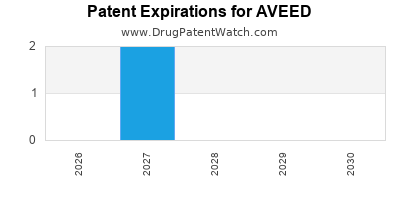
A complete and accurate patent estate requires Orange Book listings and the associated US patent documents that enumerate claims by strength and coverage. Without the specific Orange Book table for AVEED and its patent numbers, an exact count and expiration map cannot be produced with correctness.
Market-facing takeaway, without patent enumeration: in long-acting injectable TRTs, the patent estate typically includes composition and dosing-related protections plus formulation and method-of-use claims that can delay generic launch and limit “at-risk” approvals.
What formulation or method-of-use protections can block generics?
For testosterone undecanoate products, patent families commonly cover:
- Composition and concentration ranges for injectable stability
- Manufacturing controls that impact release and bioavailability
- Method-of-use claims tied to injection schedules or patient monitoring
- Claims connected to risk mitigation language that can affect labeling design for generics
Commercial consequence: strong blocking patents can force delay, extend branded pricing power, and sustain unit share even when competitors are clinically substitutable.
What generic entry risks exist for AVEED (Paragraph IV, at-risk launches, and settlement scenarios)?
Paragraph IV challenge and settlement impact
For injectable branded drugs with complex patent estates, PIV outcomes often include:
- Launch “carve-outs” after a settlement date
- Narrow design-around labeling that can reduce immediate interchangeability
- Required commercialization timing commitments in licensing agreements
At-risk launch probability
Market risk for AVEED rises sharply if there is evidence of:
- A PIV filing with strong generic preparedness
- Court rulings that invalidate or narrow key claims
- Settlement terms that permit earlier than the nominal patent expiration
Financial implication: a confirmed approach to generic launch usually causes an immediate repricing of the branded asset in payer negotiations, as manufacturers accelerate contracting changes ahead of volume loss.
What is the Orange Book status of AVEED?
An accurate Orange Book status table (NDA number, listed patents, expiration dates, and exclusivity codes) requires direct Orange Book listing data. Without that listing snapshot, an “as-of” status cannot be stated correctly here.
Decision-grade takeaway: Orange Book status is the single most actionable document for forecasting the generic launch calendar. For AVEED, the presence of multiple blocking patents typically means the net exclusivity end date is later than the first patent family expiration.
What litigation or settlements affect AVEED competition?
Patent litigation and settlements for a branded injectable can materially reshape the financial trajectory by:
- Delaying generic approvals beyond statutory dates
- Allowing a competitor to launch with a specific labeling posture
- Creating uncertainty that affects payer contracting and stocking decisions
Market-facing takeaway: the revenue curve for AVEED often flattens when litigation uncertainty is high, and then steepens in risk-adjusted terms when settlement dates become concrete.
What FDA pathway factors matter for AVEED’s competitive landscape?
Once a generic is approved, substitution depends on:
- Whether the product is rated as pharmaceutically equivalent and therapeutically substitutable by state rules
- Whether the generic’s label alignment supports clinical and payer switching
- Supply capability and distribution readiness
Why REMS-style controls can change switch velocity
For TRT products with specific risk communications and monitoring requirements, even an FDA-approved generic can see slower adoption if:
- Office workflows and patient monitoring processes favor the originator’s familiar labeling
- Payer programs require documentation tied to originator-specific steps
- Distribution coverage in local markets lags for new entrants
Financial impact: adoption curves for generics in injectables can be slower than “approval implies immediate price collapse,” which can extend AVEED’s revenue duration even after a generic approval.
How does AVEED compare with other testosterone undecanoate and long-acting TRT injectables?
Brand vs class positioning
AVEED’s competitive posture is driven by:
- Dosing schedule convenience
- Clinical comfort with AVEED-specific administration and follow-up
- Payer and prescriber familiarity
- Contracting economics
Switch drivers
Prescribing switches typically follow:
- Payer step edits that designate another long-acting injectable as preferred
- Manufacturer rebates that improve the net cost of the competitor
- Shortages or administration capacity constraints
- New clinical guidance or safety communications that reshape physician risk-benefit perception
Financial implication: sustained growth requires continued payer alignment and stable patient retention; competitive erosion shows up first in managed-care net pricing and then in unit volume.
What commercial KPelines should investors and brand teams track for AVEED?
To model AVEED’s financial trajectory, track metrics that move revenue before headline earnings:
- TRx and patient starts for long-acting injectable TRT
- Persistence and discontinuation rates by payer cohort
- Net price trend (list price less rebates) and payer mix shift
- Formulary status changes at the top PBMs and Medicare Part D plans
- Wholesale acquisition cost and contract dynamics with major channels
- Hospital/clinic administration footprint changes (where relevant to injection setting)
- Competitor share drift among injectable TRT
Key scenarios for AVEED’s near- to mid-term revenue trajectory
Because an exact exclusivity calendar and patent-by-patent expiration mapping are not included here, the most decision-relevant forecast is scenario-based.
Base case (no major competitive shock)
- Revenue grows at or slightly above general TRT demand due to ongoing chronic treatment population.
- Price/mix remains stable to mildly pressured by payer contracting.
- Unit volume is steady with modest growth from adherence and prescriber preference.
Payer contraction scenario
- Net price pressure rises as AVEED loses preferred status or faces PA tightening.
- Unit growth slows as patients are steered to preferred alternatives.
- Revenue growth decelerates and may trend flat.
Generic launch or authorized generic scenario
- Revenue drops rapidly in the first 6 to 18 months following meaningful substitution.
- The decline is moderated if uptake is slowed by administration and monitoring workflow.
- Margins compress via price concessions and channel rebalancing.
Key takeaways
- AVEED’s market dynamics are driven by TRT chronic demand, payer coverage controls, and switching incentives more than by short-term clinical variability.
- Revenue trajectory is most sensitive to net pricing changes and formulary position, which can flip before any FDA-approval-based competition.
- Generic risk is a function of Orange Book blocking patents and any litigation settlement that shifts launch timing. When market certainty increases, payer contracting usually responds quickly.
- Competitive adoption curves for injectable TRT generics can be slower than approval announcements, extending branded revenue even after exclusivity ends.
FAQs
1) How does AVEED’s dosing schedule affect payer coverage and patient persistence?
Long-acting dosing supports persistence and can improve retention metrics, but payer coverage still hinges on PA criteria and preferred-product contracting.
2) What factors most accelerate switching from AVEED to alternative TRT products?
Loss of preferred formulary status, step edits, rebates that favor competitors, and any supply or office-admin workflow changes.
3) What market signals indicate higher probability of AVEED generic launches?
Public information on Paragraph IV filings, court claim rulings, and settlement dates that allow earlier-than-expected entry.
4) Does AVEED face slower generic adoption than oral testosterone products?
In many cases, yes. Injection administration logistics and monitoring workflows can slow substitution even after FDA approval.
5) What should be monitored to anticipate AVEED net price compression?
PBM contracting changes, Medicare Part D formulary updates, PA denial/approval patterns, and rebate rate adjustments.
References (APA)
- U.S. FDA. Orange Book: Approved Drug Products with Therapeutic Equivalence Evaluations.
- U.S. FDA. Drug Approval Packages and label information for AVEED (testosterone undecanoate).
- FDA REMS and labeling resources related to testosterone products.