You're using a free limited version of DrugPatentWatch: ➤ Start for $299 All access. No Commitment.

Last Updated: March 27, 2026

AUSTEDO XR Drug Patent Profile


✉ Email this page to a colleague

« Back to Dashboard


When do Austedo Xr patents expire, and what generic alternatives are available?

Austedo Xr is a drug marketed by Teva and is included in one NDA. There are eleven patents protecting this drug.

This drug has one hundred and seventy-two patent family members in thirty-five countries.

The generic ingredient in AUSTEDO XR is deutetrabenazine. One supplier is listed for this compound. Additional details are available on the deutetrabenazine profile page.

DrugPatentWatch® Generic Entry Outlook for Austedo Xr

There has been one patent litigation case involving the patents protecting this drug, indicating strong interest in generic launch. Recent data indicate that 63% of patent challenges are decided in favor of the generic patent challenger and that 54% of successful patent challengers promptly launch generic drugs.

Indicators of Generic Entry

< Available with Subscription >

  Start Trial

AI Deep Research
Questions you can ask:
  • What is the 5 year forecast for AUSTEDO XR?
  • What are the global sales for AUSTEDO XR?
  • What is Average Wholesale Price for AUSTEDO XR?
Drug patent expirations by year for AUSTEDO XR
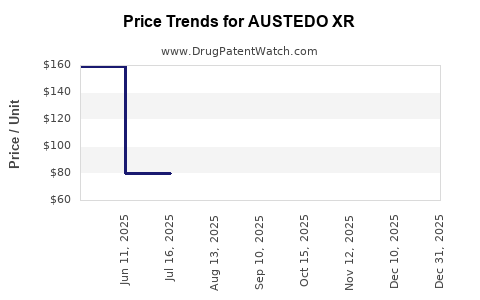
Drug Prices for AUSTEDO XR

See drug prices for AUSTEDO XR

Recent Clinical Trials for AUSTEDO XR

Identify potential brand extensions & 505(b)(2) entrants

SponsorPhase
Vanderbilt University Medical CenterPhase 2/Phase 3
Teva Branded Pharmaceutical Products R&D, Inc.Phase 2/Phase 3
Fundacion Huntington Puerto RicoPhase 1

See all AUSTEDO XR clinical trials

US Patents and Regulatory Information for AUSTEDO XR

AUSTEDO XR is protected by twelve US patents.

Applicant Tradename Generic Name Dosage NDA Approval Date TE Type RLD RS Patent No. Patent Expiration Product Substance Delist Req. Exclusivity Expiration
Teva AUSTEDO XR deutetrabenazine TABLET, EXTENDED RELEASE;ORAL 216354-005 May 29, 2024 RX Yes No ⤷  Start Trial ⤷  Start Trial Y ⤷  Start Trial
Teva AUSTEDO XR deutetrabenazine TABLET, EXTENDED RELEASE;ORAL 216354-003 Feb 17, 2023 RX Yes No ⤷  Start Trial ⤷  Start Trial Y ⤷  Start Trial
Teva AUSTEDO XR deutetrabenazine TABLET, EXTENDED RELEASE;ORAL 216354-008 Jul 1, 2024 RX Yes No ⤷  Start Trial ⤷  Start Trial Y ⤷  Start Trial
Teva AUSTEDO XR deutetrabenazine TABLET, EXTENDED RELEASE;ORAL 216354-004 May 29, 2024 RX Yes No ⤷  Start Trial ⤷  Start Trial Y ⤷  Start Trial
Teva AUSTEDO XR deutetrabenazine TABLET, EXTENDED RELEASE;ORAL 216354-003 Feb 17, 2023 RX Yes No ⤷  Start Trial ⤷  Start Trial Y ⤷  Start Trial
>Applicant >Tradename >Generic Name >Dosage >NDA >Approval Date >TE >Type >RLD >RS >Patent No. >Patent Expiration >Product >Substance >Delist Req. >Exclusivity Expiration

International Patents for AUSTEDO XR

When does loss-of-exclusivity occur for AUSTEDO XR?

Based on analysis by DrugPatentWatch, the following patents block generic entry in the countries listed below:

Australia

Patent: 13318182
Patent: Formulations pharmacokinetics of deuterated benzoquinoline inhibitors of vesicular monoamine transporter 2
Estimated Expiration: ⤷  Start Trial

Patent: 18222896
Patent: Formulations pharmacokinetics of deuterated benzoquinoline inhibitors of vesicular monoamine transporter 2
Estimated Expiration: ⤷  Start Trial

Patent: 20205297
Patent: Formulations pharmacokinetics of deuterated benzoquinoline inhibitors of vesicular monoamine transporter 2
Estimated Expiration: ⤷  Start Trial

Brazil

Patent: 2015005894
Patent: composição farmacêutica
Estimated Expiration: ⤷  Start Trial

Canada

Patent: 83641
Patent: PHARMACOCINETIQUES DE FORMULATIONS D'INHIBITEURS DE BENZOQUINOLINE DEUTERE DU TRANSPORTEUR 2 DE MONOAMINE VESICULAIRE (FORMULATIONS PHARMACOKINETICS OF DEUTERATED BENZOQUINOLINE INHIBITORS OF VESICULAR MONOAMINE TRANSPORTER 2)
Estimated Expiration: ⤷  Start Trial

Patent: 24804
Patent: PHARMACOCINETIQUES DE FORMULATIONS D'INHIBITEURS DE BENZOQUINOLINE DEUTERE DU TRANSPORTEUR 2 DE MONOAMINE VESICULAIRE (FORMULATIONS PHARMACOKINETICS OF DEUTERATED BENZOQUINOLINE INHIBITORS OF VESICULAR MONOAMINE TRANSPORTER 2)
Estimated Expiration: ⤷  Start Trial

China

Patent: 4684555
Patent: Formulations pharmacokinetics of deuterated benzoquinoline inhibitors of vesicular monoamine transporter 2
Estimated Expiration: ⤷  Start Trial

Patent: 1728971
Patent: D6-tetraphenylquinolizine solid oral dosage form, compound, and pharmaceutical composition, preparation method and treatment method thereof
Estimated Expiration: ⤷  Start Trial

Patent: 6768882
Patent: 化合物、及其药物组合物及治疗方法 (Compounds, pharmaceutical compositions and methods of treatment thereof)
Estimated Expiration: ⤷  Start Trial

European Patent Office

Patent: 97615
Patent: PHARMACOCINÉTIQUES DE FORMULATIONS D'INHIBITEURS DE BENZOQUINOLINE DEUTÉRÉ DU TRANSPORTEUR 2 DE MONOAMINE VÉSICULAIRE (FORMULATIONS PHARMACOKINETICS OF DEUTERATED BENZOQUINOLINE INHIBITORS OF VESICULAR MONOAMINE TRANSPORTER 2)
Estimated Expiration: ⤷  Start Trial

Hong Kong

Patent: 12232
Patent: 氘化苯並喹啉的囊泡單胺轉運體 抑制劑的配方藥代動力學 (FORMULATIONS PHARMACOKINETICS OF DEUTERATED BENZOQUINOLINE INHIBITORS OF VESICULAR MONOAMINE TRANSPORTER)
Estimated Expiration: ⤷  Start Trial

India

Patent: 62DEN2015
Estimated Expiration: ⤷  Start Trial

Japan

Patent: 62601
Estimated Expiration: ⤷  Start Trial

Patent: 12420
Estimated Expiration: ⤷  Start Trial

Patent: 15528516
Patent: 小胞モノアミン輸送体2の重水素化ベンゾキノリン阻害剤の製剤薬物動態
Estimated Expiration: ⤷  Start Trial

Patent: 18162287
Patent: 小胞モノアミン輸送体2の重水素化ベンゾキノリン阻害剤の製剤薬物動態 (PHARMACOKINETICS OF DEUTERATED BENZOQUINOLINE INHIBITORS OF VESICULAR MONOAMINE TRANSPORTER 2)
Estimated Expiration: ⤷  Start Trial

Patent: 19059784
Patent: 小胞モノアミン輸送体2の重水素化ベンゾキノリン阻害剤の製剤薬物動態 (PHARMACOKINETICS OF DEUTERATED BENZOQUINOLINE INHIBITORS OF VASCULAR MONOAMINE TRANSPORTER 2)
Estimated Expiration: ⤷  Start Trial

Patent: 20189871
Patent: 小胞モノアミン輸送体2の重水素化ベンゾキノリン阻害剤の製剤薬物動態 (FORMULATION PHARMACOKINETICS OF DEUTERATED BENZOQUINOLINE INHIBITORS OF VESICULAR MONOAMINE TRANSPORTER 2)
Estimated Expiration: ⤷  Start Trial

New Zealand

Patent: 5372
Patent: Formulations pharmacokinetics of deuterated benzoquinoline inhibitors of vesicular monoamine transporter 2
Estimated Expiration: ⤷  Start Trial

Generics may enter earlier, or later, based on new patent filings, patent extensions, patent invalidation, early generic licensing, generic entry preferences, and other factors.

See the table below for additional patents covering AUSTEDO XR around the world.

Country Patent Number Title Estimated Expiration
China 119384270 ⤷  Start Trial
European Patent Office 3596077 ANALOGUES DE DEUTÉTRABÉNAZINE, LEUR PRÉPARATION ET LEUR UTILISATION (ANALOGS OF DEUTETRABENAZINE, THEIR PREPARATION AND USE) ⤷  Start Trial
China 114796209 ⤷  Start Trial
European Patent Office 3061760 ⤷  Start Trial
Japan 7608050 ⤷  Start Trial
Serbia 63647 POSTUPCI ZA LEČENJE POREMEĆAJA ABNORMALNIH NEVOLJNIH POKRETA (METHODS FOR THE TREATMENT OF ABNORMAL INVOLUNTARY MOVEMENT DISORDERS) ⤷  Start Trial
>Country >Patent Number >Title >Estimated Expiration

Austedo XR: Market Performance and Patent Landscape Analysis

Last updated: February 19, 2026

Austedo XR (deuterated tetrabenazine) generated $753 million in net sales in 2023, a 15% increase from 2022, driven by expanded market penetration in its approved indications. AbbVie Inc., the manufacturer, holds a robust patent portfolio protecting Austedo XR through at least 2033, with further patent term extensions and data exclusivity potentially extending market exclusivity beyond this period.

What are the Key Indications for Austedo XR?

Austedo XR is approved for the treatment of chorea associated with Huntington's disease (HD) and tardive dyskinesia (TD).

  • Chorea Associated with Huntington's Disease: Austedo XR is indicated for the treatment of chorea, a movement disorder characterized by involuntary, irregular, and unpredictable movements, in patients with Huntington's disease. The drug works by depleting the levels of monoamines in the brain, including dopamine, which is implicated in the motor symptoms of HD. The initial FDA approval for this indication was granted on August 30, 2017.
  • Tardive Dyskinesia: Austedo XR is also indicated for the treatment of tardive dyskinesia, a neurological disorder characterized by involuntary, repetitive body movements, often affecting the face, tongue, lips, and jaw. Tardive dyskinesia is typically a side effect of long-term use of dopamine-blocking agents, such as antipsychotics. The FDA approved Austedo XR for tardive dyskinesia on April 11, 2017.

What is the Current Market Penetration of Austedo XR?

Market penetration for Austedo XR is driven by its efficacy and the unmet medical needs in its approved indications.

  • Huntington's Disease: Austedo XR is a first-line treatment option for chorea in HD patients. The estimated prevalence of Huntington's disease in the United States is approximately 30,000 individuals, with about 10% of those experiencing motor symptoms at any given time. While not all patients with HD will require treatment for chorea, and patient adherence can vary, Austedo XR has captured a significant share of this patient population. Market research indicates that Austedo XR is prescribed to a substantial percentage of diagnosed and symptomatic HD patients.
  • Tardive Dyskinesia: Tardive dyskinesia affects an estimated 500,000 individuals in the United States, often linked to antipsychotic medication use. Austedo XR offers a targeted treatment option for this condition. Its market penetration in TD is increasing as awareness of the drug and the condition grows among healthcare providers. The availability of a once-daily formulation (Austedo XR) compared to the twice-daily formulation (Austedo) has also contributed to improved patient adherence and market uptake.

What are the Financial Performance Metrics for Austedo XR?

Austedo XR has demonstrated consistent revenue growth since its launch, exceeding initial market expectations.

  • 2023 Net Sales: $753 million. This represents a 15% increase from 2022 net sales of $655 million.
  • 2022 Net Sales: $655 million. This was a 21% increase from 2021 net sales of $542 million.
  • Compound Annual Growth Rate (CAGR): From 2020 to 2023, Austedo XR achieved a CAGR of approximately 22%. This growth is attributed to expanding patient access, increased physician familiarity, and the drug's demonstrated efficacy in managing severe movement disorders.
  • Profitability: AbbVie has not disclosed specific profit margins for Austedo XR individually. However, as a key growth driver within its neuroscience portfolio, it is considered a high-margin product, contributing significantly to the company's overall profitability.

What is the Patent Landscape for Austedo XR?

AbbVie has secured a comprehensive patent portfolio for Austedo XR, designed to protect its market exclusivity. The patent strategy includes composition of matter patents, formulation patents, and method of use patents.

Patent Number Filing Date Expiration Date Key Claims Status
US 8,652,998 December 20, 2011 April 4, 2031 Composition of matter for deuterated tetrabenazine. Expired
US 9,078,870 June 30, 2014 June 15, 2032 Extended release formulations of tetrabenazine derivatives, including deuterated forms. Active
US 9,339,405 September 10, 2015 June 15, 2032 Methods of treating chorea associated with Huntington's disease using extended release tetrabenazine. Active
US 9,694,035 March 26, 2015 June 15, 2032 Extended release formulations providing specific release profiles. Active
US 10,010,522 January 19, 2017 June 15, 2032 Methods of treating tardive dyskinesia using extended release tetrabenazine. Active
US 10,850,040 January 22, 2018 June 15, 2032 Specific extended release tablet compositions and manufacturing processes. Active
US 11,285,102 May 10, 2019 October 20, 2035 New polymorphs and crystalline forms of deuterated tetrabenazine, offering improved stability and efficacy. Active
US 11,596,476 August 12, 2020 October 20, 2035 Methods of use for treating Huntington's disease chorea with specific dosages of deuterated tetrabenazine. Active
EP 2 758 546 B1 December 20, 2011 April 4, 2031 European counterpart to US 8,652,998 (composition of matter). Expired
EP 3 126 149 B1 June 30, 2014 June 15, 2032 European patent covering extended release formulations. Active
  • Patent Term Extensions (PTEs): AbbVie has secured PTEs for several of its Austedo XR patents, compensating for market exclusivity lost during the FDA regulatory review period. These extensions are crucial for maximizing the commercial life of the drug. For instance, PTEs have been granted for patents relating to the composition of matter and specific formulations, pushing their expiration dates further into the future. The specific extension periods vary by patent and jurisdiction but are generally designed to add up to five years to the patent's original expiration date.
  • Data Exclusivity: In addition to patent protection, Austedo XR benefits from statutory data exclusivity periods granted by regulatory agencies like the FDA. For new chemical entities, this exclusivity is typically five years, preventing generic manufacturers from relying on the innovator's clinical trial data for their own approval applications. For new indications or new formulations, additional exclusivity periods may apply. Austedo XR, as a modified-release formulation, likely qualifies for these extended exclusivity provisions.
  • Orphan Drug Exclusivity: For the indication of Huntington's disease, Austedo XR may also benefit from orphan drug exclusivity, which grants seven years of market exclusivity in the U.S. if the drug is approved for a rare disease affecting fewer than 200,000 people. Huntington's disease meets this criterion.

What are the Key Competitive Factors for Austedo XR?

The competitive landscape for Austedo XR is characterized by both direct and indirect competitors, as well as emerging therapies.

  • Direct Competitors (Tetrabenazine-based):
    • Xenazine (tetrabenazine): The predecessor drug to Austedo XR, Xenazine also treats chorea associated with Huntington's disease. While Xenazine is still on the market, Austedo XR offers the advantage of a more consistent pharmacokinetic profile and a once-daily dosing regimen, leading to improved patient compliance and tolerability. Xenazine's primary patents have expired, making it more susceptible to generic competition.
  • Indirect Competitors (Alternative Mechanisms):
    • VMAT2 Inhibitors: While Austedo XR is a VMAT2 inhibitor, other drugs in this class might emerge or be repurposed for similar indications. The market is sensitive to developments in this therapeutic area.
    • Dopamine Blockers: For tardive dyskinesia, the primary approach has been to manage the underlying cause (e.g., adjusting antipsychotic medication). However, drugs targeting specific dopamine receptors involved in TD are an area of ongoing research.
  • Emerging Therapies:
    • Gene Therapies and Disease-Modifying Treatments for Huntington's Disease: Several companies are developing gene therapies and other disease-modifying treatments for Huntington's disease. These therapies aim to address the root cause of the disease rather than just managing symptoms, which could potentially reduce the need for symptomatic treatments like Austedo XR in the long term.
    • New Treatments for Tardive Dyskinesia: The pipeline for TD includes novel pharmacological agents and potentially non-pharmacological interventions. The success of these future therapies could impact Austedo XR's market share.

What is the Future Market Outlook for Austedo XR?

The future market outlook for Austedo XR remains positive, driven by its established market position and ongoing unmet needs.

  • Sustained Growth in Existing Indications: AbbVie anticipates continued growth for Austedo XR, particularly as awareness of tardive dyskinesia as a treatable condition increases and diagnostic rates improve. The once-daily formulation is expected to further enhance patient adherence and physician preference.
  • Potential for New Indications: While not currently pursued, AbbVie could explore additional indications for Austedo XR or related deuterated tetrabenazine compounds, based on their mechanism of action and observed effects in clinical trials or real-world evidence.
  • Generic Erosion Post-Patent Expiry: The primary risk to Austedo XR's long-term market exclusivity lies in the eventual expiration of its key patents. While the current portfolio extends protection through at least 2033, the exact timeline for generic entry will depend on the outcome of any potential patent litigation and the specific expiration dates of remaining patents. AbbVie's strategy of filing for new patents on formulations and methods of use aims to create layers of protection.
  • Market Size Expansion: The market for neurological movement disorders is expanding due to an aging population and increased diagnosis rates. This demographic trend provides a tailwind for Austedo XR.

Key Takeaways

Austedo XR has established itself as a significant revenue-generating product for AbbVie, with strong net sales growth in 2023. The drug's robust patent portfolio, including extensions and data exclusivity, is projected to protect its market exclusivity until at least 2033. While direct and indirect competition exists, Austedo XR's differentiated formulation and efficacy in treating chorea associated with Huntington's disease and tardive dyskinesia support its positive market outlook.

Frequently Asked Questions

1. What is the primary mechanism of action for Austedo XR?

Austedo XR functions as a selective inhibitor of vesicular monoamine transporter 2 (VMAT2), leading to the depletion of monoamines like dopamine, serotonin, and norepinephrine in the central nervous system.

2. How does Austedo XR differ from Xenazine?

Austedo XR is a deuterated form of tetrabenazine. Deuteration alters the metabolic pathway of the drug, resulting in a more predictable pharmacokinetic profile and allowing for once-daily dosing, compared to Xenazine's twice-daily regimen. This improved profile is associated with potentially better tolerability and adherence.

3. What is the typical duration of patent protection for a drug like Austedo XR?

Patent protection for a drug typically begins upon the filing of the patent application and can last up to 20 years from the filing date. This can be extended through mechanisms like Patent Term Extensions (PTEs) for time lost during regulatory review, and further protection can be gained through new patents on formulations, manufacturing processes, or new uses.

4. Are there any off-label uses for Austedo XR?

While Austedo XR is FDA-approved for chorea associated with Huntington's disease and tardive dyskinesia, healthcare providers may prescribe it off-label for other movement disorders based on clinical judgment and available evidence, though such uses are not covered by regulatory approvals or associated marketing claims.

5. What is the significance of "XR" in Austedo XR?

"XR" stands for Extended Release, indicating that Austedo XR is formulated for sustained drug release over a prolonged period, enabling once-daily administration. This contrasts with immediate-release formulations which require more frequent dosing.

Citations

[1] AbbVie Inc. (2024, February 2). AbbVie Reports Fourth Quarter and Full Year 2023 Results. Retrieved from https://news.abbvie.com/news/press-releases/abbvie-reports-fourth-quarter-and-full-year-2023-results.prn

[2] U.S. Food & Drug Administration. (2017, April 11). FDA approves AUSTEDO™ (deutetrabenazine) tablets for chorea associated with Huntington's disease. Retrieved from https://www.fda.gov/drugs/resources-you-drug-patients-and-consumers/fda-approves-austedo-deutetrabenazine-tablets-chorea-associated-huntingtons-disease

[3] U.S. Patent and Trademark Office. (n.d.). Patent Search. Retrieved from https://patft.uspto.gov/

[4] European Patent Office. (n.d.). Espacenet Patent Search. Retrieved from https://worldwide.espacenet.com/

[5] Huntington's Disease Society of America. (n.d.). Facts and Statistics. Retrieved from https://hdsa.org/about-hd/facts-and-statistics/

[6] National Alliance on Mental Illness. (n.d.). Tardive Dyskinesia. Retrieved from https://www.nami.org/About-Mental-Illness/Mental-Health-Conditions/Tardive-Dyskinesia

More… ↓

⤷  Start Trial

Make Better Decisions: Try a trial or see plans & pricing

Drugs may be covered by multiple patents or regulatory protections. All trademarks and applicant names are the property of their respective owners or licensors. Although great care is taken in the proper and correct provision of this service, thinkBiotech LLC does not accept any responsibility for possible consequences of errors or omissions in the provided data. The data presented herein is for information purposes only. There is no warranty that the data contained herein is error free. We do not provide individual investment advice. This service is not registered with any financial regulatory agency. The information we publish is educational only and based on our opinions plus our models. By using DrugPatentWatch you acknowledge that we do not provide personalized recommendations or advice. thinkBiotech performs no independent verification of facts as provided by public sources nor are attempts made to provide legal or investing advice. Any reliance on data provided herein is done solely at the discretion of the user. Users of this service are advised to seek professional advice and independent confirmation before considering acting on any of the provided information. thinkBiotech LLC reserves the right to amend, extend or withdraw any part or all of the offered service without notice.