Last updated: August 2, 2026
Atrovent HFA is a mature ipratropium bromide inhalation aerosol marketed by Boehringer Ingelheim for maintenance treatment of bronchospasm associated with chronic obstructive pulmonary disease, including chronic bronchitis and emphysema. Its commercial profile is defined by an old active ingredient, limited current exclusivity, low-to-moderate clinical differentiation, and competition from generic ipratropium products, nebulized therapy, and combination inhalers.
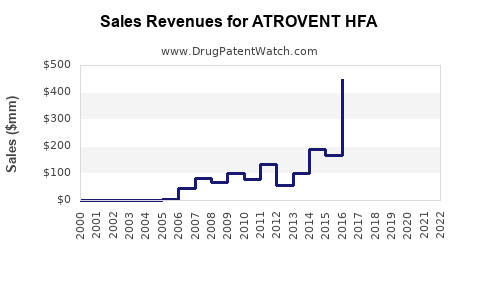
Boehringer does not report Atrovent HFA revenue as a separate product line. The product remains commercially relevant as part of the company’s respiratory portfolio, but it is no longer a major growth asset. Its principal value is recurring demand from established COPD patients, brand recognition, and distribution continuity rather than patent-protected pricing power.
What is Atrovent HFA and how does it work?
Atrovent HFA contains ipratropium bromide, a short-acting muscarinic antagonist, or SAMA. It is administered through a metered-dose inhaler and produces bronchodilation by inhibiting muscarinic-mediated bronchoconstriction in the airways.
| Attribute |
Atrovent HFA |
| Active ingredient |
Ipratropium bromide |
| Dosage form |
HFA metered-dose inhalation aerosol |
| Strength |
17 mcg per actuation |
| Labeled container |
200 actuations |
| Therapeutic category |
Short-acting anticholinergic bronchodilator |
| Primary indication |
Maintenance treatment of bronchospasm in COPD |
| U.S. sponsor |
Boehringer Ingelheim Pharmaceuticals, Inc. |
| U.S. application |
NDA 020648 |
| FDA approval |
1996 |
| Primary competitors |
Generic ipratropium HFA, nebulized ipratropium, Combivent Respimat, short-acting beta agonists, long-acting COPD inhalers |
The product is not labeled as a first-line rescue treatment for acute bronchospasm. Its label emphasizes regular maintenance use, generally two inhalations four times daily, with additional doses permitted within specified limits.[1]
What is the FDA regulatory status of Atrovent HFA?
Atrovent HFA has an established FDA approval and is not protected by new-chemical-entity exclusivity. Ipratropium bromide was known before the Atrovent HFA approval, and the product’s regulatory value derives from its dosage form, manufacturing process, device presentation, and established safety record.
The FDA-approved product is distinct from older chlorofluorocarbon-based Atrovent presentations. Atrovent HFA uses hydrofluoroalkane propellant technology, which allowed continued commercialization after the phaseout of ozone-depleting chlorofluorocarbon inhalers.
FDA regulatory milestones
| Event |
Date or status |
| Original Atrovent inhalation aerosol approval |
Prior to HFA conversion |
| Atrovent HFA NDA approval |
1996 |
| Active ingredient exclusivity |
Expired |
| New-chemical-entity exclusivity |
Not applicable |
| Pediatric exclusivity |
No current commercial significance |
| HFA transition |
Completed for U.S. marketed product |
| Current regulatory pathway |
NDA product with ANDA competition |
| Biosimilar pathway |
Not applicable |
Atrovent HFA is a small-molecule inhalation product. Biosimilar regulation does not apply. Competitive products must generally demonstrate pharmaceutical equivalence and bioequivalence, or otherwise satisfy the applicable FDA requirements for inhalation products.
What patents protect Atrovent HFA?
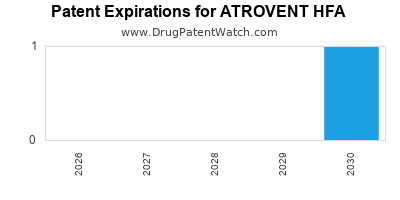
The active ingredient is not protected by a commercially meaningful current composition-of-matter patent. Any historical patent protection associated with ipratropium bromide has expired.
The remaining intellectual-property issues are more likely to involve:
- HFA formulation composition;
- metered-dose inhaler valve performance;
- canister and actuator design;
- manufacturing controls;
- aerosol particle-size distribution;
- device compatibility;
- process know-how and quality specifications.
These rights can affect the cost and complexity of developing a substitutable inhaler, but they do not create the same barrier as an unexpired active-ingredient patent.
What is the Orange Book status of Atrovent HFA?
The current commercial risk profile is consistent with a product that has no meaningful Orange Book patent barrier preventing an ANDA applicant from entering after satisfying FDA requirements. Historical Orange Book listings, if any, do not create a current exclusivity period comparable to a live patent covering the active ingredient.
Atrovent HFA’s most important legal distinction is between patent protection and regulatory substitutability. A generic applicant may face technical work involving aerosol performance and device equivalence even when the reference product has no blocking patent. Those development requirements can delay launch, but they do not preserve brand exclusivity indefinitely.
When did Atrovent HFA lose exclusivity?
Atrovent HFA lost meaningful exclusivity years ago. The product’s original regulatory and patent advantages are no longer sufficient to support premium pricing against equivalent ipratropium inhalation products.
The effective loss-of-exclusivity sequence was:
- Expiration of protection associated with the old active ingredient and early product claims.
- Completion of the HFA transition, which reduced the commercial value of the original propellant presentation.
- Entry of generic ipratropium inhalation aerosols.
- Increased substitution by nebulized ipratropium and combination products.
- Continued migration of COPD treatment toward long-acting maintenance inhalers.
Atrovent HFA therefore has no conventional future “patent cliff.” Its decline is gradual and market-driven rather than concentrated around a single upcoming expiration date.
How many patents cover Atrovent HFA?
No current patent estate appears to provide broad, commercially decisive protection for Atrovent HFA in the United States. The relevant protection is fragmented across formulation, device, manufacturing, and process claims, where those claims remain enforceable.
| Patent category |
Commercial position |
| Ipratropium composition patent |
Expired |
| New chemical entity patent |
Not applicable |
| HFA conversion technology |
Historical or narrow |
| Metered-dose inhaler device |
Potentially relevant but generally design-around capable |
| Formulation patents |
Potentially relevant to specific compositions |
| Manufacturing know-how |
Confidential and difficult to replicate, but not statutory exclusivity |
| Method-of-use patents |
Limited commercial leverage for an old COPD indication |
The absence of a broad current patent barrier does not mean that every inhaler design is interchangeable from an engineering perspective. Inhaled products must meet dose-delivery, aerodynamic particle-size, plume, valve, actuator, and stability specifications. These requirements create development friction but generally support multiple suppliers over time.
What formulations are protected by Atrovent HFA?
The commercially relevant formulation is an HFA-propelled ipratropium bromide aerosol delivered through a metered-dose inhaler. The formulation must maintain chemical stability and deliver consistent emitted doses over the labeled life of the canister.
Potential formulation and device differentiators include:
- propellant blend;
- ethanol or other formulation excipients;
- suspension or solution characteristics;
- valve metering volume;
- actuator orifice geometry;
- dose uniformity;
- plume geometry;
- particle-size distribution;
- canister coating and compatibility;
- moisture control and storage stability.
These attributes are important for regulatory approval and product quality. They are less likely to support durable pricing power once a generic manufacturer has obtained an FDA-approved equivalent.
Which companies are challenging Atrovent HFA?
Competition comes from generic manufacturers and from branded respiratory products that reduce demand for standalone ipratropium.
The competitive set includes:
- manufacturers of generic ipratropium bromide HFA inhalers;
- suppliers of ipratropium bromide inhalation solution for nebulization;
- manufacturers of albuterol/ipratropium combination products;
- long-acting muscarinic antagonist manufacturers;
- fixed-dose long-acting bronchodilator combinations;
- combination inhaler suppliers used in COPD maintenance therapy.
The most direct challenge is generic ipratropium HFA. The broader commercial challenge is therapeutic substitution. Many COPD patients are managed with long-acting muscarinic antagonists, long-acting beta agonists, or dual and triple inhaled regimens. These products address maintenance therapy with fewer daily administrations and are supported by newer clinical positioning.
What generic entry risks exist for Atrovent HFA?
Generic entry risk is high because the active ingredient is old, the indication is established, and the principal technical hurdles are manageable for experienced inhalation-product developers.
Generic launch scenarios
| Scenario |
Commercial effect |
| Single generic supplier |
Moderate price pressure; brand may retain some distribution |
| Multiple generic suppliers |
Accelerated price erosion and pharmacy substitution |
| Authorized generic or private-label supply |
Lower-cost access with limited brand differentiation |
| Supply disruption at generic manufacturers |
Temporary recovery in branded demand |
| Strong formulary preference for generic |
Rapid unit conversion |
| Device or supply-quality issue |
Potential short-term shift back to Atrovent HFA |
A generic launch does not eliminate the brand immediately. Prescriber familiarity, existing patient technique, payer contracts, pharmacy inventory, and device preference can preserve a residual branded market. The long-term direction remains downward for brand volume and price.
What patent litigation affects Atrovent HFA?
There is no widely recognized current patent litigation campaign comparable to the litigation surrounding high-value inhaled products with active blockbuster patents. Atrovent HFA is a low-litigation-risk asset relative to newer branded inhalers.
Potential disputes could involve:
- ANDA patent certifications;
- device equivalence;
- formulation similarity;
- manufacturing-process claims;
- trade dress or trademark issues;
- supply and distribution contracts.
The absence of major public litigation is commercially significant. It indicates that the central barriers are regulatory execution and manufacturing economics, not active enforcement of a high-value patent estate.
What is the commercial and financial trajectory of Atrovent HFA?
Boehringer Ingelheim is privately held and does not provide a public product-level income statement for Atrovent HFA. The company reports at the business-area level, which prevents a reliable standalone calculation of revenue, gross margin, or operating profit for the product.
The financial trajectory can nevertheless be characterized:
| Period |
Financial direction |
Main driver |
| Initial HFA commercialization |
Expansion or stabilization |
Propellant transition and established COPD demand |
| Early post-launch period |
Mature branded revenue |
Broad physician familiarity |
| Generic-entry period |
Declining price and share |
ANDA substitution |
| Current mature period |
Lower, recurring revenue |
Residual brand demand and supply reliability |
| Forward outlook |
Gradual erosion |
Generic competition and newer inhaler classes |
The product’s revenue exposure is likely concentrated in the United States and other markets where Atrovent HFA remains marketed as a branded inhaler. International revenue is difficult to isolate because ipratropium may be sold under different brands, local presentations, or generic names.
Why revenue is declining structurally
Atrovent HFA faces four persistent commercial pressures:
- Generic substitution reduces net price.
- COPD treatment is shifting toward long-acting therapies.
- The product requires multiple daily administrations.
- Combination products can replace standalone short-acting anticholinergic therapy.
Demand remains because some patients need short-acting bronchodilation, have limited access to newer products, or use ipratropium because of tolerability, formulary, or clinical-preference considerations. That supports a stable residual market rather than a growth market.
How does Atrovent HFA compare with Combivent Respimat?
Combivent Respimat combines ipratropium bromide with albuterol, while Atrovent HFA contains ipratropium alone.
| Attribute |
Atrovent HFA |
Combivent Respimat |
| Active ingredients |
Ipratropium bromide |
Ipratropium bromide and albuterol sulfate |
| Pharmacology |
Anticholinergic bronchodilation |
Anticholinergic plus beta-agonist bronchodilation |
| Device |
HFA metered-dose inhaler |
Respimat soft-mist inhaler |
| Main commercial value |
Standalone SAMA therapy |
Combination short-acting bronchodilation |
| Substitution risk |
High |
High, but combination demand can support persistence |
| Patent leverage |
Limited |
Historically stronger device and combination positioning |
| Long-term outlook |
Mature and declining |
Mature, with continued combination-product demand |
Combivent Respimat has stronger product differentiation because it combines two pharmacologic mechanisms and uses a distinct delivery system. Atrovent HFA is more exposed to direct generic substitution.
How does Atrovent HFA compare with newer COPD inhalers?
Atrovent HFA has a lower price and a long safety record, but it is less convenient than once-daily or twice-daily long-acting products. Newer COPD products generally have stronger commercial positioning because they offer longer duration, combination therapy, or device differentiation.
| Product class |
Dosing convenience |
Patent strength |
Competitive effect on Atrovent HFA |
| Generic ipratropium HFA |
Similar |
Low |
Direct substitution |
| Ipratropium nebulizer |
Frequent or episodic |
Low |
Alternative delivery route |
| SABA inhalers |
Short acting |
Low to moderate |
Functional substitute |
| LAMA inhalers |
Once or twice daily |
Often stronger |
Reduces maintenance use |
| LABA/LAMA combinations |
Once or twice daily |
Often strong |
Major treatment substitution |
| Triple inhalers |
Once or twice daily |
Stronger and newer |
Further reduces standalone use |
What manufacturing and intellectual-property barriers remain?
The largest remaining barriers are technical rather than legal. A competing manufacturer must establish reproducible aerosol performance, filling controls, container-closure integrity, valve reliability, and stability across the product shelf life.
Important development risks include:
- achieving dose uniformity across 200 actuations;
- matching aerodynamic particle-size distribution;
- controlling suspension settling or formulation homogeneity;
- validating actuator and valve performance;
- demonstrating chemical and physical stability;
- scaling HFA filling safely;
- maintaining supply of compatible components;
- meeting FDA expectations for orally inhaled and nasal drug products.
These barriers favor established inhalation manufacturers, but they are not sufficient to preserve monopoly pricing for the reference brand.
What is the geographic coverage of Atrovent HFA?
Atrovent and ipratropium products have broad international recognition, but the specific HFA presentation, regulatory status, brand ownership, and patent position vary by jurisdiction.
Key geographic differences include:
- different brand names for ipratropium products;
- varying availability of HFA and nebulized formulations;
- country-specific substitution rules;
- separate national patent registers;
- different reimbursement policies;
- local manufacturing and distribution arrangements.
The United States is the most relevant market for Orange Book and ANDA analysis. European and other markets require separate review of national approvals, centralized or decentralized marketing authorizations, local patent terms, and reimbursement systems.
Key Takeaways
- Atrovent HFA is an established ipratropium bromide inhalation aerosol for COPD maintenance therapy.
- Its active ingredient and major historical exclusivity protections have expired.
- The product has no apparent broad current patent barrier capable of preventing generic competition.
- Generic ipratropium inhalers create high substitution and price-erosion risk.
- Device, formulation, and manufacturing requirements remain meaningful but are generally design-around capable.
- Biosimilar risk does not apply because Atrovent HFA is a small-molecule inhalation product.
- Boehringer does not publicly disclose standalone Atrovent HFA revenue.
- The financial profile is mature, recurring, and structurally declining rather than growth-oriented.
- The strongest competitive pressure comes from generic ipratropium and newer long-acting COPD therapies.
- Atrovent HFA has limited litigation risk and no identifiable upcoming patent cliff that would materially change its trajectory.
FAQs
Is Atrovent HFA still under patent protection?
No broad active patent protecting ipratropium bromide itself provides meaningful current exclusivity. Any relevant rights are more likely to cover particular inhaler, formulation, or manufacturing features.
Can a generic manufacturer automatically substitute for Atrovent HFA?
Substitution depends on FDA therapeutic-equivalence status, pharmacy law, payer rules, and the specific generic product. Regulatory approval alone does not make every ipratropium presentation interchangeable.
Is Atrovent HFA a biologic or biosimilar product?
No. Atrovent HFA is a small-molecule drug-device combination. Generic competition proceeds through the FDA’s ANDA framework rather than the biosimilar pathway.
Does Atrovent HFA have a future patent cliff?
No conventional future patent cliff is apparent. The product is already in the post-exclusivity phase, so revenue erosion is expected to occur through gradual generic substitution and therapeutic migration.
What is the main investment risk associated with Atrovent HFA?
The primary risk is declining branded demand and net pricing caused by generic inhalers and replacement by longer-acting COPD therapies. Supply reliability and residual brand loyalty can moderate, but not reverse, that trend.
References
- U.S. Food and Drug Administration. (2023). Atrovent HFA (ipratropium bromide) inhalation aerosol prescribing information.
- U.S. Food and Drug Administration. (2024). Approved drug products with therapeutic equivalence evaluations.
- U.S. Food and Drug Administration. (2024). Drugs@FDA: Atrovent HFA, NDA 020648.
- U.S. Food and Drug Administration. (2020). Guidance for industry: Comparative analyses and related comparative use human factors studies for a drug-device combination product submitted in an ANDA.
- Boehringer Ingelheim. (2024). Annual report and corporate information.