Last updated: September 7, 2026
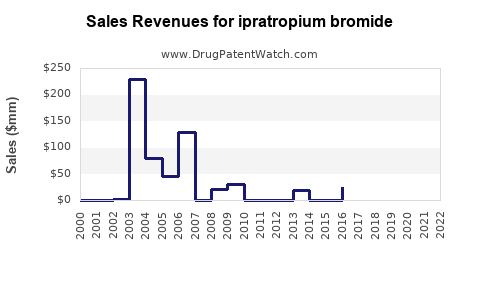
Ipratropium bromide is a mature, off-patent anticholinergic bronchodilator with declining branded economics and stable demand in respiratory care. Revenue has shifted from standalone branded products such as Atrovent to generic inhalation solutions, metered-dose inhalers, nasal sprays, and combination products with albuterol. The commercial opportunity is limited by low unit pricing, but manufacturing complexity, device requirements, hospital procurement, and intermittent supply constraints support selected margins.
What is the current market position of ipratropium bromide?
Ipratropium bromide is a short-acting muscarinic antagonist used primarily for chronic obstructive pulmonary disease, acute bronchospasm, and rhinorrhea. It is administered through several dosage forms:
| Product category |
Typical use |
Commercial status |
| Ipratropium inhalation aerosol |
COPD maintenance and bronchospasm |
Generic and branded products |
| Ipratropium inhalation solution |
Nebulized COPD and acute respiratory treatment |
Multiple generic suppliers |
| Ipratropium nasal spray |
Vasomotor and allergic rhinorrhea |
Generic and branded products |
| Ipratropium/albuterol inhalation aerosol |
COPD maintenance and rescue bronchodilation |
Generic and branded products |
| Ipratropium/albuterol inhalation solution |
Nebulized acute bronchospasm and COPD |
Generic and hospital-focused |
The original branded product, Atrovent, was developed and commercialized by Boehringer Ingelheim. The combination product Combivent was later introduced with albuterol. Combivent Respimat uses a soft-mist inhaler platform and remains commercially differentiated from basic nebulizer solutions, although generic competition has reduced pricing power.
Ipratropium is no longer a high-growth branded pharmaceutical. It is a mature essential respiratory medicine with demand linked to COPD prevalence, emergency-department utilization, hospital respiratory protocols, and generic supply reliability.
How large is the ipratropium bromide market?
Public company filings generally do not report ipratropium revenue as a standalone product category. Boehringer Ingelheim is privately held, and major generic manufacturers typically aggregate low-value respiratory products within broader portfolios. Consequently, global revenue estimates vary substantially by whether they include combination products, hospital tenders, nasal products, and branded inhalers.
The market’s financial profile is more accurately described through product economics:
- Standalone ipratropium products have low average selling prices.
- Combination products with albuterol command higher revenue per prescription.
- Inhalers generate more commercial value than unit-dose nebulizer solutions because of device and formulation requirements.
- Hospital and government tenders place sustained pressure on generic pricing.
- Shortages can temporarily raise contract prices but do not create durable brand pricing power.
- The largest commercial value is concentrated in respiratory products that combine ipratropium with another active ingredient or proprietary delivery device.
The addressable market is supported by COPD. The World Health Organization identifies COPD as a major cause of morbidity and mortality worldwide, while the Global Initiative for Chronic Obstructive Lung Disease continues to recognize short-acting bronchodilators as treatment options in selected clinical settings (World Health Organization, 2024; Global Initiative for Chronic Obstructive Lung Disease, 2024).
What is the financial trajectory for ipratropium bromide?
The financial trajectory has four stages:
| Period |
Commercial development |
Financial effect |
| 1970s-1990s |
Branded Atrovent expansion in inhaled and nasal formulations |
High branded pricing and product-level profitability |
| Late 1990s-2000s |
Generic entry and growth of albuterol combinations |
Rapid erosion of standalone branded revenue |
| 2010s |
Expansion of generic inhalers, nebulizer solutions, and Respimat competition |
Lower prices, fragmented supplier base |
| 2020s |
Mature generic market, supply-chain pressure, device differentiation |
Stable volume with limited pricing growth |
Standalone ipratropium revenue is likely to remain flat to declining in nominal terms because generic competition and formulary controls offset volume growth. Combination products should retain better revenue stability because they address both bronchodilation and anticholinergic treatment in a single regimen.
The strongest financial opportunities are not in the active pharmaceutical ingredient alone. They are in:
- Proprietary inhaler or soft-mist delivery systems.
- Combination products.
- Contract manufacturing of inhalation solutions.
- Reliable supply to hospitals and public-sector buyers.
- Geographic markets with lower generic penetration.
- Products with regulatory approval for multiple presentations.
The weakest opportunity is a new standalone immediate-release ipratropium product that competes solely on price.
Which companies compete in ipratropium bromide?
Competition is divided between the originator, generic respiratory manufacturers, and combination-product suppliers.
Branded and originator companies
Boehringer Ingelheim remains the principal originator associated with Atrovent and Combivent. Its commercial differentiation has historically depended on branded clinical familiarity, device engineering, formulation know-how, and broad respiratory sales infrastructure rather than remaining compound exclusivity.
Generic manufacturers
Generic ipratropium products have been marketed by companies including:
- Teva Pharmaceuticals
- Viatris and legacy Mylan operations
- Cipla
- Amneal Pharmaceuticals
- Hikma Pharmaceuticals
- Perrigo
- Rising Pharmaceuticals
- Sandoz and other regional suppliers
The actual supplier set differs by dosage form and market. FDA-approved inhalation products can have fewer active suppliers than oral generics because inhaled products require more complex pharmaceutical development, device testing, dose-uniformity controls, and manufacturing validation.
Combination-product competitors
The most commercially relevant competition is in ipratropium/albuterol products. Suppliers compete across:
- Metered-dose inhalers
- Nebulizer solutions
- Soft-mist inhalers
- Hospital and emergency-department channels
- Retail pharmacy formularies
Combination products face higher development and regulatory barriers than a simple inhalation solution because the manufacturer must demonstrate performance of the formulation and delivery system.
What patents protect ipratropium bromide products?
The core ipratropium bromide compound is long off patent. The original active-ingredient protection and early formulation rights expired many years ago. Generic manufacturers therefore do not face a composition-of-matter barrier for conventional ipratropium bromide.
The remaining intellectual-property value is concentrated in:
- Inhaler device architecture
- Metering-valve design
- Soft-mist aerosol generation
- Formulation stability
- Container-closure systems
- Manufacturing processes
- Combination-product formulation
- Specific therapeutic uses
- Device integration and dose-counting systems
Atrovent HFA and Combivent Respimat were protected primarily through product, formulation, device, and regulatory exclusivity strategies rather than continuing protection for the basic molecule. Patent coverage for individual presentations must be reviewed through current FDA Orange Book records, issued patent databases, and the relevant product labeling. Product-level patent listings can change as patents expire or are delisted.
When did ipratropium bromide lose exclusivity?
The active pharmaceutical ingredient lost meaningful market exclusivity decades ago. FDA approval of Atrovent inhalation products occurred before the modern generic inhaler market reached its current scale, and conventional ipratropium dosage forms have been subject to abbreviated new drug application competition for many years.
Relevant exclusivity conclusions are:
| Exclusivity type |
Current position |
| New chemical entity exclusivity |
Expired |
| Core compound patent |
Expired |
| Standalone generic entry |
Established |
| Formulation or device patents |
Product-specific and largely expired or narrowed |
| Combination-product patents |
May vary by device and formulation |
| Pediatric exclusivity |
Not commercially material to current market access |
| Biologic exclusivity |
Not applicable |
FDA’s Orange Book framework identifies patents and exclusivity associated with approved drug products, but the presence or absence of a listed patent must be assessed for the specific NDA and dosage form rather than for ipratropium as a broad chemical category (U.S. Food and Drug Administration, 2024a).
Are there Paragraph IV challenges involving ipratropium bromide?
Paragraph IV risk is primarily relevant to branded inhalers and combination products, not to the mature active ingredient itself. A generic applicant may certify that a listed patent is invalid, unenforceable, or will not be infringed. Litigation risk depends on the specific NDA, device, formulation, and patent listed in the Orange Book.
For conventional ipratropium inhalation solution, generic competition is already established, so the principal commercial issue is supplier economics rather than first-filer litigation. For branded or device-based combination products, Paragraph IV litigation can affect launch timing, settlement terms, and authorized-generic strategy.
The absence of a major current patent dispute does not eliminate risk. Inhaler products can generate litigation over:
- Dose-metering mechanisms
- Aerosol particle-size distribution
- Device compatibility
- Formulation excipients
- Manufacturing controls
- Substitution and therapeutic-equivalence standards
What is the FDA regulatory status of ipratropium bromide?
Ipratropium bromide is an FDA-approved prescription drug available in several inhaled and nasal presentations. FDA-approved categories include:
- Inhalation aerosol
- Inhalation solution
- Nasal spray
- Combination inhalation aerosol with albuterol
- Combination inhalation solution with albuterol
FDA approval does not make all presentations automatically substitutable. Therapeutic equivalence depends on the specific reference product, dosage form, device, strength, and approved labeling. A nebulized solution and a metered-dose inhaler are not interchangeable solely because both contain ipratropium bromide.
For inhaled generics, regulatory barriers include:
- Demonstration of pharmaceutical equivalence
- Device performance testing
- Delivered-dose uniformity
- Aerodynamic particle-size distribution
- Spray-pattern or plume characterization
- Stability and container-closure data
- Human-factors testing where applicable
- Therapeutic-equivalence requirements
These requirements support a moderate entry barrier compared with oral solid dosage forms.
What formulations are protected by ipratropium patents?
The highest-value protected formulations have historically involved delivery systems rather than the molecule itself.
Metered-dose inhalers
Metered-dose inhalers require control over propellant systems, valves, canisters, actuator geometry, dose uniformity, and plume characteristics. Hydrofluoroalkane-based products also require formulation and device compatibility work.
Soft-mist inhalers
Respimat-type products are more difficult to replicate than simple nebulizer solutions. The device produces a slow-moving mist through a specialized energy and nozzle system. The commercial barrier includes device engineering, manufacturing reproducibility, user handling, and regulatory performance requirements.
Nebulizer solutions
Nebulizer solutions have lower device complexity, but they remain subject to sterile manufacturing, preservative controls, unit-dose packaging, extractables and leachables testing, and reliable fill-finish operations.
Nasal sprays
Nasal products depend on pump performance, plume geometry, droplet-size distribution, dose consistency, and container-closure integrity. Generic nasal products may face meaningful development costs despite low active-ingredient complexity.
How strong is the ipratropium bromide patent estate?
The patent estate is weak for the molecule and conventional formulations but stronger for certain delivery platforms.
| IP category |
Strength |
Commercial implication |
| Core ipratropium molecule |
Low |
No meaningful exclusivity barrier |
| Conventional nebulizer solution |
Low to moderate |
Competition is feasible, subject to sterile manufacturing |
| Metered-dose inhaler |
Moderate |
Device and performance testing raise entry costs |
| Soft-mist inhaler |
Moderate to strong |
Replication requires specialized engineering |
| Combination formulation |
Moderate |
Product-specific patents may delay entry |
| Manufacturing process |
Low to moderate |
Can create targeted barriers but rarely blocks the whole market |
| Method-of-use claims |
Low |
Limited value where the drug is widely used for established indications |
The strongest moat is operational rather than chemical. A supplier with reliable sterile manufacturing, validated inhaler production, and regulatory experience can maintain share even when the underlying product is off patent.
What generic entry risks exist for ipratropium bromide?
Generic entry risk is high for conventional products and moderate for complex inhalers.
High-risk segments for incumbent revenue
- Ipratropium inhalation solution
- Ipratropium nasal spray
- Standard metered-dose inhalers
- Hospital tender products without device differentiation
More defensible segments
- Soft-mist inhalers
- Combination products with proprietary devices
- Products with strong formulary positioning
- Markets with limited approved suppliers
- Contract supply arrangements with hospitals or government agencies
Generic launch can produce immediate price compression when several suppliers enter the same channel. The effect is usually less severe when only one or two manufacturers can satisfy device, sterile manufacturing, or regulatory requirements.
What patent litigation and settlement issues affect the market?
Litigation exposure is product-specific rather than molecule-wide. The most likely disputes concern branded combination inhalers and device platforms. Potential settlement structures include:
- Early generic entry dates
- Authorized-generic agreements
- Royalty-bearing licenses
- Geographic launch restrictions
- Product-specific non-compete arrangements
- Supply agreements
A settlement involving a combination inhaler may have limited impact on standalone ipratropium demand. Conversely, an authorized generic can materially reduce the value of a Paragraph IV victory by allowing the originator to capture generic-priced sales while controlling launch timing.
No biosimilar risk exists because ipratropium bromide is a chemically synthesized small molecule, not a biologic. Competitive risk comes from ANDA filers, not biosimilar applicants.
How does ipratropium compare with tiotropium and albuterol?
| Attribute |
Ipratropium |
Tiotropium |
Albuterol |
| Pharmacology |
Short-acting muscarinic antagonist |
Long-acting muscarinic antagonist |
Beta-2 agonist |
| Main role |
Short-acting bronchodilation and rhinorrhea |
Maintenance COPD therapy |
Rescue bronchodilation |
| Patent position |
Mature generic |
More differentiated product and device estates |
Mature generic |
| Revenue outlook |
Stable to declining |
Higher value per patient in branded/device products |
Large-volume generic market |
| Device importance |
High in inhaled products |
Very high |
High |
| Combination relevance |
Often paired with albuterol |
Paired with long-acting beta agonists |
Paired with ipratropium |
| Pricing power |
Low |
Higher in selected products |
Low to moderate |
Ipratropium benefits from its use in combination with albuterol, but it competes with long-acting maintenance therapies such as tiotropium in COPD treatment. The shift toward long-acting inhalers limits the growth potential of standalone short-acting products, while acute-care and rescue use preserve a durable base.
What geographic markets offer the best commercial potential?
The United States has a large established market but intense generic competition and reimbursement pressure. Europe has similarly mature demand, with procurement and national reimbursement systems compressing prices. Emerging markets may offer higher unit growth but lower prices, variable regulatory enforcement, and local manufacturing competition.
Commercial attractiveness is greatest where:
- Generic penetration remains incomplete.
- COPD prevalence is increasing.
- Hospital nebulization is common.
- Local manufacturing capacity is limited.
- Regulatory approval can be obtained for several dosage forms.
- Public procurement rewards supply reliability.
Geographic expansion should focus on regulatory portfolios rather than a single product. An inhalation solution, nasal spray, and combination product can share commercial infrastructure, but each requires separate regulatory and manufacturing work.
What is the outlook for ipratropium bromide revenue?
The base-case outlook is mature and defensive:
- Standalone branded revenue should continue to decline or remain immaterial.
- Generic volume should remain resilient because COPD and acute respiratory care create recurring demand.
- Unit prices should remain under pressure.
- Combination products should outperform standalone ipratropium.
- Device-based products should retain better margins than nebulizer solutions.
- Supply disruptions may create temporary pricing opportunities.
- No major patent-driven revenue event is expected for the core molecule.
The market is attractive for efficient manufacturers with regulatory and supply-chain capabilities. It is unattractive for companies seeking high-growth, patent-protected pharmaceutical revenue.
Key Takeaways
- Ipratropium bromide is a mature, off-patent respiratory drug with stable clinical demand and weak molecule-level exclusivity.
- Revenue has shifted from Atrovent to generic products and ipratropium/albuterol combinations.
- Public companies generally do not disclose standalone ipratropium sales, making product-level revenue estimates unreliable.
- The strongest commercial defenses are inhaler devices, soft-mist delivery, sterile manufacturing, and reliable supply.
- Conventional nebulizer solutions face high generic competition and low pricing.
- Combination inhalers and device-based products have better margin potential.
- Paragraph IV litigation and settlements are relevant mainly to specific inhaler products, not to the core active ingredient.
- Ipratropium has no biosimilar risk because it is a small-molecule drug.
- Revenue should remain stable to declining for standalone products, with better resilience in combination and device-based formulations.
FAQs
Is ipratropium bromide still commercially profitable?
Yes, but profitability depends on dosage form and manufacturing position. Conventional products have low margins, while combination inhalers, soft-mist devices, and reliable sterile supply can support better returns.
Does ipratropium bromide have generic competition?
Yes. Generic competition is established across inhalation solutions, inhalers, nasal sprays, and several ipratropium/albuterol products.
Is Atrovent still patent protected?
The core ipratropium molecule is not meaningfully patent protected. Any remaining protection is product-specific and may involve formulation, device, manufacturing, or combination-product claims.
Is ipratropium bromide subject to biosimilar competition?
No. Ipratropium bromide is a chemically synthesized small molecule. Its competitors use generic-drug pathways rather than biosimilar pathways.
Which ipratropium product has the strongest commercial outlook?
Ipratropium/albuterol combination products and differentiated inhaler systems have stronger commercial prospects than standalone ipratropium nebulizer solutions because they provide higher value per treatment and face greater development barriers.
References
-
Global Initiative for Chronic Obstructive Lung Disease. (2024). Global strategy for the prevention, diagnosis and management of chronic obstructive pulmonary disease: 2024 report. https://goldcopd.org
-
U.S. Food and Drug Administration. (2024a). Approved drug products with therapeutic equivalence evaluations: Orange Book. https://www.accessdata.fda.gov/scripts/cder/ob/
-
U.S. Food and Drug Administration. (2024b). Drugs@FDA: FDA-approved drugs. https://www.accessdata.fda.gov/scripts/cder/daf/
-
U.S. Food and Drug Administration. (2024c). Approved drug product labels. https://labels.fda.gov
-
World Health Organization. (2024). Chronic obstructive pulmonary disease (COPD). https://www.who.int/news-room/fact-sheets/detail/chronic-obstructive-pulmonary-disease-(copd)