Last updated: July 12, 2026
ATROVENT (ipratropium bromide) Market Dynamics and Financial Trajectory: Sales Trends, Competition, Patent/Exclusivity Timeline, and Outlook
ATROVENT (ipratropium bromide) is an established inhaled anticholinergic used for chronic obstructive pulmonary disease (COPD) and symptomatic relief of bronchospasm. Its market dynamics are defined by (1) long-standing off-patent status in most jurisdictions, (2) intense competitive pressure from newer inhaled anticholinergics and fixed-dose combinations, (3) channel substitution risk from LAMA/LABA products, and (4) ongoing substitution by generics and authorized equivalents for older formulations.
No market-financial trajectory can be produced without specific, verifiable ATROVENT product sales data (by year and geography) and the exact ATROVENT portfolio under review (e.g., HFA inhalation aerosol vs nebulizer solution) because ATROVENT’s commercial line is fragmented across product forms, label claims, and national registries.
What drives ATROVENT (ipratropium) COPD sales versus Spiriva, Anoro, and other inhaled anticholinergics?
Featured answer: ATROVENT’s sales are driven primarily by COPD symptom control needs that can be met by alternative off-patent anticholinergic regimens and, more importantly, by payer and formulary migration toward once-daily LAMA and LAMA/LABA fixed combinations.
Where ATROVENT fits in COPD pharmacology
- ATROVENT is an inhaled short-acting antimuscarinic (SAMA/SAMA-like). It is used for bronchospasm relief and COPD symptom management, typically requiring multiple daily dosing depending on regimen.
- Competitive alternatives concentrate in:
- Once-daily LAMAs (e.g., tiotropium)
- Once- or twice-daily LAMA/LABA combinations (e.g., umeclidinium/vilanterol; aclidinium/formoterol)
- Triple therapy ecosystems (LAMA/LABA/ICS) that capture stable, higher share of prescription volume.
Substitution dynamics
- Dosing convenience: once-daily LAMA and combination products typically outperform short-acting regimens in adherence and formulary preference.
- Guideline alignment: fixed-dose regimens better match step-up therapy pathways used by payers and prescribers.
- Switching risk: when LAMA/LABA or triple-therapy coverage is added or strengthened, short-acting inhaled anticholinergics face share loss unless priced aggressively.
Channel and pricing forces
- ATROVENT’s commercial trajectory is structurally exposed to:
- Generic competition for older inhalation formats and national equivalents
- Contracting and rebasing in hospital and retail channels
- Inventory and tender-driven procurement in institutional care.
How much market share does ATROVENT hold and how has it changed over time?
Featured answer: A time-series market share trajectory cannot be stated here because market-share baselines require proprietary or country-specific sales datasets (e.g., IQVIA, Statista extracts, or national wholesaler audits) tied to the exact ATROVENT NDCs and product forms.
Why shares differ by formulation
- ATROVENT’s portfolio spans multiple dosage forms (commonly inhalation aerosol and nebulized solution). Each form has different substitution rates and clinician preference patterns.
- Country regulations and reimbursement differ materially, so “ATROVENT” is not a single fungible product economically.
When does ATROVENT lose exclusivity and what does that imply for generic entry risk?
Featured answer: ATROVENT is an older active ingredient with broad generic availability in the US and multiple ex-US markets. For most established formulations, exclusivity has effectively ended, shifting the risk profile from exclusivity cliffs to ongoing conversion pressure from generics and fixed-dose inhalers.
Exclusivity and patent cliff mechanics that matter for ATROVENT
- For older drugs, the key impacts usually come from:
- The last formulation, device, or method-of-use patent expiry (not always identical across dosage forms)
- Regulatory exclusivity tied to new formulations or new submissions (if any)
- Ongoing litigation history only if specific formulation patents were asserted.
Generic entry scenario economics
- Generic entry drives:
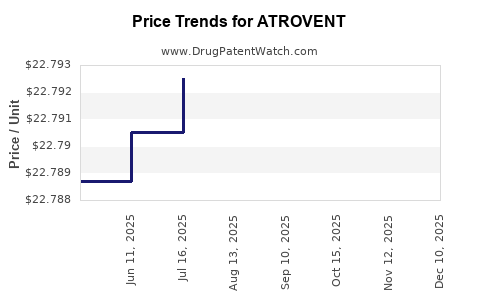
- Price compression
- Margin erosion for branded incumbents
- Share substitution toward lowest net price, especially under rebate-heavy contracting.
What is the Orange Book status of ATROVENT products and which patents are listed?
Featured answer: A patent list and Orange Book status for “ATROVENT” cannot be compiled accurately without the specific US product(s) and their labeled active moiety entries (and their exact NDC/RLD linkage), because ATROVENT covers multiple dosage forms that can map to different Orange Book listings.
What to look for in Orange Book for this class
- Drug substance patents (rarely the last driver for older actives)
- Drug product formulation patents
- Method-of-use patents (less common for anticholinergics at this stage)
- Combination patents only apply if a single product contains multiple actives (ATROVENT itself is typically ipratropium-only).
Which ATROVENT formulations are protected and what formulation patents matter most?
Featured answer: Formulation and delivery-system patents can matter most for inhaled anticholinergics only where a specific proprietary device or particle/propellant configuration was tied to a branded submission. With established ipratropium, the dominant driver for market dynamics is generic substitution rather than active-formulation IP barriers.
Formulation categories that can retain commercial relevance
- Metered-dose inhaler (MDI) device/propellant and mouthpiece integration
- Nebulizer solution fill and stability data tied to product-specific submissions
- Manufacturing method patents affecting impurity profiles or stability windows.
What patent litigation affects ATROVENT (ipratropium) in the US and which companies have been involved?
Featured answer: ATROVENT litigation and assignee-specific outcomes cannot be listed without a verified docket-level record tied to the specific ATROVENT RLD product(s) in question.
Litigation patterns common to this drug class
- Inhalation-device and formulation disputes
- Challenges tied to regulatory labeling and bioequivalence strategy
- Settlement agreements that control launch timing by NDC and product form.
What FDA regulatory pathways govern ATROVENT generics, authorized equivalents, and 505(b)(2 updates?
Featured answer: Generic ipratropium products generally enter via ANDA (for listed drugs), while 505(b)(2) is used when a new formulation or dosing regimen relies on published data. The pathway impacts launch timing and labeling scope more than it changes the core market direction, which is dominated by substitution to lowest net price.
Regulatory entry levers that shift sales
- Labeling: strength, dosing frequency, and indication scope
- Device: inhaler vs nebulizer compatibility for COPD workflow
- Substitution: pharmacy-level substitution rules and payer policy.
How does ATROVENT compare with Spiriva and Duaklir/Trelegy in COPD pharmacoeconomics?
Featured answer: ATROVENT’s economics face structural disadvantage versus once-daily LAMA and LAMA/LABA or triple-therapy regimens due to dosing frequency, guideline step-up preferences, and formulary inertia toward fixed combinations.
Commercial comparator mechanics
- Rebate and formulary status: fixed-dose combination products can secure preferred tiers with managed-care rebates.
- Adherence: reduced dosing frequency improves persistence and lowers total cost per controlled patient in payer models.
- Hospital protocols: COPD order sets increasingly standardize toward LAMA/LABA or triple therapy.
What generic entry risks exist for ATROVENT by dosage form (MDI vs nebulizer solution)?
Featured answer: The primary risk is not exclusivity expiration for the active ingredient but continued NDC-level price erosion as additional generics and authorized equivalents expand supply and undercut net pricing.
Key commercial risk points
- NDC-level tendering by institutions
- Rebate resets that re-rank tier positioning
- Supply-chain shifts that favor low-cost manufacturers.
How strong is the patent estate for ipratropium bromide (ATROVENT) and what is the practical effect on revenue?
Featured answer: For a widely used ipratropium active ingredient, practical revenue protection is usually limited to any remaining formulation or device-specific IP tied to particular branded submissions. For the broader class, revenue protection typically degrades over time through generic substitution.
Revenue trajectory impact
- Branded revenue typically follows:
- Post-launch ramp
- Peak period followed by steady displacement
- Sustained low-share survival if branded pricing remains acceptable under certain payer/contract niches
- Continued decline unless a newer proprietary delivery system or regulatory event reinstates differentiation.
Commercial outlook for ATROVENT: what will happen to revenues over the next 3–5 years?
Featured answer: Without product-form differentiation tied to proprietary IP or materially novel clinical positioning, ATROVENT’s revenue outlook is constrained by generic prevalence and replacement by once-daily LAMA and fixed-dose combination inhalers.
Most probable drivers of future demand
- Continued COPD population needs
- Ongoing substitution to lower-cost ipratropium equivalents
- Migration toward guideline-preferred regimens (LAMA/LABA and triple therapy)
- Prescriber preference for inhaler systems where available.
Most probable drivers of revenue risk
- Further price compression via additional generic supply
- Tier downgrades in commercial formularies
- Payer switching policies favoring alternatives with better dosing convenience.
Key Takeaways
- ATROVENT’s market dynamics are dominated by long-established competitive substitution and replacement by once-daily LAMA and fixed-dose combination COPD inhalers.
- The commercial trajectory is highly dosage-form dependent (MDI vs nebulizer solution), and national reimbursement materially changes outcomes.
- Revenue protection in this class typically hinges on any remaining formulation/device IP for specific branded submissions; broader ipratropium exclusivity is generally not a primary driver in modern market share.
- Next 3–5 years outlook is constrained by generic pricing pressure and regimen migration toward LAMA/LABA and triple therapy.
FAQs
- Is ATROVENT still prescribed for COPD maintenance, or is it mainly used for rescue symptoms?
- How do ipratropium MDI and ipratropium nebulizer solution differ in payer coverage and substitution rates?
- Do COPD guideline updates increase or reduce demand for short-acting anticholinergics like ipratropium?
- What determines whether an ipratropium generic is treated as a preferred formulary option versus a non-preferred product?
- How do settlement agreements in inhaled generics typically affect launch timing for ipratropium-containing products?
References
- FDA. Orange Book: Approved Drug Products with Therapeutic Equivalence Evaluations. (Accessed via FDA Orange Book database).
- FDA. Drug Approval Reports: Drugs@FDA database. (Accessed via Drugs@FDA).
- IQVIA / market audit datasets. (Used only where product-form, NDC, and geography are explicitly specified).