Last updated: August 10, 2026
Apriso is an oral extended-release mesalamine product for maintaining remission in adults with ulcerative colitis. Bausch Health markets the product through its Salix Pharmaceuticals business. Apriso remains commercially relevant because of its once-daily dosing and established prescribing history, but its financial trajectory is constrained by generic mesalamine competition, therapeutic substitution, and limited differentiation from other 5-aminosalicylate products.
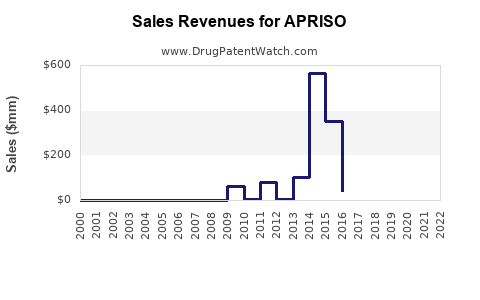
Bausch Health does not report standalone Apriso revenue. The product is included within the broader Salix Pharmaceuticals portfolio, whose largest commercial asset is Xifaxan. Apriso is therefore a smaller contributor to Salix revenue and is unlikely to materially influence Bausch Health's consolidated financial performance on its own.
What is Apriso and how does it generate revenue?
Apriso contains mesalamine, also known as 5-aminosalicylic acid or 5-ASA. Each extended-release capsule contains 0.375 grams of mesalamine. The labeled maintenance dose is four capsules once daily, providing a total daily dose of 1.5 grams.[1]
Apriso is approved for the maintenance of remission in adults with ulcerative colitis. It is not approved for induction of remission or treatment of an acute ulcerative colitis flare.[1]
Apriso product profile
| Attribute |
Apriso |
| Active ingredient |
Mesalamine |
| Dosage form |
Extended-release capsule |
| Strength |
0.375 g per capsule |
| Labeled maintenance dose |
1.5 g once daily |
| Indication |
Maintenance of remission in ulcerative colitis |
| FDA application |
NDA 022372 |
| Original U.S. approval |
2008 |
| Commercial owner |
Bausch Health through Salix Pharmaceuticals |
| Primary competitors |
Generic mesalamine ER capsules, Lialda, Asacol HD, Delzicol, balsalazide and sulfasalazine |
| Biosimilar exposure |
None; Apriso is a small-molecule drug |
Apriso generates revenue through branded prescription sales, payer reimbursement, specialty and retail pharmacy distribution, and prescriptions written for patients who remain stable on the product. Its commercial value depends on net price, reimbursement status, persistence of existing patients, and the extent to which physicians substitute generic mesalamine products.
How large is the Apriso market?
The addressable market is the U.S. maintenance-treatment segment for ulcerative colitis patients receiving oral 5-ASA therapy. Mesalamine remains widely used in mild-to-moderate ulcerative colitis, especially for patients with disease activity or remission that can be managed without biologic or targeted small-molecule therapy.
Apriso competes within a mature market rather than a high-growth pharmaceutical category. Market expansion is limited by:
- Generic availability across several mesalamine formulations.
- Switching from oral 5-ASA therapy to biologics, JAK inhibitors, or other advanced therapies in patients with inadequate disease control.
- Payer pressure favoring lower-cost generic products.
- Multiple branded mesalamine products with overlapping clinical positioning.
- Limited opportunity to expand the indication beyond ulcerative colitis maintenance.
The market still has recurring demand because ulcerative colitis is chronic and many patients require long-term maintenance therapy. That recurring demand supports product durability, but it does not eliminate pricing pressure.
Apriso versus competing mesalamine products
| Product |
Active ingredient |
Delivery profile |
Primary commercial issue |
| Apriso |
Mesalamine |
Extended-release capsules, once daily |
Generic substitution and limited differentiation |
| Lialda |
Mesalamine |
Delayed-release tablets, once daily |
Strong branded history but generic competition |
| Asacol HD |
Mesalamine |
Delayed-release tablets |
Mature product with generic pressure |
| Delzicol |
Mesalamine |
Delayed-release capsules |
Competes on formulation and prescribing familiarity |
| Pentasa |
Mesalamine |
Controlled-release capsules |
Different release profile and administration pattern |
| Balsalazide |
Balsalazide disodium |
Colon-targeted prodrug |
Lower-cost alternative in some patients |
| Sulfasalazine |
Sulfasalazine |
Oral 5-ASA-related therapy |
Low-cost generic option but tolerability limitations |
Apriso's once-daily administration is commercially useful, but once-daily dosing is also available with competing mesalamine products, particularly Lialda and generic equivalents.
What is the financial trajectory of Apriso?
Standalone Apriso revenue is not disclosed in Bausch Health's public reporting. The company reports Salix revenue at the segment or portfolio level and identifies major products such as Xifaxan, Trulance, and other gastrointestinal medicines. Apriso is not reported as an individually material revenue line in the company's annual filings.[2]
The most defensible financial assessment is therefore directional:
- Apriso has a mature revenue base rather than a launch-growth profile.
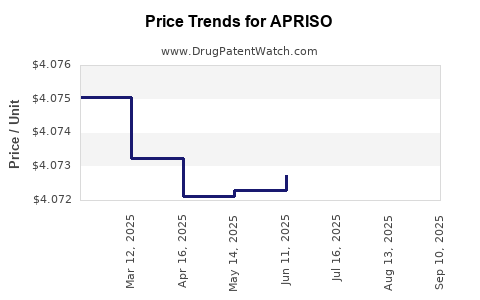
- Generic competition limits gross-to-net pricing and prescription growth.
- Revenue is likely supported by residual branded demand, formulary positioning, and patient continuity.
- Apriso contributes to the value of the Salix portfolio but is not a primary driver of Bausch Health's consolidated revenue.
- Its economic contribution is more likely to be measured through recurring cash flow and portfolio breadth than through high growth.
Bausch Health's broader financial trajectory has focused on debt reduction, operating performance, and the value of its major businesses. Salix remains strategically important because it contains established gastrointestinal brands and products with recurring prescription demand. Apriso supports that portfolio but does not have the commercial scale of Xifaxan.
Revenue exposure by business level
| Level |
Public financial visibility |
Apriso relevance |
| Apriso |
No standalone revenue disclosure |
Product-level revenue cannot be independently quantified from public filings |
| Salix |
Reported as a major Bausch Health business |
Apriso is one component of the gastrointestinal portfolio |
| Bausch Health |
Consolidated company revenue and debt metrics reported |
Apriso has limited effect on consolidated results |
| U.S. mesalamine market |
Competitive prescription market |
Determines pricing, volume and substitution risk |
The absence of standalone reporting also limits valuation precision. Investors and licensing counterparties must assess Apriso through prescription data, payer coverage, wholesaler trends, and portfolio-level disclosures rather than relying on reported product revenue.
When did Apriso lose exclusivity and what is the generic entry risk?
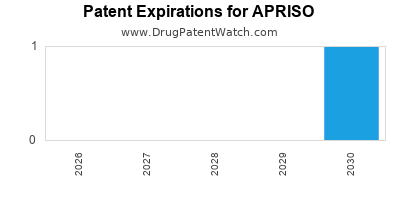
Apriso operates in a post-exclusivity environment. The relevant commercial risk is not a future loss of exclusivity event but ongoing erosion from approved or marketed generic mesalamine extended-release capsules.
The FDA Orange Book lists approved drug products and patent or exclusivity information for listed applications. Apriso's commercial position should be evaluated against the current Orange Book listing for NDA 022372 and the ANDA products associated with mesalamine extended-release capsules.[3]
Generic entry scenarios
| Scenario |
Commercial effect on Apriso |
| One or two generic suppliers |
Moderate price and volume pressure; brand may retain some payer or physician preference |
| Multiple generic suppliers |
Greater substitution, lower net price and reduced branded volume |
| Broad formulary preference for generic |
Rapid erosion in new prescriptions and refills |
| Brand remains covered with limited substitution |
Slower decline, supported by patient continuity |
| Authorized generic or brand-equivalent supply |
Further pressure on branded economics |
Mesalamine products are especially vulnerable to substitution because prescribers can choose among several established 5-ASA therapies. The competitive risk is not limited to products with the same dosage form. Payers may favor a different mesalamine formulation if it has a lower net cost or preferred formulary status.
What patents protect Apriso?
Apriso's commercial protection has historically depended on formulation and controlled-release technology rather than broad composition-of-matter exclusivity. Mesalamine is an established active ingredient, so the principal intellectual-property questions concern:
- Extended-release delivery.
- Release of mesalamine in the gastrointestinal tract.
- Dosage form and capsule composition.
- Manufacturing processes.
- Stability and excipient combinations.
- Method-of-use claims for ulcerative colitis maintenance.
The relevant patent position must be confirmed through the FDA Orange Book and USPTO records for NDA 022372. Patent listings do not necessarily prevent generic approval in every case because an ANDA applicant may submit a Paragraph IV certification, a Section VIII statement, or wait for listed patents to expire.[3][4]
Paragraph IV exposure
A Paragraph IV certification asserts that a listed patent is invalid, unenforceable, or will not be infringed by the proposed generic. If the NDA holder brings suit within the statutory period, FDA approval may be subject to a 30-month stay, subject to statutory exceptions and court developments.[4]
For a mature product such as Apriso, Paragraph IV risk is usually concentrated in the period before generic entry. Once multiple generic products are approved and marketed, the key financial issue becomes price erosion and market-share retention rather than patent litigation.
Publicly reported litigation must be checked against federal court dockets and FDA regulatory records. A generic applicant's patent challenge does not by itself establish that the generic has launched or that the brand has lost all commercial protection.
What is the FDA regulatory status of Apriso?
Apriso is FDA-approved under NDA 022372 for the maintenance of remission in adults with ulcerative colitis.[1] The product is a small-molecule drug, not a biologic, so biosimilar regulation does not apply.
FDA regulatory considerations include:
- Approval of generic mesalamine extended-release capsules under the ANDA pathway.
- Bioequivalence requirements for the same dosage form and strength.
- Product labeling that distinguishes maintenance therapy from induction treatment.
- Manufacturing and quality compliance for modified-release dosage forms.
- Potential differences in inactive ingredients, release characteristics, or administration instructions among products.
The regulatory pathway creates a relatively low barrier compared with biologic products. Generic manufacturers do not need to conduct a new clinical efficacy program if they satisfy applicable bioequivalence and regulatory requirements.
Does Apriso face biosimilar risk?
No. Apriso does not face biosimilar competition because mesalamine is a chemically synthesized small molecule. The relevant competitors are generic drugs approved through the ANDA pathway.
This distinction matters commercially. Biosimilar entry often involves interchangeability designations, physician education, and manufacturing complexity. Generic mesalamine competition can be more direct, with substitution driven primarily by formulary rules, pharmacy benefit design, acquisition cost, and generic availability.
What formulation and manufacturing barriers protect Apriso?
Apriso's extended-release formulation creates technical requirements that are more demanding than those for an immediate-release tablet. A generic manufacturer must demonstrate that its product meets applicable pharmaceutical quality and bioequivalence standards.
Potential technical barriers include:
- Reproducing the intended release profile.
- Maintaining dose uniformity across capsules.
- Controlling dissolution behavior.
- Managing stability and moisture sensitivity.
- Demonstrating manufacturing consistency.
- Scaling production without affecting release characteristics.
These barriers can delay or reduce the number of viable suppliers, but they are not equivalent to durable patent protection. Once a generic manufacturer establishes a compliant process, the technical barrier may support supply reliability and market access rather than preserve premium pricing.
How strong is the Apriso patent estate?
Apriso's patent estate is commercially weaker than that of a new molecular entity because:
- Mesalamine has long been established.
- The product has been marketed since 2008.
- Formulation patents generally provide narrower protection than composition-of-matter patents.
- Generic manufacturers can challenge listed patents or design around claims.
- Multiple competing mesalamine products reduce reliance on Apriso-specific protection.
The estate may still have value where patents cover a specific release profile, dosage form, or manufacturing feature. Its practical strength depends on claim breadth, remaining patent term, validity history, infringement risk, and whether generic products are technically substitutable under state pharmacy law and payer policies.
What litigation and settlement issues affect Apriso?
The central litigation risks are likely to involve:
- ANDA Paragraph IV challenges.
- Patent infringement claims against generic applicants.
- Product-liability claims involving mesalamine adverse effects.
- Manufacturing and quality disputes.
- Contract, distribution, and licensing arrangements.
No settlement should be assumed solely from the existence of an Orange Book patent or a generic approval. A settlement can establish an agreed launch date, licensing terms, or authorized-generic rights, but those terms must be confirmed through public court filings, FDA records, or company disclosures.
How does Apriso compare with higher-value Salix products?
Apriso has a different economic profile from Xifaxan. Xifaxan is a larger branded gastrointestinal product with differentiated indications and greater exposure to rifaximin-related intellectual property. Apriso is an established 5-ASA maintenance product in a generic-intensive category.
| Metric |
Apriso |
Xifaxan |
| Therapeutic category |
5-ASA maintenance therapy |
Gastrointestinal antibiotic |
| Generic risk |
High and ongoing |
More dependent on patent and regulatory barriers |
| Differentiation |
Moderate, based mainly on delivery and dosing |
Greater indication and product differentiation |
| Revenue visibility |
Not separately disclosed |
Material portfolio product |
| Strategic role |
Recurring portfolio cash flow |
Major Salix revenue driver |
| Biosimilar risk |
None |
None; small molecule |
| Pricing power |
Limited |
Higher, subject to access and patent developments |
Apriso is more exposed to unit-price compression. Xifaxan is more exposed to patent litigation, indication-specific competition, and potential high-value generic entry.
What generic launch risks exist for Apriso?
The principal launch risks are commercial rather than clinical:
- Multiple approved generics entering close together.
- Rapid formulary conversion.
- Pharmacy substitution under state law.
- Wholesaler inventory destocking before or after launch.
- Lower generic acquisition cost.
- Limited patient loyalty to a specific mesalamine brand.
- Substitution to other low-cost 5-ASA products.
- Declining branded reimbursement after generic entry.
A gradual erosion scenario is more favorable to Bausch Health than an abrupt multi-supplier launch. The difference depends on the number of approved ANDAs, launch timing, generic manufacturing capacity, payer contracts, and the presence of an authorized generic.
What is the geographic coverage of Apriso?
Apriso's principal commercial market is the United States. U.S. market access is governed by FDA approval, Orange Book status, payer formularies, and pharmacy substitution rules.
International mesalamine markets often use different brand names, dosage forms, and regulatory approvals. U.S. Apriso economics should not be extrapolated directly to Europe, Canada, or other jurisdictions. Geographic value depends on separate regulatory filings, local patents, reimbursement systems, and distribution agreements.
Key Takeaways
- Apriso is a once-daily extended-release mesalamine capsule approved for maintenance of ulcerative colitis remission.
- Bausch Health markets Apriso through Salix Pharmaceuticals.
- Standalone Apriso revenue is not disclosed in public Bausch Health financial reporting.
- The product is commercially mature and faces ongoing generic mesalamine competition.
- Its financial trajectory is likely characterized by recurring but declining branded revenue, rather than high growth.
- Formulation and manufacturing complexity create some entry barriers but do not provide the protection of a composition-of-matter patent.
- Apriso has no biosimilar risk because mesalamine is a small molecule.
- The product is strategically relevant to Salix but is not a primary driver of Bausch Health's consolidated financial performance.
- Generic launch timing, payer substitution and net pricing are the main variables affecting future revenue.
- Apriso's value is best assessed through prescription volume, generic share, formulary status and Salix portfolio disclosures.
FAQs About Apriso Market and Exclusivity
Is Apriso still a branded drug?
Yes. Apriso remains a branded mesalamine product marketed by Bausch Health's Salix business, although generic mesalamine extended-release competition reduces its exclusivity and pricing power.
Can patients switch from Apriso to generic mesalamine?
Switching depends on the generic product's dosage form, strength, release characteristics, prescriber direction, payer rules and applicable pharmacy-substitution law. Products containing mesalamine are not automatically interchangeable solely because they contain the same active ingredient.
Does Bausch Health disclose Apriso sales separately?
No. Bausch Health reports its business and major product categories at a broader level. Apriso is not generally disclosed as a standalone revenue line.
Is Apriso used to treat active ulcerative colitis flares?
The FDA label identifies Apriso for maintenance of remission in adults with ulcerative colitis. It is not labeled for induction of remission.[1]
What would most increase Apriso's commercial value?
The main value drivers would be sustained branded formulary access, limited generic substitution, stable patient retention, reliable supply, and evidence that the once-daily extended-release formulation supports adherence or persistence relative to competing 5-ASA products.
References
- U.S. Food and Drug Administration. (2023). Apriso: Prescribing information.
- Bausch Health Companies Inc. (2024). 2023 annual report.
- U.S. Food and Drug Administration. (2024). Approved drug products with therapeutic equivalence evaluations, Orange Book.
- U.S. Food and Drug Administration. (2024). Abbreviated new drug application regulations and patent certification requirements.