Last updated: September 8, 2026
Amzeeq is a branded topical minocycline foam approved by the U.S. Food and Drug Administration for the treatment of non-nodular moderate-to-severe acne vulgaris in adults and pediatric patients aged 9 years and older. The product’s commercial opportunity depends on physician adoption of topical antibiotics, payer coverage, patient adherence, and the ability to defend a differentiated foam formulation against lower-cost generic acne therapies.
Amzeeq’s financial trajectory is difficult to quantify because its current commercial owner, Journey Medical Corporation, is privately held and does not publish product-level revenue. Public filings from VYNE Therapeutics provide historical information from the period when VYNE commercialized Amzeeq, but they do not establish a current, continuous revenue series.
What is Amzeeq and who commercializes it?
Amzeeq contains minocycline hydrochloride equivalent to 4% minocycline. It is a topical aerosol foam applied once daily to acne-affected areas. The product was developed using Foamix Pharmaceuticals’ foam technology and received FDA approval on October 18, 2019.[1]
| Item |
Detail |
| Brand |
Amzeeq |
| Active ingredient |
Minocycline hydrochloride |
| Strength |
4% |
| Dosage form |
Topical aerosol foam |
| FDA indication |
Non-nodular moderate-to-severe acne vulgaris |
| Initial FDA approval |
October 18, 2019 |
| Initial commercial company |
Foamix Pharmaceuticals, later VYNE Therapeutics |
| Current commercial rights |
Journey Medical Corporation |
| Administration |
Once daily |
| Primary market |
U.S. prescription dermatology |
Amzeeq is positioned between traditional topical acne products and oral minocycline. Its value proposition is localized antibiotic delivery with lower systemic exposure than oral therapy, combined with a formulation intended to improve spreadability and patient use.
Journey Medical acquired U.S. commercial rights to Amzeeq and Zilxi from VYNE in 2022. The transaction included an upfront payment and potential milestone payments, according to VYNE’s public disclosures.[2]
How large is the Amzeeq acne market?
The addressable market is large, but Amzeeq competes in a crowded and price-sensitive category. Acne treatment includes generic topical retinoids, benzoyl peroxide, topical antibiotics, oral antibiotics, hormonal therapies, isotretinoin, and newer branded products.
The relevant competitive segments are:
- Generic topical clindamycin and clindamycin combinations
- Generic tretinoin, adapalene, and tazarotene
- Oral minocycline and doxycycline
- Sarecycline, marketed as Seysara
- Clascoterone cream, marketed as Winlevi
- Trifarotene, marketed as Aklief
- Clindamycin, adapalene, and benzoyl peroxide, marketed as Cabtreo
- Other branded foam and vehicle-based acne treatments
Amzeeq’s commercial opportunity is strongest in patients who require antibiotic treatment but may be poor candidates for oral therapy, prefer a topical product, or have not responded adequately to generic topical regimens.
What differentiates Amzeeq from generic minocycline?
Amzeeq is not a generic topical version of oral minocycline. Its competitive distinction is the foam formulation and topical delivery route. The product uses a heat-activated, aerosol foam vehicle designed to spread across acne-prone skin.
The formulation may support:
- Local delivery of minocycline
- Reduced systemic exposure relative to oral minocycline
- Once-daily use
- Application across larger acne-affected areas
- A differentiated prescribing rationale in dermatology
The commercial limitation is that many acne treatments are available at substantially lower prices. A branded topical antibiotic must demonstrate enough clinical, tolerability, convenience, or formulary value to overcome payer restrictions and generic substitution.
What is Amzeeq’s FDA regulatory status?
Amzeeq has full FDA approval under New Drug Application 212055. The approval covers moderate-to-severe non-nodular acne vulgaris in patients aged 9 years and older.[1]
The FDA-approved labeling identifies common local adverse reactions including erythema, dryness, discoloration, and headache. As with other tetracycline-class products, labeling includes warnings related to bacterial resistance and potential class effects.[3]
| Regulatory milestone |
Date |
| FDA approval |
October 18, 2019 |
| Commercial launch period |
2020 |
| Pediatric use expanded through original labeling |
Patients aged 9 years and older |
| Current regulatory pathway |
Approved NDA product |
Amzeeq does not have biosimilar risk because it is a small-molecule drug, not a biologic. Its principal substitution risk comes from generic and branded topical acne products, not from biosimilar competition.
What is the financial trajectory for Amzeeq?
A complete current revenue trajectory is not publicly available. Journey Medical is privately held and does not routinely report Amzeeq net sales, prescription volume, gross-to-net deductions, operating profit, or promotional spending.
Historical public disclosures from VYNE show that Amzeeq was part of a broader commercial portfolio that also included Zilxi, a topical minocycline foam for rosacea. VYNE reported product sales and operating results at the company level, but the company’s results were affected by both products, commercialization costs, research spending, restructuring, and later asset transactions.[2]
| Financial metric |
Public visibility |
| Current Amzeeq net sales |
Not separately disclosed by Journey Medical |
| Current prescription volume |
Not routinely disclosed |
| Current gross margin |
Not disclosed |
| Current sales and marketing expense |
Not disclosed |
| Historical VYNE product revenue |
Reported at company level, with portfolio effects |
| Acquisition consideration |
Disclosed in VYNE transaction filings |
| Current EBITDA contribution |
Not disclosed |
What determines Amzeeq revenue growth?
Amzeeq revenue is driven by the interaction of prescription demand and realized net price. The main variables are:
- Dermatologist prescribing and repeat use.
- Commercial and government formulary placement.
- Prior-authorization requirements.
- Copay assistance and patient affordability.
- Pharmacy benefit manager reimbursement.
- Competition from generic topical antibiotics.
- Antibiotic stewardship concerns.
- Field-force productivity and sampling.
- Patient persistence with once-daily treatment.
- Product availability and pharmacy fulfillment.
A branded dermatology product can produce prescription growth without proportional revenue growth if higher rebates, copay support, or payer restrictions reduce net price.
When does Amzeeq lose market exclusivity?
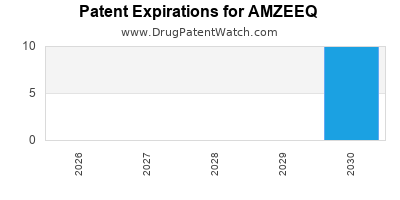
Amzeeq’s commercial exclusivity is based on a combination of FDA regulatory exclusivity and formulation-related patent protection. FDA approval alone does not establish a single, publicly stated “loss of exclusivity” date.
The relevant exclusivity categories are:
- Five-year new chemical entity exclusivity generally associated with approval of a qualifying new active ingredient.
- Three-year clinical investigation exclusivity for certain supplemental approvals, where applicable.
- Patent protection covering the foam formulation, topical delivery system, manufacturing process, or related compositions.
- Potential pediatric exclusivity, if granted for qualifying FDA-requested studies.
The five-year NCE period would ordinarily restrict submission of an ANDA with a Paragraph IV certification during the initial period, subject to statutory exceptions. It would not necessarily prevent all competing regulatory filings after the applicable restriction expires.
What patents protect Amzeeq?
Amzeeq’s protection is centered on foam and topical composition technology developed by Foamix. FDA Orange Book listings and USPTO records are the controlling sources for the active patent set, expiration dates, and any patent-term adjustment or extension.[4][5]
The patent estate may include claims directed to:
- Minocycline-containing topical foam compositions
- Pharmaceutical vehicles and excipient combinations
- Aerosol delivery systems
- Foam stability and dispensing characteristics
- Methods of treating acne with topical minocycline
- Manufacturing and filling processes
The practical strength of the estate depends on claim scope, written-description support, enablement, prosecution history, and whether an ANDA applicant can design around the claims. A formulation patent is generally more valuable when it covers the commercial product’s essential excipient system rather than an optional manufacturing parameter.
Are there Paragraph IV challenges to Amzeeq?
Publicly verified Paragraph IV litigation information should be evaluated through FDA ANDA records, district court dockets, and the Orange Book patent dispute listings. No broadly documented, market-defining Paragraph IV challenge has established an authorized generic or court-ordered early launch for Amzeeq in the public record available for this analysis.
The risk profile remains material because Amzeeq is a small-molecule topical product. Potential ANDA applicants could challenge:
- Patent validity
- Infringement
- Obviousness
- Written description
- Enablement
- Lack of patent listing eligibility
- Non-infringement through a different vehicle or manufacturing process
A generic applicant would also need to demonstrate pharmaceutical equivalence and bioequivalence under the applicable topical-product standards. Topical foam products can present greater formulation and bioequivalence complexity than conventional tablets, but that complexity does not eliminate generic risk.
What formulation patents and manufacturing barriers affect Amzeeq?
Amzeeq’s vehicle is commercially important because the drug’s differentiation is linked to topical delivery rather than to a novel systemic mechanism. Formulation patents can create a higher barrier than ordinary method-of-use claims when they cover the product’s actual commercial composition.
Manufacturing barriers may include:
- Consistent dispersion of minocycline in the foam vehicle
- Aerosol canister and valve compatibility
- Foam stability over shelf life
- Uniform dose delivery
- Control of particle size and viscosity
- Protection against degradation and discoloration
- Scale-up and filling reproducibility
These barriers can delay or increase the cost of generic development. They do not guarantee long-term exclusivity. A generic manufacturer can pursue a different vehicle, device, or process if it meets FDA requirements and avoids valid enforceable claims.
How does Amzeeq compare with other branded acne drugs?
| Product |
Active ingredient |
Route/form |
Commercial distinction |
Main risk to Amzeeq |
| Amzeeq |
Minocycline 4% |
Topical foam |
Topical tetracycline delivery |
Generic topical and oral antibiotics |
| Seysara |
Sarecycline |
Oral tablet |
Narrow-spectrum oral tetracycline |
Oral substitution and price |
| Winlevi |
Clascoterone |
Topical cream |
Androgen-receptor inhibition |
Non-antibiotic topical alternative |
| Aklief |
Trifarotene |
Topical cream |
Retinoid therapy |
Retinoid substitution |
| Cabtreo |
Clindamycin/adapalene/benzoyl peroxide |
Topical gel |
Combination therapy |
Broader regimen coverage |
| Generic clindamycin |
Clindamycin |
Topical lotion, gel, solution |
Low cost and availability |
Price-driven substitution |
| Oral minocycline |
Minocycline |
Oral capsule or tablet |
Familiar systemic therapy |
Lower acquisition cost |
Amzeeq is most differentiated against topical antibiotic products that lack a foam formulation. It is less differentiated when physicians prioritize low cost, combination therapy, or non-antibiotic treatment.
What patent litigation affects Amzeeq?
No major publicly established patent litigation outcome has materially changed Amzeeq’s U.S. market position in the available record. The most important legal events have been asset ownership and commercial-rights transactions rather than a reported generic launch injunction or settlement.
Are there Amzeeq settlement agreements?
No widely reported settlement agreement has established an agreed generic entry date for Amzeeq. If a Paragraph IV case is filed, a settlement could define an earlier authorized generic launch, a license date, or restrictions on the generic product. No such public settlement should be assumed without a court filing, SEC disclosure, or FDA-related record.
What is the competitive outlook for Amzeeq?
Amzeeq’s near-term commercial outlook is tied to specialty dermatology execution rather than broad primary-care penetration. The strongest growth case requires:
- Improved formulary access
- Consistent reimbursement
- High refill rates
- Continued dermatologist adoption
- Clear differentiation from generic minocycline and clindamycin
- Limited disruption from new branded acne therapies
The principal downside risks are payer pressure, antibiotic stewardship, treatment switching, and generic erosion after applicable patent barriers weaken.
Amzeeq has strategic value as a differentiated topical antibiotic asset, but its market size does not automatically translate into high revenue. The product must earn a branded price in a category with many inexpensive alternatives. Its commercial performance is therefore more sensitive to access and net price than to the total number of acne patients.
What generic launch scenarios exist for Amzeeq?
Three scenarios are commercially relevant:
| Scenario |
Timing driver |
Market effect |
| No near-term generic |
Patent challenges fail or development is delayed |
Continued branded pricing and specialty promotion |
| At-risk generic launch |
ANDA applicant launches before final patent resolution |
Rapid price erosion and litigation exposure |
| Post-expiry generic entry |
Entry follows patent expiry or settlement license |
Gradual-to-rapid erosion depending on generic count |
Topical products can experience slower generic uptake than oral solids when manufacturing is difficult or physician familiarity is limited. The effect can reverse if several approved generics launch at the same time and payers move products to preferred tiers.
Key Takeaways
- Amzeeq is a once-daily 4% minocycline topical foam approved by the FDA in 2019 for moderate-to-severe non-nodular acne.
- Journey Medical owns current U.S. commercial rights, while historical public financial data came primarily from VYNE Therapeutics.
- Current Amzeeq revenue, prescriptions, profitability, and market share are not separately disclosed by the private commercial owner.
- The product competes with generic topical antibiotics, oral tetracyclines, retinoids, Winlevi, Seysara, Aklief, and Cabtreo.
- Its main strategic asset is formulation-based differentiation rather than a novel systemic mechanism.
- Generic risk is meaningful because Amzeeq is a small-molecule drug, although topical foam development and bioequivalence may raise technical barriers.
- No publicly established Paragraph IV settlement or generic launch date has materially reset the Amzeeq market.
- Long-term value depends on reimbursement, refill persistence, dermatologist adoption, and the durability of formulation and delivery patents.
FAQs About Amzeeq Market Dynamics and Exclusivity
Is Amzeeq a biologic or a small-molecule drug?
Amzeeq is a small-molecule topical drug containing minocycline hydrochloride. Biosimilar substitution does not apply.
Is Amzeeq the same as oral minocycline?
No. Amzeeq uses topical 4% minocycline foam, while oral minocycline is administered systemically in tablet or capsule form.
Does Amzeeq have an authorized generic?
No publicly verified authorized generic launch has been established in the available record.
Why can Amzeeq remain expensive when minocycline is generic?
The generic availability of oral minocycline does not make the patented topical foam formulation generic. Amzeeq’s price reflects its branded formulation, delivery system, regulatory approval, commercialization costs, and payer contracting.
What is the main investment risk associated with Amzeeq?
The main risk is commercial underperformance caused by payer restrictions and substitution by lower-cost generic acne therapies. Patent and formulation disputes are secondary risks that could accelerate price erosion if a competing product reaches the market.
References
- U.S. Food and Drug Administration. (2019). FDA approves new treatment for acne. https://www.fda.gov
- VYNE Therapeutics Inc. (2022). Annual report and reports on asset transactions involving AMZEEQ and ZILXI. U.S. Securities and Exchange Commission. https://www.sec.gov
- U.S. Food and Drug Administration. (2023). AMZEEQ prescribing information. https://www.accessdata.fda.gov
- U.S. Food and Drug Administration. (2024). Approved drug products with therapeutic equivalence evaluations, Orange Book. https://www.fda.gov
- United States Patent and Trademark Office. (2024). Patent Center and Patent Public Search. https://ppubs.uspto.gov