Last updated: September 19, 2026
ALYQ is Teva Pharmaceuticals’ tadalafil 20 mg product for pulmonary arterial hypertension (PAH), marketed as an alternative to United Therapeutics’ Adcirca. Its commercial trajectory is driven by chronic PAH demand, generic tadalafil competition, payer substitution, and price erosion. Teva does not separately disclose ALYQ revenue, volume, gross margin, or profitability, so its financial trajectory must be assessed through product positioning, market structure, and Teva’s broader generic-drug reporting.
What is ALYQ and what is it approved to treat?
ALYQ contains tadalafil, a phosphodiesterase type 5 inhibitor. The FDA-approved indication is to improve exercise ability in adults with PAH, classified as World Health Organization functional class I, II, or III [1].
| Product |
Active ingredient |
Strength |
Indication |
Manufacturer |
| ALYQ |
Tadalafil |
20 mg |
Pulmonary arterial hypertension |
Teva Pharmaceuticals |
| Adcirca |
Tadalafil |
20 mg |
Pulmonary arterial hypertension |
United Therapeutics |
| Revatio |
Sildenafil |
20 mg |
Pulmonary arterial hypertension |
Pfizer |
| Generic tadalafil PAH products |
Tadalafil |
20 mg |
Pulmonary arterial hypertension |
Multiple manufacturers |
ALYQ is not the same commercial product as Cialis, although both contain tadalafil. Cialis is marketed for erectile dysfunction and benign prostatic hyperplasia. ALYQ is labeled for PAH and is distributed through the specialty-pharmacy and pulmonary-hypertension treatment channels.
What is the FDA regulatory status of ALYQ?
ALYQ is an FDA-approved prescription drug. The product is marketed under an FDA-approved new drug application and is listed as a tadalafil PAH product in FDA drug databases and labeling materials [1, 2].
The product’s regulatory value comes from its indication-specific positioning rather than a novel active ingredient. Tadalafil was approved in the United States for PAH before ALYQ entered the market. ALYQ therefore competes primarily on price, supply reliability, contracting, and access rather than on differentiated pharmacology.
Key FDA milestones
| Milestone |
Date or status |
| Tadalafil first approved in the United States |
2003 for erectile dysfunction |
| Tadalafil approved for PAH as Adcirca |
2009 |
| ALYQ commercialized by Teva |
2018-era U.S. market entry |
| Current regulatory category |
Prescription drug for PAH |
| Dosage form |
Oral tablet |
| Standard adult PAH dose |
40 mg once daily, generally administered as two 20 mg tablets |
The standard dose creates a practical commercial distinction. Although ALYQ is supplied as a 20 mg tablet, many adults require two tablets daily. That makes tablet count, dispensing limits, copay structure, and specialty-pharmacy contracting relevant to net revenue.
How large is the ALYQ market?
The relevant market is the U.S. PAH oral vasodilator market, not the much larger tadalafil market used for erectile dysfunction. PAH is a rare, specialist-managed disease with high treatment costs and concentrated prescribing.
Demand is supported by several factors:
- PAH is a chronic disease requiring long-term therapy.
- Tadalafil is administered orally once daily.
- The drug is used in treatment-naive patients and in combination regimens.
- Pulmonary-hypertension centers often use standardized treatment pathways.
- Generic entry expands access and may increase tadalafil utilization.
The market is constrained by:
- A relatively small diagnosed patient population.
- Competition from sildenafil and other PAH therapies.
- Use of combination therapy with endothelin-receptor antagonists and prostacyclin-pathway drugs.
- Specialty-pharmacy requirements.
- Payer controls and prior authorization.
- Clinical preference for alternative agents in selected patients.
The commercial ceiling is therefore limited by disease prevalence, but product persistence can be attractive because PAH therapy is chronic and switching is less frequent than in short-course primary-care markets.
What are the main competitive threats to ALYQ?
Tadalafil competition
Adcirca remains the principal branded comparator. Its commercial strength is based on original product recognition, established reimbursement pathways, and United Therapeutics’ PAH commercial infrastructure. ALYQ competes by offering a lower-cost or contractually preferred tadalafil option.
Other tadalafil products may enter or expand in the same therapeutic category after intellectual-property barriers expire. Each additional supplier increases price pressure and reduces the likelihood that ALYQ can maintain premium generic pricing.
Sildenafil competition
Generic sildenafil and Revatio compete directly for patients requiring a PDE5 inhibitor. Sildenafil is often available at lower acquisition cost and is familiar to PAH specialists. Formulary placement can determine whether a payer favors sildenafil or tadalafil.
Tadalafil retains clinical advantages for some patients because it is dosed once daily and has a longer half-life. Sildenafil is commonly administered three times daily in PAH, which can affect adherence and patient preference.
Advanced PAH therapies
ALYQ also competes indirectly with:
- Endothelin-receptor antagonists such as ambrisentan and macitentan.
- Soluble guanylate cyclase stimulators such as riociguat.
- Prostacyclin analogues and prostacyclin-receptor agonists.
- Fixed-dose and combination treatment strategies.
These therapies do not always substitute for tadalafil on a one-for-one basis. PAH treatment is often sequenced or combined, which supports tadalafil demand but limits its ability to capture the entire patient’s drug budget.
What is the patent and exclusivity position for ALYQ?
ALYQ does not have the patent profile of a novel molecular entity. Tadalafil’s basic compound protection and the principal Adcirca-era patent estate have largely expired or lost practical market exclusivity in the United States. The commercial question is therefore generic competition rather than long-term patent exclusivity.
Compound and use patents
The original tadalafil compound patents are no longer the primary barrier to U.S. entry. Later patents covering PAH use, dosing, or related commercial aspects extended protection for portions of the Adcirca franchise, but those barriers did not preserve broad, permanent exclusivity for the active ingredient.
The relevant patent issues historically included:
- Tadalafil compound protection.
- PAH method-of-use claims.
- Dosage and administration claims.
- Pediatric or regulatory exclusivity periods.
- Patent settlements governing generic launch timing.
Exact patent coverage depends on the specific ANDA, product label, listed Orange Book patents, and litigation history. The commercially material fact is that ALYQ entered after the principal barriers to tadalafil PAH competition had weakened.
Orange Book status
The Orange Book distinguishes between patents listed for an innovator NDA and the regulatory status of a competing product. Adcirca-related listings and patent certifications affected generic entry, while ALYQ’s value came from obtaining approval and commercial access after the relevant exclusivity constraints.
There is no meaningful expectation that ALYQ will receive a new period of market exclusivity based on tadalafil’s original active ingredient. Its protection is commercial and contractual rather than based on a new chemical entity.
Were there Paragraph IV challenges involving tadalafil PAH products?
Tadalafil PAH entry was associated with generic patent certification and litigation activity around Adcirca-related patents. The competitive pattern was consistent with a Paragraph IV market: generic applicants challenged or addressed listed patents, followed by settlements, licenses, or launches after the applicable barriers ended.
The principal commercial result was that generic or branded-generic tadalafil became available before the complete erosion of the broader tadalafil market. That allowed Teva to establish ALYQ as a differentiated PAH product while avoiding the development cost and regulatory risk associated with a new molecule.
A Paragraph IV challenge can create a first-filer opportunity, but that value is temporary. Once multiple suppliers enter, launch economics depend more on contracting and supply execution than on first-mover status.
What is the financial trajectory of ALYQ?
Teva does not report ALYQ as a separately disclosed revenue line in its public financial statements. Teva reports results by broader business categories, including its generic medicines operations, rather than by every individual product [3].
The most defensible trajectory is:
| Period |
Commercial condition |
Financial implication |
| Initial launch |
Entry into a protected or semi-protected PAH market |
Higher launch pricing and stronger gross-to-net economics |
| Early competition |
Additional tadalafil suppliers and payer negotiations |
Lower prices and reduced market share |
| Mature generic phase |
Multiple suppliers, formulary substitution, stable chronic demand |
Lower unit economics but recurring volume |
| Long-term phase |
Ongoing PAH demand and possible further price compression |
Revenue stability depends on share and supply reliability |
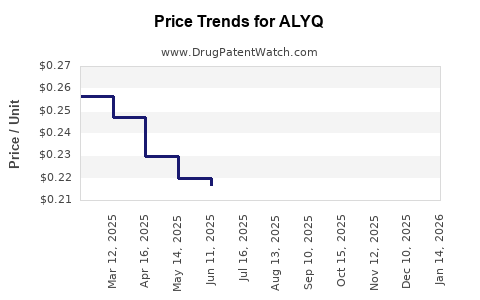
ALYQ likely generated its strongest product-level economics near launch, before broad tadalafil PAH competition intensified. Its later financial profile is more likely to resemble a mature specialty generic: recurring demand, moderate volume, lower prices, and limited ability to raise price.
Why standalone revenue cannot be calculated from Teva filings
Teva’s annual reports aggregate many products within its generic medicines business. The company does not generally disclose:
- ALYQ net sales.
- ALYQ prescription volume.
- ALYQ average selling price.
- ALYQ gross margin.
- ALYQ market share.
- ALYQ customer concentration.
- ALYQ contribution to operating income.
Any precise ALYQ revenue estimate requires third-party prescription, claims, sales, or channel data. Public filings support directional analysis but not a reliable product-level income statement.
What factors will determine ALYQ revenue over the next several years?
Price erosion
The largest risk is continued decline in net price as generic tadalafil suppliers compete for payer and specialty-pharmacy contracts. PAH products can maintain higher prices than mass-market generics because of specialist distribution and reimbursement complexity, but the active ingredient itself is not difficult to manufacture relative to biologics or complex injectables.
Volume retention
Volume depends on whether Teva maintains preferred access and retains prescribers after payer substitution. Once a product is established in specialty-pharmacy systems, switching can be slower than in retail generic markets. That can support recurring revenue even when prices decline.
Supply reliability
Manufacturing consistency is commercially important. PAH treatment is chronic, and stock-outs can lead specialty pharmacies and health plans to shift utilization to competing tadalafil products or sildenafil. Teva’s global manufacturing scale is a competitive asset, but it also exposes the product to portfolio-level manufacturing prioritization.
Clinical positioning
Tadalafil’s once-daily administration supports adherence and may preserve demand against sildenafil. Its role in combination therapy also reduces the risk that the product becomes irrelevant when patients require escalation.
Payer and specialty-pharmacy contracting
A product can lose share without losing clinical acceptance if a competing supplier wins a preferred contract. Net revenue is therefore shaped by rebates, discounts, copay support, distribution fees, and specialty-pharmacy economics, not only by the list price.
How strong is the ALYQ patent estate?
ALYQ has a weak long-term patent position but a potentially durable commercial position.
| Dimension |
Assessment |
| Active-ingredient protection |
Low; tadalafil is an established molecule |
| PAH method-of-use protection |
Historically important but substantially eroded |
| Formulation protection |
Limited strategic value for a conventional oral tablet |
| Manufacturing barriers |
Moderate to low |
| Regulatory complexity |
Moderate because PAH labeling and distribution require specialty execution |
| Brand differentiation |
Moderate through Teva’s commercial platform |
| Long-term exclusivity |
Low |
| Recurring-demand profile |
Moderate to strong |
The product’s economic defense is based on execution rather than patent exclusion. A conventional oral tablet has fewer manufacturing barriers than an injectable prostacyclin product, inhaled therapy, or biologic. That makes ALYQ more vulnerable to additional suppliers.
What generic launch scenarios exist for ALYQ?
Base case: gradual price erosion
ALYQ remains commercially available, retains a share of tadalafil PAH prescriptions, and experiences declining net price as competitors expand. Revenue declines gradually, while the product remains cash-generative if manufacturing and distribution costs stay controlled.
Downside case: accelerated substitution
A competitor wins preferred payer or specialty-pharmacy status. Teva loses volume faster than expected, and ALYQ becomes a secondary source. This would reduce revenue and could make the product less strategically important within Teva’s portfolio.
Upside case: stable contracted share
Teva preserves access through supply reliability, contracting, and broad generic-channel coverage. Unit prices still decline, but stable prescription volume limits the revenue decline.
What litigation and settlement issues affect ALYQ?
The material litigation risk historically concerned generic entry into the Adcirca market and the validity, scope, or timing of tadalafil PAH patents. Once the principal entry disputes were resolved and competitors launched, ongoing litigation became less important than contract competition and market share.
No product-specific litigation conclusion should be inferred solely from ALYQ’s continued marketing. A product may remain commercially available while its associated patents, settlements, or distribution contracts have changed. Current case status must be verified against federal court records, FDA patent listings, and Teva disclosures.
How does ALYQ compare with Adcirca and Revatio?
| Attribute |
ALYQ |
Adcirca |
Revatio |
| Active ingredient |
Tadalafil |
Tadalafil |
Sildenafil |
| PAH dosing pattern |
Once daily; commonly 40 mg total |
Once daily; commonly 40 mg total |
Typically three times daily |
| Market role |
Generic or branded-generic competitor |
Originator brand |
Originator brand with generic competition |
| Patent strength |
Low |
Historical originator estate, largely eroded |
Historical originator estate, largely eroded |
| Main commercial advantage |
Price and Teva distribution |
Brand history and PAH infrastructure |
Established PDE5 alternative |
| Main risk |
Price erosion and substitution |
Generic erosion |
Tadalafil substitution and generic competition |
Key Takeaways
- ALYQ is Teva’s tadalafil 20 mg PAH product and competes mainly with Adcirca, generic tadalafil, Revatio, and generic sildenafil.
- Its market is smaller than the overall tadalafil market because ALYQ is labeled for PAH rather than erectile dysfunction or benign prostatic hyperplasia.
- Teva does not disclose standalone ALYQ revenue, profit, prescription volume, or market share.
- The product’s financial trajectory likely shifted from launch-related pricing strength to mature-generic price erosion.
- Long-term patent protection is limited. Commercial performance depends on payer access, specialty-pharmacy contracts, supply reliability, and prescriber retention.
- PAH’s chronic treatment profile supports recurring demand, while the small patient population and multiple competing therapies limit market expansion.
- The principal financial risk is accelerated substitution after a competitor secures preferred reimbursement or distribution status.
FAQs About ALYQ Market and Financial Outlook
Is ALYQ the same drug as Cialis?
No. Both contain tadalafil, but ALYQ is approved for PAH, while Cialis is approved for erectile dysfunction and benign prostatic hyperplasia.
Does Teva disclose ALYQ sales separately?
No. Teva reports broader business-segment results and does not provide a standalone ALYQ revenue or profit line in its public financial reporting.
Is ALYQ a biologic or biosimilar?
No. ALYQ is a conventional small-molecule oral tablet. Biosimilar regulation does not apply.
Can generic tadalafil replace ALYQ?
A therapeutically equivalent tadalafil PAH product may compete with ALYQ, subject to FDA approval, indication, formulation, prescribing, and payer requirements. Pharmacy substitution also depends on the product’s regulatory status and state law.
What is the largest threat to ALYQ profitability?
The largest threat is sustained net-price erosion combined with loss of preferred payer or specialty-pharmacy access. The product’s conventional tablet formulation provides limited protection against additional generic competition.
References
- U.S. Food and Drug Administration. (n.d.). ALYQ (tadalafil) tablets prescribing information. Drugs@FDA.
- DailyMed. (n.d.). ALYQ- tadalafil tablet, film coated. National Library of Medicine.
- Teva Pharmaceutical Industries Ltd. (2024). Annual report for the year ended December 31, 2023.
- United Therapeutics Corporation. (2024). Annual report for the year ended December 31, 2023.
- U.S. Food and Drug Administration. (2024). Approved drug products with therapeutic equivalence evaluations. Orange Book.