Last Updated: September 24, 2026

ALYFTREK Drug Patent Profile


✉ Email this page to a colleague

« Back to Dashboard


When do Alyftrek patents expire, and what generic alternatives are available?

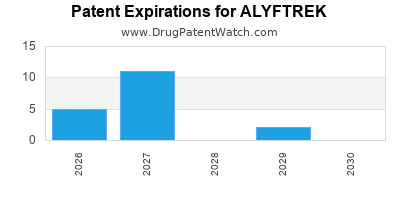
Alyftrek is a drug marketed by Vertex Pharms Inc and is included in one NDA. There are thirty-three patents protecting this drug.

The generic ingredient in ALYFTREK is deutivacaftor; tezacaftor; vanzacaftor calcium. There is one drug master file entry for this compound. One supplier is listed for this compound. Additional details are available on the deutivacaftor; tezacaftor; vanzacaftor calcium profile page.

DrugPatentWatch® Generic Entry Outlook for Alyftrek

Alyftrek will be eligible for patent challenges on December 20, 2028. This date may extended up to six months if a pediatric exclusivity extension is applied to the drug's patents.

By analyzing the patents and regulatory protections it appears that the earliest date for generic entry will be March 27, 2033. This may change due to patent challenges or generic licensing.

There have been twenty-eight patent litigation cases involving the patents protecting this drug, indicating strong interest in generic launch. Recent data indicate that 63% of patent challenges are decided in favor of the generic patent challenger and that 54% of successful patent challengers promptly launch generic drugs.

Indicators of Generic Entry

< Available with Subscription >

  Start Trial

AI Deep Research
Questions you can ask:
  • What is the 5 year forecast for ALYFTREK?
  • What are the global sales for ALYFTREK?
  • What is Average Wholesale Price for ALYFTREK?
Summary for ALYFTREK
DrugPatentWatch® Estimated Loss of Exclusivity (LOE) Date for ALYFTREK
Generic Entry Date for ALYFTREK*:
Constraining patent/regulatory exclusivity:

TREATMENT OF CYSTIC FIBROSIS (CF) IN ADULT AND PEDIATRIC PATIENTS 6 YEARS OF AGE AND OLDER WHO HAVE A CLINICAL DIAGNOSIS OF CF AND WHO HAVE AT LEAST ONE VARIANT IN THE CYSTIC FIBROSIS TRANSMEMBRANE CONDUCTANCE REGULATOR (CFTR) GENE THAT IS EITHER RESPONSIVE BASED ON CLINICAL AND/OR IN VITRO DATA OR RESULTS IN PRODUCTION OF CFTR PROTEIN AND IS IDENTIFIED IN THE APPROVAL ON MARCH 27, 2026, EXCLUDING PATIENTS COVERED BY THE PREVIOUS APPROVAL FOR ALYFTREK ON DECEMBER 20, 2024

NDA:
Dosage:

TABLET;ORAL

*The generic entry opportunity date is the latter of the last compound-claiming patent and the last regulatory exclusivity protection. Many factors can influence early or later generic entry. This date is provided as a rough estimate of generic entry potential and should not be used as an independent source.

US Patents and Regulatory Information for ALYFTREK

ALYFTREK is protected by fifty-one US patents and three FDA Regulatory Exclusivities.

Based on analysis by DrugPatentWatch, the earliest date for a generic version of ALYFTREK is ⤷  Start Trial.

This potential generic entry date is based on TREATMENT OF CYSTIC FIBROSIS (CF) IN ADULT AND PEDIATRIC PATIENTS 6 YEARS OF AGE AND OLDER WHO HAVE A CLINICAL DIAGNOSIS OF CF AND WHO HAVE AT LEAST ONE VARIANT IN THE CYSTIC FIBROSIS TRANSMEMBRANE CONDUCTANCE REGULATOR (CFTR) GENE THAT IS EITHER RESPONSIVE BASED ON CLINICAL AND/OR IN VITRO DATA OR RESULTS IN PRODUCTION OF CFTR PROTEIN AND IS IDENTIFIED IN THE APPROVAL ON MARCH 27, 2026, EXCLUDING PATIENTS COVERED BY THE PREVIOUS APPROVAL FOR ALYFTREK ON DECEMBER 20, 2024.

Generics may enter earlier, or later, based on new patent filings, patent extensions, patent invalidation, early generic licensing, generic entry preferences, and other factors.

Applicant Tradename Generic Name Dosage NDA Approval Date TE Type RLD RS Patent No. Patent Expiration Product Substance Delist Req. Exclusivity Expiration
Vertex Pharms Inc ALYFTREK deutivacaftor; tezacaftor; vanzacaftor calcium TABLET;ORAL 218730-001 Dec 20, 2024 RX Yes No ⤷  Start Trial ⤷  Start Trial Y ⤷  Start Trial
Vertex Pharms Inc ALYFTREK deutivacaftor; tezacaftor; vanzacaftor calcium TABLET;ORAL 218730-002 Dec 20, 2024 RX Yes Yes ⤷  Start Trial ⤷  Start Trial Y ⤷  Start Trial
Vertex Pharms Inc ALYFTREK deutivacaftor; tezacaftor; vanzacaftor calcium TABLET;ORAL 218730-002 Dec 20, 2024 RX Yes Yes ⤷  Start Trial ⤷  Start Trial ⤷  Start Trial
Vertex Pharms Inc ALYFTREK deutivacaftor; tezacaftor; vanzacaftor calcium TABLET;ORAL 218730-001 Dec 20, 2024 RX Yes No ⤷  Start Trial ⤷  Start Trial ⤷  Start Trial
Vertex Pharms Inc ALYFTREK deutivacaftor; tezacaftor; vanzacaftor calcium TABLET;ORAL 218730-002 Dec 20, 2024 RX Yes Yes ⤷  Start Trial ⤷  Start Trial Y Y ⤷  Start Trial
>Applicant >Tradename >Generic Name >Dosage >NDA >Approval Date >TE >Type >RLD >RS >Patent No. >Patent Expiration >Product >Substance >Delist Req. >Exclusivity Expiration

Expired US Patents for ALYFTREK

International Patents for ALYFTREK

When does loss-of-exclusivity occur for ALYFTREK?

Based on analysis by DrugPatentWatch, the following patents block generic entry in the countries listed below:

Australia

Patent: 12255711
Estimated Expiration: ⤷  Start Trial

Patent: 17208313
Patent: Deuterated derivatives of ivacftor
Estimated Expiration: ⤷  Start Trial

Patent: 19222862
Patent: Deuterated derivatives of ivacaftor
Estimated Expiration: ⤷  Start Trial

Patent: 21200970
Patent: Deuterated derivatives of ivacaftor
Estimated Expiration: ⤷  Start Trial

Patent: 21203786
Patent: Deuterated derivatives of ivacaftor
Estimated Expiration: ⤷  Start Trial

Brazil

Patent: 2013029240
Patent: derivados deuterados do ivacaftor
Estimated Expiration: ⤷  Start Trial

Canada

Patent: 34574
Patent: DERIVES DEUTERES DE L'IVACAFTOR (DEUTERATED DERIVATIVES OF IVACAFTOR)
Estimated Expiration: ⤷  Start Trial

Chile

Patent: 15001358
Patent: Potenciadores del cftr deuterados
Estimated Expiration: ⤷  Start Trial

Croatia

Patent: 0170754
Estimated Expiration: ⤷  Start Trial

Patent: 0192114
Estimated Expiration: ⤷  Start Trial

Cyprus

Patent: 19090
Estimated Expiration: ⤷  Start Trial

Patent: 22498
Estimated Expiration: ⤷  Start Trial

Denmark

Patent: 09986
Estimated Expiration: ⤷  Start Trial

Patent: 35812
Estimated Expiration: ⤷  Start Trial

Eurasian Patent Organization

Patent: 8378
Patent: ДЕЙТЕРИРОВАННЫЕ ПОТЕНЦИАТОРЫ CFTR (DEUTERATED DERIVATIVES OF IVACAFTOR)
Estimated Expiration: ⤷  Start Trial

Patent: 1391615
Patent: ДЕЙТЕРИРОВАННЫЕ ПОТЕНЦИАТОРЫ CFTR (DEUTERATED DERIVATIVES OF IVACAFTOR)
Estimated Expiration: ⤷  Start Trial

European Patent Office

Patent: 09986
Patent: DÉRIVÉS DEUTÉRÉS DE L'IVACAFTOR (DEUTERATED DERIVATIVES OF IVACAFTOR)
Estimated Expiration: ⤷  Start Trial

Patent: 35812
Patent: DÉRIVÉS DEUTÉRÉS D'IVACAFTOR (DEUTERATED DERIVATIVES OF IVACAFTOR)
Estimated Expiration: ⤷  Start Trial

Hong Kong

Patent: 44183
Patent: IVACAFTOR的氘化衍生物 (DEUTERATED DERIVATIVES OF IVACAFTOR)
Estimated Expiration: ⤷  Start Trial

Hungary

Patent: 32771
Estimated Expiration: ⤷  Start Trial

Patent: 47354
Estimated Expiration: ⤷  Start Trial

Japan

Patent: 63455
Estimated Expiration: ⤷  Start Trial

Patent: 14515351
Patent: 重水素化されたイバカフトルの誘導体
Estimated Expiration: ⤷  Start Trial

Patent: 17078082
Patent: 重水素化されたイバカフトルの誘導体 (DEUTERATED DERIVATIVES OF IVACAFTOR)
Estimated Expiration: ⤷  Start Trial

Lithuania

Patent: 09986
Estimated Expiration: ⤷  Start Trial

Malaysia

Patent: 8621
Patent: DEUTERATED CFTR POTENTIATORS
Estimated Expiration: ⤷  Start Trial

Patent: 3582
Patent: DEUTERATED CFTR POTENTIATORS
Estimated Expiration: ⤷  Start Trial

Mexico

Patent: 9159
Patent: DERIVADOS DEUTERADOS DE IVACAFTOR. (DEUTERATED DERIVATIVES OF IVACAFTOR.)
Estimated Expiration: ⤷  Start Trial

Patent: 13013450
Patent: DERIVADOS DEUTERADOS DE IVACAFTOR. (DEUTERATED DERIVATIVES OF IVACAFTOR.)
Estimated Expiration: ⤷  Start Trial

Montenegro

Patent: 749
Patent: DEUTERISANI DERIVATI IVAKAFTORA (DEUTERATED DERIVATIVES OF IVACAFTOR)
Estimated Expiration: ⤷  Start Trial

Patent: 652
Patent: DEUTERISANI DERIVATI IVAKAFTORA (DEUTERATED DERIVATIVES OF IVACAFTOR)
Estimated Expiration: ⤷  Start Trial

Poland

Patent: 09986
Estimated Expiration: ⤷  Start Trial

Patent: 35812
Estimated Expiration: ⤷  Start Trial

Portugal

Patent: 09986
Estimated Expiration: ⤷  Start Trial

Patent: 35812
Estimated Expiration: ⤷  Start Trial

San Marino

Patent: 01700302
Estimated Expiration: ⤷  Start Trial

Patent: 01900679
Estimated Expiration: ⤷  Start Trial

Serbia

Patent: 096
Patent: DEUTERISANI DERIVATI IVAKAFTORA (DEUTERATED DERIVATIVES OF IVACAFTOR)
Estimated Expiration: ⤷  Start Trial

Patent: 744
Patent: DEUTERISANI DERIVATI IVAKAFTORA (DEUTERATED DERIVATIVES OF IVACAFTOR)
Estimated Expiration: ⤷  Start Trial

Slovenia

Patent: 09986
Estimated Expiration: ⤷  Start Trial

Patent: 35812
Estimated Expiration: ⤷  Start Trial

Spain

Patent: 28465
Estimated Expiration: ⤷  Start Trial

Patent: 58028
Estimated Expiration: ⤷  Start Trial

Generics may enter earlier, or later, based on new patent filings, patent extensions, patent invalidation, early generic licensing, generic entry preferences, and other factors.

See the table below for additional patents covering ALYFTREK around the world.

Country Patent Number Title Estimated Expiration
Australia 2007235260 ⤷  Start Trial
Brazil PI0710965 ⤷  Start Trial
Canada 2648719 ⤷  Start Trial
Canada 2869945 ⤷  Start Trial
China 101460489 ⤷  Start Trial
>Country >Patent Number >Title >Estimated Expiration

Supplementary Protection Certificates for ALYFTREK

Patent Number Supplementary Protection Certificate SPC Country SPC Expiration SPC Description
1773816 C300748 Netherlands ⤷  Start Trial PRODUCT NAME: N-(5-HYDROXY-2,4-DI-TERT-BUTYL-; REGISTRATION NO/DATE: EU/1/12/782/001-002 20120725
1773816 CA 2015 00038 Denmark ⤷  Start Trial PRODUCT NAME: IVACAFTOR, N-(5-HYDROXY-2,4-DITERT-BUTYL-PHENYL)-4-OXO-1H-QUINOLIN-3-CARBOXAMID ELLER ET FARMACEUTISK ACCEPTABLET SALT DERAF; REG. NO/DATE: EU/1/12/782/001-002 20120723
1773816 PA2015028 Lithuania ⤷  Start Trial PRODUCT NAME: IVACAFTORUM; REGISTRATION NO/DATE: EU/1/12/782/001 - EU/1/12/782/002 20120723
1773816 C20150028 00162 Estonia ⤷  Start Trial PRODUCT NAME: IVAKAFTOOR;REG NO/DATE: EU/1/12/782/001-002 25.07.2012
1773816 1590036-8 Sweden ⤷  Start Trial PRODUCT NAME: N-(5-HYDROXY-2,4-DITERT-BUTYL-PHENYL)-4-OXO-1H-QUINOLINE-3- CARBOXAMIDE OR A PHARMACEUTICALLY ACCEPTABLE SALT THEROF; FIRST MARKETING AUTHORIZATION NUMBER SE: EG EU/1/12/782/001, 2012-07-25; DEN 2025-05-21 MEDDELADE PRV BESLUT OM RAETTAD SKYDDSTID FOER FOELJANDE TILLAEGGSSKYDD: 1590036-8,1690018-5, 1490016-1
>Patent Number >Supplementary Protection Certificate >SPC Country >SPC Expiration >SPC Description

ALYFTREK Market Dynamics, Patent Exclusivity, and Financial Trajectory

Last updated: August 13, 2026

Alyftrek, Vertex Pharmaceuticals' once-daily cystic fibrosis combination of vanzacaftor, tezacaftor, and deutivacaftor, was approved by the U.S. Food and Drug Administration on December 20, 2024. It is positioned as the next-generation replacement for Trikafta/Kaftrio, with a simpler dosing schedule and clinical efficacy that was broadly comparable to the established triple-combination regimen. The commercial opportunity is substantial because Vertex controls the dominant cystic fibrosis modulator market, but Alyftrek's growth will depend primarily on conversion of existing Trikafta patients rather than on a large untreated population.

The near-term financial profile is likely to show a transition period: initial Alyftrek revenue will be modest relative to Trikafta, while the combined cystic fibrosis franchise remains durable. The principal risks are payer resistance to switching stable patients, contracting pressure, international reimbursement delays, and patent challenges to Vertex's cystic fibrosis portfolio.

What is Alyftrek and how does it compare with Trikafta?

Alyftrek is a fixed-dose combination of three CFTR modulators:

  • Vanzacaftor
  • Tezacaftor
  • Deutivacaftor

The FDA approved Alyftrek for patients aged 6 years and older with cystic fibrosis who have at least one F508del mutation or another mutation responsive to the regimen. The product is administered once daily, compared with Trikafta's twice-daily schedule. [1]

Product Active ingredients Dosing Sponsor FDA status
Alyftrek Vanzacaftor, tezacaftor, deutivacaftor Once daily Vertex Pharmaceuticals Approved December 20, 2024
Trikafta Elexacaftor, tezacaftor, ivacaftor Twice daily Vertex Pharmaceuticals Approved October 21, 2019
Symdeko Tezacaftor, ivacaftor Twice daily Vertex Pharmaceuticals Approved 2018
Kalydeco Ivacaftor Once or twice daily, depending on regimen Vertex Pharmaceuticals Approved 2012

Alyftrek's clinical positioning is based on non-inferiority to Trikafta for lung function, with a potential convenience advantage from once-daily treatment. In the Phase 3 SKYLINE trials, Alyftrek maintained lung function and produced comparable or favorable outcomes on several secondary measures. Vertex reported that sweat chloride reduction was greater with Alyftrek than with Trikafta in the relevant study populations. [2]

The commercial distinction is therefore incremental rather than transformational. Alyftrek does not expand the cystic fibrosis market in the same way that earlier CFTR modulators did. It is principally a lifecycle product designed to retain patients within Vertex's franchise.

How large is the Alyftrek market opportunity?

The addressable U.S. population is approximately 35,000 people with cystic fibrosis, while the global cystic fibrosis population is estimated at more than 90,000. Not every patient is eligible for Alyftrek, but most patients in developed markets who are eligible for Trikafta or Kaftrio represent potential Alyftrek candidates. [3]

The relevant market is larger than the number of new patients because Vertex can convert:

  1. Existing Trikafta users.
  2. Patients previously treated with Symdeko or other CFTR modulators.
  3. Newly diagnosed children who become eligible for a modulator.
  4. Patients in international markets where Alyftrek receives reimbursement approval.

The initial conversion pool is large. Vertex reported approximately $10.2 billion in 2023 product revenue from Trikafta/Kaftrio, reflecting the scale of the predecessor franchise. [4] Trikafta remained the principal source of Vertex's revenue and operating cash flow entering the Alyftrek launch.

Market-size drivers

Alyftrek's revenue opportunity depends on four variables:

Driver Effect on Alyftrek
Patient conversion from Trikafta Main source of early revenue
New patient starts Provides underlying market growth
Net price and payer rebates Determines revenue per converted patient
Geographic approvals and reimbursement Controls international uptake

The U.S. will likely produce the earliest revenue because FDA approval and commercial infrastructure are already in place. Europe and other markets will follow separate regulatory and reimbursement timelines. The European product is expected to be marketed under the Kaftrio franchise architecture, subject to local approvals and pricing negotiations.

What is the financial trajectory for Alyftrek?

Alyftrek had no material reported revenue before its December 2024 approval. Its financial trajectory should be analyzed as a staged substitution cycle rather than as a stand-alone launch into an unserved market.

Expected revenue phases

Period Commercial phase Financial effect
2024 FDA approval and pre-launch preparation No material Alyftrek revenue
2025 U.S. launch and early patient conversion Initial revenue; launch expenses rise
2026-2027 Broader U.S. adoption and international expansion Accelerating Alyftrek revenue; Trikafta erosion begins
2028-2030 Franchise migration and market normalization Alyftrek reaches a larger share of CFTR-modulator sales
Beyond 2030 Mature product and patent-defense period Revenue depends on conversion, price, and generic timing

Vertex's aggregate cystic fibrosis revenue may remain relatively stable during the transition if Alyftrek conversion offsets Trikafta decline. A rapid conversion could preserve franchise revenue while shifting product mix. A slower conversion would leave Trikafta revenue higher for longer but reduce Alyftrek's standalone growth rate.

The most important financial metric is therefore combined revenue from Vertex's CFTR portfolio, not Alyftrek revenue in isolation. Investors should monitor:

  • Alyftrek prescriptions and new patient starts.
  • Trikafta-to-Alyftrek switching rates.
  • Gross-to-net deductions and payer rebates.
  • U.S. and international reimbursement decisions.
  • Quarterly CFTR franchise revenue.
  • Research and development spending related to next-generation modulators.

Vertex does not publish a separate long-term Alyftrek revenue forecast in its publicly available financial reporting. Consensus estimates vary because they depend on assumptions about conversion speed, pricing, and the durability of Trikafta exclusivity.

When does Alyftrek lose exclusivity?

Alyftrek's practical exclusivity period is expected to extend well beyond the initial approval date because Vertex's protection is likely to rely on multiple patent categories rather than a single composition-of-matter patent.

Relevant categories include:

  • Active pharmaceutical ingredient patents covering vanzacaftor and deutivacaftor.
  • Combination-product patents covering the three-modulator regimen.
  • Formulation patents.
  • Pharmaceutical composition patents.
  • Method-of-treatment patents.
  • Manufacturing and solid-state patents.
  • Pediatric and regulatory exclusivity.

The FDA's standard five-year new chemical entity exclusivity generally does not apply in a simple manner to a combination containing previously approved active ingredients. The regulatory exclusivity analysis depends on whether the relevant ingredients or combinations qualify for new-chemical-entity treatment and how FDA applies the combination-product rules. Patent protection is therefore more important than statutory exclusivity in evaluating Alyftrek's long-term market position.

Patent expiration and Orange Book status

Alyftrek's exact U.S. patent expiration dates should be taken from the current FDA Orange Book entries and Vertex's patent disclosures. The Orange Book is the controlling source for listed patents and certifications associated with an abbreviated new drug application. [5]

Vertex's broader CFTR portfolio has been protected by numerous U.S. patents with expiration dates extending into the 2030s. The company has historically used layered patent protection to defend Trikafta and related products, including patents covering compounds, combinations, formulations, and treatment methods. [6]

The likely commercial outcome is a staggered loss of exclusivity:

  1. Early patents may be vulnerable to Paragraph IV challenges.
  2. Later formulation or combination patents may delay practical generic substitution.
  3. Method-of-use patents may be less effective where generic labeling can omit protected indications.
  4. Regulatory exclusivity may expire before the final patent barrier.

Alyftrek's earliest generic-entry date cannot be determined solely from the approval date. It depends on the full Orange Book listing, patent-term adjustments, patent-term extensions, pediatric exclusivity, litigation outcomes, and settlement agreements.

Which companies are likely to challenge Alyftrek patents?

Alyftrek has no established biosimilar risk because it is a small-molecule drug, not a biologic. The principal threat is an abbreviated new drug application from a generic manufacturer.

Potential challengers include large generic companies such as:

  • Teva Pharmaceutical Industries.
  • Sandoz.
  • Viatris.
  • Sun Pharmaceutical Industries.
  • Dr. Reddy's Laboratories.
  • Zydus Lifesciences.
  • Cipla.
  • Lupin.

No publicly reported Paragraph IV litigation involving an Alyftrek ANDA had established market significance immediately after FDA approval. A challenge would require a generic company to file an ANDA and certify against listed patents. Vertex could then bring infringement litigation, generally triggering a 30-month stay of FDA approval under the Hatch-Waxman framework, subject to statutory exceptions. [7]

The expected litigation risk is higher for a commercially important product with a concentrated manufacturer base. Alyftrek's high annual treatment value and Vertex's strong cash generation create incentives for both patent challenges and settlement negotiations.

What formulations and manufacturing technologies are protected?

Alyftrek's formulation protection may be commercially important because once-daily dosing is a central product advantage. Potentially relevant protection includes:

  • Fixed-dose tablet composition.
  • Ratios of the three active ingredients.
  • Release characteristics and bioavailability.
  • Tablet stability and shelf life.
  • Particle size and solid-state forms.
  • Manufacturing processes.
  • Packaging and storage conditions.

Manufacturing complexity can increase the practical barrier to generic entry. A generic applicant must demonstrate pharmaceutical equivalence and bioequivalence across a three-component product. Differences in active-ingredient ratios, dissolution profiles, impurities, or stability can create regulatory and patent disputes.

The manufacturing barrier is not absolute. Large generic manufacturers routinely develop complex oral combinations, and the existence of a technically difficult formulation does not prevent an ANDA filing. It can, however, increase development cost and reduce the number of credible challengers.

What is the regulatory status of Alyftrek?

Alyftrek received FDA approval for eligible cystic fibrosis patients aged 6 years and older. The approval was supported by Phase 3 studies comparing Alyftrek with Trikafta in patients already receiving CFTR-modulator therapy and in patients initiating treatment. [1,2]

Key regulatory factors include:

  • FDA approval: December 20, 2024.
  • Indication: Cystic fibrosis with qualifying CFTR mutations.
  • Dosage form: Oral tablets.
  • Regulatory pathway: New drug application.
  • Pediatric scope: Patients aged 6 years and older at approval.
  • Post-approval expansion potential: Younger pediatric cohorts and additional responsive mutations.

The pediatric label is commercially important because Vertex has historically expanded CFTR-modulator eligibility into younger age groups. Each age expansion increases the replacement market and supports long-term patient retention within the franchise.

What patent litigation affects Alyftrek and the Vertex CFTR franchise?

Alyftrek's litigation risk is linked to Vertex's broader CFTR patent strategy. The company has faced repeated challenges to patents covering cystic fibrosis products, particularly Trikafta-related intellectual property. Those disputes establish the litigation environment for future Alyftrek challenges but do not automatically determine Alyftrek's outcome.

Potential disputes may involve:

  • Validity of compound claims.
  • Obviousness of the triple combination.
  • Written-description and enablement requirements.
  • Patent-term calculations.
  • Double-patenting arguments.
  • Infringement of formulation claims.
  • Carve-out labeling for method-of-use patents.

A successful Paragraph IV challenge could produce an at-risk generic launch before the full patent estate expires. A settlement could provide a negotiated launch date, royalty arrangement, or other commercial terms. Publicly disclosed Alyftrek-specific settlement terms were not an established feature of the product's post-approval commercial record at the initial launch stage.

How strong is the Alyftrek patent estate?

Alyftrek has a potentially strong patent estate because Vertex can combine new active ingredients with product-specific combination and formulation claims. The estate's strength is higher if the patents:

  • Claim vanzacaftor or deutivacaftor with narrow structural specificity.
  • Cover the exact fixed-dose combination.
  • Include clinically meaningful formulation limitations.
  • Have expiration dates later than the earliest compound patents.
  • Survive validity challenges in district court or at the Patent Trial and Appeal Board.

The estate is weaker if protection depends mainly on broad method-of-use claims or patents that can be avoided through a different formulation. Patent strength should be assessed claim by claim, not by counting the number of listed patents.

How does Alyftrek compare with competing CFTR modulators?

Alyftrek has no direct branded competitor with equivalent triple-modulator status and comparable market penetration. Its primary competitor is Vertex's own Trikafta/Kaftrio franchise.

Factor Alyftrek Trikafta/Kaftrio
Dosing Once daily Twice daily
Sponsor Vertex Vertex
Market role Next-generation replacement Established standard of care
Patient base New starts and switchers Large installed base
Main advantage Convenience and newer regimen Long clinical and reimbursement history
Main risk Slow switching and payer controls Patent erosion and lifecycle decline

Non-CFTR treatments, including inhaled antibiotics, mucolytics, airway-clearance therapies, and anti-inflammatory treatments, remain complementary rather than direct substitutes. They do not offer the same mechanism or disease-modifying profile.

What generic launch scenarios exist for Alyftrek?

Three scenarios are commercially relevant.

Scenario 1: Delayed generic entry

Vertex maintains strong patent protection into the 2030s, and generic manufacturers settle for a later launch. Alyftrek becomes the dominant CFTR product as Trikafta declines.

Scenario 2: At-risk launch

A generic company launches after invalidating or avoiding key patents. Vertex's CFTR revenue experiences rapid price erosion, although the company may retain patients through brand loyalty, contracting, or additional patent protection.

Scenario 3: Limited initial competition

A generic enters for a narrow indication or after a labeling carve-out. Price pressure develops gradually, allowing Vertex to preserve a portion of the market through differentiated access and supply reliability.

The most likely near-term scenario is continued Vertex control, followed by gradual product migration within the franchise. The timing of meaningful generic erosion will depend on the earliest enforceable patent and any litigation settlement.

What revenue exposure does Vertex have to Alyftrek?

Vertex's revenue exposure is substantial because cystic fibrosis remains the company's core commercial franchise. The company reported 2023 total revenue of approximately $9.9 billion, with Trikafta/Kaftrio contributing approximately $10.2 billion on a product basis as the principal growth driver. [4]

Alyftrek protects this revenue base in two ways:

  • It gives Vertex a new branded product for patients who might otherwise remain on an aging regimen.
  • It creates a new exclusivity layer around the triple-modulator franchise.

The risk is cannibalization. Every patient who switches from Trikafta to Alyftrek shifts revenue within Vertex's portfolio rather than creating a fully incremental sale. The economic benefit comes from extending the period during which Vertex captures the patient's treatment value.

Key Takeaways

  • Alyftrek was FDA-approved on December 20, 2024, for eligible cystic fibrosis patients aged 6 years and older.
  • Its principal commercial advantage is once-daily dosing, not a fundamentally new disease market.
  • Early revenue will come mainly from switching Trikafta patients and adding newly eligible patients.
  • Vertex's combined CFTR revenue is more important than Alyftrek's stand-alone sales during the transition.
  • The product has no biosimilar risk because it is a small molecule.
  • Generic risk will arise through Paragraph IV ANDA challenges and depend on the complete Orange Book patent estate.
  • Formulation, combination, manufacturing, and method-of-use patents may extend practical protection beyond basic compound patents.
  • The most probable initial market structure is continued Vertex control, with gradual migration from Trikafta to Alyftrek.
  • Key financial indicators are conversion rate, net price, reimbursement timing, international launches, and later generic litigation.

FAQs About Alyftrek Market and Patent Risk

Will Alyftrek replace Trikafta?

Alyftrek is designed to become Vertex's next-generation CFTR modulator, but replacement will be gradual. Stable patients, physicians, and payers may not switch immediately when clinical outcomes are already satisfactory on Trikafta.

Is Alyftrek more effective than Trikafta?

Clinical trials supported non-inferior lung-function outcomes, with greater sweat chloride reductions reported for Alyftrek in relevant analyses. The principal practical advantage is once-daily dosing.

Does Alyftrek have biosimilar competition?

No. Alyftrek is a small-molecule combination tablet. Any future competition would proceed through the generic drug and ANDA pathway rather than the biosimilar pathway.

What would cause Alyftrek sales to underperform?

The main causes would be slow patient switching, restrictive payer coverage, lower-than-expected international reimbursement, manufacturing constraints, or early generic patent litigation.

Will Alyftrek increase Vertex's total cystic fibrosis revenue?

It can preserve and extend Vertex's CFTR revenue, but much of its early sales will replace Trikafta revenue. Net franchise growth depends on new patient additions, price realization, and the timing of Trikafta erosion.

References

  1. U.S. Food and Drug Administration. (2024, December 20). FDA approves new treatment for cystic fibrosis. https://www.fda.gov
  2. Vertex Pharmaceuticals Incorporated. (2023, September 29). Vertex announces positive results from Phase 3 studies of vanzacaftor/tezacaftor/deutivacaftor. https://investors.vrtx.com
  3. Cystic Fibrosis Foundation. (2024). Cystic fibrosis care and population data. https://www.cff.org
  4. Vertex Pharmaceuticals Incorporated. (2024). 2023 annual report. https://investors.vrtx.com
  5. U.S. Food and Drug Administration. (2024). Approved drug products with therapeutic equivalence evaluations: Orange Book. https://www.accessdata.fda.gov/scripts/cder/ob/
  6. Vertex Pharmaceuticals Incorporated. (2024). Form 10-K for the fiscal year ended December 31, 2023. U.S. Securities and Exchange Commission. https://www.sec.gov
  7. U.S. Food and Drug Administration. (2024). ANDA submissions: Amendments and requests for final approval to tentatively approved ANDAs. https://www.fda.gov

More… ↓

⤷  Start Trial

Make Better Decisions: Try a trial or see plans & pricing

Drugs may be covered by multiple patents or regulatory protections. All trademarks and applicant names are the property of their respective owners or licensors. Although great care is taken in the proper and correct provision of this service, thinkBiotech LLC does not accept any responsibility for possible consequences of errors or omissions in the provided data. The data presented herein is for information purposes only. There is no warranty that the data contained herein is error free. We do not provide individual investment advice. This service is not registered with any financial regulatory agency. The information we publish is educational only and based on our opinions plus our models. By using DrugPatentWatch you acknowledge that we do not provide personalized recommendations or advice. thinkBiotech performs no independent verification of facts as provided by public sources nor are attempts made to provide legal or investing advice. Any reliance on data provided herein is done solely at the discretion of the user. Users of this service are advised to seek professional advice and independent confirmation before considering acting on any of the provided information. thinkBiotech LLC reserves the right to amend, extend or withdraw any part or all of the offered service without notice.