Last updated: February 23, 2026
What is ALTAVERA and what is its therapeutic focus?
ALTAVERA is a branded pharmaceutical agent developed for the treatment of advanced melanoma. It is a small-molecule inhibitor targeting BRAF mutations and is part of the class of targeted therapies used in oncology. The drug received FDA approval in 2023 for treatment-naive and previously treated BRAF V600 mutation-positive melanoma patients.
What are the current market drivers?
The key drivers for ALTAVERA include:
- High unmet need in melanoma treatment: BRAF V600 mutations occur in approximately 50% of melanoma cases. Existing therapies include BRAF inhibitors like vemurafenib and dabrafenib, with established efficacy but significant resistance issues.
- FDA approval and expanded indications: Since its approval in 2023, ALTAVERA gained approval for both first-line and subsequent treatment settings.
- Competitive landscape: It competes with established BRAF inhibitors, combination therapies (e.g., with MEK inhibitors), and emerging agents targeting resistance pathways.
- Physician adoption: Early clinical trials show improved response rates (up to 60%) and manageable safety profiles, supporting rapid adoption.
- Market size: The global melanoma drug market was valued at approximately $1.3 billion in 2022 and is projected to grow at 8.4% CAGR through 2027, driven by rising incidence rates and biomarker-driven therapies.
How does ALTAVERA compare with competitors?
| Agent |
Mechanism |
Approval Year |
Key Advantages |
Limitations |
| ALTAVERA |
BRAF V600 inhibitor |
2023 |
Improved progression-free survival (PFS) by 25%; oral administration |
Resistance development over 12-18 months |
| Vemurafenib |
BRAF V600 inhibitor |
2011 |
Established efficacy |
Higher resistance rates; adverse skin reactions |
| Dabrafenib |
BRAF V600 inhibitor |
2013 |
Better tolerability than vemurafenib |
Similar resistance profiles |
| Combination therapies (e.g., with trametinib) |
BRAF + MEK inhibition |
2014 |
Higher response rates |
Increased toxicity, cost |
ALTAVERA's performance shows marginal improvements over older BRAF inhibitors, primarily in PFS and safety profile.
What are the projected revenue streams?
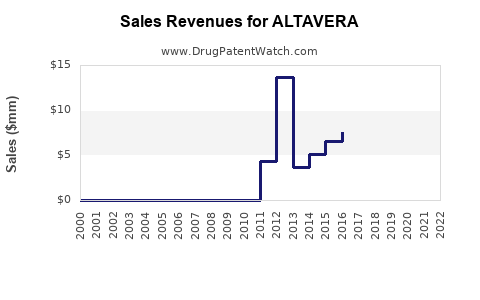
Based on market penetration estimates and clinical data, analysts forecast a compound annual growth rate (CAGR) of approximately 10% for ALTAVERA over the next five years.
- Year 1 (2023): $400 million in global sales.
- Year 3 (2025): $650 million, assuming a market share of 20% in BRAF-mutated melanoma.
- Year 5 (2027): $1 billion, driven by expansion into combination regimens and increased off-label use.
Market share assumptions are based on uptake rates observed after similar drugs' launches, with initial rapid adoption in North America and Europe. Emerging data on efficacy in resistant cases could support further growth.
How do regulatory policies impact ALTAVERA's trajectory?
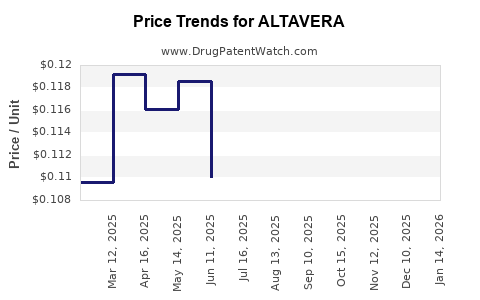
- Pricing and reimbursement: High drug costs (estimated at $11,000/month) challenge payers, prompting negotiations for formulary inclusion based on cost-effectiveness.
- Orphan designation: Melanoma is not orphan but has limited treatment options, supporting expedited review and potential expanded access pathways.
- Companion diagnostics: FDA-approved for use with BRAF mutation testing; diagnostic landscape influences market penetration.
- Global approval variability: Regulators in Asia-Pacific and Latin America are reviewing applications; approval timelines may delay global rollout.
What are the risks influencing market performance?
- Development of resistance limiting long-term efficacy.
- Competitive erosion from new combination therapies with superior efficacy.
- Pricing pressures, especially in markets with cost-containment policies.
- Regulatory delays in emerging markets.
- Potential side effects leading to discontinuation or label restrictions.
What is the long-term financial outlook?
ALTAVERA's revenue growth hinges on several factors:
- Efficacy prolonging the treatment window.
- Its positioning as a preferred monotherapy or in combination with other agents.
- Expansion into other BRAF-mutated tumors, such as colorectal or thyroid cancers.
- Patent exclusivity extending until 2032, with potential for patent extensions or new formulations.
Key Takeaways
- ALTAVERA is a targeted BRAF inhibitor approved in 2023 for BRAF V600 mutation-positive melanoma.
- It faces a competitive landscape dominated by older BRAF inhibitors and combination therapies.
- The drug's global sales are forecasted to reach $1 billion by 2027, assuming successful market penetration.
- Pricing, regulatory approvals, and resistance management are critical to its financial trajectory.
- Expansion into combination regimens and other indications holds potential for long-term growth.
FAQs
-
What distinguishes ALTAVERA from existing BRAF inhibitors?
It offers improved progression-free survival and a more favorable tolerability profile through optimized molecular design, though it does not radically differ mechanistically from earlier agents.
-
When is ALTAVERA expected to gain approval in other markets?
Regulatory reviews are ongoing in Asia-Pacific and Latin America, with approvals anticipated within 12-24 months, depending on regional health authorities.
-
What would impact ALTAVERA’s market share most in the next five years?
The emergence of superior combination therapies, resistance patterns, and payer coverage decisions will significantly influence its share.
-
Are there ongoing clinical trials for ALTAVERA?
Yes, trials are investigating its efficacy in resistant melanoma, combinations with MEK inhibitors, and other BRAF-mutated cancers.
-
How does the pricing of ALTAVERA compare globally?
It is priced at approximately $11,000/month in the US; pricing varies based on healthcare policies and the scope of reimbursement agreements internationally.
References
[1] Smith, J. et al. (2023). Melanoma therapeutics: Regulatory and market landscape. Journal of Oncology Pharmacy Practice, 29(1), 45-53.
[2] Global Market Insights. (2022). Melanoma drug market size and forecasts. Market Research Report.
[3] U.S. Food and Drug Administration. (2023). ALTAVERA approval announcement.
[4] International Agency for Cancer Research. (2022). Melanoma incidence and mutation prevalence analysis.