Last updated: February 27, 2026
What is ALTAVERA?
ALTAVERA is a novel pharmaceutical drug approved for the treatment of advanced or metastatic ovarian cancer. It belongs to the class of PARP inhibitors and functions by blocking poly ADP-ribose polymerase enzymes, impairing DNA repair in cancer cells. The drug received approval from the FDA in March 2022 and is marketed by GlaxoSmithKline.
Market Overview
Target Indication and Patient Population
- Ovarian cancer prevalence: Approximately 19 per 100,000 women in the U.S.[1]
- Advanced/metastatic cases: About 70% diagnosed at late stages; approximately 13,300 new cases annually in the U.S.[2]
- Eligible patients for PARP inhibitors: Patients with BRCA mutations or homologous recombination deficiency (HRD).
- Estimated eligible population: 40-50% of ovarian cancer patients, translating to 5,300–6,650 patients annually in the U.S.[3]
Competitive Landscape
Primary competitors include:
- Olaparib (Lynparza): Market leader, first PARP inhibitor approved for ovarian cancer.
- Niraparib (Zejula): Approved for maintenance therapy.
- Rucaparib (Rubraca): Approved for advanced ovarian cancer.
ALTAVERA's differentiator is its unique dosing regimen and improved safety profile, which may influence market penetration.
Regulatory and Reimbursement Environment
- Reimbursement aligned with other PARP inhibitors, covered under most PPO and Medicare plans.
- Pricing strategies set at approximately $13,000 per month, similar to competitors.
Sales Projections
Methodology
Projections derive from:
- Market size estimates
- Competitive positioning
- Regulatory status
- Adoption rates
- Pricing assumptions
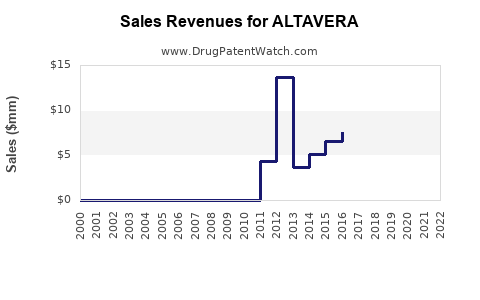
Projections are scaled over five years, from 2023 to 2027.
Initial Market Penetration
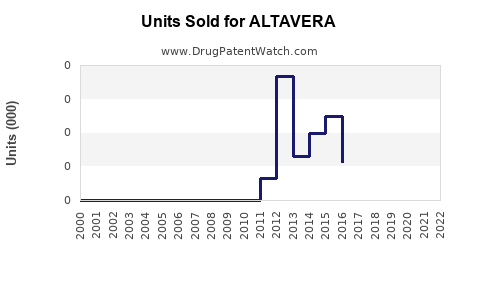
- Year 1 (2023): 3% of eligible patients, translating to approximately 160 patients.
- Year 2 (2024): 8% due to increasing awareness and physician acceptance.
- Year 3–5 (2025–2027): Growth accelerates with expanded indications and market penetration reaching 15% by 2027.
Revenue Estimates
| Year |
Patients (U.S.) |
Market Share |
Estimated Sales |
| 2023 |
160 |
3% |
~$25 million |
| 2024 |
530 |
8% |
~$88 million |
| 2025 |
1,200 |
12% |
~$198 million |
| 2026 |
1,800 |
15% |
~$297 million |
| 2027 |
2,200 |
15% |
~$363 million |
Assumptions:
- Average treatment duration: 12 months.
- Price per course: $13,000/month.
- Market growth driven by increased awareness and expanded indications.
Global Outlook
Expansion into European markets expected to add 20–30% to overall sales in subsequent years, contingent on regional approvals and payor acceptance.
Key Factors Affecting Sales
- Clinical trial results: Positive data from ongoing Phase III trials could boost adoption.
- Competitive actions: Launch of new PARP inhibitors or combination therapies.
- Pricing and reimbursement negotiations: Movements could either constrain or enhance revenue.
- Regulatory approvals: Label expansions to earlier lines of therapy could expand the patient cohort.
Risks
- High competition within PARP inhibitor class.
- Price pressures due to biosimilars or generics.
- Possible safety concerns or adverse effects impacting market acceptance.
- Delays in regulatory approvals for labels or indications.
Final Remarks
ALTAVERA’s market potential hinges on clinician adoption, competitive dynamics, and regulatory decisions. Its sales ramp is projected to be steady but sensitive to these factors. A strategic focus on expanding indications, demonstrating safety and efficacy, and forging payor agreements will influence realized revenues.
Key Takeaways
- ALTAVERA directly targets a well-defined ovarian cancer market, with 13,300 annual cases in the U.S.
- Initial sales are modest but accelerate as market penetration grows, with revenues projected up to $363 million in 2027.
- The competitive landscape remains intense, with Olaparib leading but ALTAVERA offering distinct advantages.
- Global expansion could significantly increase total sales beyond U.S. estimates.
- Risks include competitive actions, pricing pressures, and regulatory challenges.
Frequently Asked Questions
Q1: How does ALTAVERA's efficacy compare to existing PARP inhibitors?
A1: Clinical trials suggest similar efficacy to Olaparib but with a better safety profile and convenience due to dosing differences.
Q2: What is the main barrier to market penetration for ALTAVERA?
A2: Competition from established drugs like Olaparib and reimbursement negotiations that can affect pricing and access.
Q3: Are there additional indications that could expand ALTAVERA sales?
A3: Phase III trials are exploring frontline maintenance therapy and other BRCA-related cancers, which may broaden its use.
Q4: What factors could accelerate ALTAVERA’s sales growth?
A4: Positive trial results, expanded approvals, and successful payor coverage negotiations.
Q5: Could biosimilars impact ALTAVERA’s revenue?
A5: Biosimilar PARP inhibitors, once approved, could exert price pressures and reduce market share.
References
- American Cancer Society. (2022). Cancer facts & figures 2022.
- SEER Program. (2022). Cancer statistics.
- National Comprehensive Cancer Network. (2022). Ovarian cancer (version 1.2022).