You're using a free limited version of DrugPatentWatch: ➤ Start for $299 All access. No Commitment.

Last Updated: March 27, 2026

ALECENSA Drug Patent Profile


✉ Email this page to a colleague

« Back to Dashboard


When do Alecensa patents expire, and when can generic versions of Alecensa launch?

Alecensa is a drug marketed by Hoffmann-la Roche and is included in one NDA. There are five patents protecting this drug and one Paragraph IV challenge.

This drug has one hundred and forty-three patent family members in thirty-nine countries.

The generic ingredient in ALECENSA is alectinib hydrochloride. One supplier is listed for this compound. Additional details are available on the alectinib hydrochloride profile page.

DrugPatentWatch® Generic Entry Outlook for Alecensa

Alecensa was eligible for patent challenges on December 11, 2019.

By analyzing the patents and regulatory protections it appears that the earliest date for generic entry will be April 24, 2035. This may change due to patent challenges or generic licensing.

There is one Paragraph IV patent challenge for this drug. This may lead to patent invalidation or a license for generic production.

Indicators of Generic Entry

< Available with Subscription >

  Start Trial

AI Deep Research
Questions you can ask:
  • What is the 5 year forecast for ALECENSA?
  • What are the global sales for ALECENSA?
  • What is Average Wholesale Price for ALECENSA?
Summary for ALECENSA
International Patents:143
US Patents:5
Applicants:1
NDAs:1
Finished Product Suppliers / Packagers: 1
Raw Ingredient (Bulk) Api Vendors: 61
Clinical Trials: 23
Patent Applications: 505
Drug Prices: Drug price information for ALECENSA
What excipients (inactive ingredients) are in ALECENSA?ALECENSA excipients list
DailyMed Link:ALECENSA at DailyMed
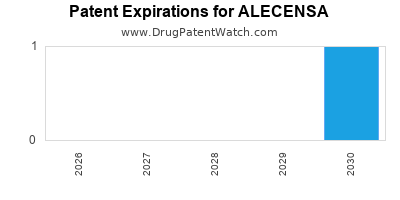
Drug patent expirations by year for ALECENSA
Drug Prices for ALECENSA

See drug prices for ALECENSA

DrugPatentWatch® Estimated Loss of Exclusivity (LOE) Date for ALECENSA
Generic Entry Date for ALECENSA*:
Constraining patent/regulatory exclusivity:
NDA:
Dosage:
CAPSULE;ORAL

*The generic entry opportunity date is the latter of the last compound-claiming patent and the last regulatory exclusivity protection. Many factors can influence early or later generic entry. This date is provided as a rough estimate of generic entry potential and should not be used as an independent source.

Recent Clinical Trials for ALECENSA

Identify potential brand extensions & 505(b)(2) entrants

SponsorPhase
Han Xu, M.D., Ph.D., FAPCR, Sponsor-Investigator, IRB ChairPhase 2/Phase 3
Cancer Research UKPhase 2/Phase 3
Royal Marsden NHS Foundation TrustPhase 2/Phase 3

See all ALECENSA clinical trials

Pharmacology for ALECENSA
Drug ClassKinase Inhibitor
Mechanism of ActionKinase Inhibitors
Paragraph IV (Patent) Challenges for ALECENSA
Tradename Dosage Ingredient Strength NDA ANDAs Submitted Submissiondate
ALECENSA Capsules alectinib hydrochloride 150 mg 208434 1 2019-12-11

US Patents and Regulatory Information for ALECENSA

ALECENSA is protected by five US patents and two FDA Regulatory Exclusivities.

Based on analysis by DrugPatentWatch, the earliest date for a generic version of ALECENSA is ⤷  Start Trial.

This potential generic entry date is based on patent ⤷  Start Trial.

Generics may enter earlier, or later, based on new patent filings, patent extensions, patent invalidation, early generic licensing, generic entry preferences, and other factors.

Applicant Tradename Generic Name Dosage NDA Approval Date TE Type RLD RS Patent No. Patent Expiration Product Substance Delist Req. Exclusivity Expiration
Hoffmann-la Roche ALECENSA alectinib hydrochloride CAPSULE;ORAL 208434-001 Dec 11, 2015 RX Yes Yes ⤷  Start Trial ⤷  Start Trial Y ⤷  Start Trial
Hoffmann-la Roche ALECENSA alectinib hydrochloride CAPSULE;ORAL 208434-001 Dec 11, 2015 RX Yes Yes ⤷  Start Trial ⤷  Start Trial ⤷  Start Trial
Hoffmann-la Roche ALECENSA alectinib hydrochloride CAPSULE;ORAL 208434-001 Dec 11, 2015 RX Yes Yes ⤷  Start Trial ⤷  Start Trial Y ⤷  Start Trial
>Applicant >Tradename >Generic Name >Dosage >NDA >Approval Date >TE >Type >RLD >RS >Patent No. >Patent Expiration >Product >Substance >Delist Req. >Exclusivity Expiration

International Patents for ALECENSA

When does loss-of-exclusivity occur for ALECENSA?

Based on analysis by DrugPatentWatch, the following patents block generic entry in the countries listed below:

Argentina

Patent: 0187
Estimated Expiration: ⤷  Start Trial

Patent: 2148
Estimated Expiration: ⤷  Start Trial

Australia

Patent: 15250574
Estimated Expiration: ⤷  Start Trial

Patent: 20230293
Estimated Expiration: ⤷  Start Trial

Brazil

Patent: 2016021206
Estimated Expiration: ⤷  Start Trial

Canada

Patent: 46518
Estimated Expiration: ⤷  Start Trial

Patent: 40565
Estimated Expiration: ⤷  Start Trial

China

Patent: 6456651
Estimated Expiration: ⤷  Start Trial

Patent: 3975243
Estimated Expiration: ⤷  Start Trial

European Patent Office

Patent: 35287
Estimated Expiration: ⤷  Start Trial

Patent: 97659
Estimated Expiration: ⤷  Start Trial

Israel

Patent: 8363
Estimated Expiration: ⤷  Start Trial

Patent: 3152
Estimated Expiration: ⤷  Start Trial

Japan

Patent: 2015163448
Estimated Expiration: ⤷  Start Trial

Patent: 59712
Estimated Expiration: ⤷  Start Trial

Patent: 29942
Estimated Expiration: ⤷  Start Trial

Patent: 16104762
Estimated Expiration: ⤷  Start Trial

Malaysia

Patent: 9913
Patent: PREPARATION CONTAINING TETRACYCLIC COMPOUND AT HIGH DOSE
Estimated Expiration: ⤷  Start Trial

Patent: 0583
Patent: FORMULATION CONTAINING A LARGE AMOUNT OF TETRACYCLIC COMPOUND
Estimated Expiration: ⤷  Start Trial

Mexico

Patent: 6901
Patent: FORMULACION QUE CONTIENE UNA GRAN CANTIDAD DE COMPUESTO TETRACICLICO. (PREPARATION CONTAINING TETRACYCLIC COMPOUND AT HIGH DOSE)
Estimated Expiration: ⤷  Start Trial

Patent: 16013809
Estimated Expiration: ⤷  Start Trial

Patent: 21012300
Patent: FORMULACION QUE CONTIENE UNA GRAN CANTIDAD DE COMPUESTO TETRACICLICO. (PREPARATION CONTAINING TETRACYCLIC COMPOUND AT HIGH DOSE.)
Estimated Expiration: ⤷  Start Trial

New Zealand

Patent: 4713
Patent: Preparation containing tetracyclic compound at high dose
Estimated Expiration: ⤷  Start Trial

Patent: 3604
Patent: Preparation containing tetracyclic compound at high dose
Estimated Expiration: ⤷  Start Trial

Poland

Patent: 35287
Estimated Expiration: ⤷  Start Trial

Russian Federation

Patent: 24056
Patent: ПОЛУЧЕНИЕ ТЕТРАЦИКЛИЧЕСКОГО СОЕДИНЕНИЯ, СОДЕРЖАЩЕГОСЯ В ВЫСОКОЙ ДОЗЕ (OBTAINING A TETRACYCLIC COMPOUND CONTAINED IN A HIGH DOSE)
Estimated Expiration: ⤷  Start Trial

Patent: 16145057
Patent: ПОЛУЧЕНИЕ ТЕТРАЦИКЛИЧЕСКОГО СОЕДИНЕНИЯ, СОДЕРЖАЩЕГОСЯ В ВЫСОКОЙ ДОЗЕ
Estimated Expiration: ⤷  Start Trial

Patent: 20119391
Patent: ПОЛУЧЕНИЕ ТЕТРАЦИКЛИЧЕСКОГО СОЕДИНЕНИЯ, СОДЕРЖАЩЕГОСЯ В ВЫСОКОЙ ДОЗЕ
Estimated Expiration: ⤷  Start Trial

Singapore

Patent: 202009484W
Patent: PREPARATION CONTAINING TETRACYCLIC COMPOUND AT HIGH DOSE
Estimated Expiration: ⤷  Start Trial

Patent: 201607623X
Patent: PREPARATION CONTAINING TETRACYCLIC COMPOUND AT HIGH DOSE
Estimated Expiration: ⤷  Start Trial

South Africa

Patent: 1606447
Patent: PREPARATION CONTAINING TETRACYCLIC COMPOUND AT HIGH DOSE
Estimated Expiration: ⤷  Start Trial

South Korea

Patent: 2412321
Estimated Expiration: ⤷  Start Trial

Patent: 2478887
Estimated Expiration: ⤷  Start Trial

Patent: 160146800
Estimated Expiration: ⤷  Start Trial

Patent: 220087583
Estimated Expiration: ⤷  Start Trial

Spain

Patent: 94202
Estimated Expiration: ⤷  Start Trial

Taiwan

Patent: 20943
Estimated Expiration: ⤷  Start Trial

Patent: 71839
Estimated Expiration: ⤷  Start Trial

Patent: 31128
Estimated Expiration: ⤷  Start Trial

Patent: 1622706
Patent: Formulation comprising tetracyclic compounds in high dose
Estimated Expiration: ⤷  Start Trial

Patent: 2114693
Patent: Formulation comprising tetracyclic compounds in high dose
Estimated Expiration: ⤷  Start Trial

Patent: 2235088
Patent: Formulation comprising tetracyclic compounds in high dose
Estimated Expiration: ⤷  Start Trial

Generics may enter earlier, or later, based on new patent filings, patent extensions, patent invalidation, early generic licensing, generic entry preferences, and other factors.

See the table below for additional patents covering ALECENSA around the world.

Country Patent Number Title Estimated Expiration
Japan WO2010143664 4環性化合物 ⤷  Start Trial
New Zealand 763604 Preparation containing tetracyclic compound at high dose ⤷  Start Trial
Hungary S1700026 ⤷  Start Trial
>Country >Patent Number >Title >Estimated Expiration

Supplementary Protection Certificates for ALECENSA

Patent Number Supplementary Protection Certificate SPC Country SPC Expiration SPC Description
2441753 LUC00022 Luxembourg ⤷  Start Trial PRODUCT NAME: ALECTINIB OU SEL OU SOLVATE DE CELUI-CI; AUTHORISATION NUMBER AND DATE: EU/1/16/1169/001 20170220
2441753 201740017 Slovenia ⤷  Start Trial PRODUCT NAME: ALECTINIB OR ITS SALT OR SOLVATE; NATIONAL AUTHORISATION NUMBER: EU/1/16/1169/001; DATE OF NATIONAL AUTHORISATION: 20170216; AUTHORITY FOR NATIONAL AUTHORISATION: EU
2441753 132017000079367 Italy ⤷  Start Trial PRODUCT NAME: ALECTINIB O UN SUO SALE O SOLVATO(ALECENSA); AUTHORISATION NUMBER(S) AND DATE(S): EU/1/16/1169, 20170220
>Patent Number >Supplementary Protection Certificate >SPC Country >SPC Expiration >SPC Description

ALUNIGIB (Alecensa) Market Dynamics and Financial Trajectory

Last updated: February 19, 2026

ALUNIGIB, marketed as Alecensa, a prescription medicine used to treat adults with anaplastic lymphoma kinase (ALK)-positive, advanced or metastatic non-small cell lung cancer (NSCLC), demonstrates a significant market presence driven by its efficacy and the unmet need in its target population. The drug's trajectory is shaped by patent exclusivity, market penetration, and competitive landscape.

What is the patent landscape for ALUNIGIB?

ALUNIGIB is protected by a portfolio of patents, primarily held by Chugai Pharmaceutical Co., Ltd., a member of the Roche Group. These patents cover various aspects of the drug, including its composition of matter, methods of use, and manufacturing processes.

  • Composition of Matter Patents: These are foundational patents that protect the active pharmaceutical ingredient (API) itself. For ALUNIGIB (alectinib), these patents provide the broadest protection.
    • The primary composition of matter patent in the United States is expected to expire around 2031. However, patent expiration dates can vary significantly by country and can be extended through mechanisms like patent term extensions (PTE) or supplementary protection certificates (SPCs) in regions like Europe, which compensate for regulatory review time.
  • Method of Use Patents: These patents cover specific uses of the drug, such as treating ALK-positive metastatic NSCLC.
    • Method of use patents can extend market exclusivity beyond the initial composition of matter patent expiry. These often relate to specific dosing regimens, patient populations, or indications.
  • Formulation and Manufacturing Patents: These patents protect specific ways the drug is formulated (e.g., capsule formulation) or manufactured, which can also contribute to market exclusivity.
  • Patent Litigation and Exclusivity: Like many innovative drugs, ALUNIGIB has faced and may face patent challenges. The outcome of such litigation can significantly impact its market exclusivity period. Generic manufacturers often challenge patents in an effort to bring their versions to market sooner.
    • In the United States, the Hatch-Waxman Act provides for 5-year data exclusivity for new chemical entities (NCEs), which can be extended. ALUNIGIB received FDA approval on December 11, 2015 [1].
    • Orphan drug exclusivity, granted for drugs treating rare diseases, can provide an additional 7 years of market exclusivity in the U.S. ALUNIGIB is designated as an orphan drug in the U.S. for certain indications.
    • In Europe, SPCs can extend patent protection for up to 5 years beyond the expiry of the basic patent, with a possible 6-month extension for pediatric studies.

What is ALUNIGIB's market performance and revenue generation?

ALUNIGIB has achieved substantial market penetration and revenue growth since its launch, driven by its clinical profile and strategic market access.

  • Sales Revenue: Roche reported net sales for Alecensa reaching CHF 1.297 billion in 2021, a 31% increase from CHF 992 million in 2020 [2].
    • In 2022, Alecensa sales grew to CHF 1.561 billion, a 20% increase year-over-year [3].
    • For the full year 2023, Alecensa generated CHF 1.878 billion in sales, a 19.8% increase compared to 2022 [4]. This trend indicates sustained market demand and successful commercialization.
  • Geographic Distribution: Sales are distributed globally, with major contributions from the U.S., Europe, and Japan. The U.S. market typically represents the largest share due to higher drug prices and market size.
  • Growth Drivers:
    • Clinical Efficacy: ALUNIGIB's demonstrated efficacy in patients with ALK-positive metastatic NSCLC, particularly those who have progressed on or are intolerant to other ALK inhibitors, is a primary driver. The ALEX study, for instance, showed superior progression-free survival (PFS) compared to crizotinib in first-line treatment [5].
    • Indication Expansion: FDA approval for expanded indications, such as the treatment of ALK-positive metastatic NSCLC in the first-line setting (approved in November 2017) [6], significantly broadened the eligible patient population and fueled sales growth.
    • Market Penetration: Increasing physician and patient awareness, coupled with favorable reimbursement policies, supports deeper market penetration.
    • Competitive Positioning: ALUNIGIB competes with other ALK inhibitors, including crizotinib (Xalkori), ceritinib (Zykadia), brigatinib (Alunbrig), and ensartinib (Xanox). Its distinct efficacy and safety profile have allowed it to capture significant market share.

What is the competitive landscape for ALUNIGIB?

The market for ALK-positive NSCLC treatments is characterized by an evolving competitive landscape, with multiple targeted therapies available.

  • Key Competitors:
    • Brigatinib (Alunbrig): Developed by Takeda Pharmaceutical Company, brigatinib is another potent ALK inhibitor approved for both first-line and later-line treatment of ALK-positive NSCLC. It competes directly with ALUNIGIB, particularly in the first-line setting.
    • Crizotinib (Xalkori): Developed by Pfizer, crizotinib was one of the first ALK inhibitors approved. While still used, it is generally considered less effective than newer-generation inhibitors like ALUNIGIB and brigatinib, especially in the first-line setting.
    • Ceritinib (Zykadia): Developed by Novartis, ceritinib is also an ALK inhibitor used in the treatment of ALK-positive NSCLC.
    • Ensartinib (Xanox): Developed by Xcovery, ensartinib is approved in China for ALK-positive NSCLC and is being investigated in other regions.
  • Differentiating Factors:
    • Efficacy Data: Clinical trial data comparing ALUNIGIB against competitors is crucial. The ALEX study demonstrating superior PFS in the first-line setting compared to crizotinib is a key differentiator [5]. Studies comparing ALUNIGIB to brigatinib also inform its positioning.
    • Safety and Tolerability Profile: Differences in side effect profiles can influence physician choice and patient adherence.
    • Central Nervous System (CNS) Activity: ALUNIGIB has shown significant activity against brain metastases, a common complication of NSCLC. This CNS penetration is a critical advantage.
    • First-Line vs. Later-Line Use: The approval for first-line treatment has been a major catalyst for ALUNIGIB's market growth.
  • Emerging Therapies: The field continues to evolve with the development of next-generation ALK inhibitors and novel treatment combinations. The emergence of resistance mutations can also drive the need for new therapeutic strategies.

What is the regulatory status and R&D pipeline for ALUNIGIB?

ALUNIGIB has secured approvals in major markets and continues to be evaluated for new indications and combinations.

  • Current Approvals:
    • U.S. Food and Drug Administration (FDA): Approved for ALK-positive metastatic NSCLC in patients who have progressed on or are intolerant to a crizotinib-containing regimen (December 2015) and for the first-line treatment of patients with ALK-positive metastatic NSCLC (November 2017) [1, 6].
    • European Medicines Agency (EMA): Approved for the treatment of adult patients with ALK-positive advanced NSCLC who have received prior treatment with at least one ALK inhibitor, and for adult patients with ALK-positive advanced NSCLC in the first-line setting.
    • Pharmaceuticals and Medical Devices Agency (PMDA) in Japan: Approved for ALK-positive advanced NSCLC.
  • Ongoing R&D:
    • Combination Therapies: Roche is actively investigating ALUNIGIB in combination with other agents to overcome resistance mechanisms and improve treatment outcomes. This includes combinations with immunotherapy agents and other targeted therapies.
    • Other Cancer Types: While primarily approved for NSCLC, ALK alterations can occur in other cancer types, presenting potential future indications. However, the primary focus remains on NSCLC.
    • Adjuvant Setting: Research into ALUNIGIB's efficacy in the adjuvant setting (after surgery) for early-stage NSCLC could represent a significant expansion of its use.

What is the projected financial outlook for ALUNIGIB?

The financial outlook for ALUNIGIB remains positive, supported by ongoing sales growth, albeit with increasing competitive and eventual generic pressures.

  • Sales Projections:
    • Analyst consensus generally projects continued single-digit to low double-digit growth for ALUNIGIB in the near to medium term, driven by its established position in both first-line and later-line ALK-positive NSCLC.
    • Global sales are expected to exceed CHF 2 billion in the coming years. For instance, by 2025, consensus estimates placed sales in the range of CHF 2.3 to 2.7 billion.
  • Factors Influencing Future Revenue:
    • Market Share Maintenance: Sustaining market share against emerging competitors and generic entries post-patent expiry will be critical.
    • R&D Success: The success of combination therapy trials and potential label expansions can provide incremental revenue boosts.
    • Pricing and Reimbursement: Evolving healthcare policies and payer negotiations will influence pricing power.
    • Generic Competition: The advent of generic ALUNIGIB upon patent expiry will lead to a significant decline in sales for the branded product. The timing of this generic entry is the most significant factor impacting long-term revenue. Based on current patent expiry projections (around 2031 in the U.S. with potential extensions), significant generic competition is not anticipated for several years.
    • Geographic Expansion: Further penetration in emerging markets could offer additional growth opportunities, though access and pricing in these regions present challenges.

Key Takeaways

  • ALUNIGIB's patent exclusivity is robust, with primary composition of matter patents expiring around 2031 in the U.S., potentially extended by regulatory exclusivities.
  • The drug has demonstrated strong revenue growth, exceeding CHF 1.8 billion in annual sales in 2023, driven by its clinical efficacy in ALK-positive NSCLC.
  • Key competitors include brigatinib, crizotinib, and ceritinib, with ALUNIGIB differentiating through its efficacy, CNS activity, and first-line approval.
  • Ongoing R&D focuses on combination therapies and potential label expansions, though the primary market remains ALK-positive NSCLC.
  • The financial outlook is positive in the medium term, with projected continued growth, but will be significantly impacted by generic competition following patent expiry.

Frequently Asked Questions

  1. When is the earliest a generic version of ALUNIGIB could be available in the U.S.? Based on projected patent expiry dates for the primary composition of matter patent around 2031, and considering potential patent term extensions and regulatory exclusivities, significant generic entry is not expected before the early to mid-2030s.
  2. What is the primary mechanism of action for ALUNIGIB? ALUNIGIB is a potent and selective inhibitor of anaplastic lymphoma kinase (ALK), which plays a critical role in the development of certain types of non-small cell lung cancer.
  3. Which clinical trial was pivotal in establishing ALUNIGIB's first-line efficacy? The ALEX study demonstrated superior progression-free survival (PFS) for ALUNIGIB compared to crizotinib in the first-line treatment of ALK-positive metastatic NSCLC.
  4. Does ALUNIGIB have any activity against brain metastases? Yes, ALUNIGIB has shown significant activity against brain metastases in patients with ALK-positive NSCLC, which is a key clinical advantage.
  5. What are the main drivers for ALUNIGIB's ongoing sales growth? Ongoing sales growth is driven by its established efficacy in both first-line and later-line treatment settings for ALK-positive NSCLC, expanded indications, and physician adoption.

Citations

[1] U.S. Food & Drug Administration. (2015, December 11). FDA approves Alecensa (alectinib) for patients with ALK-positive, advanced non-small cell lung cancer. Retrieved from FDA News Release

[2] Roche. (2022, February 3). Full-year results 2021. Retrieved from Roche Media Releases

[3] Roche. (2023, February 2). Full-year results 2022. Retrieved from Roche Media Releases

[4] Roche. (2024, January 31). Full-year results 2023. Retrieved from Roche Media Releases

[5] Peters, S., Chau, N., Vansteenkiste, J. F., Chou, T. G., Chen, M., John, S. P., ... & Kim, D. W. (2017). Alectinib versus crizotinib in previously untreated patients with ALK-positive advanced non-small-cell lung cancer (ALEX): a randomized, open-label, phase 3 tyrosine kinase inhibitor study. The Lancet, 389(10077), 1322-1330. doi:10.1016/S0140-6736(17)30410-X

[6] U.S. Food & Drug Administration. (2017, November 21). FDA expands approval of Alecensa to include first-line treatment for ALK-positive non-small cell lung cancer. Retrieved from FDA News Release

More… ↓

⤷  Start Trial

Make Better Decisions: Try a trial or see plans & pricing

Drugs may be covered by multiple patents or regulatory protections. All trademarks and applicant names are the property of their respective owners or licensors. Although great care is taken in the proper and correct provision of this service, thinkBiotech LLC does not accept any responsibility for possible consequences of errors or omissions in the provided data. The data presented herein is for information purposes only. There is no warranty that the data contained herein is error free. We do not provide individual investment advice. This service is not registered with any financial regulatory agency. The information we publish is educational only and based on our opinions plus our models. By using DrugPatentWatch you acknowledge that we do not provide personalized recommendations or advice. thinkBiotech performs no independent verification of facts as provided by public sources nor are attempts made to provide legal or investing advice. Any reliance on data provided herein is done solely at the discretion of the user. Users of this service are advised to seek professional advice and independent confirmation before considering acting on any of the provided information. thinkBiotech LLC reserves the right to amend, extend or withdraw any part or all of the offered service without notice.