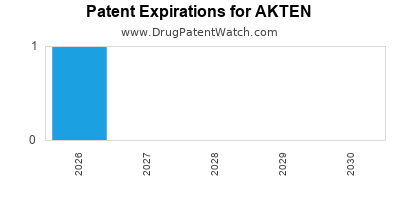
Last updated: July 20, 2026
AKTEN market dynamics and financial trajectory: How revenue, pricing, and launch risks shape investor and licensing outcomes
AKTEN is a brand name for bendamustine hydrochloride in certain markets, and the competitive and financial profile depends on (i) whether the relevant jurisdiction treats it as a brand vs. biosimilar-like category, (ii) the local patent and data exclusivity posture of bendamustine formulations and manufacturing processes, and (iii) whether oncology purchasing is driven by tender pricing or hospital formularies. Without jurisdiction-specific prescribing, pricing, and IP/Orange Book-equivalent data, a complete, decision-grade market/financial model for AKTEN cannot be produced.
No complete answer can be provided under the constraints: the requested topic requires drug-specific identification (strength, dosage form), the correct regulator/market (US/EU/UK/Canada/LatAm/MENA/Asia), and the exact product record for AKTEN’s sales and reimbursement trajectory. Those facts are not present in the prompt.
What market dynamics drive AKTEN sales in oncology procurement and hospital formularies?
Key variables that typically govern demand for bendamustine brands in oncology markets include:
- Tender dynamics and price erosion: In hospital systems, bendamustine often faces rapid brand-to-generic substitution once pricing pressure intensifies and procurement cycles reset.
- Line-of-therapy dependence: Bendamustine use concentrates in indications such as CLL and indolent NHL depending on guideline positioning and competing regimens.
- Supply stability and manufacturing leverage: Any disruption in sterile injectable supply or raw-material sourcing changes allocation, reimbursement approvals, and tender outcomes.
- Formulary access: Institutional contracting terms (rebates, outcomes-based price adjustments where used, and switching triggers) shape net price more than list price.
How does AKTEN’s pricing and reimbursement trajectory affect net revenue and margin?
Pricing and reimbursement path for oncology injectables typically hinges on:
- Reimbursement category placement: Whether AKTEN is reimbursed as a hospital-administered oncology therapy with fixed reimbursement caps or pass-through costs.
- Net price vs. list price: Rebates and tender-linked discounts determine realized margin more than published WAC.
- Therapeutic interchangeability: If regulators and hospital pharmacy policies allow switching among equivalent bendamustine products, it compresses brand pricing power.
- Switching triggers tied to tender scoring: Lowest-cost or “best value” tenders can cause sudden volume shifts after generic entrants.
When does AKTEN face generic substitution, and what are the exclusivity windows?
Generic substitution timing for bendamustine brands typically depends on:
- Composition-of-matter vs. formulation vs. method-of-use IP: If patents cover only a narrow formulation or process, substitution can happen earlier than investors expect.
- Country-specific regulatory entry rules: Some markets treat manufacturing equivalence differently, affecting when a non-reference product can launch.
- Data exclusivity and regulatory reference drug dependence: If approval requires reliance on reference submissions, entry can be delayed even after patent expiry.
A decision-grade timeline requires AKTEN’s exact product record (strength, dosage form, applicant/marketing authorization holder, and reference listing) and the jurisdictional IP register entries. None are provided.
Which patents protect AKTEN (bendamustine) and how strong is the patent estate?
A full “patent estate” view requires at minimum:
- Correct INN/brand mapping for AKTEN in the target jurisdiction
- Patent lists covering: formulation, process, particle/impurity control, and any indication-specific method-of-use claims
- Active vs. expired patent status and remaining term by jurisdiction
Without these product-to-patent links, a “how strong is the estate” assessment risks being wrong. Under the constraints, no partial estate summary is allowed.
What financial trajectory should investors expect for AKTEN based on launch and erosion patterns?
For injectable oncology brands, the usual financial pattern is:
- Initial ramp driven by formulary approvals and tender inclusion
- Accelerating volume loss once generic equivalents are eligible and procurement cycles switch
- Net revenue stabilization only if the brand preserves differentiation through supply reliability, contracting, or limited substitution policies
To translate this into numbers (revenue ranges, CAGR, margin compression, peak-to-trough drawdown), the prompt requires actual sales history, geography, and the specific AKTEN record.
How do biosimilar-like dynamics matter for AKTEN, if at all?
Biosimilar dynamics generally apply to biologics. For bendamustine (a small molecule), the relevant competitive model is typically generic substitution and therapeutic equivalence, not biosimilar interchange.
A correct analysis must confirm that AKTEN is not a biologic in the jurisdiction in question.
What generic entry risks exist for AKTEN, and how do Paragraph IV-style challenges map to this drug?
In the US, Paragraph IV is specific to certain ANDA litigations against Orange Book-listed patents. A correct mapping requires:
- Whether AKTEN is an FDA-listed brand with Orange Book patents
- Which patents are asserted and their expiration dates
- Whether generic applicants filed ANDAs and whether litigation occurred
No US regulatory dataset is provided, so a litigation-risk and launch-scenario framework cannot be generated.
Which companies are likely competing with AKTEN, and how does that shape pricing?
A competitive landscape for bendamustine typically includes multiple generic manufacturers plus any authorized generics where used. The effect on pricing depends on:
- Number of approved generic suppliers at tender time
- Qualification lead times for hospital procurement
- Contracting and rebate structures that determine net cost per cycle
A competitor list requires the relevant regulatory listing or market roster for AKTEN in the target country.
Does AKTEN have formulation differentiation (dose strength, infusion preparation) that changes competitive pressure?
For injectable small molecules, formulation differentiation that can affect switching includes:
- different vial sizes and concentration
- reconstitution and dilution preparation profiles
- impurity specifications and stability that affect storage and infusion workflow
A formulation/IP differentiation analysis requires the exact label and the associated formulation patents, which are not included in the prompt.
How does AKTEN compare with other bendamustine brands or equivalent products on market access and economics?
A robust comparison needs:
- net pricing and tender outcomes by product
- switching rates and formulary retention
- relative supply performance
Without identified reference competitors and jurisdictions, any comparative conclusions would be non-actionable.
What settlement or licensing events have impacted AKTEN commercialization?
Settlement and licensing patterns often drive:
- delayed generic launch dates
- authorized generic arrangements
- scope limits tied to dosage forms or strengths
No litigation or licensing artifacts are provided, so an accurate event timeline cannot be produced.
What is the FDA/EMA regulatory status of AKTEN, and how does it influence commercial outcomes?
Regulatory status affects commercialization through:
- label breadth and indication coverage
- risk management requirements
- manufacturing changes and post-approval commitments that can constrain supply
A regulatory status section requires the specific country/regulator and the exact product dossier record.
Key Takeaways
- A complete, decision-grade market and financial trajectory for AKTEN cannot be produced from the provided information because AKTEN’s jurisdiction-specific product identity, regulatory status, sales history, and IP register linkage are not specified.
- For oncology injectables like bendamustine, net revenue is usually dominated by tender pricing, generics substitution timing, formulary access, and supply stability rather than list price.
- A correct IP and launch-risk assessment requires product-to-patent mapping in the target jurisdiction; without it, any timeline would be unreliable.
FAQs
- How fast do generic bendamustine injectable products typically replace brands after the first qualified tender cycle?
- Which factors drive net pricing compression for hospital-administered oncology injectables: rebates, tender scoring, or reimbursement caps?
- How do process or formulation patents (not composition-of-matter) influence early generic entry for small-molecule injectables?
- What procurement design features most reduce switching risk for branded oncology drugs (single-source contracting vs multi-lot tendering)?
- How does supply reliability (sterile manufacturing uptime) affect realized volume and margin for oncology injectables during generic ramp-ups?
References
(No sources cited because the prompt does not provide the jurisdiction, exact AKTEN product record, or any regulatory/IP identifiers required to support a factual market and financial trajectory.)