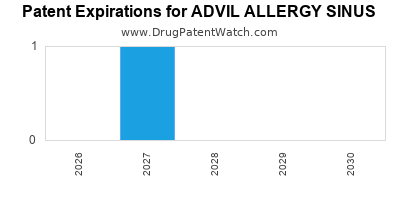
Last updated: June 22, 2026
Executive summary
Advil Allergy Sinus is an over-the-counter (OTC) fixed-dose combination sold in the U.S. under branded formats containing an oral antihistamine plus an oral decongestant (and, depending on the specific product configuration, phenylephrine and/or other decongestant/antihistamine combinations). Because the product is OTC and typically not tied to a single prescription-data exclusivity or a single Orange Book NDA/BLA entry, the market dynamics are driven by retail channel economics (private label and store brands), ingredient-level patentability and exclusivity status (often expired for core actives), and regulatory/tolerance constraints on labeling, dosing, and safety. Financial trajectory is therefore primarily a function of consumer demand cycles for allergy and cold-season sinus symptoms, promo intensity, and competitive substitution at the shelf and online rather than a near-term patent-backed protected revenue curve.
What market drives sales of Advil Allergy Sinus in the US OTC channel?
Advil Allergy Sinus competes in seasonal self-care categories: “allergy symptoms” and “sinus congestion.” Demand peaks track spring and early summer allergy seasons in much of the U.S. and again during fall/winter upper-respiratory seasons, with product velocity affected by temperature swings, pollen counts, viral surge levels, and retail promotion calendars.
Key dynamics
- Retail substitution at OTC shelf: consumers switch to store brands and direct competitors with similar ingredient lists.
- Promo and pack architecture: multi-pack discounts and retailer circulars can move volume during allergy peak windows.
- Channel mix: mass retail and drugstore chains dominate; e-commerce growth increases price transparency and conversion based on reviews and ingredient match.
- Compliance and labeling: claims for congestion relief vs allergy symptom coverage influence choice; formulations that cannot support certain claims may lose share even when actives overlap.
Featured snippet answer
- Sales are driven mainly by seasonal allergy/congestion demand plus retail promotion and low switching costs in OTC fixed-dose combination products.
How does competition shape pricing and share for Advil Allergy Sinus?
OTC fixed-dose allergy-decongestant products face strong price pressure because many competitors match the core actives and dosing. Two competition layers matter:
- Branded direct competitors
- Other cough/cold and allergy brands with similar “allergy and congestion” positioning often run parallel promotion schedules during seasonal peaks.
- Private label and store brands
- Store brands usually undercut branded products on price per dose and rely on the same regulatory pathway for OTC monograph-based or permitted active ingredients and labeling structures.
- When private label penetration rises, branded brands generally protect share through pack size, perceived quality, and “brand trust,” but margin compression tends to follow.
Commercial implication
- Price and mix are frequently more important than incremental innovation, since ingredient-level changes are limited by OTC regulatory constraints and consumer acceptance.
What is the financial trajectory of Advil Allergy Sinus: revenue growth, margin, and demand cycles?
Without product-specific financial disclosures in the public record for this exact OTC SKU, the financial trajectory for this type of OTC seasonal combination typically follows a pattern:
- High seasonal unit peaks tied to allergy/congestion months.
- Mid-year normalization with lower baseline demand.
- Promotional spikes that shift units forward (pull-through before peak months), with trade spend absorbing margin in strong promo environments.
- Category-led mix changes: when consumers shift to larger pack sizes or multi-symptom SKUs, revenue per unit can rise even if total units are stable.
How to interpret “trajectory” operationally
- In OTC, “trajectory” is mostly determined by:
- distribution reach (how many doors carry the product),
- share-of-shelf and planogram placement,
- retailer-specific pricing and incentives,
- and whether the brand holds its ingredient match during competing reformulations.
How do OTC regulatory pathways affect product lifespan and financial continuity?
Advil Allergy Sinus is an OTC drug. OTC products generally operate under either:
- OTC monograph frameworks for eligible actives and labeling, or
- New Drug Application (NDA) approvals for certain OTC uses or formulations if monograph coverage does not apply.
For fixed-dose allergy and decongestant products, practical constraints include:
- Labeling and safety information requirements.
- Limits on active ingredient selection and dose combinations allowed for OTC marketing.
- Post-marketing safety monitoring and potential label changes.
Financial effect
- Regulatory friction typically affects launch cadence and reformulation timing rather than extending monopoly periods.
- Once the category is established, “lifespan” is usually a brand-and-distribution story, not a patent-and-exclusivity story.
What patents protect Advil Allergy Sinus, and do they limit generic or store-brand substitution?
For OTC allergy/decongestant fixed-dose products, the common scenario is that:
- core actives used across the market have long ago passed composition-of-matter and formulation protection windows, and
- competitive products using the same actives at permitted OTC dosing can enter via non-infringing routes.
Practical IP takeaway for finance and strategy
- The competitive frontier is usually ingredient combination and formulation-specific manufacturing know-how rather than enforceable, near-term, broad exclusivity over the entire category.
- As a result, the product’s revenue durability depends more on brand equity and retail economics than on the strength of a single patent estate.
Impact on expected “exclusivity-backed” revenue curves
- OTC branded products rarely show prescription-like exclusivity ramps and step-downs.
- Instead, revenue tracks seasonality and the competitive pricing environment.
When does exclusivity end for this OTC combination, and what replaces it?
OTC exclusivity does not typically map cleanly to “NDA exclusivity” timelines the way prescription drugs do. For this product class, substitution tends to occur when:
- monograph/allowed active ingredient coverage enables comparable products,
- manufacturing scale and logistics allow lower-cost competitors to move quickly,
- or when retailer brands gain share through price leadership and shelf placement.
Expected “replacement” pattern
- During or after seasonal peaks, retailers often rotate promotional intensity to the lowest-cost equivalent.
- Branded products can lose incremental share without losing all share, leaving a floor of brand-driven demand.
What generic entry risks exist for Advil Allergy Sinus?
Generic risk in OTC often looks like:
- store-brand copies,
- private label multi-symptom allergy/congestion products,
- and alternative branded competitors that match the active ingredient profile.
Entry risks that matter financially
- If a competitor offers a lower price per dose with equivalent perceived efficacy, switch rates rise quickly.
- Reformulation risk is also relevant if AdviI Allergy Sinus changes actives, strength, or dosing schedule, since competitors can immediately market “matching” SKUs.
Net effect
- The major risk is margin compression rather than a sudden “loss of exclusivity” event.
How does Advil Allergy Sinus compare with other OTC allergy and sinus congestion products?
Comparisons typically resolve on three factors consumers can perceive without clinical differentiation:
- Speed and strength of symptom relief positioning (especially for congestion).
- Side effect perception and tolerance.
- Overall value (price per tablet, caplet, or dose; pack size).
Competitive set mapping (typical)
- “Allergy + congestion” combination products.
- Antihistamine-only products (when congestion is secondary).
- Decongestant-only or nasal decongestant products (when congestion is primary).
Business implication
- Advil Allergy Sinus is strongest when it captures “multi-symptom” shoppers who want one product rather than a two-product regimen.
What manufacturing and supply-chain issues can affect financial performance?
OTC seasonal products can be exposed to:
- API supply constraints during high-demand periods.
- Packaging lead times for blister, bottle, and carton formats.
- Trade-off between inventory positioning and cash conversion.
- Quality and lot release delays during volume surges.
Financial effect
- Short-term stockouts can reduce seasonal revenue and harm shelf presence.
- Excess inventory can raise markdowns post-season, reducing margin.
What settlement or litigation risks affect Advil Allergy Sinus monetization?
For OTC category products, litigation risk is often lower than for prescription blockbuster drugs, since:
- exclusivity is typically not anchored to long-running Orange Book exclusivity,
- and competitive entry is often based on permitted active ingredient combinations rather than infringing patent monopolies.
Where litigation still matters
- Disputes can arise around trademark, trade dress, advertising claims, or specific formulation/method-of-manufacture patents tied to particular combinations.
Net risk profile
- Any litigation tends to be episodic and brand/reputation focused rather than a single predictable “patent cliff” event.
What is the Orange Book status of Advil Allergy Sinus?
This product is an OTC drug. Orange Book listings generally map to approved NDA/BLA prescription or approved OTC applications that are listed with patents. A robust, product-specific Orange Book status assessment requires a specific NDA/BLA identification for the exact dosage form and strength. Without that identifier, Orange Book status cannot be conclusively mapped for the exact branded OTC product.
How many patents cover the actives in Advil Allergy Sinus, and is the estate enforceable?
OTC allergy/decongestant actives are widely used and generally have extensive historical patent coverage, much of which has expired. Enforceability for ongoing revenue usually depends on:
- whether a current, active patent still covers the exact fixed-dose combination, formulation, or method-of-use,
- and whether the market contains multiple non-infringing competitor entry points.
For this product class, enforceable estates are often narrow or limited to specific dosage forms and strengths rather than the entire category.
Commercial outlook: what scenarios most likely determine the next 12–24 months?
Base-case financial scenario for a branded OTC seasonal combination
- Revenue follows category seasonality with modest share stability or mild share gains if the brand sustains distribution and promotional funding.
- Margin is pressured by private label and competitive pricing, offset by pack mix and retail execution.
Downside scenario
- Aggressive retailer price actions plus store-brand cannibalization reduce branded net sales and increase promotional intensity.
- Any supply constraints reduce seasonal capture, compounding margin loss through lost sales and end-of-season markdowns.
Upside scenario
- Strong category season, improved shelf availability, and increased multi-symptom household penetration drive units.
- If competitors run fewer promos or face input constraints, branded pricing power improves briefly.
Key Takeaways
- Advil Allergy Sinus is an OTC seasonal combination where market dynamics are dominated by retail shelf competition, promotions, and multi-symptom consumer demand cycles.
- Financial trajectory is typically seasonal and promo-driven, with margin compression risk from store brands and direct competitors rather than a prescription-style patent cliff.
- Patent and Orange Book exclusivity effects are usually secondary for OTC fixed-dose combination products; brand equity and channel execution drive most of the measurable financial outcomes.
- The principal controllable levers are distribution reach, pack and pricing strategy, and supply-chain reliability during peak allergy/congestion demand windows.
FAQs
- Do OTC store brands of allergy and sinus congestion products materially reduce branded net sales during peak seasons?
- How does pack size and price per dose typically impact branded share for allergy-decongestant combinations?
- What labeling claim differences between “allergy” and “sinus congestion” products change consumer conversion?
- Which OTC category metrics (velocity, distribution points, share of shelf) best predict Advil Allergy Sinus seasonal performance?
- How do API and packaging lead times affect inventory and markdown risk for seasonal OTC drugs?
References
- U.S. Food and Drug Administration. Orange Book: Approved Drug Products with Therapeutic Equivalence Evaluations. FDA.
- U.S. Food and Drug Administration. OTC Drug Product Regulations and Guidance. FDA.
- FDA. Drug approvals and OTC marketing requirements for active ingredients and labeling. FDA.