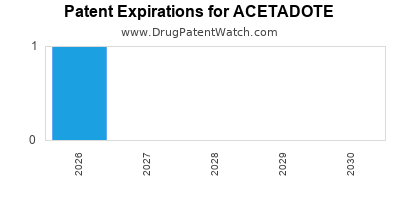
Last updated: September 24, 2026
ACETADOTE is Cumberland Pharmaceuticals’ branded intravenous acetylcysteine product for reducing hepatic injury after acute acetaminophen overdose. Its commercial profile has shifted from specialty branded growth to a mature hospital product exposed to generic competition, purchasing pressure, supply reliability, and toxicology protocol demand. The active ingredient is clinically established, but the branded product has limited exclusivity protection and faces structurally low barriers to generic substitution.
What is ACETADOTE and how is it used?
ACETADOTE is acetylcysteine injection, supplied for intravenous administration in patients with suspected or confirmed acetaminophen overdose. The product replenishes glutathione and helps prevent or reduce hepatic injury when administered within the clinically relevant treatment window.
| Attribute |
ACETADOTE |
| Active ingredient |
Acetylcysteine |
| Dosage form |
Intravenous injection |
| Primary indication |
Acute acetaminophen overdose |
| U.S. marketing authorization |
NDA 020539 |
| U.S. sponsor |
Cumberland Pharmaceuticals, Inc. |
| Main customers |
Hospitals, emergency departments, poison-control systems, government purchasers |
| Therapeutic category |
Antidote and emergency medicine |
| Main competitors |
Generic acetylcysteine injection products |
| Commercial model |
Hospital and institutional procurement |
The product is administered using weight-based protocols. Its demand is tied to emergency-department volume, acetaminophen exposure, poison-center recommendations, and hospital stocking policies rather than chronic prescription utilization.
The FDA approved intravenous acetylcysteine for acetaminophen overdose in 2004. ACETADOTE was later commercialized by Cumberland as a ready-to-use, branded hospital product. The label includes dosage regimens based on a 21-hour intravenous protocol, although hospitals may use alternative protocols under institutional guidance. [1]
How large is the ACETADOTE market?
The addressable U.S. market is a mature emergency-care market rather than a high-growth specialty pharmaceutical market. Demand is recurring because hospitals must maintain access to an antidote for a common overdose emergency, but unit growth is constrained by generic availability and the absence of meaningful patient-driven brand preference.
Market demand is influenced by:
- Acetaminophen exposure and overdose incidence.
- Emergency-department admissions.
- Hospital formulary stocking requirements.
- Government and public-health procurement.
- Availability of generic acetylcysteine injection.
- Product shortages and back-order conditions.
- Contracting terms with group purchasing organizations.
- The cost and convenience of dosing configurations.
ACETADOTE’s commercial value is higher than the value of the active ingredient alone because a branded supplier can offer established packaging, regulatory support, product continuity, and a known hospital procurement channel. Those advantages are limited when purchasers view generic acetylcysteine as therapeutically interchangeable.
What drives ACETADOTE demand?
The main demand driver is clinical necessity. Hospitals generally need an acetylcysteine product available for overdose treatment. The principal commercial question is which supplier wins the institutional order, not whether acetylcysteine will be used.
Demand is relatively defensive because acetaminophen overdose treatment cannot be deferred. Sales can still decline if:
- A hospital changes formulary preference.
- A generic supplier offers lower pricing.
- A competitor resolves a shortage.
- Procurement consolidates through a group purchasing organization.
- Hospitals reduce branded inventory levels.
- The product is replaced with another acetylcysteine presentation.
What is the financial trajectory of ACETADOTE?
Cumberland’s public filings show a company with a diversified portfolio that includes ACETADOTE, Caldolor, Kristalose, Vaprisol and other products. Public disclosure does not provide a consistently detailed, standalone long-term revenue series for ACETADOTE comparable to a public company reporting segment-level product sales in every reporting period. As a result, the product’s financial trajectory is best evaluated through Cumberland’s product mix, reported corporate revenue, market-entry history, and generic exposure.
The commercial trajectory has four phases:
| Period |
Commercial phase |
Financial implication |
| 2004-2006 |
FDA approval and launch |
Initial branded market development |
| 2007-2011 |
Branded expansion |
Higher value from hospital adoption and limited competition |
| 2012 onward |
Generic-entry period |
Price and volume pressure |
| Current mature market |
Institutional defense |
Revenue depends on supply reliability, contracting, and share retention |
Cumberland has treated ACETADOTE as part of a hospital-focused portfolio rather than as a pipeline asset with significant future exclusivity. The product can generate recurring cash flow, but it is unlikely to provide the margin profile of a protected specialty product.
How does generic competition affect ACETADOTE revenue?
Generic entry changed the economics of the product. Before generic competition, Cumberland could monetize ACETADOTE through branded pricing and hospital contracting. Once equivalent acetylcysteine injection products became available, buyers gained negotiating leverage.
The resulting pressures include:
- Lower average selling prices.
- Reduced hospital willingness to pay for brand status.
- Higher sensitivity to supply interruptions.
- Greater importance of package size and concentration.
- More frequent tendering and contract rebidding.
The brand can preserve revenue where hospitals value supply continuity, established ordering procedures, or specific presentations. That protection is commercial rather than patent-based.
When did ACETADOTE lose exclusivity?
ACETADOTE’s principal U.S. market exclusivity has expired. The product was approved in 2004, and any approval-based exclusivity associated with the original application is no longer commercially relevant. The current market is governed primarily by generic competition, FDA approval status, procurement contracts, and manufacturing availability.
There is no durable composition-of-matter patent protecting acetylcysteine itself. Acetylcysteine is an old active pharmaceutical ingredient with broad prior use. Any product-specific protection would have had to rely on formulation, manufacturing, packaging, or method-of-use claims, none of which appears to provide a current barrier equivalent to an active new-molecule patent.
What patents protect ACETADOTE?
ACETADOTE does not have a commercially significant remaining patent estate comparable to a recently approved branded drug. The relevant protection is primarily regulatory and commercial.
| Protection type |
Current significance |
| Active-ingredient patent |
Not commercially relevant; acetylcysteine is an established compound |
| Formulation patent |
No known active patent barrier that prevents routine generic competition |
| Method-of-use patent |
Treatment of acetaminophen overdose is established medical use |
| Manufacturing patent |
Potentially relevant to supplier operations, but not a broad market blocker |
| Orange Book patents |
No material current patent listing is generally associated with blocking generic entry |
| FDA exclusivity |
Expired for the original product approval |
| Trademark |
ACETADOTE brand remains commercially usable, but trademark rights do not prevent generic substitution |
A current Orange Book review should be used for transaction or litigation diligence because listings can change. The relevant legal conclusion is that any remaining brand rights are unlikely to block an approved generic acetylcysteine injection product. [2]
What is the FDA regulatory status of ACETADOTE?
ACETADOTE is an FDA-approved prescription product under NDA 020539. The FDA-approved indication is intravenous treatment for acetaminophen overdose. The regulatory pathway for competing products is generally an abbreviated new drug application, provided the applicant demonstrates pharmaceutical equivalence, bioequivalence where applicable, and compliance with manufacturing requirements.
The FDA has also approved generic acetylcysteine injection products. Generic competition is therefore based on ANDA approval rather than biosimilar substitution. ACETADOTE is a small-molecule drug, not a biologic.
Is ACETADOTE a biologic or biosimilar-risk product?
No. ACETADOTE is a small-molecule injectable drug. Biosimilar litigation, reference-product exclusivity, and biologics patent dance procedures under the Biologics Price Competition and Innovation Act do not apply.
The relevant competitive risk is generic substitution under the Hatch-Waxman framework.
Which companies are challenging ACETADOTE?
The competitive field consists mainly of generic injectable-drug manufacturers and hospital suppliers rather than a single branded challenger. Generic acetylcysteine injection has been marketed or approved by companies including major injectable-drug manufacturers and generic suppliers. Availability has varied over time by presentation, concentration, and manufacturing status.
The key competitive groups are:
- Large generic injectable manufacturers.
- Contract manufacturers supplying hospital distributors.
- Specialty suppliers focused on antidotes and emergency medicines.
- Hospital systems using centralized purchasing.
- Group purchasing organizations negotiating on behalf of member hospitals.
The market does not depend on a Paragraph IV challenge to a blocking patent because the principal patent barrier has expired or is not material. A generic applicant can generally enter through the ANDA pathway without confronting a high-value, late-life patent estate.
Are there Paragraph IV challenges involving ACETADOTE?
A Paragraph IV challenge is not the principal current market issue for ACETADOTE. Paragraph IV litigation is used when an ANDA applicant asserts that a listed patent is invalid, unenforceable, or not infringed. Because ACETADOTE’s commercially relevant exclusivity has expired and no major blocking Orange Book patent is generally associated with the product, generic entry risk is primarily regulatory and commercial.
The absence of a material current patent barrier reduces the probability of a litigation-driven launch delay. It also limits Cumberland’s ability to use settlement agreements to defer generic competition.
What formulation patents protect ACETADOTE?
The principal commercial differentiation is the injectable presentation, concentration, container configuration, labeling, and hospital usability. These characteristics can create procurement advantages, but they do not necessarily create enforceable exclusivity.
Potential formulation issues include:
- Concentration and fill volume.
- Dilution requirements.
- Container and closure systems.
- Stability and storage conditions.
- Compatibility with infusion equipment.
- Reduced preparation time.
- Labeling and dosing instructions.
A formulation patent would need claims that are both valid and difficult for a generic applicant to design around. For a mature acetylcysteine product, those conditions are difficult to sustain as a broad market barrier. Generic products can often compete through alternative concentrations, presentations, or packaging while maintaining therapeutic equivalence.
What patent litigation affects ACETADOTE?
ACETADOTE does not have a widely recognized active patent litigation profile comparable to major branded products with substantial Orange Book protection. The principal legal risk is ordinary product liability, manufacturing compliance, labeling, and procurement disputes rather than an active patent war over market entry.
For commercial diligence, the more important legal questions are:
- Whether a generic product has FDA approval.
- Whether the generic is listed as therapeutically equivalent.
- Whether a supplier has an FDA manufacturing warning or import restriction.
- Whether shortages affect contract performance.
- Whether hospitals have changed formulary policy.
- Whether Cumberland has entered supply or distribution agreements.
How strong is the ACETADOTE patent estate?
The patent estate is weak as a current exclusivity instrument. Its strength is better characterized as commercial brand protection supported by regulatory compliance and supply execution.
| Patent-estate factor |
Assessment |
| Compound protection |
Weak or expired |
| Current Orange Book barrier |
Limited |
| Method-of-use protection |
Limited |
| Formulation protection |
Narrow if present |
| Generic design-around risk |
High |
| Litigation leverage |
Low |
| Commercial brand value |
Moderate in institutional channels |
| Supply-chain value |
Potentially meaningful during shortages |
Cumberland’s defensibility depends more on operational performance than on patents. Reliable supply, acceptable pricing, hospital contracting, and established ordering systems can preserve share after patent expiry.
What generic launch risks exist for ACETADOTE?
Generic launch risk is high in principle because the product is old, clinically standardized, and suitable for ANDA competition. The practical timing of generic growth depends on FDA approvals, manufacturing capacity, shortage conditions, and hospital contracting cycles.
Base-case launch scenario
Generic suppliers retain or expand institutional share. Cumberland maintains a branded position in selected hospitals but experiences long-term pricing pressure. Revenue remains recurring but mature.
Upside scenario
A generic shortage, manufacturing disruption, or recall increases demand for ACETADOTE. Cumberland captures temporary volume and may improve net pricing during the disruption.
Downside scenario
Multiple reliable generic suppliers compete aggressively. Hospitals remove ACETADOTE from preferred formularies, and Cumberland’s revenue declines faster than overall acetylcysteine demand.
How does ACETADOTE compare with generic acetylcysteine injection?
| Factor |
ACETADOTE |
Generic acetylcysteine injection |
| Brand recognition |
Established |
Supplier-specific |
| FDA approval |
Yes |
Yes, for approved products |
| Clinical ingredient |
Acetylcysteine |
Acetylcysteine |
| Patent barrier |
Limited |
Usually no blocking barrier |
| Price position |
Typically higher |
Typically lower |
| Hospital value proposition |
Continuity, familiarity, contracting |
Cost and interchangeability |
| Switching risk |
High where formularies permit substitution |
High competitive pressure |
| Margin outlook |
Mature and pressured |
Low-cost, volume-driven |
What is the competitive landscape for ACETADOTE?
The market is a procurement market, not a conventional retail-prescription market. The most important competitive variables are contract price, fill rate, shortage history, packaging, and regulatory reliability.
Cumberland competes against suppliers with larger injectable manufacturing networks. That creates a structural disadvantage when hospitals prioritize cost and multi-product purchasing agreements. Cumberland can offset part of that disadvantage through brand familiarity and targeted hospital relationships.
The product has limited exposure to direct-to-consumer substitution. Patients do not select ACETADOTE at the point of treatment. Pharmacy directors, emergency physicians, toxicologists, and purchasing committees control product selection.
Are there licensing deals for ACETADOTE?
ACETADOTE has been commercialized through Cumberland’s branded pharmaceutical platform and hospital distribution relationships. Publicly disclosed licensing activity has not created a major new exclusivity position for the product. Any current commercial agreement is more likely to concern distribution, supply, or procurement than patent licensing.
The absence of a major licensing transaction limits the likelihood of a near-term valuation event based solely on ACETADOTE. Its value is primarily as a mature marketed product within Cumberland’s broader portfolio.
What are the geographic coverage and manufacturing barriers?
ACETADOTE’s principal commercial market is the United States. The product’s economics are strongest where Cumberland has established hospital distribution and contracting infrastructure. International opportunities are constrained by local registrations, procurement rules, and the availability of generic acetylcysteine.
Manufacturing barriers are meaningful but not equivalent to patent barriers. Sterile injectable production requires:
- Validated aseptic manufacturing.
- Container-closure integrity.
- Stability data.
- Sterility assurance.
- FDA-compliant facilities.
- Reliable active-ingredient supply.
- Capacity to meet emergency-hospital demand.
These requirements can limit the number of reliable suppliers. They may support branded sales during shortages, but they do not permanently prevent generic entry.
Key Takeaways
- ACETADOTE is an FDA-approved intravenous acetylcysteine product for acetaminophen overdose.
- Its market is mature, hospital-based, and driven by emergency treatment demand.
- The product has no commercially significant remaining compound exclusivity.
- Generic competition is the main source of pricing and volume pressure.
- ACETADOTE is not subject to biosimilar competition; the relevant pathway is generic ANDA approval.
- Paragraph IV litigation and patent settlements are not the central current market risks.
- Cumberland’s remaining competitive advantages are brand familiarity, hospital relationships, supply reliability, and procurement execution.
- Revenue upside is most likely during generic shortages or competitor supply disruptions.
- Long-term financial performance depends more on net pricing and hospital retention than on unit-market growth.
- Manufacturing quality and sterile-injectable capacity create operational barriers, but they do not replace patent protection.
FAQs
Is ACETADOTE still commercially available?
ACETADOTE has been marketed as Cumberland Pharmaceuticals’ branded intravenous acetylcysteine product. Availability can vary by package size, distributor inventory, and hospital purchasing contracts.
Does ACETADOTE have a patent protecting acetylcysteine?
No active compound patent can provide meaningful exclusivity for acetylcysteine because the ingredient is long established. Any formulation or manufacturing claims would be narrower and less likely to block generic competition.
Can hospitals substitute generic acetylcysteine for ACETADOTE?
Hospitals can generally use an FDA-approved generic acetylcysteine injection when it is therapeutically equivalent and consistent with institutional policy, availability, and prescribing requirements.
Is ACETADOTE a high-growth pharmaceutical product?
No. ACETADOTE is a mature hospital product. Its growth potential is limited, with revenue driven primarily by market share, pricing, shortages, and procurement contracts.
What would increase the value of ACETADOTE?
The most likely value drivers are sustained generic shortages, competitor recalls, improved hospital contracting, reliable product availability, and favorable pricing. A new patent-based exclusivity period is unlikely to be the main value driver.
References
- U.S. Food and Drug Administration. (2023). ACETADOTE (acetylcysteine) injection prescribing information. FDA. https://www.accessdata.fda.gov
- U.S. Food and Drug Administration. (2024). Approved drug products with therapeutic equivalence evaluations: Orange Book. FDA. https://www.accessdata.fda.gov/scripts/cder/ob/
- Cumberland Pharmaceuticals, Inc. (2024). Annual report pursuant to Section 13 or 15(d) of the Securities Exchange Act of 1934. U.S. Securities and Exchange Commission. https://www.sec.gov
- U.S. Food and Drug Administration. (2024). Drugs@FDA: FDA-approved drugs. FDA. https://www.accessdata.fda.gov/scripts/cder/daf/
- U.S. Food and Drug Administration. (2024). Approved drug products and generic drug competition. FDA. https://www.fda.gov/drugs/generic-drugs