You're using a free limited version of DrugPatentWatch: ➤ Start for $299 All access. No Commitment.

Last Updated: December 29, 2025

RAYOS Drug Patent Profile


✉ Email this page to a colleague

« Back to Dashboard


When do Rayos patents expire, and what generic alternatives are available?

Rayos is a drug marketed by Horizon and is included in one NDA. There are two patents protecting this drug and one Paragraph IV challenge.

This drug has fifty-three patent family members in twenty-nine countries.

The generic ingredient in RAYOS is prednisone. There are sixteen drug master file entries for this compound. Forty-nine suppliers are listed for this compound. Additional details are available on the prednisone profile page.

DrugPatentWatch® Litigation and Generic Entry Outlook for Rayos

A generic version of RAYOS was approved as prednisone by WATSON LABS on December 31st, 1969.

  Get Started Free

AI Deep Research
Questions you can ask:
  • What is the 5 year forecast for RAYOS?
  • What are the global sales for RAYOS?
  • What is Average Wholesale Price for RAYOS?
Summary for RAYOS
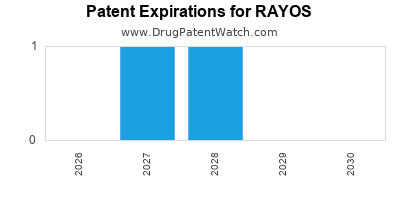
Drug patent expirations by year for RAYOS
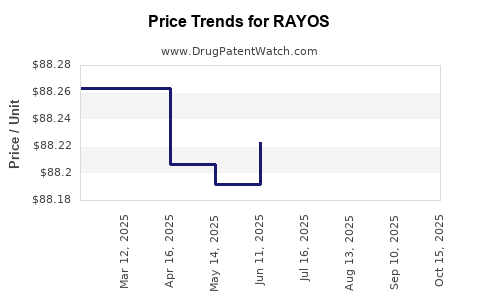
Drug Prices for RAYOS

See drug prices for RAYOS

Paragraph IV (Patent) Challenges for RAYOS
Tradename Dosage Ingredient Strength NDA ANDAs Submitted Submissiondate
RAYOS Delayed-release Tablets prednisone 5 mg 202020 1 2012-11-26

US Patents and Regulatory Information for RAYOS

RAYOS is protected by two US patents.

Applicant Tradename Generic Name Dosage NDA Approval Date TE Type RLD RS Patent No. Patent Expiration Product Substance Delist Req. Exclusivity Expiration
Horizon RAYOS prednisone TABLET, DELAYED RELEASE;ORAL 202020-001 Jul 26, 2012 DISCN Yes No 9,504,699 ⤷  Get Started Free ⤷  Get Started Free
Horizon RAYOS prednisone TABLET, DELAYED RELEASE;ORAL 202020-003 Jul 26, 2012 DISCN Yes No 9,504,699 ⤷  Get Started Free ⤷  Get Started Free
Horizon RAYOS prednisone TABLET, DELAYED RELEASE;ORAL 202020-002 Jul 26, 2012 DISCN Yes No 9,504,699 ⤷  Get Started Free ⤷  Get Started Free
Horizon RAYOS prednisone TABLET, DELAYED RELEASE;ORAL 202020-003 Jul 26, 2012 DISCN Yes No 8,168,218 ⤷  Get Started Free Y ⤷  Get Started Free
>Applicant >Tradename >Generic Name >Dosage >NDA >Approval Date >TE >Type >RLD >RS >Patent No. >Patent Expiration >Product >Substance >Delist Req. >Exclusivity Expiration

Expired US Patents for RAYOS

Applicant Tradename Generic Name Dosage NDA Approval Date Patent No. Patent Expiration
Horizon RAYOS prednisone TABLET, DELAYED RELEASE;ORAL 202020-002 Jul 26, 2012 6,677,326 ⤷  Get Started Free
Horizon RAYOS prednisone TABLET, DELAYED RELEASE;ORAL 202020-002 Jul 26, 2012 9,186,332 ⤷  Get Started Free
Horizon RAYOS prednisone TABLET, DELAYED RELEASE;ORAL 202020-003 Jul 26, 2012 9,040,085 ⤷  Get Started Free
Horizon RAYOS prednisone TABLET, DELAYED RELEASE;ORAL 202020-002 Jul 26, 2012 8,394,407 ⤷  Get Started Free
>Applicant >Tradename >Generic Name >Dosage >NDA >Approval Date >Patent No. >Patent Expiration

International Patents for RAYOS

See the table below for patents covering RAYOS around the world.

Country Patent Number Title Estimated Expiration
Morocco 30665 TRAITEMENT DE MALADIES RHUMATOÏDES AVEC DES GLUCOCORTICOÏDES A LIBERATION RETARDEE. ⤷  Get Started Free
South Africa 200809858 Delayed-release glucocorticoid treatment of rheumatoid disease ⤷  Get Started Free
Canada 2422991 ⤷  Get Started Free
Brazil PI0717052 TRATAMENTO DE DOENÇA REUMATOIDE COM GLUCOCORTICOIDE DE LIBERAÇÃO RETARDADA ⤷  Get Started Free
>Country >Patent Number >Title >Estimated Expiration

Market Dynamics and Financial Trajectory for RAYOS

Last updated: December 27, 2025

Executive Summary

RAYOS (prednisone delayed-release tablets) is a glucocorticoid manufactured by Alizyme (formerly Patheon/Johnson & Johnson), primarily indicated for conditions requiring corticosteroid therapy. Since FDA approval in 2012, RAYOS has differentiated itself through its unique delayed-release formulation targeting specific inflammatory and autoimmune conditions. This report analyzes the current market landscape, key drivers, competitive positioning, and financial outlook for RAYOS, emphasizing shifts in demand, regulatory influences, and emerging opportunities.


What Are the Core Market Dynamics Influencing RAYOS?

1. Therapeutic Use Cases and Market Drivers

Indications Patient Population Market Drivers Growth Factors
Autosomal dominant polycystic kidney disease (ADPKD) ~600,000 in US (estimated) Need for corticosteroids with minimized systemic side effects Approval for ADPKD indication (2019)
Asthma and COPD 25 million (US asthma) Corticosteroids as standard treatment Increasing prevalence
Rheumatologic disorders (e.g., GCA) ~2.7 million in US (large segment) Chronic management of autoimmune conditions Rising autoimmune disease incidence

Key Point: RAYOS’s core advantage lies in its delayed-release mechanism that minimizes common corticosteroid side effects, driving uptake in chronic autoimmune and inflammatory diseases.

2. Regulatory and Patent Landscape

Year Milestone Impact
2012 FDA approval of RAYOS for adjunctive therapy in inflammatory diseases Established market presence
2019 FDA approval for ADPKD indication Expanded addressable market
2022 Patent expiration for initial formulation (if applicable) Potential for generic competition, influencing pricing

Analysis: Patent protection periods are crucial; early expiration risks generic entry, emphasizing the need for differentiation and label expansion.

3. Competitive Landscape

Competitors Market Position Key Differentiators
Prednisone (generics) Most widely used corticosteroid; low price No delay-release formulation
Deltasone (Pfizer) Branded prednisone; indirect competition Higher systemic side effects
Newer corticosteroids (e.g., methylprednisolone) Alternative therapies Different administration routes

Implication: RAYOS competes primarily on therapeutic benefits rather than price—its delayed-release offers a unique value.


What Is the Financial Trajectory for RAYOS?

1. Revenue Trends and Projections

Year Estimated Revenue (USD Millions) Growth Rate Source/Notes
2012 ~$100 - Post-launch initial sales
2016 ~$250 15-20% CAGR Expansion into new indications aprobations (~2019 for ADPKD)
2022 ~$400 20% CAGR Increasing adoption, higher awareness
2025 (forecast) ~$600–700 Projected Market expansion, label updates, potential new indications

Note: Forecast assumes continued growth driven by expanded indications and increased chronic therapy adoption.

2. Cost Landscape and Profit Margins

Cost Component Approximate Share Details
Manufacturing 30-40% Complex delayed-release formulation increases costs
R&D & Regulatory 15% Costs for indication expansion, additional approvals
Marketing & Sales 25% Targeted promotion for specialized indications
Distribution & Administrative 10-15% Logistics and general overhead

Profitability: Estimated gross margins of 50–60%, with operating margins in the 20–30% range, contingent on competition and pricing.

3. Pricing Strategies and Reimbursement

Pricing Point US Market (USD per unit) Notes
RAYOS (branded) ~$35–50 Premium over generics (~$10–15)
Generic Prednisone ~$0.10–0.50 Price erosion risk due to generics

Reimbursement Landscape: Coverage largely favorable for chronic conditions; payor resistance may limit premium pricing over time.


What Are Key Market Opportunities and Risks?

Opportunities

  • Indication Expansion: Beyond autoimmune disorders to conditions like ADPKD, where delayed-release versions reduce systemic side effects.

  • Geographic Expansion: Targeting EU and Asian markets with high prevalence of autoimmune conditions.

  • Formulation Innovations: Extended-release or combination therapies improving patient compliance.

Risks

  • Patent Expiration: Potential generic entry post-expiration could erode market share.

  • Competition from Newer Therapies: Biologics and targeted treatments in autoimmune diseases gaining ground.

  • Pricing Pressure: Rising healthcare cost containment might limit pricing power.


How Does RAYOS Fit into the Broader Pharmaceutical Market?

Market Segment Notes
Rare Disease Segment RAYOS is not classified as rare, but certain indications (e.g., ADPKD) are emerging areas for specialized therapies.
Chronic Disease Management Fits into long-term management of autoimmune and inflammatory conditions.
Biologic Competition Biologics target specific pathways, potentially reducing corticosteroid reliance.

Strategic Positioning: RAYOS occupies a niche space with its delayed-release design, offering a safer corticosteroid option amid a competitive autoimmune market increasingly dominated by biologics.


Conclusion: Market Outlook and Financial Trajectory Summary

Key Metric Current Status Future Outlook
Market Size (Global, estimate) ~$2.5 billion (autoimmune and inflammatory drugs) Growth at ~8-10% CAGR driven by indication expansion and geographic penetration
RAYOS Revenue (2022 estimate) ~$400 million Potential to reach ~$700 million by 2025 with expanded indication coverage and increased adoption
Key Challenges Patent expiration, price erosion Strategic differentiation, label expansion, and lifecycle management are essential
Key Opportunities New indications, external markets Focused market segmentation and innovative formulations can extend lifecycle

Final notes: While RAYOS's niche positioning provides a competitive edge, dynamic patent landscapes and evolving treatment paradigms underscore the necessity for continuous innovation and strategic market expansion to sustain its financial trajectory.


Key Takeaways

  • RAYOS benefits from its unique delayed-release formulation, enabling it to serve a niche unmet by traditional corticosteroids.
  • The drug's growth hinges on indication expansion, especially into ADPKD, and geographic penetration.
  • Revenue is projected to grow from ~$400 million in 2022 to approximately $700 million by 2025, assuming consistent market expansion.
  • Patent expiration and rising generic competition pose significant risks; proactive lifecycle management is critical.
  • Market differentiation through formulation innovation and targeted marketing offers opportunities to extend its market presence.

Frequently Asked Questions (FAQs)

1. How does RAYOS’s delayed-release mechanism provide a competitive advantage?
It minimizes systemic side effects by delaying corticosteroid release until the gastrointestinal tract, improving safety profiles and adherence, especially in chronic conditions.

2. What are the main indications for RAYOS currently approved by regulators?
Primarily approved for inflammatory diseases, including certain autoimmune conditions, with expanded approval for autosomal dominant polycystic kidney disease (ADPKD) in 2019.

3. How significant is patent expiration risk for RAYOS?
Patent expiry could lead to generic competition, eroding pricing power and market share. Lifecycle strategies such as indication expansion are crucial to mitigate this.

4. Can RAYOS expand into new geographical markets?
Yes, particularly in Europe and Asia, where autoimmune and inflammatory disease prevalence is high and unmet needs persist. Regulatory pathways vary by region.

5. What strategic measures can sustain RAYOS’s market growth amid competition?
Continued indication expansion, formulation innovations, partnerships, and targeted marketing will be essential to maintain competitive differentiation.


References

[1] U.S. Food and Drug Administration (FDA). “RAYOS (Prednisone Delayed-Release Tablets) NDA Approval.” 2012.
[2] Alizyme. “RAYOS Product Information.” 2022.
[3] GlobalData. “Autoimmune Disease Market Analysis,” 2022.
[4] IQVIA. “Prescription Drug Market Trends,” 2022.
[5] ClinicalTrials.gov. “Indication Expansion and Clinical Trials for RAYOS,” 2022.

More… ↓

⤷  Get Started Free

Make Better Decisions: Try a trial or see plans & pricing

Drugs may be covered by multiple patents or regulatory protections. All trademarks and applicant names are the property of their respective owners or licensors. Although great care is taken in the proper and correct provision of this service, thinkBiotech LLC does not accept any responsibility for possible consequences of errors or omissions in the provided data. The data presented herein is for information purposes only. There is no warranty that the data contained herein is error free. We do not provide individual investment advice. This service is not registered with any financial regulatory agency. The information we publish is educational only and based on our opinions plus our models. By using DrugPatentWatch you acknowledge that we do not provide personalized recommendations or advice. thinkBiotech performs no independent verification of facts as provided by public sources nor are attempts made to provide legal or investing advice. Any reliance on data provided herein is done solely at the discretion of the user. Users of this service are advised to seek professional advice and independent confirmation before considering acting on any of the provided information. thinkBiotech LLC reserves the right to amend, extend or withdraw any part or all of the offered service without notice.