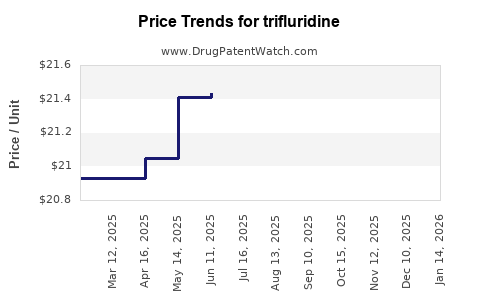
Last updated: August 7, 2026
Trifluridine has two commercially distinct markets. The ophthalmic product is a mature, low-growth generic antiviral. The larger value driver is Lonsurf, an oral fixed-dose combination of trifluridine and tipiracil marketed for metastatic colorectal cancer and metastatic gastric or gastroesophageal-junction cancer. Lonsurf has generated sustained oncology revenue because treatment is chronic, later-line, and supported by limited therapeutic alternatives. Its growth outlook is constrained by generic-entry risk, competing targeted therapies, and a finite treatment population.
What is the commercial market for trifluridine?
Trifluridine is marketed primarily through two product categories:
| Product |
Active ingredients |
Main use |
Commercial status |
| Lonsurf |
Trifluridine plus tipiracil |
Metastatic colorectal cancer; metastatic gastric or gastroesophageal-junction cancer |
Branded oncology product |
| Trifluridine ophthalmic solution |
Trifluridine |
Herpes simplex keratoconjunctivitis and related ocular infections |
Mature generic ophthalmic market |
Trifluridine alone is not the principal source of pharmaceutical revenue. Lonsurf’s value comes from the combination with tipiracil, which increases oral bioavailability by inhibiting thymidine phosphorylase-mediated degradation of trifluridine [1].
Taiho Pharmaceutical developed Lonsurf and commercializes it in Japan and the United States. Servier has commercial rights in many territories outside the United States and Japan. The product is sold under the Lonsurf name in major oncology markets.
How does Lonsurf work and which patients receive it?
Lonsurf combines a cytotoxic nucleoside analog with a metabolic inhibitor:
- Trifluridine is incorporated into DNA and disrupts DNA function.
- Tipiracil inhibits trifluridine degradation and raises systemic exposure.
- The product is administered orally in repeated treatment cycles.
- The principal toxicities are neutropenia, anemia, thrombocytopenia, nausea, fatigue, and diarrhea.
The FDA approved Lonsurf in September 2015 for previously treated metastatic colorectal cancer. The agency expanded the label in February 2019 to include previously treated metastatic gastric or gastroesophageal-junction adenocarcinoma [2].
The approved colorectal indication was supported by the RECOURSE trial. The gastric-cancer indication was supported by the TAGS trial. Both indications address patients who have progressed after multiple prior therapies, making Lonsurf a later-line treatment rather than an early-line competitor to chemotherapy, immunotherapy, or targeted biologics [3,4].
What is the financial trajectory for Lonsurf?
Lonsurf has had a relatively durable revenue profile rather than a conventional rapid-growth launch followed by steep erosion.
Revenue drivers
The product’s financial performance has been supported by:
- Expansion from colorectal cancer into gastric and gastroesophageal-junction cancer.
- Continued use after failure of fluoropyrimidines, oxaliplatin, irinotecan, anti-VEGF therapy, anti-EGFR therapy, or other approved treatments.
- Combination-use potential with bevacizumab in colorectal cancer.
- International commercialization through Servier.
- Low substitution from biosimilars because Lonsurf is a small-molecule oral product, not a biologic.
Taiho reports Lonsurf sales within company product disclosures, but reported figures are generally presented in Japanese yen and can be affected by exchange rates, geographic accounting, and fiscal-year differences. Servier does not consistently disclose a standalone global Lonsurf revenue figure in the same level of detail as a public pharmaceutical company.
| Financial factor |
Impact on Lonsurf |
| Chronic later-line use |
Supports recurring prescription volume |
| Limited treatment duration |
Caps revenue per patient |
| Combination with bevacizumab |
Expands clinical utility but increases treatment complexity |
| Generic oral competition |
Creates the largest long-term price risk |
| Geographic licensing |
Reduces direct commercial cost for Taiho but shares economics |
| Foreign-exchange movement |
Affects reported international revenue |
| Small eligible population |
Limits peak sales compared with first-line oncology products |
The financial trajectory is therefore best characterized as mature growth with a gradual transition toward erosion risk. Lonsurf is not dependent on a single short-lived launch indication, but it also lacks the broad patient base of first-line colorectal cancer products.
What is the market size and competitive landscape?
The relevant market is the later-line treatment segment for metastatic colorectal and gastric cancers. Competition is disease-specific.
Metastatic colorectal cancer
Lonsurf competes with:
- Regorafenib, marketed as Stivarga.
- Fruquintinib, marketed as Fruzaqla in the United States.
- Anti-VEGF combinations.
- Anti-EGFR therapy for molecularly selected patients.
- BRAF-targeted therapy for BRAF V600E-positive disease.
- HER2-directed therapy for HER2-positive disease.
- KRAS G12C inhibitors for selected patients.
- Immunotherapy for microsatellite instability-high or mismatch-repair-deficient tumors.
- Clinical trials and physician-directed rechallenge strategies.
Fruquintinib increases competitive pressure because it provides an oral later-line option with a distinct mechanism. Regorafenib has a longer market history but is limited by tolerability. Lonsurf’s competitive position is strongest where clinicians prioritize a familiar oral cytotoxic regimen and where patients have exhausted biomarker-directed options.
Gastric and gastroesophageal-junction cancer
Lonsurf competes with:
- Paclitaxel plus ramucirumab.
- Trastuzumab-based regimens for HER2-positive disease.
- Nivolumab or pembrolizumab in biomarker-defined settings.
- Trifluridine/tipiracil-based later-line treatment.
- Clinical trials and regional chemotherapy regimens.
Its position is more defensive in gastric cancer because treatment sequencing depends heavily on HER2 status, PD-L1 expression, MSI status, prior immunotherapy, and regional treatment standards.
When does Lonsurf lose exclusivity?
Lonsurf’s regulatory exclusivity has already declined materially.
Regulatory exclusivity
| Protection |
Event |
| FDA approval |
September 2015 for metastatic colorectal cancer |
| Initial new chemical entity exclusivity |
Expired after the standard five-year period |
| Gastric-cancer approval |
February 2019 |
| Three-year clinical-investigation exclusivity associated with the later indication |
Generally expired by 2022 |
| Current commercial protection |
Primarily patent-based, subject to Orange Book listings and litigation |
Lonsurf is a small-molecule drug, so biosimilar exclusivity does not apply. The relevant threat is an ANDA generic containing trifluridine and tipiracil.
Exact generic-entry timing depends on the patents listed in the current FDA Orange Book, paragraph IV certifications, litigation outcomes, and any settlement agreements. Patent expiry can differ by patent family, claim type, pediatric extensions, and court decisions. The FDA Orange Book is the controlling source for current listed patent information [5].
What patents protect Lonsurf?
Lonsurf’s patent estate is expected to contain multiple layers:
- Composition and combination patents covering trifluridine with tipiracil.
- Pharmaceutical-composition patents.
- Dosage-regimen patents.
- Method-of-use patents for colorectal cancer.
- Method-of-use patents for gastric or gastroesophageal-junction cancer.
- Potential patents covering administration schedules, dose adjustments, or combination treatment.
The central commercial patent issue is whether a generic applicant can enter with a trifluridine/tipiracil product after challenging listed patents under Paragraph IV of the Hatch-Waxman Act.
Patent strength is mixed by claim category:
| Claim category |
Relative strength |
Commercial relevance |
| Core combination claims |
Usually strongest if validity and infringement survive review |
Can block the entire generic product |
| Formulation claims |
Relevant if the generic uses a materially different formulation |
May be designed around |
| Method-of-use claims |
Vulnerable to skinny-label strategies |
May not prevent all generic sales |
| Dosing claims |
Useful for specific regimens |
Often narrower and easier to design around |
| Manufacturing claims |
Can increase supply-chain friction |
Usually weaker as a product-wide barrier |
Composition claims generally provide the most direct protection. Method-of-use patents may have less practical force because generic applicants can seek approval for indications or uses that omit patented treatment methods, subject to inducement and contributory-infringement risks.
Which companies are challenging Lonsurf?
Potential or reported ANDA challengers may include major generic manufacturers such as Dr. Reddy’s Laboratories, Zydus Lifesciences, Teva, Sun Pharmaceutical, Apotex, and other companies active in oncology generics. The exact challenger group depends on current FDA filings and litigation dockets.
Paragraph IV litigation can delay approval through the statutory 30-month stay if the branded company files suit within the applicable period. A court can:
- Uphold the patent and delay entry until expiry.
- Invalidate the patent.
- Find the patent not infringed.
- Permit an agreed launch date under a settlement.
- Resolve only some patents while leaving others in force.
A public patent challenge does not establish that a generic will launch. The economic outcome depends on the number of challengers, patent survival, authorized-generic strategy, and settlement terms.
What generic launch scenarios exist for Lonsurf?
Three scenarios are commercially relevant.
Delayed single-generic entry
A first generic enters after patent litigation or a settlement. Price erosion is meaningful but may be moderated if only one supplier has approval or if the branded company maintains payer coverage and supply reliability.
Multiple-generic entry
Several ANDA products launch after core patents expire or are invalidated. This produces sharper price compression, lower branded volume, and rapid substitution in payer-controlled channels.
Authorized-generic or controlled launch
The brand owner or licensee may use an authorized generic, a supply agreement, or a settlement structure to capture part of the post-exclusivity market. Such arrangements can reduce the abruptness of revenue loss but usually do not preserve pre-entry pricing.
For Lonsurf, the most material risk is not immediate loss of all demand. Later-line oncology patients may remain clinically appropriate for the product, but the price per treatment cycle can fall rapidly after several approved generics become available.
What is the status of trifluridine ophthalmic products?
Trifluridine ophthalmic solution is a mature antiviral product. Its principal market characteristics are:
- Generic availability.
- Low pricing relative to oncology products.
- Limited patent protection.
- Modest clinical differentiation.
- Demand tied to herpes simplex eye infections rather than chronic oncology treatment.
- Potential supply vulnerability because sterile ophthalmic manufacturing is more complex than ordinary oral-tablet production.
The ophthalmic market does not have the same revenue trajectory as Lonsurf. It is unlikely to create material growth for a large pharmaceutical company, although a manufacturer with reliable sterile capacity can benefit from intermittent shortages or limited supplier competition.
How do the trifluridine markets compare?
| Metric |
Lonsurf |
Trifluridine ophthalmic |
| Product type |
Oral combination |
Ophthalmic solution |
| Ingredient role |
Trifluridine plus tipiracil |
Trifluridine alone |
| Disease area |
Oncology |
Ophthalmic viral infection |
| Revenue potential |
Material specialty-pharma revenue |
Low generic revenue |
| Patent relevance |
Combination, use, formulation, and dosing claims |
Limited legacy protection |
| Generic risk |
High once core patents lapse |
Already established |
| Biosimilar risk |
None |
None |
| Manufacturing barrier |
Oral oncology tablets and supply scale |
Sterile ophthalmic production |
| Growth profile |
Mature, with possible erosion |
Mature and price-sensitive |
What licensing deals affect trifluridine revenue?
Taiho’s international commercialization structure is central to the economics of Lonsurf. Servier obtained rights to develop and commercialize Lonsurf in territories outside Japan and the United States under an agreement with Taiho [6].
The arrangement allows Taiho to participate in international sales without directly carrying all regional commercial infrastructure costs. Servier gains access to a late-line oncology product with established clinical data and regulatory approvals. The structure also means that reported Taiho revenue and total global product sales are not identical.
No comparable high-value licensing economics apply to standard generic trifluridine ophthalmic products.
What FDA regulatory issues affect the market?
The main FDA issues are:
- ANDA approval for trifluridine/tipiracil tablets.
- Patent certifications under Paragraph IV.
- Labeling differences between brand and generic products.
- Bioequivalence and product-quality requirements.
- Manufacturing continuity for oncology products.
- Pharmacovigilance concerning myelosuppression and serious infection risk.
- Indication-specific labeling and the treatment sequence after prior therapies.
Lonsurf is not a biologic and does not require a biosimilar pathway. Generic applicants must instead satisfy the ANDA pathway and address listed patents.
How strong is the patent estate for trifluridine?
The Lonsurf estate is commercially meaningful but time-limited. Its strongest protection is likely to arise from claims directed to the trifluridine-tipiracil combination and approved treatment regimens. Formulation and dosing patents can extend litigation leverage, but their value depends on claim breadth and whether a generic can design around them.
The estate is weaker against:
- Skinny-label approval.
- Noninfringing dosing instructions.
- Invalidity attacks based on prior art or obviousness.
- Generic products using alternative excipients or manufacturing processes.
- Post-expiry multi-generic competition.
The ophthalmic trifluridine estate is substantially weaker because the product is old, genericized, and not dependent on a modern branded patent franchise.
What is the revenue exposure to generic entry?
Taiho faces the greatest exposure in markets where:
- Lonsurf represents a significant share of later-line colorectal-cancer treatment.
- Multiple generic manufacturers have filed ANDAs.
- Payers impose automatic substitution.
- The brand lacks a differentiated formulation.
- The commercial agreement does not restrict or delay generic competition.
Revenue erosion may be slower in Japan or markets with physician-directed substitution than in the United States. It may also differ between tablets and any future dosage-form variation.
Key Takeaways
- The economically important trifluridine product is Lonsurf, not ophthalmic trifluridine.
- Lonsurf is an oral trifluridine-tipiracil combination for later-line metastatic colorectal and gastric cancers.
- Its revenue trajectory has benefited from two approved indications and chronic specialty-oncology use.
- The product has no biosimilar risk because it is a small-molecule drug.
- Generic ANDA and Paragraph IV activity represent the main long-term threat.
- Combination and regimen patents are more commercially important than legacy trifluridine ophthalmic patents.
- Servier’s international license affects how global Lonsurf revenue is divided between commercial partners.
- The ophthalmic market is mature, generic, low-value, and more exposed to sterile-manufacturing constraints than patent barriers.
- Exact generic-entry timing depends on the current Orange Book, litigation results, and settlement terms.
FAQs
Is trifluridine the same as Lonsurf?
No. Lonsurf contains trifluridine and tipiracil. Trifluridine ophthalmic solution contains trifluridine alone.
Is Lonsurf a chemotherapy drug?
Yes. Trifluridine is a nucleoside analog that damages tumor-cell DNA, while tipiracil increases trifluridine exposure.
Can Lonsurf be replaced by a biosimilar?
No. Biosimilars apply to biologic products. Lonsurf faces conventional generic-drug competition through the ANDA pathway.
Does trifluridine have significant standalone revenue?
Standalone ophthalmic trifluridine revenue is generally limited. The major commercial value is associated with the trifluridine-tipiracil combination.
Which factor will most affect Lonsurf valuation?
The timing and scope of generic entry will have the largest effect, followed by later-line treatment demand, competitive products such as fruquintinib and regorafenib, and the economics of Taiho’s international licensing structure.
References
- Taiho Pharmaceutical Co., Ltd. (n.d.). Lonsurf prescribing information.
- U.S. Food and Drug Administration. (2015). FDA approves Lonsurf for metastatic colorectal cancer.
- Mayer, R. J., Van Cutsem, E., FalOl, A., Yoshino, T., Garcia-Carbonero, R., Wiezorkowska, A., et al. (2015). Randomized trial of TAS-102 for refractory metastatic colorectal cancer. New England Journal of Medicine, 372(20), 1909-1919.
- Shitara, K., Doi, T., Dvorkin, M., Mansoor, W., Arkenau, H.-T., Prokharau, A., et al. (2018). Trifluridine/tipiracil versus placebo in patients with heavily pretreated metastatic gastric cancer. Lancet Oncology, 19(11), 1437-1448.
- U.S. Food and Drug Administration. (n.d.). Approved drug products with therapeutic equivalence evaluations: Orange Book.
- Servier. (2015). Servier and Taiho Pharmaceutical enter agreement for Lonsurf commercialization outside the United States and Japan.