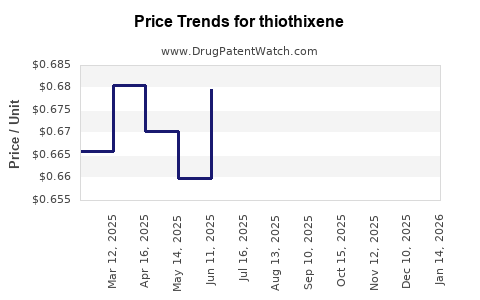
Last updated: September 1, 2026
Thiothixene is a mature, low-revenue generic antipsychotic with limited commercial growth prospects. The drug was approved in the United States in 1967 under the Navane brand and is now marketed primarily as generic thiothixene hydrochloride capsules. Its patent and regulatory exclusivity have expired, no meaningful biosimilar issue exists, and public companies do not report material standalone thiothixene revenue. The key commercial risks are supply continuity, manufacturing economics, and declining use of older first-generation antipsychotics rather than patent litigation or generic entry.
What is thiothixene and how is it used?
Thiothixene is an oral thioxanthene antipsychotic approved for the management of schizophrenia. It is pharmacologically related to other dopamine D2 receptor antagonists, including chlorprothixene and fluphenazine, and is generally classified as a first-generation or typical antipsychotic.
The FDA-approved dosage forms are capsules containing thiothixene hydrochloride equivalent to 1 mg, 2 mg, 5 mg, 10 mg, and 20 mg of thiothixene. Dosing is individualized and typically begins at a low dose before titration based on clinical response and tolerability.[1]
The drug carries class-related risks, including:
- Tardive dyskinesia
- Extrapyramidal symptoms
- Neuroleptic malignant syndrome
- Orthostatic hypotension
- Seizures
- QT-related cardiac risk
- Increased mortality in elderly patients with dementia-related psychosis
Thiothixene is not approved for the treatment of dementia-related psychosis. The FDA labeling states that antipsychotics in this class are associated with increased mortality in elderly patients with dementia-related psychosis.[1]
What therapeutic category does thiothixene compete in?
Thiothixene competes in a broad schizophrenia market dominated by atypical antipsychotics and long-acting injectable products. Relevant alternatives include:
- Risperidone
- Paliperidone
- Olanzapine
- Quetiapine
- Aripiprazole
- Haloperidol
- Fluphenazine
- Chlorpromazine
- Lurasidone
- Clozapine
Atypical antipsychotics generally have stronger prescribing positions because of broader indications, larger clinical development programs, newer formulations, and better commercial support. Long-acting injectables such as aripiprazole, risperidone, and paliperidone also address adherence concerns that limit the value proposition of an oral legacy product.
What is the FDA regulatory status of thiothixene?
Thiothixene remains an FDA-approved active ingredient, but the original branded product Navane is no longer a major commercial product in the U.S. market. Generic thiothixene capsules have been approved through abbreviated new drug applications, or ANDAs.
The regulatory profile is summarized below.
| Attribute |
Thiothixene status |
| Active ingredient |
Thiothixene hydrochloride |
| Original brand |
Navane |
| Original sponsor |
Pfizer predecessor companies and associated licensees |
| FDA approval era |
1960s |
| Initial approval |
1967 |
| Primary indication |
Schizophrenia |
| U.S. dosage form |
Oral capsules |
| Regulatory pathway for current products |
ANDA generic approvals |
| Reference product |
Navane |
| Pediatric approval |
Not established as a broad pediatric indication |
| Biologic status |
Small-molecule drug |
| Current market structure |
Generic, low-volume market |
The FDA’s current labeling system and DailyMed records continue to identify thiothixene capsule products, although product availability may differ by manufacturer, wholesaler, and package size.[1][2]
When did thiothixene lose exclusivity?
Thiothixene lost meaningful market exclusivity decades ago. The original Navane approval predates the modern Hatch-Waxman framework, and any composition-of-matter, formulation, or product patents associated with the original development program would have expired long before the present generic market.
No commercially relevant active-patent barrier is associated with the thiothixene molecule today. The product therefore has no modern branded exclusivity period comparable to those protecting newer antipsychotics.
| Exclusivity category |
Current position |
| Original compound protection |
Expired |
| Original product patents |
Expired |
| FDA new-drug exclusivity |
Expired |
| Pediatric exclusivity |
No material current relevance |
| Orphan exclusivity |
None identified |
| Generic competition |
Permitted |
| Active Orange Book patent barrier |
No material current barrier identified |
The FDA Orange Book is the controlling source for patents and exclusivity associated with approved drug products. Public Orange Book records do not indicate an active patent estate that would delay ANDA approval or generic launch for thiothixene.[3]
What patents protect thiothixene?
No active U.S. patent estate of commercial significance protects thiothixene as an active pharmaceutical ingredient, its standard capsule presentation, or its approved schizophrenia use.
The original intellectual property value was concentrated in historical compound and product development rights. Those rights have expired. Current manufacturers compete through ANDA approvals, supply reliability, manufacturing cost, and wholesaler access rather than through proprietary patent positions.
Are there formulation patents for thiothixene?
No material current formulation patent position is associated with the standard immediate-release thiothixene capsule. The generic product is a conventional oral solid dosage form, and there is no widely commercialized extended-release, depot, transdermal, or abuse-deterrent thiothixene formulation with independent market protection.
A new delivery system could theoretically generate patentable subject matter, but no such platform has established a meaningful commercial position in the United States. Any attempt to reposition thiothixene through a new formulation would face a small addressable market, limited reimbursement leverage, and competition from established long-acting injectable antipsychotics.
Are method-of-use patents relevant to thiothixene?
Method-of-use patents are not a significant commercial factor. The approved use is the treatment of schizophrenia, an indication that has been available for many decades. There is no known active method-of-use patent that materially restricts generic prescribing or creates a litigation risk comparable to branded specialty drugs.
Are there Paragraph IV challenges to thiothixene?
Paragraph IV litigation is not a meaningful current issue for thiothixene. Paragraph IV certifications are typically important when a branded reference product has active Orange Book patents. Thiothixene lacks that patent-driven structure.
Generic manufacturers can market the drug through ANDA approvals after satisfying FDA requirements for pharmaceutical equivalence and bioequivalence. Any historic ANDA disputes would have limited current commercial relevance because the underlying patents and brand market protections have expired.
The competitive process is therefore based on ordinary generic entry rather than a sequence of patent challenges, 30-month stays, settlements, or authorized generic agreements.
How many patents cover thiothixene?
No material active U.S. patent count covers the conventional thiothixene capsule product. The practical answer for commercial planning is zero relevant blocking patents.
This assessment applies to:
- Thiothixene hydrochloride as the active ingredient
- Standard immediate-release capsules
- The established schizophrenia indication
- Routine generic manufacturing and packaging
It does not exclude unrelated third-party patents that could theoretically affect a new manufacturing process or novel delivery system. Those patents do not currently create a recognized barrier to ordinary generic supply.
What is the Orange Book status of thiothixene?
The Orange Book status is generic and post-exclusivity. Thiothixene has an approved reference-product history, but the commercial market is supplied through generic versions rather than an actively promoted branded Navane franchise.
The relevant Orange Book conclusions are:
- The drug has an established reference product.
- Generic equivalents have been approved.
- No active patent listing creates a practical delay to generic competition.
- The product does not have current brand exclusivity.
- Substitution depends on state pharmacy rules and the specific FDA-rated generic product.
Orange Book status does not guarantee continuous availability. A product can remain FDA-approved while having limited commercial distribution or intermittent shortages.
What market dynamics affect thiothixene?
Thiothixene is exposed to the standard economics of mature generic drugs. Prices tend to decline as manufacturers enter, while the cost of maintaining production remains relatively fixed. The resulting market often supports only a small number of active suppliers.
Demand is structurally limited
Thiothixene prescriptions have declined over the long term as clinicians shifted toward atypical antipsychotics. The drug may retain use among patients who are stable on therapy, respond poorly to alternatives, or require a low-cost oral treatment. Those segments do not provide a strong growth platform.
Demand is also constrained by:
- Lower use of typical antipsychotics in newly diagnosed patients
- Safety concerns related to movement disorders
- Availability of generic atypical antipsychotics
- Broad formulary access to risperidone, quetiapine, and olanzapine
- Limited product differentiation
- Absence of major new clinical development
Supply concentration is more important than demand expansion
A low-volume drug can experience shortages when one manufacturer exits, a contract manufacturer encounters production problems, or a supplier reduces inventory because of weak margins. The FDA Drug Shortages database has periodically listed thiothixene products or specific strengths as unavailable or in short supply.[4]
Shortage exposure is often strength-specific. A 1 mg or 20 mg capsule may be unavailable even when other strengths remain distributed. Hospital and retail pharmacies may respond through therapeutic substitution, temporary use of other antipsychotics, or compounding and procurement adjustments where legally permitted.
Pricing power is weak
Thiothixene has little ability to support price increases without attracting substitution or payer pressure. Any price movement is more likely to reflect:
- A temporary shortage
- A manufacturer withdrawal
- A wholesaler allocation
- A package-size change
- Reimbursement changes
- Increased manufacturing costs
The product lacks the clinical differentiation and patent protection required to sustain premium pricing.
What is the financial trajectory for thiothixene?
The financial trajectory is mature to declining, with occasional short-term revenue spikes caused by supply disruption. Thiothixene is unlikely to become a material growth product for a diversified pharmaceutical company.
Public companies generally do not disclose thiothixene revenue separately because sales are immaterial relative to consolidated pharmaceutical portfolios. Financial analysis must therefore rely on product availability, manufacturer participation, generic pricing, prescription volume, and shortage conditions rather than audited product-level revenue.
| Financial driver |
Expected effect |
| Aging patient base on established therapy |
Supports residual demand |
| Shift to atypical antipsychotics |
Reduces volume |
| Generic competition |
Compresses price |
| Manufacturer exits |
Can increase short-term pricing |
| Shortages |
Create temporary revenue volatility |
| Lack of formulation innovation |
Limits upside |
| No patent protection |
Prevents durable margin expansion |
| Low promotional spending |
Reduces customer-acquisition cost but also limits growth |
A manufacturer may still retain thiothixene because it complements a broader generic portfolio, uses existing capsule manufacturing capacity, or provides strategic access to hospital and institutional buyers. Standalone investment in the product is less attractive because the market does not support substantial clinical development or brand promotion.
Which companies are challenging or supplying thiothixene?
The relevant competitive set consists of generic manufacturers and distributors with approved products. Supplier participation can change quickly because manufacturers may discontinue individual strengths without withdrawing the active ingredient entirely.
The commercial competitors are typically evaluated on:
- FDA approval status
- Number of marketed strengths
- National distribution
- Wholesale inventory
- Shortage history
- Manufacturing location
- Ability to maintain low-volume production
- Contracting with hospitals and pharmacy benefit managers
Because the product is old and low volume, the principal competitive threat is not a new entrant with a superior product. It is the withdrawal of an existing supplier, which can shift market share temporarily to remaining manufacturers.
What generic entry risks exist for thiothixene?
Generic entry risk is already fully realized. Thiothixene has been generic for many years, so the relevant risk is continued erosion of the remaining branded or manufacturer-specific economics.
The principal risks are:
- Additional generic suppliers entering a thin market.
- Price erosion after a temporary supply constraint ends.
- Product discontinuation because of low profitability.
- Substitution by clinicians and payers to other generic antipsychotics.
- Regulatory action related to manufacturing quality.
- Reduced pharmacy stocking because of low prescription velocity.
There is no meaningful risk of a sudden first generic launch destroying a protected brand franchise. The product is already in the post-exclusivity phase.
What manufacturing and intellectual-property barriers affect thiothixene?
Manufacturing barriers are operational rather than intellectual-property based. Thiothixene capsules require controlled raw-material sourcing, validated blending and encapsulation, quality testing, and compliance with current good manufacturing practice requirements.
Potential barriers include:
- Low-volume active pharmaceutical ingredient supply
- Minimum order quantities
- Limited qualified API vendors
- Stability requirements across multiple strengths
- Packaging and labeling costs
- FDA inspection findings
- Inventory obligations for low-turnover products
- Economic difficulty maintaining all dosage strengths
These issues can support short-term supplier leverage but do not create durable exclusivity. A manufacturer that solves a supply problem can capture share temporarily, but competitors can usually enter once they secure API and manufacturing capacity.
How does thiothixene compare with competing antipsychotics?
| Drug |
Market status |
Differentiation |
Patent risk |
Commercial outlook |
| Thiothixene |
Mature generic |
Limited; oral typical antipsychotic |
None material |
Low and declining |
| Haloperidol |
Mature generic, injectable and oral |
Broad institutional use |
None material |
More durable clinical demand |
| Fluphenazine |
Mature generic, including depot use |
Long-acting injectable option |
None material |
Niche but differentiated |
| Risperidone |
Mature generic, oral and injectable |
Broad use and depot options |
None material for standard products |
Larger generic market |
| Paliperidone |
Generic and long-acting injectable |
Extensive depot franchise |
Product-specific legacy patents may vary |
Higher-value than thiothixene |
| Aripiprazole |
Generic, oral and long-acting injectable |
Strong clinical and formulation position |
Standard product patents expired; formulations vary |
Larger and more commercially active |
| Quetiapine |
Mature generic |
Broad prescribing and multiple formulations |
No major standard-product barrier |
High-volume generic |
| Olanzapine |
Mature generic |
Broad use and established efficacy |
No major standard-product barrier |
High-volume generic |
Thiothixene’s only meaningful commercial advantages are low acquisition cost, established clinician familiarity, and continued use in selected patients. It lacks the long-acting delivery systems, broader indications, and formulation differentiation that support stronger franchises.
What is the litigation and settlement outlook for thiothixene?
There is no material current patent litigation or settlement activity affecting the conventional thiothixene market. The drug does not present the economic profile that usually supports major ANDA litigation, including:
- A high-revenue branded reference product
- A valuable remaining patent term
- Multiple Paragraph IV filers
- Delayed generic entry
- Authorized generic negotiations
- Reverse-payment settlement exposure
Future disputes would more likely concern manufacturing quality, product liability, labeling, distribution, or supply contracts than pharmaceutical patent validity.
What revenue exposure does thiothixene create for manufacturers?
For a diversified generic company, thiothixene typically represents limited revenue exposure but can create disproportionate operational responsibility during shortages. A supplier may face customer pressure to maintain availability even when the product contributes little to total sales.
Revenue exposure is best characterized as:
- Low absolute revenue
- Low strategic growth value
- Moderate supply-continuity importance for dependent patients
- High sensitivity to manufacturer exits
- Minimal patent-related downside
- Minimal opportunity for durable margin expansion
The product can produce temporary upside during a shortage, but that upside is unstable and may trigger additional competition or regulatory scrutiny.
Key Takeaways
- Thiothixene is a 1967-approved, first-generation antipsychotic now sold primarily as a generic oral capsule.
- Navane-era patent and regulatory exclusivity have expired.
- No material active Orange Book patent barrier protects the conventional product.
- Paragraph IV litigation, patent settlements, and biosimilar competition are not meaningful current issues.
- Demand is structurally limited by competition from atypical and long-acting injectable antipsychotics.
- The main market risk is supply disruption, not loss of exclusivity.
- Product-level revenue is generally not disclosed by public manufacturers.
- The financial outlook is low-growth to declining, with temporary volatility during shortages.
- Manufacturing economics, API availability, and supplier concentration determine market stability.
- A new thiothixene formulation would face a limited market and strong competition from existing long-acting antipsychotic products.
FAQs About Thiothixene Commercial and Patent Risk
Is thiothixene still available in the United States?
Yes. FDA-approved generic thiothixene capsule products remain part of the U.S. drug market, although availability may vary by strength, manufacturer, and distributor inventory.[2][4]
Is Navane still sold as a branded drug?
Navane is no longer a significant branded commercial franchise in the United States. Current supply is primarily associated with generic thiothixene products.
Can a generic manufacturer obtain market exclusivity for thiothixene today?
A standard thiothixene capsule manufacturer would not receive meaningful new exclusivity merely by marketing another generic version. A materially different formulation or indication could create separate regulatory rights, but no such product has established a major market position.
Does thiothixene have an active patent in Europe or other regions?
The original compound and conventional product protection are old and would generally have expired in major jurisdictions. Country-specific patent registers must be reviewed for any later formulation or manufacturing patent, but no internationally significant active estate is associated with standard thiothixene capsules.
Could thiothixene become a shortage-driven investment opportunity?
Any opportunity would likely be temporary and supply-dependent. Shortage pricing can improve revenue for a remaining supplier, but the product’s low demand, weak differentiation, and lack of patent protection limit the probability of sustained value creation.
References
-
U.S. Food and Drug Administration. (2023). Thiothixene hydrochloride capsule prescribing information. FDA/DailyMed labeling materials.
-
National Library of Medicine. (2024). DailyMed: Thiothixene hydrochloride capsule. U.S. National Library of Medicine.
-
U.S. Food and Drug Administration. (2024). Approved drug products with therapeutic equivalence evaluations, 44th edition. FDA Center for Drug Evaluation and Research.
-
U.S. Food and Drug Administration. (2024). Drug shortages database: Thiothixene. FDA Drug Shortages Staff.