Share This Page
Thioridazine - Generic Drug Details
✉ Email this page to a colleague
What are the generic drug sources for thioridazine and what is the scope of patent protection?
Thioridazine
is the generic ingredient in four branded drugs marketed by Novartis, Actavis Mid Atlantic, Alpharma Us Pharms, Ani Pharms, Epic Pharma Llc, Pharm Assoc, Sandoz, Wockhardt, Roxane, Chartwell Rx, Heritage Pharma Avet, Mutual Pharm, Mylan, Par Pharm, Sun Pharm Industries, Superpharm, Watson Labs, Watson Labs Teva, and West Ward, and is included in eighty-one NDAs. Additional information is available in the individual branded drug profile pages.Summary for thioridazine
| US Patents: | 0 |
| Tradenames: | 4 |
| Applicants: | 19 |
| NDAs: | 81 |
| Drug Master File Entries: | 18 |
| Raw Ingredient (Bulk) Api Vendors: | 60 |
| Clinical Trials: | 10 |
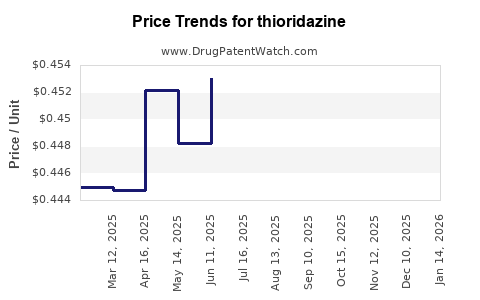
| Drug Prices: | Drug price trends for thioridazine |
| DailyMed Link: | thioridazine at DailyMed |
Recent Clinical Trials for thioridazine
Identify potential brand extensions & 505(b)(2) entrants
| Sponsor | Phase |
|---|---|
| Rabin Medical Center | Early Phase 1 |
| Rambam Health Care Campus | Early Phase 1 |
| State University of New York at Buffalo | Phase 4 |
Medical Subject Heading (MeSH) Categories for thioridazine
Anatomical Therapeutic Chemical (ATC) Classes for thioridazine
US Patents and Regulatory Information for thioridazine
Thioridazine Market Dynamics, Financial Trajectory, Patent Status, and Generic Risk
Thioridazine is a mature, low-value antipsychotic with no meaningful U.S. branded market. The active ingredient, thioridazine hydrochloride, lost commercial importance after generic substitution, safety restrictions, and the discontinuation of the Mellaril brand. Its principal commercial barriers are regulatory and clinical rather than patent-based. Current revenue is likely limited to small, geographically fragmented generic markets, institutional procurement, and occasional use where treatment alternatives are unsuitable.
What is thioridazine and how is it used?
Thioridazine is a first-generation, piperidine-class phenothiazine antipsychotic. It was developed for schizophrenia and related psychotic disorders. The drug is administered orally, generally as tablets or oral liquid formulations.
The U.S. product was marketed as Mellaril by Novartis and later supplied by generic manufacturers. The FDA-approved labeling restricts use to patients who have failed to respond adequately to treatment with other antipsychotics or who cannot tolerate those drugs because of insufficient efficacy or serious adverse effects.[1]
The restriction reflects thioridazine’s cardiac safety profile. The drug can prolong the QT interval and cause torsades de pointes, ventricular arrhythmias, and sudden death. The labeling also identifies clinically important interactions involving CYP2D6 inhibition and other QT-prolonging medicines.[1]
What therapeutic products compete with thioridazine?
Thioridazine competes with both older and newer antipsychotics:
| Competitor group | Examples | Commercial position |
|---|---|---|
| First-generation antipsychotics | Haloperidol, chlorpromazine, fluphenazine, perphenazine | Low-cost generic alternatives |
| Second-generation antipsychotics | Risperidone, olanzapine, quetiapine, ziprasidone, aripiprazole | Higher use because of broader clinical adoption and differentiated safety profiles |
| Long-acting injectables | Haloperidol decanoate, fluphenazine decanoate, paliperidone palmitate, aripiprazole formulations | Compete where adherence is a major concern |
| Clozapine | Clozapine tablets and orally disintegrating tablets | Reserved for treatment-resistant schizophrenia, with monitoring requirements |
Thioridazine has few commercial advantages over these products. It is inexpensive where available, but its cardiac warnings, monitoring requirements, and restricted treatment position reduce prescribing demand.
When did thioridazine lose market exclusivity?
Thioridazine’s meaningful U.S. exclusivity expired many years ago. The product was introduced before the modern Hatch-Waxman framework, and any original composition or product patents would have expired decades ago. The commercial market therefore shifted to generic thioridazine hydrochloride long before the brand’s discontinuation.
The critical loss of commercial protection was not a recent patent event. It was the cumulative effect of generic entry, declining clinical preference, and safety-related restrictions.
What is the FDA regulatory status of thioridazine?
The FDA approved Mellaril for schizophrenia. The product was later subject to major label changes addressing QT prolongation and sudden cardiac death. The FDA-approved labeling states that thioridazine should be reserved for patients who fail to respond adequately to other antipsychotic treatments.[1]
The regulatory status can be summarized as follows:
| Regulatory issue | Status |
|---|---|
| Active ingredient | Thioridazine hydrochloride |
| U.S. therapeutic class | First-generation antipsychotic |
| Original brand | Mellaril |
| U.S. brand commercial status | Discontinued |
| Generic status | Historically approved and marketed; current commercial availability is limited and may vary |
| Boxed warning | QT prolongation, arrhythmia, sudden death, and restricted treatment use |
| Biosimilar pathway | Not applicable |
| Prescription status | Prescription-only medicine |
| Primary regulatory barrier | Cardiac safety and drug-interaction risk |
The FDA’s Drugs@FDA database identifies the Mellaril regulatory history, while the FDA labeling provides the safety restrictions and approved indication.[1,2]
What patents protect thioridazine?
No commercially significant U.S. patent estate appears to remain for thioridazine hydrochloride. The original active-ingredient and product protections are long expired. Modern generic manufacturers therefore compete primarily on abbreviated new drug application status, manufacturing cost, supply reliability, and regulatory compliance.
What formulations are protected by thioridazine patents?
The commercial formulations are conventional oral dosage forms, including tablets and oral liquid preparations. Any historical formulation patents would have expired or become commercially irrelevant. There is no evident active U.S. formulation patent blocking ordinary generic tablets.
Potential technical barriers are more likely to involve:
- Stability of thioridazine hydrochloride in oral dosage forms.
- Control of impurities and degradation products.
- Manufacturing compliance for a low-volume product.
- Packaging and supply-chain requirements.
- Demonstration of bioequivalence for any newly filed generic product.
These are manufacturing and regulatory execution issues, not durable exclusivity rights.
Are there method-of-use patents for thioridazine?
No meaningful current U.S. method-of-use patent position is associated with the established schizophrenia indication. The indication is old, and new use patents would face substantial commercial challenges because thioridazine’s safety liabilities limit development opportunities.
The drug has attracted research interest in areas outside its approved psychiatric use, including antimicrobial and oncology-related laboratory studies. Preclinical findings do not create an approved commercial market or establish enforceable exclusivity for the original product. Any newer use would require separate clinical, regulatory, and patent analysis.
How many patents cover thioridazine?
For current U.S. commercial purposes, the number of enforceable, market-blocking patents is effectively zero. Historical patents may remain visible in patent databases because of their publication history, but their expiration dates prevent them from restricting generic entry.
The relevant distinction is between:
- Historical patents associated with the original compound or brand.
- Expired formulation or manufacturing patents.
- Current, enforceable patents capable of delaying a generic launch.
Thioridazine falls into the third category only in a limited or immaterial sense. Its commercial position is not protected by a live Orange Book patent estate.
What is the Orange Book status of thioridazine?
The Orange Book is relevant to approved U.S. drug products and listed patents, but the practical value of any thioridazine listing is limited because the product is old and the branded Mellaril franchise has been discontinued.
| Orange Book issue | Commercial assessment |
|---|---|
| Reference listed drug | Mellaril historically served as the branded reference product |
| Listed patent protection | No meaningful unexpired protection expected |
| Pediatric exclusivity | Not commercially relevant to the current market |
| New chemical entity exclusivity | Expired decades ago |
| Generic entry | Not blocked by modern brand exclusivity |
| Paragraph IV exposure | Low practical significance because the product is already off-patent |
The absence of a live patent estate means that a Paragraph IV challenge would not be the principal route to market entry. A generic applicant would more likely rely on ordinary ANDA approval against an established reference product, subject to product availability and FDA requirements.
When did Mellaril lose exclusivity and why was it discontinued?
Mellaril’s commercial decline followed the FDA’s safety actions concerning QT prolongation and ventricular arrhythmias. Novartis discontinued Mellaril in the United States in the mid-2000s. The discontinuation was not a patent expiration event in the conventional modern sense. It reflected weak commercial economics combined with safety restrictions and the availability of alternative antipsychotics.
The commercial sequence was:
| Period | Market development |
|---|---|
| 1960s | Thioridazine introduced as a phenothiazine antipsychotic |
| 1980s-1990s | Generic competition expands and newer antipsychotics gain share |
| 2000 | Stronger FDA safety warnings address QT prolongation and arrhythmia risk |
| Early-to-mid 2000s | Branded Mellaril demand declines; U.S. brand is discontinued |
| Later period | Limited generic and international availability persists in selected markets |
| Current market | Mature, low-volume, largely generic and fragmented |
What is the financial trajectory for thioridazine?
Thioridazine’s financial trajectory is best characterized as a long-term erosion from branded revenue to low-volume generic sales. There is no reliable public disclosure of current product-level revenue for thioridazine, and major manufacturers do not generally report it as a standalone commercial asset.
Historical revenue profile
During its branded period, Mellaril generated revenue as part of the conventional antipsychotic market. The product later lost value because:
- Generic alternatives reduced price and market share.
- Second-generation antipsychotics displaced older phenothiazines.
- The FDA warning narrowed the eligible patient population.
- Physicians faced greater monitoring and liability concerns.
- The brand was discontinued.
- The remaining market became too small for meaningful promotional investment.
The financial model changed from branded pharmaceutical economics to low-margin generic economics. Gross margins for an established generic can be positive, but the total market may remain unattractive if demand is small, supply requirements are burdensome, and active manufacturers are few.
Current revenue exposure
Current direct revenue exposure is likely negligible for large multinational pharmaceutical companies. Any remaining sales are more likely to be associated with:
- Small generic manufacturers.
- Regional distributors.
- Hospital and institutional purchasing contracts.
- Countries where older antipsychotics remain available.
- Special-access or limited-supply channels.
No major publicly traded company appears to depend materially on thioridazine revenue. The asset does not represent a meaningful earnings driver, pipeline catalyst, or valuation support for a large pharmaceutical issuer.
Financial trajectory by market phase
| Market phase | Revenue condition | Margin condition |
|---|---|---|
| Branded Mellaril period | Established prescription revenue | Higher branded margins |
| Generic substitution period | Rapid price and share erosion | Lower margins |
| Post-warning period | Reduced eligible population and demand | Higher compliance and liability burden |
| Post-brand period | Fragmented, low-volume sales | Potentially acceptable unit margin but weak total profit |
| Current position | Limited and geographically variable | Commercially marginal |
Which companies are challenging thioridazine?
There is no active branded company-versus-generic patent contest that defines the thioridazine market. The competitive set consists primarily of generic manufacturers and alternative antipsychotic suppliers.
The most important competitive pressure comes from substitute therapies rather than direct thioridazine challengers. Risperidone, olanzapine, quetiapine, aripiprazole, haloperidol, perphenazine, and chlorpromazine compete for the same broad treatment population or for overlapping clinical situations.
The absence of a major patent challenger is itself commercially significant. Companies have little incentive to finance Paragraph IV litigation against an old product with limited revenue potential and no valuable remaining patent barrier.
What patent litigation affects thioridazine?
No material current U.S. patent litigation is associated with the thioridazine franchise. The principal legal issues are historical product-liability and regulatory matters rather than active patent enforcement.
A new entrant would face more risk from:
- FDA manufacturing inspection findings.
- Product-quality failures.
- Inadequate impurity control.
- Supply interruption.
- Pharmacovigilance obligations.
- Litigation related to QT prolongation or drug interactions.
These risks can affect profitability even when patent barriers are absent.
What generic launch scenarios exist for thioridazine?
A generic launch would not require a conventional patent clearance strategy against a valuable live estate. The main scenarios are:
Existing generic supply continues
This is the most likely market structure. One or more suppliers maintain limited production for institutional or specialized demand. Pricing remains low, but supply can be vulnerable to manufacturing interruptions.
A new manufacturer enters
A new entrant could pursue an ANDA or another applicable FDA pathway. The commercial case would depend on expected volume, reference-product availability, manufacturing cost, and the ability to maintain reliable supply.
The product becomes commercially unavailable
Low demand and safety-related restrictions can lead manufacturers to stop production. In that scenario, the market may experience intermittent shortages even though no patent prevents manufacture.
International supply persists after U.S. contraction
Thioridazine may remain available in selected foreign markets. Regulatory status, prescribing practice, and local supply conditions differ substantially by country. U.S. discontinuation of the brand does not establish worldwide withdrawal.
How strong is the thioridazine patent estate?
The patent estate is commercially weak to nonexistent. Its characteristics are:
| Patent-strength factor | Assessment |
|---|---|
| Original compound protection | Expired |
| Core composition claims | Expired |
| Brand protection | No active commercial moat |
| Formulation protection | No material current barrier identified |
| Method-of-use protection | No meaningful approved-use barrier |
| Orange Book leverage | Minimal |
| Paragraph IV leverage | Minimal |
| Manufacturing know-how | Possible, but not a durable legal monopoly |
| Regulatory exclusivity | Expired |
| Biosimilar protection | Not applicable |
The remaining competitive advantage, if any, comes from manufacturing capability, regulatory history, supply reliability, and familiarity with a small niche market.
How does thioridazine compare with other first-generation antipsychotics?
| Drug | Patent position | Safety differentiation | Current commercial position |
|---|---|---|---|
| Thioridazine | Expired | High QT and arrhythmia concern | Limited and restricted |
| Haloperidol | Expired | Extrapyramidal and QT risks | Broad generic use, including injectable forms |
| Chlorpromazine | Expired | Sedation, hypotension, anticholinergic effects | Generic and institutional use |
| Fluphenazine | Expired | Extrapyramidal effects | Generic, including long-acting injection |
| Perphenazine | Expired | Extrapyramidal and other phenothiazine effects | Generic use, generally more practical than thioridazine |
Thioridazine is commercially weaker than several peers because its most prominent safety concern directly affects cardiac risk management. Haloperidol and injectable fluphenazine also have tolerability limitations, but their dosage forms and clinical use cases provide greater market utility.
What licensing deals involve thioridazine?
No major current licensing transaction is publicly associated with thioridazine. The drug’s age, lack of patent protection, limited market size, and safety profile reduce the rationale for an originator-style licensing deal.
A transaction involving thioridazine would more likely concern:
- A regional generic portfolio.
- A hospital-supply contract.
- A product transfer from one manufacturer to another.
- A discontinued-product acquisition.
- A limited-territory distribution arrangement.
Such arrangements would have little effect on global pharmaceutical valuations.
What are the geographic coverage and manufacturing barriers?
Thioridazine’s geographic footprint is uneven. Regulatory authorities in different countries have taken different approaches to older antipsychotics, and availability can change because of manufacturer decisions rather than patent events.
Manufacturing barriers include:
- Small batch economics.
- Need for validated analytical methods.
- Control of impurities and degradation.
- Consistent tablet or liquid dosage performance.
- FDA and other agency compliance.
- Limited availability of active pharmaceutical ingredient.
- Low inventory turnover.
The principal risk is supply fragility. A product can be legally manufacturable yet commercially unavailable because expected volume does not justify ongoing production.
Key Takeaways
- Thioridazine is an old, off-patent first-generation antipsychotic with limited current commercial value.
- Mellaril was discontinued in the United States after safety restrictions, generic erosion, and declining demand.
- The principal safety issue is QT prolongation and the risk of ventricular arrhythmia.
- No meaningful active U.S. patent estate is expected to block generic entry.
- Paragraph IV litigation has little commercial relevance because the product is already broadly off-patent.
- Biosimilar competition does not apply because thioridazine is a small-molecule drug.
- Current revenue is not publicly reported as a material standalone category and is likely limited to fragmented generic markets.
- Manufacturing reliability, FDA compliance, and product availability are more important than intellectual-property protection.
- The main competitive threat comes from alternative antipsychotics, especially risperidone, olanzapine, quetiapine, aripiprazole, haloperidol, and perphenazine.
- Thioridazine has little relevance to large-company valuation, licensing strategy, or branded pharmaceutical investment.
FAQs
Is thioridazine still sold in the United States?
Generic thioridazine has historically been approved and marketed, but availability is limited and may vary by supplier and time. The original Mellaril brand was discontinued.
Can a company obtain new patents on thioridazine?
A company could seek patents on a genuinely novel formulation, delivery system, manufacturing process, or new therapeutic use. Such patents would need to satisfy novelty and nonobviousness requirements and would not restore protection to the old active ingredient.
Is thioridazine more profitable than newer generic antipsychotics?
Usually not. Its market is smaller, its safety restrictions are more severe, and its use has declined relative to many alternative antipsychotics.
Does thioridazine have biosimilar competition?
No. Biosimilars apply to biological products. Thioridazine is a chemically synthesized small-molecule drug, so competition occurs through generic-drug pathways.
What is the biggest commercial risk for a thioridazine supplier?
The largest risk is insufficient volume to support reliable manufacturing. A supplier can face weak demand, regulatory obligations, and supply-chain costs even when no patent competitor exists.
References
-
U.S. Food and Drug Administration. (n.d.). Thioridazine hydrochloride prescribing information. FDA labeling database.
-
U.S. Food and Drug Administration. (n.d.). Drugs@FDA: FDA-approved drugs database. https://www.accessdata.fda.gov/scripts/cder/daf/
-
U.S. Food and Drug Administration. (2024). Approved drug products with therapeutic equivalence evaluations. U.S. Department of Health and Human Services.
-
U.S. Food and Drug Administration. (2000). Public health advisory: Revised labeling for thioridazine hydrochloride. U.S. Department of Health and Human Services.
-
National Library of Medicine. (n.d.). DailyMed: Thioridazine hydrochloride drug labeling. https://dailymed.nlm.nih.gov/alc/ fasterxml/..
More… ↓
