Last updated: July 30, 2026
Sulfamethoxazole is an established, off-patent antimicrobial with a generic-dominant U.S. market structure and limited remaining exclusivity tail. The financial trajectory is driven less by new product launches and more by (1) sustained volume in uncomplicated infections and prophylaxis in defined patient populations, (2) recurring price erosion from multi-source generics, and (3) periodic formulation and supply-chain shocks that temporarily tighten availability and move pricing. Long-term growth is largely a function of baseline infectious-disease demand and antibiotic utilization patterns, not brand-funded innovation.
How big is the sulfamethoxazole market in the U.S., and what drives demand?
What is sulfamethoxazole’s core commercial demand base?
Sulfamethoxazole is typically used as:
- Fixed-dose oral combinations with trimethoprim (commonly known as co-trimoxazole or TMP-SMX) for urinary tract infections, respiratory infections, and other susceptible bacterial infections.
- Chronic prophylaxis regimens in immune-compromised patients, most notably to prevent Pneumocystis jirovecii pneumonia (PJP) in HIV and other high-risk settings.
Demand is shaped by:
- Antibiotic prescribing behavior and stewardship rules that constrain broad, non-targeted use.
- Patient population incidence in HIV and transplant or immunology cohorts.
- Resistance patterns that can shift utilization among alternatives.
- Supply stability of TMP-SMX components and finished-dose products.
How does the generic mix affect revenue and profitability?
Because sulfamethoxazole and TMP-SMX products are largely multi-source:
- Manufacturer revenue is dominated by net pricing, not differentiated value.
- Margins compress during periods of price competition.
- Shifts in wholesaler purchasing behavior and formulary contracting can create revenue volatility even when total prescription counts are stable.
What market segments matter most commercially?
- Oral solid dose products (tablets, suspensions where applicable).
- Prescription channels through retail and specialty pharmacies for prophylaxis cohorts.
- Government and managed-care procurement lines where payer contracting dictates price ceilings.
When does sulfamethoxazole lose exclusivity, and what’s left of patent protection?
Does sulfamethoxazole have any meaningful near-term exclusivity in the U.S.?
As an older small-molecule antibiotic, sulfamethoxazole is not positioned as an innovation-led product. Commercial availability is dominated by generics and authorized generics. Any remaining protection tends to be:
- Weak or narrow formulation or method patents, where they exist, often tied to specific dosage forms or manufacturing methods.
- Use-related patents that are less likely to block multi-source generic entry unless they map to specific labeled indications and are still enforceable.
In practice, the “exclusivity question” for business planning is usually not “when does the molecule expire,” but whether any enforceable, listed Orange Book protections still prevent a particular competitor’s product from being marketed as substitutable.
What is the practical regulatory exclusivity landscape for generic entry?
For off-patent generics:
- FDA’s 505(b)(2) and 505(j) pathways determine whether a product can rely on listed formulations and whether it must navigate differences in bioavailability and labeling.
- Patent-litigated entry risk, if any, depends on whether an ANDA applicant files a Paragraph IV certification to Orange Book patents for a specific reference product and whether the case triggers the 30-month stay.
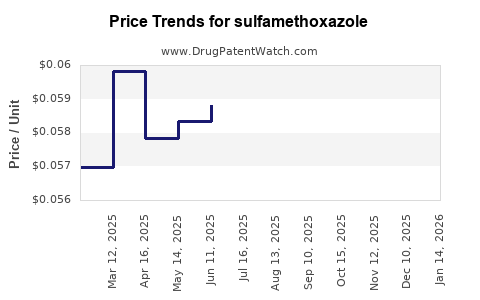
How does sulfamethoxazole’s pricing trend typically move over time?
What are the recurring pricing drivers in generic antibiotics?
- Multi-source competition: increased supply and additional ANDAs compress acquisition cost.
- Input costs: bulk chemical feedstocks and excipients can produce short-term price changes.
- Contracting dynamics: pharmacy benefit manager (PBM) and payer formularies can change net pricing quickly.
- Product discontinuations and shortages: when specific strengths or dosage forms go temporarily unavailable, pricing spikes can follow.
What does the financial trajectory look like after genericization?
Genericization usually produces:
- Declining brand-to-generic transition revenue.
- A long “low growth, low margin” market profile.
- Episodic profit spikes during constrained supply periods rather than sustained growth.
How do wholesalers and pharmacies influence realized revenue?
- Net revenue for manufacturers depends on chargebacks, rebates, distribution agreements, and prompt-pay discounts.
- Retail demand elasticity is high when alternatives are interchangeable, especially for common indications where guidelines permit switching.
Which sulfamethoxazole formulations and combination products create the most commercial revenue?
What dosage forms are most commercially relevant?
- Tablets and oral suspension products.
- Fixed-dose combinations used in outpatient and prophylaxis settings.
How does TMP-SMX positioning affect sulfamethoxazole economics?
In the real-world market, sulfamethoxazole is inseparable from its commercial footprint in TMP-SMX combinations. Financial trajectory for “sulfamethoxazole” purchasing is driven by co-formulated usage and availability, not by standalone sulfamethoxazole alone.
What patent or litigation issues can still impact sulfamethoxazole generic launch timelines?
Are Paragraph IV challenges common in sulfamethoxazole?
In older small molecules, patent challenges can occur when:
- The reference product still has Orange Book-listed patents tied to a specific formulation or dosing.
- A generic applicant seeks to be first or obtain a favorable contract position.
But in established generic markets, litigation rarely changes the medium-term trajectory of demand. The primary effect is timing and channel availability during launch windows.
How do settlement agreements change market entry risk?
Settlements typically influence:
- When an ANDA product can launch.
- Which strengths or dosage forms a competitor can market first.
- Whether “authorized generic” tactics appear during the post-settlement period.
For sulfamethoxazole, the key business implication is that these events are usually narrow and product-specific rather than molecule-wide.
How does FDA regulatory status affect sulfamethoxazole supply, labeling, and commercialization?
What matters for FDA status monitoring?
- ANDA approvals and any facility/CMC compliance-driven disruptions.
- Labeling updates affecting prescriber behavior.
- Pediatric dosing information and suspension formulation availability.
What is the typical path for new entrants?
Most commercial entries in this category are ANDAs relying on established reference reliance:
- FDA bioequivalence and CMC compliance are the core gating items.
- New clinical differentiation is uncommon, so product differentiation often comes from supply reliability and contract terms rather than clinical claims.
How do biosimilar dynamics apply to sulfamethoxazole?
Sulfamethoxazole is a small-molecule antibiotic, not a biologic. Biosimilar pathways do not apply. Competitive dynamics are instead shaped by generic ANDAs, product switching among antibiotics, and stewardship patterns.
How does sulfamethoxazole compare with alternative antibiotics economically and competitively?
What alternatives compete at the prescribing decision level?
For UTIs and related bacterial infections, and for prophylaxis needs:
- Alternatives include other oral antibiotics and, for prophylaxis, different regimens depending on patient-specific constraints.
- Market share can shift when resistance increases or when tolerability concerns steer prescribers toward alternatives.
What makes sulfamethoxazole sticky commercially?
- Long clinical history and entrenched guideline usage in many settings.
- Broad multi-source availability, which supports payer access.
- Cost competitiveness when net pricing remains low.
What can cause share loss?
- Safety concerns driving switch away in specific patient groups.
- Increased resistance that makes targeted antibiotics more attractive.
- Formulary restrictions or prior authorization requirements during constrained availability.
What generic entry risks exist for sulfamethoxazole?
Where do entry risks still concentrate in established generic categories?
Even in a mature molecule:
- Launch delays can stem from manufacturing capacity constraints rather than legal barriers.
- Compliance actions (facility inspections, warning letters) can slow approvals or lead to market withdrawal and subsequent re-entry costs.
Why do supply constraints sometimes outweigh patent risk?
For commodity antibiotics:
- Channel stockouts can create revenue opportunity for remaining suppliers even when patents are irrelevant.
- New supply often determines price more than legal exclusivity does.
What manufacturing and IP barriers can affect sulfamethoxazole profitability?
What CMC bottlenecks matter most?
- Scale-up reliability for solid dose/tablet lines or suspension manufacturing.
- Stability and shelf-life constraints affecting distribution.
- Excipient supply and reprocessing capabilities.
How do these barriers translate into financial effects?
- Reduced competition during bottlenecks leads to higher realized pricing.
- Subsequent normalization returns pricing to multi-source trough levels.
What are the geographic dynamics outside the U.S.?
Sulfamethoxazole’s global footprint tends to track:
- Regional generic manufacturing capacity.
- Public procurement cycles for essential medicines.
- Local regulatory approvals and bioequivalence requirements.
While regional pricing varies, the overarching economic pattern stays generic-driven: persistent volume with price compression and periodic supply disruptions.
Key Takeaways
- Sulfamethoxazole’s financial trajectory is primarily generic-driven: low growth, pricing pressure from multi-source competition, and margin variability tied to net pricing and supply stability.
- Commercial demand is sustained by prophylaxis and staple outpatient indications, with prescribing stewardship acting as the main long-term volume brake.
- Patent and litigation effects are usually narrow and product-specific in mature antibiotics, while CMC and supply constraints are more frequent drivers of short-term financial swings.
- Comparative competition is determined by guideline position, resistance and tolerability, and payer contracting rather than by innovation.
FAQs
-
Is sulfamethoxazole (TMP-SMX) priced as a commodity, and what determines net pricing?
Net pricing is set by PBM and payer contracting, wholesaler chargebacks/rebates, and multi-source competitive intensity; supply constraints can temporarily lift realized pricing.
-
What drives sulfamethoxazole demand for Pneumocystis prophylaxis?
Demand tracks risk population size and treatment access for HIV and other immunocompromised groups, plus clinician adherence to prophylaxis protocols.
-
Do supply shortages in TMP-SMX affect sulfamethoxazole revenues even when patents are irrelevant?
Yes. Finished-dose availability and manufacturing line constraints can dominate realized revenue through channel stockouts and subsequent repricing.
-
Are there still meaningful legal barriers to generic entry for sulfamethoxazole products?
Any legal barrier would be product-specific and depends on whether Orange Book-listed patents remain enforceable for particular reference products and formulations, rather than molecule-level exclusivity.
-
How do formulary restrictions change sulfamethoxazole market share over time?
Formulary tiering, prior authorization, and substitution rules can shift utilization toward or away from TMP-SMX, especially when alternatives are clinically acceptable.
References
- FDA. “ANDA Approval History and Related Information.” U.S. Food and Drug Administration.
- FDA Orange Book. “Approved Drug Products with Therapeutic Equivalence Evaluations (Orange Book).” U.S. Food and Drug Administration.
- PubMed. “Sulfamethoxazole and trimethoprim clinical use and indications (review articles).” National Library of Medicine.