Last updated: June 3, 2026
Praziquantel Market Dynamics and Financial Trajectory (Sales, Demand Drivers, Pricing, and Competitive Outlook)
Praziquantel is a long-established antiparasitic (Bayer and later multiple generics) used for schistosomiasis and several other helminth infections. Market dynamics are driven by (1) endemic disease burden and mass drug administration (MDA) programs, (2) country-level procurement and donor-funded purchasing, (3) generic supply and price compression, and (4) whether praziquantel is used as a key platform asset alongside other neglected tropical disease (NTD) products. Financial trajectory in major channels is characterized by stable-to-moderate unit volumes in endemic regions, strong tender-driven pricing pressure, and uneven revenue visibility outside public-health procurement.
How big is the praziquantel market and what has driven sales growth or decline?
Bottom line: Praziquantel behaves like a procurement-led NTD product. Sales are typically less influenced by brand loyalty and more by endemic geography, treatment program scale, and tender cycles. Global revenue is usually reported as modest in “value terms” relative to unit volumes, reflecting generic pricing.
What are the demand drivers for praziquantel (schistosomiasis and non-schistosomal uses)?
Key drivers split into schistosomiasis versus other indications:
- Schistosomiasis (major): Praziquantel is central to treatment programs for Schistosoma haematobium (urogenital) and S. mansoni (intestinal). Demand rises with MDA expansions and national scaling targets tied to global NTD roadmaps.
- Other helminths (secondary): Praziquantel is also used for certain trematodes and cestodes depending on country practice and guideline adoption; the incremental market contribution is smaller than schistosomiasis.
- MDA program continuity: In many endemic regions, purchasing is bundled into national NTD procurement rather than retail channels, smoothing demand but constraining pricing power.
Why do tendering and procurement cycles matter for financial trajectory?
- Public procurement leads to price compression: Multiple licensed and generic manufacturers bid in tenders. This typically caps price increases and forces margin dilution.
- Formulation mix influences unit economics: Tablets dominate for MDA; if liquid or fixed-dose combinations are procured in some programs, that can shift revenue by pack economics.
- Supply reliability is commercially decisive: Program continuity can be disrupted by supply constraints. In competitive tender environments, reliable supply wins volume.
What pricing and reimbursement dynamics shape praziquantel revenue?
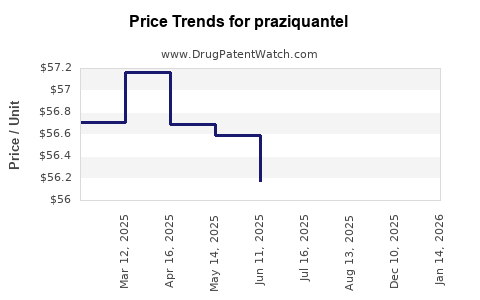
Bottom line: Praziquantel’s revenue trajectory is constrained by generic competition and procurement-led pricing. Pricing is usually stable in nominal terms only where procurement contracts lock in supply and where volumes are bundled.
How does generic entry affect praziquantel pricing?
- Low differentiation: Praziquantel is an established small-molecule with mature manufacturing. Switching costs for procurement buyers are low.
- Scale effects: Large generic suppliers can undercut smaller competitors due to lower manufacturing cost and higher scale utilization.
- Tender-based awards: Winners are commonly selected based on price, bioequivalence/quality dossier acceptance, and delivery schedule.
What role do donor programs and bulk purchasing play?
Donor and intergovernmental procurement tends to:
- Anchor volumes in endemic countries,
- Reduce the role of commercial reimbursement,
- Make the market’s “growth” more a function of program expansion than of negotiated payer pricing.
When does praziquantel lose exclusivity and how does that influence the competitive landscape?
Bottom line: Praziquantel’s branded patent life has long ended for most jurisdictions. The current market structure is primarily generic and supply-chain driven.
Are there still meaningful exclusivity or patent barriers today?
In practice, for many markets:
- Active ingredient exclusivity has already expired, and the competitive set is driven by manufacturing capacity, regulatory approvals, and formulation-specific IP where available (e.g., certain fixed-dose combinations or manufacturing process improvements).
- Regulatory barriers remain pragmatic rather than legal: buyers focus on quality systems and regulatory dossier acceptance for generic products rather than on brand-level IP.
What does this mean for revenue trajectory?
- Revenue volatility is buyer-driven: contract awards, delivery performance, and tender timing drive swings.
- Long-term growth depends on public-health scaling: absent new indications or new dosing modalities, market value tends to track patient-treated counts with downward pressure on price.
What formulations are sold and do dosage forms change the economics?
Bottom line: Oral tablets are the dominant MDA dosage form. Economics depend on pack size, strength, patient dosing compliance, and regulatory acceptance.
Which dosage forms matter commercially?
- Tablets (dominant): Used for schistosomiasis MDA. Procurement contracts often specify pack formats and strength targets.
- Pediatric dosing considerations: Because schistosomiasis programs treat children widely, tablet strength and ease of dosing can affect procurement preference.
- Alternative formulations (smaller share): Where present, they can support specific administration contexts, but total market value is usually still anchored by tablet tenders.
Are fixed-dose combinations (FDCs) a material revenue lever?
Potentially, but only when:
- National guidelines adopt combinations,
- Procurement budgets and tender specifications include combination products,
- Additional regulatory approvals and supply chain readiness exist.
Which companies sell praziquantel and how concentrated is supply?
Bottom line: The market is supplier-competitive with a broad generic base. Concentration can increase in specific tenders where procurement buyers prefer established track records.
What is the competitive structure across procurement channels?
- NTD procurement panel dynamics: Procurement agencies often maintain supplier lists that include manufacturers with established dossier acceptance and consistent delivery.
- Quality and regulatory acceptance govern switching: Even if price is lower, products that fail inspections or dossier review do not win volume.
How does competition affect financial trajectories by company type?
- Large-scale generics: Typically sustain volume with margin compression.
- Region-specific suppliers: Can win share when they meet tender requirements and delivery schedules at competitive pricing.
- Brand-era incumbents: Limited upside; value is tied to existing contracts or legacy positioning.
What patent litigation and Paragraph IV risk exists for praziquantel generics?
Bottom line: Paragraph IV risk is generally low for an old small-molecule whose active ingredient patents are long expired. Litigation, where it occurs, tends to center on:
- formulation or process IP,
- regulatory data exclusivity disputes, or
- bioequivalence and ANDA-related governance issues (less frequent for entrenched products with extensive generic history).
Is there meaningful Orange Book listing activity today?
Praziquantel is widely generic. If new formulation patents exist in specific markets, they typically surface as:
- patent estate attached to particular NDA/ANDA holders,
- settlement agreements around product launch timing where patents are asserted.
What is the Orange Book status of praziquantel and how does it affect generic entry?
Bottom line: In the U.S., praziquantel is commercially mature with a broad generic presence, so Orange Book barriers are usually limited to any remaining, product-specific patents (if listed).
What matters most for entry timing in the U.S.?
- Whether any unexpired patents are listed for specific strengths or formulations
- Whether data exclusivity or other regulatory exclusivity blocks exist
- Whether launch triggers settlement-driven launch dates
How do regulatory pathways and quality requirements impact praziquantel market access?
Bottom line: Regulatory approvals for generics are typically manageable for a well-known API, but quality systems and dossier strength determine adoption speed.
What regulatory pathway dominates in major markets?
- U.S.: Generic application pathways for small molecules with bioequivalence requirements.
- Other endemic markets: Often rely on national drug regulatory authority acceptance, WHO prequalification in procurement environments, and GMP compliance.
How do manufacturing and GMP issues affect sales?
- Batch release delays and inspections can cause short-term supply shortfalls.
- Quality failures can remove suppliers from procurement panels, creating abrupt revenue losses.
How does praziquantel compare with other NTD antiparasitics in market dynamics?
Bottom line: Praziquantel competes in the same treatment ecosystem but faces different IP and procurement pressures than newer branded NTD assets.
What comparisons matter commercially?
- Versus artemisinin-based therapies: Praziquantel pricing and demand are heavily program-based rather than payer-based.
- Versus albendazole and mebendazole: Similar MDA procurement dynamics, often tender-linked and generic-saturated.
- Versus newer NTD drugs with active patent estates: Praziquantel is less likely to generate brand-driven growth; it behaves like a volume product under cost pressure.
What drives revenue for praziquantel in the short term versus the long term?
Bottom line: Short-term revenue swings are driven by tender cycles, supply availability, and contract awards. Long-term revenue is driven by MDA scale-up, re-treatment schedules, and endemic disease program funding continuity.
Short-term levers
- Contract awards and delivery performance
- Competitive tender pricing
- Regulatory release timelines
- Supplier qualification renewals
Long-term levers
- National schistosomiasis control expansion and re-treatment coverage
- Funding continuity for NTD programs
- Any new clinical positioning that changes dosing recommendations
- Shift to combination regimens if adopted at scale
What is the likely financial trajectory under continued generic competition?
Bottom line: Under generic saturation, revenue growth is likely to come from incremental volume expansion (more treated patients, wider coverage) rather than from price. Profitability can remain thin unless a supplier wins recurring contracts and maintains supply reliability.
What does this imply for supplier margins and returns?
- Margins compress with each additional low-price bid
- Scale and working capital efficiency become critical
- Quality and uninterrupted supply can be commercial differentiators despite commodity pricing
Key Takeaways
- Praziquantel’s market is procurement-led and driven by schistosomiasis control programs, not payer or brand economics.
- Generic saturation governs pricing, making revenue growth more dependent on treated volumes and tender cycles than on price increases.
- Financial trajectory is characterized by stable demand in endemic procurement channels, with periodic volatility from contract awards and supply/regulatory readiness.
- Patent and Paragraph IV risks are typically limited for an old active ingredient, shifting competition to formulation quality, regulatory acceptance, and manufacturing reliability.
- Competitive positioning hinges on winning and keeping NTD procurement panel status and delivering consistently at low cost.
FAQs
- How do schistosomiasis MDA treatment schedules affect praziquantel annual demand?
- What supply-chain failures most often disrupt praziquantel procurement contracts?
- Which praziquantel strengths and tablet formats are most commonly specified in tenders?
- How does WHO prequalification status influence who wins praziquantel supply agreements?
- What commercial advantages can a manufacturer gain in a commodity antiparasitic like praziquantel?
References (APA)
- WHO. (n.d.). Schistosomiasis fact sheet and control strategy resources. World Health Organization.
- World Health Organization. (n.d.). Neglected tropical diseases (NTD) program overview and mass drug administration guidance. World Health Organization.
- FDA. (n.d.). Orange Book: Approved Drug Products with Therapeutic Equivalence Evaluations. U.S. Food and Drug Administration.