Last updated: August 15, 2026
Pimozide is a mature, low-revenue generic antipsychotic with a narrow U.S. indication for Tourette's disorder. Its original regulatory and patent exclusivity expired decades ago. The current market is shaped by low-cost generic competition, limited demand, safety-related prescribing constraints, and supply continuity rather than by patent barriers or branded innovation. No public source reports standalone global revenue for pimozide.
What is the current market position of pimozide?
Pimozide is an oral dopamine receptor antagonist marketed in the United States under the brand name Orap and through generic tablets. FDA labeling limits its approved use to the suppression of motor and phonic tics in patients with Tourette's disorder who have not responded adequately to standard treatment.[1]
| Market attribute |
Pimozide position |
| Active ingredient |
Pimozide |
| Brand |
Orap |
| U.S. dosage forms |
Oral tablets, including 1 mg and 2 mg strengths |
| Original U.S. approval |
1984 |
| U.S. reference product |
Orap, NDA 018273 |
| Primary indication |
Tourette's disorder |
| Regulatory pathway for competitors |
ANDA generic approval |
| Biologic status |
Small-molecule drug; biosimilar pathway does not apply |
| Patent exposure |
No active Orange Book patent barrier identified for the reference product |
| Commercial maturity |
Mature, niche, generic |
| Public standalone revenue |
Not disclosed |
Pimozide occupies a specialized position in the tic-disorder market. Its use is restricted by QT-interval prolongation, ventricular arrhythmia risk, drug interactions, and extrapyramidal adverse effects. The label contraindicates use with several drugs that prolong the QT interval or inhibit pimozide metabolism.[1]
These safety constraints limit broad substitution into general psychiatric treatment. Physicians increasingly have access to alternative agents, including atypical antipsychotics and newer therapies for Tourette's disorder. Pimozide remains relevant when clinicians value its historical efficacy for severe tics or when other treatments have failed.
When did pimozide lose exclusivity?
Pimozide lost meaningful U.S. market exclusivity many years ago. The product was approved in 1984, and generic competition has been available for a substantial portion of its commercial life.[2]
The original Orap exclusivity period ended long before the current market. The reference product does not have the commercial profile of a recently approved drug protected by patents, regulatory exclusivity, or pediatric exclusivity.
Pimozide exclusivity timeline
| Event |
Timing |
Commercial effect |
| FDA approval of Orap |
1984 |
Established the U.S. reference product |
| Generic ANDA entry |
Historical, following expiry of original exclusivity |
Shifted pricing and volume to generic suppliers |
| Current market |
Mature generic period |
Low pricing, limited differentiation, supply-focused competition |
| Current exclusivity |
None of material commercial significance identified |
No branded monopoly remains |
Pimozide is not an FDA-regulated orphan drug with a current seven-year orphan exclusivity period. Its historical indication does not create a present-day market monopoly.
What patents protect pimozide?
No active Orange Book patent listing has been identified for Orap in the FDA Orange Book product information reviewed for the reference product.[2] The absence of a current listed patent means that generic applicants do not face a listed patent requiring a Paragraph IV certification against Orap.
| Patent issue |
Pimozide status |
| Active composition-of-matter patent |
No current Orange Book barrier identified |
| Active formulation patent |
No current Orange Book barrier identified |
| Active method-of-use patent |
No current Orange Book barrier identified |
| Listed patent number |
None identified in the current reference-product listing |
| Patent term extension |
No current commercial relevance |
| Generic patent challenge |
No active Orange Book-linked challenge apparent |
This does not mean that every possible patent claim relating to pimozide, manufacturing, packaging, or treatment methods is legally impossible. It means that the principal FDA-linked patent framework for generic substitution does not present a current listed-patent obstacle.
What formulations are protected by pimozide patents?
The commercial pimozide product is an immediate-release oral tablet. No active formulation patent protecting a differentiated U.S. pimozide formulation is identified in the Orange Book listing for Orap.[2]
There is no established U.S. commercial market for long-acting injectable pimozide, transdermal pimozide, extended-release pimozide, or a proprietary abuse-deterrent formulation. That limits opportunities to create new exclusivity through delivery technology.
Are there Paragraph IV challenges for pimozide?
Pimozide has no apparent current Paragraph IV dispute tied to an active Orange Book patent. Paragraph IV litigation is most relevant when a generic applicant challenges a listed patent before its expiration. Because no active Orap patent barrier is identified, pimozide generic entry is primarily an ordinary ANDA competition issue rather than a patent-litigation issue.[2,3]
A generic applicant would generally certify to the status of listed patents in its ANDA. With no current listed patent identified for the reference product, the commercial dispute is more likely to involve approval timing, manufacturing capacity, product availability, or market economics.
What is the FDA regulatory status of pimozide?
Pimozide remains an FDA-approved prescription drug for Tourette's disorder. The FDA-approved label includes substantial cardiac and drug-interaction warnings.[1]
Key regulatory restrictions include:
- Baseline and follow-up electrocardiographic monitoring may be required.
- Pimozide is contraindicated in patients with certain cardiac conditions.
- Concomitant use with drugs that prolong the QT interval is restricted.
- CYP3A4 inhibition can increase exposure and arrhythmia risk.
- The drug is not approved as a general treatment for schizophrenia, bipolar disorder, or other broad psychiatric indications.
- The product is a small-molecule prescription drug, so the FDA biosimilar framework does not apply.
The regulatory profile creates a narrow prescriber base. Pimozide is not positioned as a first-line, high-volume antipsychotic.
How strong is the pimozide patent estate?
The pimozide patent estate is commercially weak because the core product is old, generic, and not protected by a current listed patent barrier. Its remaining defensibility comes from regulatory familiarity, clinical experience, supplier reliability, and manufacturing capability rather than exclusivity.
| Patent-strength factor |
Assessment |
| Core molecule |
Weak; long commercial history |
| Reference-product exclusivity |
Expired |
| Orange Book patents |
None currently identified |
| Formulation differentiation |
Limited |
| Method-of-use protection |
No current listed barrier identified |
| Generic entry risk |
High |
| Litigation protection |
Low |
| Manufacturing moat |
Moderate operational barrier, not a legal monopoly |
| Brand pricing power |
Low |
Manufacturing may still create practical barriers. Pimozide suppliers must meet controls for assay, impurities, tablet uniformity, stability, packaging, and supply continuity. Those requirements can reduce the number of reliable manufacturers in a small market. They do not prevent entry by a qualified generic manufacturer.
What is the competitive landscape for pimozide?
Pimozide competes in two overlapping markets: pharmacologic treatment of Tourette's tics and broader antipsychotic prescribing.
Tourette's disorder competitors
Clinicians may consider haloperidol, risperidone, aripiprazole, clonidine, guanfacine, tetrabenazine-related therapies, and behavioral interventions. Aripiprazole and risperidone have a stronger modern commercial presence in tic treatment, while deutetrabenazine and valbenazine represent newer pharmacologic approaches in movement-disorder markets.
Pimozide retains a role in selected patients because of its established tic-suppression profile. Its disadvantages include:
- QT prolongation risk
- Extrapyramidal symptoms
- Tardive dyskinesia risk
- Extensive drug-interaction restrictions
- Need for cardiac monitoring in appropriate patients
- Narrow approved indication
- Low commercial investment
Direct comparison with alternative agents
| Drug or class |
Commercial position |
Main competitive effect on pimozide |
| Aripiprazole |
Broadly used atypical antipsychotic; generic |
Strong substitution pressure |
| Risperidone |
Generic atypical antipsychotic |
Competes in tic treatment |
| Haloperidol |
Older generic antipsychotic |
Similar maturity, but different tolerability profile |
| Guanfacine/clonidine |
Non-antipsychotic options |
Relevant in selected patients, particularly when sedation or cardiovascular effects are manageable |
| Deutetrabenazine |
Newer movement-disorder product |
Higher-cost alternative with differentiated positioning |
| Behavioral therapy |
Non-drug treatment |
Reduces drug demand in appropriate patients |
Pimozide is therefore exposed to therapeutic substitution, not only direct generic substitution.
What is the financial trajectory for pimozide?
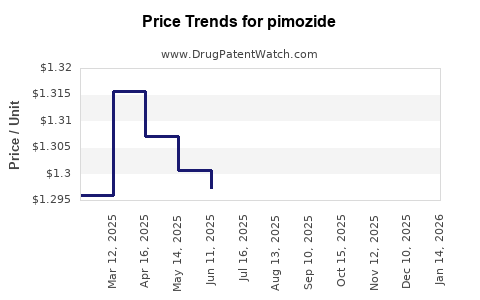
Pimozide has the financial profile of a mature niche generic. Revenue is likely concentrated among a small number of manufacturers and distributors, but public filings generally do not break out pimozide sales separately. No reliable standalone revenue series supports a precise annual market-size or growth-rate estimate.
Financial trajectory
| Period |
Financial profile |
| Branded period |
Higher unit economics under Orap |
| Early generic period |
Price erosion and share redistribution |
| Mature generic period |
Low unit prices and limited promotional spending |
| Current outlook |
Stable or declining nominal value, with episodic supply-driven price changes |
The main revenue drivers are prescription volume, generic supplier count, reimbursement rates, and product availability. Price increases can occur in small generic markets when a manufacturer exits or when supply becomes constrained. Those increases do not necessarily indicate durable market expansion.
The market has limited upside because:
- The approved indication is narrow.
- The patient population is small relative to major psychiatric categories.
- Generic competition limits pricing.
- New clinical investment is difficult without a differentiated formulation or expanded indication.
- Safety warnings reduce prescribing breadth.
- Public companies typically aggregate pimozide revenue into broader generic portfolios.
Revenue exposure for manufacturers
Pimozide is unlikely to be a material revenue driver for a diversified pharmaceutical company. Its strategic value is more likely to come from portfolio completeness, niche generic coverage, or supply contracts than from high growth.
The main financial risks are:
- Low margins after manufacturing and distribution costs
- Product discontinuation by one or more suppliers
- FDA manufacturing observations
- API sourcing constraints
- Hospital and pharmacy purchasing pressure
- Small-volume demand volatility
- Substitution by newer tic-disorder therapies
The main commercial opportunity is reliable supply in a market where the number of active manufacturers may be limited.
Which companies are involved in pimozide supply?
Teva has been associated with the U.S. Orap reference product and generic pimozide distribution. The broader generic market may include multiple ANDA holders, contract manufacturers, and distributors depending on the product strength and current supply status.[2,3]
Supplier participation can change through discontinuations, transfers, corporate acquisitions, and manufacturing decisions. For a mature low-volume drug, an apparent multi-supplier market may still depend on a small number of active production sites.
No major current pimozide licensing transaction has been identified as a significant driver of the market. The product’s commercial history is primarily associated with legacy branded commercialization and subsequent generic supply rather than recent platform licensing.
What patent litigation affects pimozide?
No major active U.S. patent litigation affecting pimozide’s core market position is identified through the current Orange Book status. The lack of a listed patent means that litigation is unlikely to determine generic launch timing.
Potential non-patent disputes could involve:
- ANDA approval or deficiency issues
- Manufacturing-site compliance
- Product quality
- Labeling
- Distribution contracts
- Shortage-related procurement
- Antitrust issues in a concentrated generic market
These issues are operational or regulatory rather than part of a branded patent-defense strategy.
What generic launch risks exist for pimozide?
Generic launch risk is high from an exclusivity perspective because the core product has no current patent barrier. Commercial launch risk is more balanced because low demand can make entry unattractive.
| Risk category |
Impact on a new generic entrant |
| Patent blocking |
Low |
| FDA approval pathway |
Standard ANDA process |
| Price competition |
High |
| Market size |
Limited |
| Manufacturing complexity |
Moderate |
| Supplier concentration |
Potentially meaningful |
| Physician switching |
Moderate; constrained by clinical familiarity and safety |
| Reimbursement |
Price-sensitive |
| Commercial launch attractiveness |
Limited unless supply is constrained |
A new entrant may obtain approval but choose not to launch aggressively if expected volume cannot support manufacturing, pharmacovigilance, regulatory, and distribution costs.
What is the geographic coverage of pimozide?
Pimozide has international availability under Orap and generic names, but regulatory status and commercial availability differ by country. The drug’s market is generally stronger where Tourette's treatment includes established use of conventional dopamine antagonists and weaker where newer atypical antipsychotics dominate.
Geographic risks include:
- Country-specific withdrawal or discontinuation
- Different labeling for cardiac monitoring
- Local generic registration requirements
- Reimbursement restrictions
- Limited API or finished-dose supply
- National tender pricing
The United States remains relevant because of its formal Orange Book and ANDA framework, but pimozide is not a high-value U.S. exclusivity asset.
Key Takeaways
- Pimozide is a mature generic drug approved by the FDA in 1984 for Tourette's disorder.
- Orap has no current Orange Book patent barrier identified for the reference product.
- Paragraph IV litigation is not a material current risk for generic entry.
- The drug has no biosimilar exposure because it is a small molecule.
- Its market is narrow and exposed to therapeutic substitution from aripiprazole, risperidone, haloperidol, guanfacine, and newer movement-disorder therapies.
- Public companies do not generally disclose standalone pimozide revenue.
- Financial performance is driven by generic pricing, supplier participation, and product availability rather than demand growth.
- Manufacturing reliability may create a practical supply moat, but not durable legal exclusivity.
- The strongest commercial opportunity is dependable supply in a potentially concentrated low-volume market.
- The patent estate is weak, and the generic launch barrier is primarily economic and operational.
FAQs
Is pimozide still protected by a U.S. patent?
No active Orange Book patent protecting Orap has been identified in the current FDA reference-product listing.[2]
Can a generic company launch pimozide without a Paragraph IV lawsuit?
Yes. With no current listed patent barrier identified, a generic applicant does not appear to face the conventional Paragraph IV patent-litigation pathway associated with protected branded products.
Does pimozide have orphan-drug exclusivity?
No current orphan-drug exclusivity protects pimozide’s U.S. Tourette's market. Its commercial exclusivity expired long ago.
Is pimozide a controlled substance?
Pimozide is regulated as a prescription antipsychotic, not as a controlled substance under the principal U.S. controlled-substance scheduling framework.
Could pimozide become commercially attractive again?
A meaningful revival would require a new commercial driver, such as a differentiated formulation, a new approved indication, a supply shortage that supports higher pricing, or clinical evidence favoring pimozide over competing therapies. The existing tablet market alone offers limited growth potential.
References
-
U.S. Food and Drug Administration. (2023). Orap (pimozide) tablets, prescribing information. FDA/DailyMed.
-
U.S. Food and Drug Administration. (2025). Approved drug products with therapeutic equivalence evaluations: Orange Book. FDA.
-
U.S. Food and Drug Administration. (2025). Drugs@FDA: FDA-approved drugs database. FDA.