Last updated: July 31, 2026
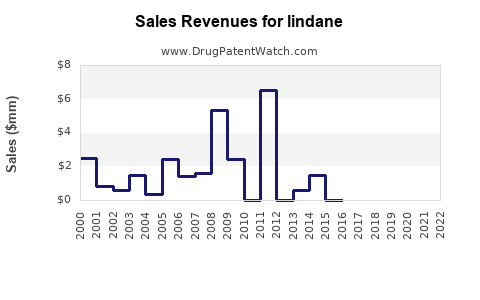
Lindane is a mature generic antiparasitic drug with minimal commercial growth potential. The FDA-approved product remains a prescription treatment for scabies and lice, but its use is restricted because of neurotoxicity and the availability of safer alternatives. Lindane has no meaningful remaining regulatory exclusivity, no active branded commercial franchise, and no publicly disclosed standalone revenue stream. Its market is sustained by low-volume generic demand, limited treatment access, and occasional use when first-line therapies fail or are unavailable.
What is the current market position of lindane?
Lindane is the active pharmaceutical ingredient in prescription products used topically for scabies and pediculosis. It is available as a 1% lotion and shampoo in the United States. The FDA labeling limits use to patients who cannot tolerate or have failed safer therapies, including permethrin and ivermectin-based treatments [1].
The commercial market is small because lindane competes against:
- Permethrin 5% cream for scabies
- Permethrin 1% lotion for head lice
- Oral ivermectin for selected scabies and lice cases
- Spinosad topical suspension for head lice
- Malathion and pyrethrin-based products
- Benzyl alcohol and newer topical agents in the lice market
Lindane’s label carries a boxed warning concerning neurotoxicity, including seizures and death. The product is contraindicated in premature infants, patients with uncontrolled seizure disorders, and individuals with known sensitivity to lindane or its formulation components [1].
Its clinical position is therefore defensive rather than expansionary. Prescribing is generally limited to treatment-resistant cases, contraindications to first-line medicines, or settings where alternative products are inaccessible.
How large is the lindane market and what is its revenue trajectory?
No major pharmaceutical company publicly reports lindane revenue as a separate product line. Available commercial and regulatory records support the conclusion that U.S. lindane sales are low relative to mainstream dermatology and anti-infective products.
| Market indicator |
Lindane position |
| U.S. product status |
FDA-approved prescription generic |
| Primary indications |
Scabies and pediculosis |
| U.S. brand status |
No active branded franchise |
| Public standalone revenue |
Not disclosed by current manufacturers |
| Growth profile |
Declining or structurally flat |
| Main demand driver |
Limited second-line use |
| Main commercial constraint |
Toxicity and safer substitutes |
| Patent-based pricing power |
None material |
| Regulatory exclusivity |
None identified |
| Generic competition |
Established |
The financial trajectory has three phases:
- The original branded period, when lindane had broader use and limited competition.
- The generic period, marked by price erosion and falling utilization.
- The restricted-use period, when warnings, public-health concerns, and replacement therapies reduced demand further.
The FDA required labeling changes in 2003 after continued reports of serious adverse events, particularly seizures and deaths associated with misuse, excessive application, ingestion, or use in vulnerable patients [2]. Those warnings reduced the addressable patient population and increased prescriber reluctance.
Lindane does not have the characteristics of a growth pharmaceutical. A revenue rebound would require a supply disruption affecting alternatives, a public-health event increasing demand for scabies treatment, or a major deterioration in access to permethrin and ivermectin. Those conditions would likely produce temporary volume increases rather than durable market expansion.
When did lindane lose exclusivity?
Lindane’s core pharmaceutical patent protection expired decades ago. The active ingredient was commercialized long before the modern Orange Book exclusivity framework became relevant to most current generic products. Any original composition-of-matter protection is no longer commercially significant.
No current patent term appears capable of supporting branded exclusivity for lindane in the United States. The commercial market is governed by generic competition, manufacturing availability, product listing status, and regulatory compliance.
| Exclusivity category |
Current assessment |
| New chemical entity exclusivity |
Expired or unavailable |
| Original compound patent |
Expired |
| Pediatric exclusivity |
None material |
| Orphan exclusivity |
None |
| Clinical investigation exclusivity |
None |
| Current formulation exclusivity |
None identified |
| Current method-of-use exclusivity |
None identified |
Lindane is therefore exposed to ordinary generic substitution and price competition. Any commercial value is tied to an approved product, reliable supply, and low operating costs rather than intellectual property.
What patents protect lindane products?
No active U.S. patent estate is publicly associated with the core lindane drug product that would create meaningful market exclusivity. Historical patents covering gamma-hexachlorocyclohexane, its preparation, or topical formulations have expired.
Potentially relevant IP categories include:
- Historical chemical and manufacturing patents
- Formulation patents covering emulsions, lotions, or shampoos
- Packaging and applicator patents
- Process-control know-how
- Stability and impurity-control methods
- Trade secrets concerning production and quality testing
These rights do not appear to create a current barrier to generic entry. Manufacturing know-how can still affect supply economics, especially because lindane is a mature and tightly regulated chemical with environmental and toxicological concerns. That is an operational barrier, not a durable patent moat.
What is the FDA regulatory status of lindane?
The FDA-approved U.S. label covers prescription treatment of scabies and lice. Lindane must be used only after failure of, intolerance to, or contraindication of safer alternatives [1].
The boxed warning states that lindane can cause seizures and death even when used according to labeling. Risk increases with repeated treatment, excessive application, ingestion, use on broken skin, and exposure in children or individuals with seizure risk.
The FDA also states that lindane should not be used:
- As a preventive treatment
- On premature infants
- On patients with uncontrolled seizure disorders
- On patients with extensive dermatitis or damaged skin
- In repeated or excessive applications
- On children unless the potential benefit justifies the risk
The regulatory profile suppresses demand because prescribers must document a clinical reason for selecting lindane over safer alternatives. The product remains legally available, but its practical use is highly constrained.
What is the Orange Book status of lindane?
The Orange Book historically listed FDA-approved lindane products and their therapeutic equivalents. Current listing status can vary by manufacturer, product strength, dosage form, and marketing activity. A product may remain approved while being marked not marketed or may disappear from active distribution without a change in the underlying FDA approval.
The relevant commercial question is not whether an original patent blocks generic entry. It does not. The relevant questions are whether a manufacturer has an active abbreviated new drug application, whether the product is currently marketed, and whether an approved equivalent is available.
Because lindane has no material patent barrier, an ANDA applicant would generally face product-specific FDA requirements rather than patent-based entry restrictions. Any Paragraph IV certification would have limited strategic value unless an applicant challenged a newly listed formulation or method patent, neither of which appears to define the current U.S. market.
Which companies are challenging lindane, and what generic entry risks exist?
The market is already genericized. No prominent branded company is defending a current lindane franchise against a major Paragraph IV campaign. Publicly reported patent litigation involving lindane is not a significant feature of the current market.
Generic entry risk is therefore asymmetric:
- For an incumbent manufacturer, additional entrants can reduce price and market share.
- For a new entrant, regulatory and manufacturing costs may be more important than patent risk.
- For wholesalers and pharmacies, supply interruption may matter more than patent expiry.
- For investors, the principal risk is demand erosion rather than a sudden patent cliff.
A new manufacturer could enter if it meets FDA quality requirements, demonstrates pharmaceutical equivalence, and obtains a compliant source of active ingredient. The commercial opportunity would likely remain limited because the total market is small and the product carries substantial liability and pharmacovigilance exposure.
What litigation and settlement agreements affect lindane?
No material current U.S. patent litigation or settlement agreement is known to determine lindane market access. Historical regulatory and product-liability disputes are more relevant than present-day Hatch-Waxman litigation.
The most significant legal exposure arises from:
- Failure to follow boxed-warning instructions
- Dispensing to contraindicated patients
- Excessive or repeated use
- Pediatric exposure
- Inadequate counseling
- Product contamination or quality failures
- Environmental and occupational handling obligations
Lindane has also been subject to international restrictions because of persistence, bioaccumulation, and toxicity. The Stockholm Convention listed lindane for restricted use and later elimination, while allowing limited pharmaceutical use for human head lice and scabies in certain circumstances [3].
How does lindane compare with competing scabies and lice drugs?
| Product |
Main use |
Safety position |
Commercial position |
| Lindane |
Second-line scabies and lice treatment |
Significant neurotoxicity concerns |
Small generic niche |
| Permethrin |
First-line scabies and lice treatment |
Generally preferred |
Broad generic use |
| Ivermectin |
Selected scabies and lice cases |
Systemic exposure; use depends on patient factors |
Established generic |
| Spinosad |
Head lice |
Effective topical alternative |
Higher-value branded/generic segment |
| Malathion |
Head lice |
Topical organophosphate concerns |
Limited use |
| Benzyl alcohol |
Head lice |
Non-neurotoxic mechanism |
Niche alternative |
Permethrin and ivermectin have stronger clinical positioning because guideline bodies and regulators generally prefer them over lindane when appropriate. The Centers for Disease Control and Prevention identifies permethrin as a commonly recommended scabies therapy and lists lindane as a less preferred option because of toxicity [4].
Lindane’s only competitive advantage is historical familiarity and availability in situations where alternatives cannot be used. It does not have a meaningful efficacy-based or intellectual-property advantage.
What manufacturing and geographic barriers affect lindane?
Lindane manufacturing is constrained by chemical toxicity, environmental regulation, and declining commercial demand. A manufacturer must manage:
- Active-ingredient sourcing
- Residual impurity control
- Worker exposure
- Hazardous-material transportation
- Environmental disposal
- Stability of topical formulations
- Child-resistant packaging and labeling
- Pharmacovigilance obligations
Geographic access varies sharply. Many countries have discontinued or restricted lindane because of environmental persistence and safer alternatives. The product may remain available in limited markets for second-line medical use, but international demand is fragmented.
The global market is therefore less dependent on patent geography than on national regulatory decisions. A product can be legally approved in one jurisdiction and unavailable in another because of environmental restrictions, market withdrawal, or lack of a local manufacturer.
How strong is the lindane patent estate?
The patent estate is weak from a commercial perspective.
| Patent-strength factor |
Assessment |
| Core compound protection |
Expired |
| Formulation protection |
No material active barrier identified |
| Method-of-use protection |
No material active barrier identified |
| Manufacturing protection |
Possible know-how, not a public exclusivity moat |
| Regulatory exclusivity |
None material |
| Litigation leverage |
Low |
| Generic entry barrier |
Primarily regulatory and operational |
Lindane’s value lies in regulatory continuity and supply reliability. Those assets can support a niche product but cannot sustain premium pricing or long-term market exclusivity.
Key Takeaways
- Lindane is a mature, low-volume generic drug for second-line treatment of scabies and lice.
- Its FDA-approved use remains constrained by a boxed warning for seizures and death.
- Permethrin and ivermectin have stronger first-line market positions.
- Core lindane patent protection expired decades ago.
- No material current Orange Book patent barrier or Paragraph IV campaign defines the market.
- Public companies do not disclose meaningful standalone lindane revenue.
- The financial trajectory is flat to declining, with occasional short-term supply-driven demand increases.
- Manufacturing, environmental compliance, and liability exposure are more important than patent protection.
- The principal commercial risk is additional generic competition combined with continued clinical substitution.
FAQs
Is lindane still available in the United States?
Yes. FDA-approved prescription lindane products may remain available through approved manufacturers or distributors, although marketing status can vary by product and time.
Is lindane stronger than permethrin?
Lindane is not generally preferred over permethrin. Permethrin has a more favorable safety profile and is commonly used as first-line therapy for scabies and lice.
Can a generic company launch lindane without a Paragraph IV challenge?
Generally, yes, if no relevant unexpired patent is listed for the target product and the applicant satisfies FDA requirements through the applicable ANDA pathway.
Does lindane have biosimilar competition?
No. Lindane is a small-molecule drug, not a biologic. Competition occurs through generic-drug pathways rather than biosimilar approval.
What is the main investment risk associated with lindane?
The main risk is structural demand decline caused by toxicity warnings, clinical substitution, regulatory restrictions, and limited patient use. Patent expiry is no longer the central commercial issue.
References
- U.S. Food and Drug Administration. (2023). Lindane lotion and shampoo prescribing information. FDA.
- U.S. Food and Drug Administration. (2003). FDA public health advisory: FDA issues stronger warnings for lindane. FDA.
- Stockholm Convention on Persistent Organic Pollutants. (2023). Lindane. United Nations Environment Programme.
- Centers for Disease Control and Prevention. (2024). Clinical care of scabies. U.S. Department of Health and Human Services.