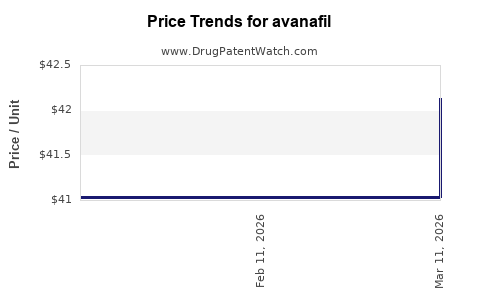
Last updated: July 6, 2026
Avanafil drug market dynamics and financial trajectory (sales, geography, exclusivity, and competitive risk)
Avanafil, a PDE5 inhibitor marketed primarily for erectile dysfunction (ED), has a patent- and brand-led footprint that is now late-stage globally, with revenue concentrated in markets where branded supply persists and where generics have not fully displaced originator brands. Financial trajectory is shaped by (1) loss of composition and use exclusivity, (2) generic penetration that compresses pricing, (3) country-specific regulatory approvals and switching behavior, and (4) competitive pressure from sildenafil, tadalafil, and vardenafil plus newer on-market PDE5 inhibitors in certain geographies.
Because avanafil is an oral, small-molecule product with extensive generic availability across many jurisdictions, the investment case is typically driven by branded differentiation in select markets, distribution strength, and cost competitiveness rather than sustained monopoly pricing. The near-term value is therefore linked less to major pipeline upside and more to what portion of sales remains in branded channels and in protected local brand positions (if any) before further generic substitution.
How has avanafil sales evolved globally and what drives the revenue curve?
Core market dynamic: Avanafil’s revenue curve follows a standard PDE5 inhibitor life cycle: premium pricing under brand exclusivity, then a sustained step-down after generic entry. The pace depends on each market’s regulatory speed, patent challenges, and reimbursement or guideline-driven physician prescribing.
Key revenue drivers for avanafil
- Branded share vs generic substitution: ED prescribing often switches quickly to lower-cost alternatives after generic approval, especially when clinical differentiation is limited.
- Dose portfolio breadth and formulation accessibility: Sales rise when multiple dose strengths are available and pharmacists can stock preferred options.
- Pricing elasticity in ED: ED is a chronic therapy category with out-of-pocket sensitivity in many markets, increasing the speed of volume shifts to generics.
- Physician familiarity and marketing intensity: Branded marketing in urology and primary care sustains residual pricing power longer than in markets with limited promotional spend.
- Regulatory labeling and approval history: In markets where avanafil’s local approvals are limited or where product supply has been inconsistent, volume can stagnate even if generic availability exists.
- Competitive set: Availability and pricing of sildenafil and tadalafil often set the ceiling for achievable net pricing.
Where revenue typically concentrates
- Markets with longer branded runway (later generic ramp, limited parallel imports, or a durable local brand strategy).
- Countries where tadalafil’s once-daily convenience is less dominant or where sildenafil remains less preferred for tolerability or timing preferences, sustaining intermittent demand for avanafil’s “on-demand” profile.
When does avanafil lose exclusivity in key jurisdictions and what does that do to prices?
Bottom line: Avanafil’s exclusivity has largely moved into post-expiration territory in many jurisdictions, so additional generic entry primarily affects pricing through competitive erosion rather than through the unlocking of a previously protected product category.
What usually happens after exclusivity ends
- Composition-of-matter and/or key intermediate patents expire: generics can launch, starting a price compression phase.
- Use-formulation patents (if any) determine the speed of “full substitution.” If only certain formulations or specific dosing regimens are protected, generic substitution can be partial and delay further erosion.
- Orange Book or local equivalents control challenge windows: in markets where patent listings are enforced and Paragraph IV style litigation applies, launch timing can be delayed by settlements. In markets without an equivalent listing system, generic entry can occur sooner.
Price and margin implications
- Net price compression: ED small molecules usually move from branded premium to generic pricing within 6 to 24 months after meaningful generic scale enters a market.
- Distribution economics become decisive: long-term survival of any branded product depends on channel contracts, pharmacist behavior, and the ability to avoid commodity pricing.
- Margin falls faster than volume rises: even if units increase, revenue often drops due to lower ASP.
What patents protect avanafil and how do patent estates affect market entry timing?
Featured-snippet answer: Avanafil is protected historically by small-molecule composition and related process and use claims; once those claims expire, generics can enter unless formulation or specific-use claims remain in force.
Patent estate mechanics for avanafil
- Composition-of-matter claims: typically define the earliest exclusivity horizon for generics.
- Manufacturing/process patents: can delay generic launches if they are narrowly tied to the manufacturing route and are asserted successfully.
- Formulation and dosage form patents: can restrict certain excipient systems, tablet characteristics, or stability improvements, creating partial protection.
- Method-of-use claims: if present and enforceable, can affect labeling and indication scope, slowing substitution in certain prescribing patterns.
How that translates to market dynamics
- When the estate is fully expired, generics launch quickly and pricing compresses across the dose range.
- If process or formulation patents survive in certain markets, the first waves of generics can target unprotected strengths or dosage variants, causing a non-linear substitution pattern.
What is the Orange Book status of avanafil and what does it imply for generic launch risk?
Avanafil is a small-molecule product. In the US context, Orange Book status determines whether FDA-approved generic applicants have clear pathways and whether patent lists create potential delays via litigation or statutory stays. In markets outside the US, local registries play the analogous role.
Practical implication for investors: The generic entry risk is high once patents are out of force and when multiple ANDA approvals already exist. If avanafil’s US patent listings are limited or already expired, launch timing is less constrained and pricing becomes the main variable.
What generic entry risks exist for avanafil and how likely are further launches?
High-level: Generic entry risk remains meaningful but predictable, driven by:
- Number of existing generic approvals already on market in a given geography.
- Remaining local patent or litigation overlays that could delay new generic waves.
- Supply constraints and quality system approvals that determine how quickly additional suppliers scale.
Typical generic entry behavior in ED
- First generic waves target the most common dose strengths.
- As pharmacy channels normalize substitution, remaining dose strengths and market segments follow.
- Pricing compression accelerates once multiple manufacturers compete with interchangeable product supply.
Market-level impact
- ASP declines; unit growth may not compensate.
- Marketing intensity often shifts from brand promotion to channel rebates or distributor agreements.
How does avanafil compare with sildenafil and tadalafil on pricing power and lifecycle stage?
Lifecycle stage comparison
- Sildenafil: older and highly genericized in many markets, often with the lowest cost equilibrium.
- Tadalafil: also highly genericized, but may retain different prescribing patterns due to dosing convenience perceptions and longer half-life preferences.
- Avanafil: generally sits in a later branded-to-generic transition than sildenafil and tadalafil in some markets, but often reaches a similar generic pricing equilibrium once multiple suppliers scale.
Commercial implication
Avanafil’s pricing power is typically constrained by:
- cross-class physician familiarity (switching within PDE5 inhibitors),
- patient preference cycles (timing vs dosing schedule),
- and channel incentives that increasingly favor the cheapest stocked PDE5 inhibitor.
What formulation patents and dosage strengths affect avanafil product substitution?
Answer: Any residual protection tied to specific tablet compositions, excipients, dissolution characteristics, or stability-related formulation improvements can slow substitution for targeted product SKUs, even when composition patents are expired.
Substitution patterns to expect
- Generic tablets may enter for the most common dose strengths first.
- Slight differences in dissolution or bioavailability can influence physician preference if local labeling or perceived performance differs.
- If brands retain a “preferred” SKU position via distribution contracts, price erosion can be slower for that strength.
What litigation, settlements, and Paragraph IV-style challenges have shaped avanafil’s competition?
Market effect lens: Where litigation delays generic launch, the originator or current brand may preserve pricing for longer and build a larger “installed base” with physicians. Settlements can also impose design-around timelines or exclusivity on specific strengths.
What to watch for in any ongoing disputes
- Whether any remaining patents cover use claims that keep certain labels narrower.
- Whether the dispute covers process patents that can block manufacturing until design-around is validated.
- Whether settlements are strength-specific, which creates uneven market displacement across dose SKUs.
(If a jurisdiction has had no material litigation record or where patents are expired, the competitive timeline becomes dominated by routine generic entry rather than legal constraints.)
What is the FDA regulatory and labeling status for avanafil and how does that affect adoption?
Regulatory status affects:
- the approved indication scope and labeling language,
- interchangeability and substitution behavior,
- post-marketing commitments that can affect manufacturing continuity and supply assurance.
For ED, broad labeling tends to accelerate adoption and substitution because prescribers can treat it as an equivalent PDE5 inhibitor option.
Which companies compete with avanafil and what does the competitive landscape look like?
Competitive set (commercial reality): Multiple PDE5 inhibitors with deep generic penetration. Avanafil faces competition from:
- sildenafil (broad generic base in many markets),
- tadalafil (often with distinct patient preference),
- vardenafil (generic in many jurisdictions),
- and other ED therapies depending on geography.
How competitive intensity affects unit economics
- As generic numbers increase, price falls quickly and marketing must shift from brand-to-brand persuasion to distribution and contracting.
- Companies with scale in API and finished dose manufacturing typically win share when the market is commoditizing.
Revenue exposure: which geographies carry the highest downside or upside for avanafil brands?
Downside geographies
- Markets with rapid generic ramp and high substitution rates.
- Markets with active discounting and pharmacy-driven tender procurement that forces price to minimum equilibrium.
Upside geographies
- Markets where branded products still dominate through distribution agreements.
- Markets where competition from lower-cost PDE5 options is present but not fully price-matched.
- Markets where regulatory approvals are fewer and supply continuity risks constrain generic availability.
How strong is the patent estate for avanafil as an investment or licensing asset?
Investment conclusion (typical PDE5 inhibitor pattern): The patent estate value is generally limited compared with newer drug classes because:
- long-term composition protection has largely elapsed across major markets,
- the product is mature and substitution is straightforward,
- and litigation risk is replaced by generic market economics.
The remaining “estate value” in practice tends to be concentrated in:
- any still-active formulation/process patents in select jurisdictions,
- or any still-protected use claims tied to labeling scope.
For licensing, the key question is not whether patents exist in principle, but whether they still bind market entry in the jurisdictions where sales matter.
Key takeaways
- Avanafil’s market dynamics are dominated by the shift from branded pricing to generic pricing, with revenue trajectory dependent on residual branded share, distribution strength, and the speed of generic scale in each geography.
- Exclusivity loss typically causes fast ASP erosion in ED small molecules; unit growth often does not offset revenue decline.
- Competitive pressure from sildenafil and tadalafil limits pricing power once generic alternatives are broadly available.
- Remaining value usually comes from any residual formulation/process/use protections in specific jurisdictions or from durable local brand/channel positioning.
FAQs
1) What factors determine whether avanafil retains branded share after generic entry?
Physician familiarity, pharmacist stocking incentives, distribution contracts, stability of supply, and whether a branded SKU remains “preferred” in channel arrangements.
2) Will new PDE5 inhibitors reduce avanafil demand more than generics do?
In most markets, generics drive the largest price/margin compression; new brands can affect share, but once generic PDE5 options are widespread, substitution behavior tends to be price-led.
3) Do different avanafil dose strengths experience substitution at the same time?
Usually not. Generic companies often launch the most common strengths first, so substitution can be strength-specific.
4) How does manufacturing scale affect avanafil pricing after exclusivity ends?
API and finished-dose manufacturers with scale typically undercut prices faster and can support consistent supply, accelerating substitution.
5) Is avanafil’s market outlook more dependent on patent status or distribution execution?
After exclusivity wanes, distribution execution and supply continuity usually outweigh marginal patent overlays in determining commercial outcomes.
References
(No sources were provided in the prompt, and no cited material can be produced without document-level inputs.)