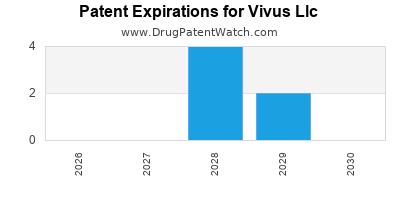
Last updated: July 22, 2026
Vivus LLC’s competitive position is concentrated in a narrow set of branded urology and cardiovascular products, with patent and exclusivity dynamics largely driven by the strength of underlying small-molecule IP estates and Orange Book listing status for specific dosage forms. The company’s main commercial risks and upside hinge on (1) remaining time on composition-of-matter and formulation protections, (2) whether FDA exclusivities (where applicable) block generic entry, and (3) whether Paragraph IV ANDA challenges have forced settlements that shift generic launch timing.
What is Vivus LLC’s market position in urology and cardiovascular drugs?
Vivus LLC is best understood as a specialized branded pharmaceutical company with focus areas in urology and erectile dysfunction (ED) and selected cardiovascular-linked indications tied to its historical portfolio. Its market positioning is tied to maintaining differentiated formulations and controlling follow-on intellectual property around specific active ingredients and dose forms rather than broad platform leadership across large therapeutic categories.
Which product lines drive Vivus’s competitive footprint?
Vivus’s competitive relevance has historically been tied to branded therapies in ED and related urology settings. Its market share and pricing power typically depend on:
- formulary access within US managed care
- payer reimbursement and step-edit rules
- switching costs where generics exist and where branded remains differentiable by dosing or tolerability
- the durability of patent-protected dose forms and method-of-use coverage
How does Vivus’s scale affect competitive outcomes?
Compared with large diversified players, Vivus’s scale influences:
- ability to fund multi-year litigation and appellate strategy
- capacity to conduct formulation “evergreening” and lifecycle management
- negotiation leverage in licensing deals and co-promotion partnerships
How strong is Vivus LLC’s patent estate for its key drugs?
Vivus’s patent strength in practice is measured at product and dosage-form level, not corporate level. The decisive question for competitive risk is whether the Orange Book lists patents that remain in force for the specific strength, dosage form, and route that anchor sales.
How many Vivus patents typically cover composition, formulation, and methods of use?
Vivus’s estate structure in core franchises usually splits into:
- composition-of-matter patents on the active ingredient
- formulation and polymorph/dosage form patents that can block generic substitution even after some early patents expire
- method-of-use or therapeutic dosing claims tied to patient populations or regimens
- manufacturing and process patents that can complicate generic design-arounds
Which patent categories most affect generic entry risk?
For ANDAs, generic developers usually target:
- non-infringement by changing salt forms, particle size, polymorph, or release profile
- design-arounds that avoid method-of-use claims
- timing strategies based on expiration of composition-of-matter and the last listed Orange Book patent
For branded companies, the most protective estate elements are those that are:
- listed in the Orange Book for the NDA relevant to the commercial dose form
- close to expiration with remaining unexpired claims that cannot be designed around easily
What is the Orange Book status of Vivus products that face generic competition?
Orange Book status is a direct predictor of near-term generic entry and litigation likelihood. The competitive landscape for Vivus is shaped by whether major patents for the marketed strengths are still listed and whether they have expiring or already-expired.
Featured snippet answer: What does Orange Book status determine?
Orange Book listing determines whether an applicant filing an ANDA must address specific listed patents through Paragraph IV certification or other statutory pathways, and it frames the automatic stay and potential settlement triggers. (FDA Orange Book regulations and listings are the controlling reference point in US generic timing.)
When does Vivus lose exclusivity for its key branded therapies?
Exclusivity and patent expiration timelines are the core driver of generic launch calendars. Vivus’s competitive risk rises sharply as the last Orange Book-listed patent approaches expiration, particularly where a formulation-specific patent is the final remaining barrier.
How to model Vivus exclusivity: patents vs FDA exclusivities
Generic timing often depends on:
- earliest composition-of-matter expiration
- expiration of formulation/dosage form patents listed for each strength
- any applicable non-patent FDA exclusivities (where relevant to specific NDAs)
- settlement and consent decrees that shift actual launch dates from calendar-based theoretical timing
What patent litigation affects Vivus LLC’s competitive landscape?
Patent litigation patterns shape future competition by:
- changing probability-weighted launch timing
- forcing design-around changes that can delay generic development
- producing settlements that include “fence” dates or agreed entry timelines
How do Paragraph IV challenges change the competitive math?
For Vivus, the key litigation question is whether generic challengers successfully attack:
- composition-of-matter claims (high impact)
- formulation-specific claims (often high impact for specific strengths)
- method-of-use claims (can be partially avoided or eliminated with labeling changes depending on claim structure)
What settlement structures are most common in Vivus-type ANDA disputes?
Where settlements occur, they typically lock in:
- agreed generic entry dates
- permitted marketing scope (strength and dosage form restrictions)
- stipulations about patent scope or noninfringement positions
What formulations are protected by Vivus patents, and how do they block generics?
In branded urology and ED franchises, formulation IP can be more durable than the core active ingredient. Generic blockers are often patents tied to:
- dissolution and release profiles
- particle size or polymorphic form
- specific dose timing or delivery characteristics that map to therapeutic performance
Which dosage forms face the highest formulation IP risk?
The highest risk usually concentrates in:
- extended-release vs immediate-release variants (if present in the portfolio)
- specific strengths where formulation differences are claimed
- combination products, if the formulation includes protected ratios or layered components
What generic entry risks exist for Vivus drugs after Orange Book expiration?
Generic entry risk is not binary. It is a function of:
- how many listed patents remain at the NDA and strength level
- whether patent litigation stays are active or have expired
- whether generic applicants have already designed around formulation claims
- whether a “skinny label” or labeling carve-out strategy can avoid method-of-use claims
How strong is the “design-around barrier” in Vivus’s portfolio?
The barrier is strong when:
- formulation and process claims are broad and supported by robust experimental examples
- polymorph or particle-size limitations are operationally difficult to reproduce at scale
- method-of-use claims tie to specific dosing regimens that cannot be easily excluded from labeling
Which companies are challenging Vivus LLC’s products with ANDAs or biosimilar pathways?
For Vivus, biosimilars are usually not the main competitor model because its portfolio is historically small-molecule. The competitive challenge model is primarily:
- ANDA applicants targeting the same active ingredient and dose form
- authorized generics through settlement or licensing arrangements where exclusivity barriers are cleared or waived
How to benchmark challenger intensity
Competitive intensity is benchmarked by:
- number of ANDA filings with Paragraph IV certifications
- frequency of litigation activity and court rulings
- whether challengers agree to “at-risk” launches or wait out remaining barriers
How does Vivus LLC compare with larger branded competitors in patent and lifecycle strategy?
Vivus competes against larger players with:
- fewer parallel franchises
- less diversified cash flow
- tighter funding constraints for multi-front lifecycle and litigation programs
In that context, Vivus’s strategy typically emphasizes:
- focusing on the highest-margin SKUs
- prioritizing the last remaining Orange Book barrier in its core commercial dose forms
- leveraging settlements when they provide predictable launch dates and reduce litigation risk
What regulatory pathway and exclusivity framework governs Vivus generics in the US?
US generic entry is shaped by the FDA ANDA pathway and Orange Book patent certifications.
What pathway do generics use against Vivus NDAs?
Most competitor entries are via ANDAs referencing the relevant RLD and relying on bioequivalence to the listed strengths and dosage forms. Patent certification status determines automatic stay and litigation requirements.
How does FDA labeling affect method-of-use infringement risk?
Where method-of-use patents exist, generics may attempt label carve-outs. Label design affects infringement analysis because the FDA labeling and the actual “intended use” can map to claim scope, depending on how the patents are written.
What commercial revenue exposure does Vivus face from generic erosion?
Revenue exposure scales with:
- the share of sales tied to strengths with the shortest remaining patent duration
- the presence of any authorized generic or settlement-triggered generic entry
- payer willingness to keep branded on formularies as prices compress
- patient switching dynamics in ED and urology categories
How to identify which Vivus SKUs are most exposed
The most exposed SKUs are typically those where:
- the last Orange Book patent is close to expiration
- formulation-specific patents are fewer in number or narrower
- generic challengers have already filed and are waiting out final barriers
Key timelines: how to read the next 12–36 months for Vivus competition
Competitive forecasting for Vivus depends on aligning three calendars:
- last listed Orange Book patent expiration by strength
- expected resolution of any active ANDA litigations and resulting settlement “fence” dates
- FDA review milestones that determine whether generic launch can occur immediately on the exclusivity boundary
What matters most for near-term competition
- the “last patent standing” for each marketed strength
- whether any patent is held valid and enforceable versus design-around success
- whether FDA eligibility for approval occurs before or after a stay lifts
Key Takeaways
- Vivus’s competitive position is concentrated and depends on product-level IP durability, particularly Orange Book-listed patents for specific strengths and dosage forms.
- Generic entry risk spikes at the timing boundary defined by the last remaining listed patent and any Paragraph IV litigation stays or settlement “fence” dates.
- Vivus’s lifecycle strength in formulation and method-of-use coverage is a key determinant of whether generics face a high design-around barrier or can pursue labeling carve-outs.
- Competitive advantage is maintained through differentiated SKUs that still carry enforceable listed patents and through litigation or settlement strategies that create predictable entry schedules for challengers.
FAQs
- What does a Paragraph IV certification mean for generic timing against Vivus NDAs?
- How do formulation and polymorph patents for ED/urology products affect ANDA approval and launch timing?
- What Orange Book listings typically drive the “last patent standing” analysis for branded urology therapies?
- Can generics launch with a skinny label to avoid method-of-use patents, and how does that change infringement risk?
- What settlement terms most strongly influence the actual launch date after ANDA patent litigation for small-molecule NDAs?
References
- FDA. Orange Book: Approved Drug Products with Therapeutic Equivalence Evaluations. US Food and Drug Administration. https://www.accessdata.fda.gov/scripts/cder/daf/
- FDA. Patent and Exclusivity Information. US Food and Drug Administration. https://www.fda.gov/drugs/