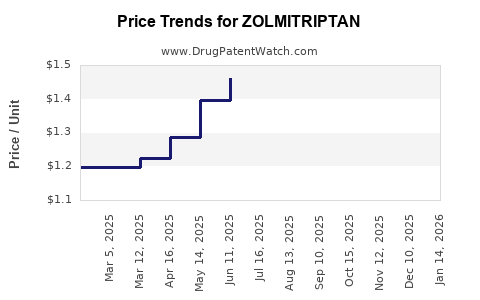
Last updated: August 15, 2026
Zolmitriptan is a mature, off-patent small-molecule migraine treatment with declining branded economics and continuing generic demand. The product competes in the acute migraine market against low-cost triptans, while newer gepants and lasmiditan pressure its long-term clinical relevance. Revenue has shifted from AstraZeneca’s branded Zomig franchise to generic manufacturers and regional licensees. The main remaining commercial value is in differentiated delivery formats, established physician familiarity, and access through low-cost formularies.
What is the current FDA status of zolmitriptan?
Zolmitriptan is FDA-approved for the acute treatment of migraine with or without aura in adults. It is marketed in three principal dosage forms:
| Dosage form |
Typical strengths |
FDA regulatory position |
| Immediate-release tablet |
2.5 mg, 5 mg |
Approved |
| Orally disintegrating tablet |
2.5 mg, 5 mg |
Approved |
| Nasal spray |
2.5 mg, 5 mg |
Approved |
The reference brand is Zomig, originally developed and commercialized by AstraZeneca. The product is prescription-only and is not indicated for migraine prevention.
Zolmitriptan is a selective serotonin 5-HT1B/1D receptor agonist. Its clinical value comes from rapid relief of migraine-associated headache and symptoms such as nausea, photophobia and phonophobia. The nasal formulation has a faster onset profile than oral products and retains commercial relevance where patients have nausea, vomiting or difficulty swallowing.[1]
The FDA label limits use based on cardiovascular risk. Contraindications include ischemic coronary artery disease, coronary vasospasm, certain cerebrovascular conditions, peripheral vascular disease, uncontrolled hypertension and use with ergot-containing drugs or another triptan within the relevant treatment window.[1]
When did zolmitriptan lose patent exclusivity?
The core U.S. composition patent for zolmitriptan was U.S. Patent No. 5,466,699, assigned to entities associated with Glaxo and Wellcome. Its term expired in the mid-2010s, allowing generic entry after the branded exclusivity period ended.[2]
The commercial consequences were substantial:
- Zomig lost its ability to sustain premium pricing.
- Generic oral tablets became the principal volume product.
- Manufacturer economics shifted from innovation returns to manufacturing scale and contract access.
- The nasal spray retained some differentiation, but did not preserve broad branded exclusivity.
The key U.S. patent and exclusivity milestones were:
| Milestone |
Approximate timing |
Commercial effect |
| Initial FDA approval of Zomig tablets |
1997 |
Launch of branded oral product |
| FDA approval of orally disintegrating formulation |
Early 2000s |
Added convenience and lifecycle protection |
| FDA approval of nasal spray |
2003 |
Added rapid-delivery option |
| Core composition patent expiry |
Mid-2010s |
Generic entry and price erosion |
| Broad generic availability |
Mid- to late 2010s |
Branded revenue decline |
| Current market position |
2020s |
Mature generic and regional branded market |
The U.S. Orange Book should be used for the operative patent and exclusivity record because listings can change by product, dosage form and regulatory status.[3] Current commercial protection does not depend on a live, broad composition patent for zolmitriptan.
What patents protect zolmitriptan formulations and delivery systems?
The original patent estate covered the zolmitriptan chemical entity and related pharmaceutical uses. Later intellectual-property protection focused on formulations, dosage forms and administration routes.
Oral tablets and orally disintegrating tablets
The oral market has the weakest current barrier to entry. Multiple generic manufacturers can produce immediate-release tablets after expiration of the core patent and applicable regulatory exclusivities. Orally disintegrating tablets may require separate formulation development, manufacturing controls and bioequivalence work, but those requirements generally do not create a durable commercial moat once the reference product’s exclusivity has ended.
The main technical challenges are:
- Dose uniformity at low milligram strengths.
- Rapid disintegration without compromising stability.
- Taste masking.
- Moisture control in packaging.
- Bioequivalence for a dosage form with different dissolution characteristics.
Nasal spray
The nasal product has stronger technical differentiation than the tablet. Its barriers are manufacturing and device-related rather than broad molecule protection.
Key development requirements include:
- Consistent spray-actuation performance.
- Droplet-size and plume characterization.
- Preservative and container compatibility.
- Device filling and assembly controls.
- Local tolerability and nasal mucosal safety.
- Product performance over shelf life.
These requirements can delay generic development, but they do not eliminate competition. The nasal spray’s value depends on whether its speed and administration advantages justify higher reimbursement or out-of-pocket cost.
Manufacturing and intellectual-property barriers
Zolmitriptan itself is a conventional small molecule, not a biologic. It does not face biosimilar-style manufacturing barriers. A generic producer needs control of:
- Active pharmaceutical ingredient supply.
- Chiral purity and impurity profile.
- Tablet compression and coating.
- Orally disintegrating technology, if applicable.
- Nasal-device filling and testing.
- FDA-compliant analytical methods.
The manufacturing barrier is moderate for tablets and higher for nasal spray. The IP barrier is low for the molecule and moderate for specific device or formulation implementations.
How many patents cover zolmitriptan?
The number of historical patents is materially higher than the number of patents that currently constrain commercial entry. The estate has included:
- Core composition patents.
- Pharmaceutical-composition patents.
- Oral dosage-form patents.
- Orally disintegrating formulation patents.
- Nasal-delivery and device-related patents.
- Method-of-use claims for migraine treatment.
The most commercially important patent was U.S. Patent No. 5,466,699. Later formulation patents helped extend the product lifecycle but did not preserve a broad, durable monopoly after generic competition emerged.[2]
For business analysis, counting historical patents overstates current protection. The relevant question is whether a patent can block an ANDA, delay approval, or support an enforceable infringement claim. For zolmitriptan, the current blocking effect is limited.
Which companies challenged Zomig through Paragraph IV filings?
Generic entry into oral zolmitriptan followed the standard Hatch-Waxman pathway. ANDA sponsors could submit Paragraph IV certifications against listed patents or Paragraph III certifications where patents had expired.
Public FDA records identify generic zolmitriptan products from multiple manufacturers over time, including major generic suppliers and regional pharmaceutical companies. The competitive field has included manufacturers such as Teva, Mylan, Dr. Reddy’s Laboratories and Apotex, although product availability differs by dosage form, strength and market period.[4]
Paragraph IV risk was highest during the period when later-listed formulation or dosage-form patents remained active. That risk has diminished as the principal patents expired and generic approvals accumulated.
No current commercial assessment should treat zolmitriptan as a molecule with a meaningful unresolved Paragraph IV barrier unless a specific Orange Book listing or pending litigation record supports that conclusion.
What is the Orange Book status of Zomig and generic zolmitriptan?
Zomig and its dosage forms are recorded through FDA drug databases and the Orange Book framework. The commercial status is characterized by:
| Category |
Status |
| Reference product |
Zomig |
| Active ingredient |
Zolmitriptan |
| Regulatory class |
Small-molecule prescription drug |
| Generic pathway |
ANDA |
| Current broad composition protection |
Expired |
| Biosimilar pathway |
Not applicable |
| Principal remaining differentiation |
Nasal delivery, brand recognition and distribution |
| Main reimbursement pressure |
Generic substitution and formulary preference |
FDA listing status does not guarantee active commercial supply. A product can remain approved while being intermittently marketed, discontinued by a sponsor or restricted to particular channels. For investment analysis, approval, marketing status and actual wholesaler availability must be separated.[3][4]
How has the zolmitriptan market changed financially?
Zolmitriptan followed the standard financial trajectory of an acute-care branded medicine:
Launch and growth phase
Zomig entered a growing triptan class in the late 1990s. The brand benefited from:
- High migraine prevalence.
- Expansion of physician awareness of triptan therapy.
- Multiple delivery formats.
- Repeat use by patients with episodic migraine.
- AstraZeneca’s global commercial infrastructure.
The product’s value was highest before generic substitution, when the brand captured a premium for clinical familiarity and formulation choice.
Maturity phase
During the mature-brand period, growth slowed as the market became crowded with sumatriptan, rizatriptan, eletriptan, naratriptan and other triptans. Payers increasingly treated triptans as therapeutic alternatives, limiting pricing power.
The nasal spray and orally disintegrating tablet helped extend the lifecycle, but the underlying mechanism remained part of an older therapeutic class. Brand sales were also exposed to patent expiry and the migration of prescriptions to generic tablets.
Post-expiry phase
After core patent expiry, the financial model changed:
- Unit volumes could remain stable or increase.
- Net prices fell sharply.
- Generic manufacturers competed on supply reliability and payer contracts.
- Brand revenue became concentrated in residual branded prescriptions and differentiated formats.
- Royalty and licensing economics became more important than direct branded sales.
Public company filings do not provide a consistent current standalone revenue series for global zolmitriptan. Regional rights transfers, discontinued reporting lines and generic substitution make historical brand figures difficult to compare directly. The direction is clear: the branded franchise contracted after exclusivity loss, while total molecule demand persisted at lower prices.
Which companies own or commercialize zolmitriptan rights?
AstraZeneca was the original owner and global commercial developer of Zomig. Over time, rights were transferred or licensed in several markets as AstraZeneca reduced exposure to mature products.
The U.S. rights were associated with Impax Laboratories, which later became part of Amneal Pharmaceuticals. AstraZeneca also entered transactions involving other regional rights, including an agreement with Grünenthal covering Zomig commercialization in selected territories.[5][6]
The commercial structure has therefore been fragmented:
| Participant |
Role in the lifecycle |
| AstraZeneca |
Original developer and global brand owner |
| Impax Laboratories |
U.S. commercial rights associated with Zomig |
| Amneal Pharmaceuticals |
Successor to Impax’s relevant commercial assets |
| Grünenthal |
Regional commercialization rights in selected markets |
| Multiple generic firms |
Post-expiry supply across oral and other dosage forms |
The value of these rights depends on geographic market share, supply continuity, reimbursement status and the strength of local generic competition. A territory with limited generic penetration may retain brand or authorized-generic value even after U.S. patent expiry.
What generic entry risks exist for zolmitriptan?
Generic entry risk is high for oral zolmitriptan and moderate for the nasal spray.
Oral tablets
The oral tablet has low regulatory and technical complexity. Generic entry can occur through conventional ANDA development, and substitution is straightforward where state pharmacy rules and payer policies support it.
Expected effects include:
- Rapid price erosion.
- Reduced brand prescription share.
- Increased rebate and contracting pressure.
- Lower inventory value for branded wholesalers.
- Greater dependence on supply reliability.
Orally disintegrating tablets
The orally disintegrating product has somewhat greater formulation complexity. Generic competition can still be effective because patients and prescribers may accept other oral dosage forms if reimbursement is materially better.
Nasal spray
The nasal spray faces a higher development hurdle. Device performance and product characterization increase cost and development time. A successful generic or authorized generic nasal spray could still create substantial pricing pressure because the product’s therapeutic advantage is linked to delivery speed rather than a protected new mechanism.
How does zolmitriptan compare with competing migraine drugs?
| Product or class |
Competitive position versus zolmitriptan |
Patent and pricing profile |
| Sumatriptan |
Lower-cost, high-recognition triptan alternative |
Broad generic competition |
| Rizatriptan |
Similar acute-use positioning; strong oral convenience |
Generic and low-price market |
| Eletriptan |
Often positioned for efficacy or response in selected patients |
Generic competition |
| Naratriptan |
Longer-acting option with slower onset |
Generic competition |
| Ubrogepant |
Acute migraine treatment without triptan vasoconstrictive mechanism |
Branded, newer-class economics |
| Rimegepant |
Acute and preventive use, with differentiated dosing |
Branded, patent-protected |
| Lasmiditan |
Non-triptan acute therapy for selected patients |
Branded, controlled-driving restrictions |
| Zolmitriptan nasal spray |
Rapid delivery and established clinical familiarity |
Mature product with limited current IP protection |
The most important competitive shift is from triptan-versus-triptan substitution to class substitution. Gepants can be used in patients who cannot tolerate triptans or have cardiovascular concerns, although price and access remain different.
Zolmitriptan retains relevance where low cost, previous patient response and rapid administration matter. Its disadvantages include class contraindications, tolerability concerns and limited differentiation in the tablet segment.
What is the biosimilar risk for zolmitriptan?
There is no biosimilar risk. Zolmitriptan is a chemically synthesized small molecule and competes through the generic drug pathway, not the FDA biosimilar pathway.
The applicable risks are:
- ANDA approval.
- Paragraph IV litigation during any remaining patent term.
- Formulation-specific generic entry.
- Authorized-generic competition.
- API and finished-dose supply disruption.
- Pharmacy-level substitution.
This distinction matters because generic competition is generally faster and more price-destructive than biosimilar competition for a mature small molecule.
What patent litigation and settlement issues affect zolmitriptan?
Zolmitriptan’s central litigation risk occurred during the transition from branded exclusivity to generic availability. Any relevant dispute would likely involve:
- Validity of a formulation patent.
- Infringement by a nasal-spray or orally disintegrating product.
- Paragraph IV notice.
- ANDA approval timing.
- Settlement provisions governing a generic launch date.
The current commercial market does not indicate a major unresolved patent dispute that would restore broad exclusivity for Zomig. Settlement economics should be evaluated by dosage form and jurisdiction because an agreement affecting tablets may not control nasal spray products or non-U.S. markets.
When does zolmitriptan lose exclusivity in major markets?
U.S. composition-patent protection ended in the mid-2010s. European and other national exclusivity periods varied according to local patent prosecution, supplementary protection certificates and regulatory approval dates.
| Market |
Exclusivity position |
Commercial implication |
| United States |
Core patent expired; generic supply established |
High price pressure |
| European Union |
National and regional patent rights expired or matured at different times |
Market-by-market generic penetration |
| Canada |
Mature product with generic competition |
Limited branded pricing power |
| Latin America |
Rights and enforcement vary by country |
Potential residual brand value |
| Emerging markets |
Local registration and manufacturing rules matter |
Mixed generic access and pricing |
Geographic analysis remains important because a mature medicine can have low U.S. value but retain commercial cash flow in countries where generic registration is incomplete, local distribution is concentrated or branded prescribing persists.
What is the long-term financial outlook for zolmitriptan?
The base-case outlook is stable-to-declining revenue at the molecule level, with continued low-cost demand. The financial profile is:
- Low growth.
- Low pricing power.
- Moderate volume persistence.
- High generic substitution.
- Limited innovation premium.
- Greater value in supply contracts and regional rights than in global branding.
Upside could come from a supply shortage, a focused nasal-spray strategy, improved payer access or a co-branded low-cost product. These factors would support volume, not a return to pre-expiry branded economics.
Downside risks include further generic entrants, withdrawal of the branded nasal spray, API price competition, reduced triptan use as gepants expand and payer restrictions on nonpreferred products.
The most defensible investment thesis is therefore a cash-flow and supply-chain thesis, not a patent-restoration thesis. A company with efficient API sourcing, reliable nasal-device manufacturing or a strong regional distribution network may extract value from zolmitriptan. A company relying on premium tablet pricing faces structural erosion.
Key Takeaways
- Zolmitriptan is an FDA-approved acute migraine treatment marketed historically as Zomig.
- The core U.S. patent expired in the mid-2010s, and broad molecule-level exclusivity is gone.
- Generic risk is high for tablets and moderate for the nasal spray.
- The nasal formulation has greater technical barriers but no equivalent broad commercial moat.
- Zolmitriptan is not subject to biosimilar competition.
- AstraZeneca’s original franchise has been replaced by fragmented regional rights and generic supply.
- Financial value has shifted from brand pricing to low-cost volume, supply reliability and selected geographic markets.
- Gepants and lasmiditan create class-level competitive pressure beyond traditional triptans.
- No current patent position supports a credible return to pre-generic Zomig economics.
FAQs About Zolmitriptan Market and Patent Economics
Is Zomig still commercially relevant?
Yes, but primarily as a mature brand and delivery platform. Generic zolmitriptan accounts for much of the economic activity in oral dosage forms.
Can a generic company launch zolmitriptan nasal spray?
Yes. The company must satisfy FDA requirements for nasal-product equivalence, device performance, manufacturing controls and product characterization.
Does zolmitriptan have pediatric exclusivity?
The FDA-approved Zomig labeling is directed to adults. Pediatric exclusivity is not a current source of broad commercial protection for the product.
Are gepants likely to replace zolmitriptan?
They are likely to take selected share, especially among patients with triptan contraindications, inadequate response or tolerability problems. Low generic prices will preserve zolmitriptan use among cost-sensitive patients.
Is zolmitriptan an attractive licensing asset?
It can be attractive for a low-cost manufacturer or regional distributor with supply and formulary capabilities. It is less attractive as a premium branded asset because patent protection and pricing power have largely expired.
References
-
U.S. Food and Drug Administration. (2023). Zomig (zolmitriptan) prescribing information. FDA/DailyMed.
-
United States Patent and Trademark Office. (1995). U.S. Patent No. 5,466,699: 5-substituted-3-pyrrolines. U.S. Department of Commerce.
-
U.S. Food and Drug Administration. (2024). Approved drug products with therapeutic equivalence evaluations: Orange Book. U.S. Department of Health and Human Services.
-
U.S. Food and Drug Administration. (2024). Drugs@FDA: FDA-approved drugs and abbreviated new drug applications for zolmitriptan. U.S. Department of Health and Human Services.
-
AstraZeneca PLC. (2017). Annual report and form 20-F 2016. AstraZeneca.
-
Amneal Pharmaceuticals, Inc. (2019). Annual report on Form 10-K. U.S. Securities and Exchange Commission.