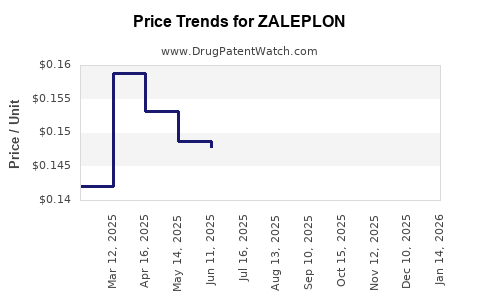
Last updated: September 7, 2026
Zaleplon is a mature, low-cost generic hypnotic used for short-term treatment of insomnia. The original Sonata brand lost commercial exclusivity years ago, and the U.S. market is now driven by generic manufacturers, pharmacy benefit substitution, low reimbursement, and limited clinical differentiation from other short-acting sleep medicines. Standalone product revenue is not publicly disclosed by major manufacturers, so financial analysis relies on market structure, prescription demand, generic pricing, regulatory records, and the absence of branded exclusivity.
What is the current FDA status of zaleplon?
Zaleplon is an FDA-approved prescription sedative-hypnotic indicated for the short-term treatment of insomnia characterized by difficulty falling asleep. It is a pyrazolopyrimidine that acts at the benzodiazepine receptor complex and is classified as a Schedule IV controlled substance in the United States (FDA, 2017; DEA, 2023).
| Attribute |
Zaleplon status |
| Active ingredient |
Zaleplon |
| Original U.S. brand |
Sonata |
| Original innovator |
King Pharmaceuticals |
| FDA approval |
1999 |
| Drug class |
Nonbenzodiazepine sedative-hypnotic |
| Schedule |
Schedule IV |
| Common strengths |
5 mg and 10 mg capsules |
| Primary indication |
Short-term insomnia treatment |
| Current commercial status |
Generic-dominated |
| Biosimilar pathway |
Not applicable |
| FDA pathway for competitors |
Abbreviated New Drug Application, or ANDA |
The FDA-approved label limits use to insomnia and emphasizes short treatment duration. Zaleplon has a short elimination half-life of approximately one hour, which supports its positioning for sleep-onset insomnia rather than sleep-maintenance problems (FDA, 2017).
When did zaleplon lose exclusivity?
Zaleplon lost meaningful U.S. market exclusivity in the mid-2000s. The original Sonata patent estate no longer protects current sales, and the product does not have a commercially relevant period of remaining regulatory exclusivity.
The original brand launched in the United States in 1999. Generic zaleplon entered after expiration or clearance of the principal brand protections, with multiple ANDA suppliers eventually entering the market. The commercial result was a rapid shift from branded pricing to commodity generic pricing.
Zaleplon exclusivity timeline
| Period |
Commercial event |
Market effect |
| 1999 |
FDA approval of Sonata |
King Pharmaceuticals establishes branded market |
| Early 2000s |
Sonata receives branded formulary and physician adoption |
Brand captures insomnia prescriptions |
| Mid-2000s |
Generic zaleplon approvals and market entry |
Price competition begins |
| Late 2000s onward |
Multiple generic suppliers |
Brand share and pricing decline |
| Current market |
Generic-dominated distribution |
Low unit economics and limited differentiation |
The specific patent and regulatory exclusivity history should be separated from current commercial protection. Even if historical Sonata patents covered the active ingredient, formulation, or use, those rights do not create a current barrier to generic entry.
What patents protect zaleplon today?
No material active-ingredient patent barrier protects ordinary generic zaleplon capsules in the United States. The relevant commercial protection is based on manufacturing capability, FDA approval, supply contracts, controlled-substance compliance, and pharmacy distribution rather than enforceable exclusivity around the molecule.
The original zaleplon patent estate covered the compound and related pharmaceutical uses. Generic competition has rendered those protections commercially obsolete. Current generic suppliers generally rely on ANDA approvals referencing the established Sonata product and demonstrate pharmaceutical equivalence, bioequivalence, manufacturing quality, and labeling conformity.
What formulations are protected by zaleplon patents?
Zaleplon is primarily sold as immediate-release capsules. The commercial opportunity for formulation patents is limited because:
- the molecule has a short half-life;
- the principal clinical use is sleep initiation;
- standard capsules are inexpensive to manufacture;
- physicians can substitute other short-acting or longer-acting hypnotics;
- an extended-release or abuse-deterrent formulation would need to show meaningful clinical and commercial value.
There is no widely recognized, currently dominant patent-protected extended-release zaleplon franchise. The main market remains conventional immediate-release oral capsules.
Are method-of-use patents important for zaleplon?
Method-of-use patents have limited current commercial impact. The FDA-approved use is narrow, and generic labels generally track the reference-product indication. Potential use claims involving dosing time, patient selection, or insomnia subtypes would face difficulty generating durable market power because physicians can prescribe generic zaleplon under the established indication and because competing hypnotics are available.
How many patents cover zaleplon?
The practical answer is that historical patents covered zaleplon, but few, if any, create a current commercial barrier to standard generic capsules.
Patent-count databases can report multiple family members, continuations, foreign counterparts, and expired U.S. patents. Those counts can overstate the live estate. For market analysis, the relevant questions are whether a valid U.S. patent remains enforceable, whether it is listed in the Orange Book against a marketed product, and whether it covers the dosage form or use that generates current sales.
The current risk profile is therefore low for ordinary generic entry. Patent risk could arise only from a newly developed formulation, combination product, or delivery technology with a separate claim scope.
What is the Orange Book status of zaleplon?
The Orange Book historically listed Sonata as the reference drug for generic zaleplon approvals. Because Sonata is an old product with generic competition, Orange Book-listed patent protection is not a meaningful constraint on the current market.
Generic applicants use the ANDA pathway and may rely on certifications addressing listed patents. For a mature product such as zaleplon, Paragraph IV litigation is unlikely to be a central market event unless a new patent is listed against a reformulated or newly approved product.
What is the Paragraph IV risk for zaleplon?
Paragraph IV risk is low for conventional zaleplon capsules because generic entry has already occurred. Paragraph IV litigation matters most before the first generic launch, when an ANDA applicant challenges an unexpired patent and seeks 180-day exclusivity. That stage has passed for the original Sonata product.
A future Paragraph IV dispute could occur if a company obtained approval for a new protected dosage form or a product with a new indication. Such a dispute would concern the newer patent, not the ordinary generic zaleplon market.
How large is the zaleplon market?
The U.S. zaleplon market is commercially small relative to major insomnia drugs and central nervous system products. It competes with:
- zolpidem immediate-release and extended-release products;
- eszopiclone;
- temazepam and other benzodiazepines;
- low-dose doxepin;
- ramelteon;
- suvorexant and lemborexant;
- over-the-counter melatonin and sedating antihistamines.
Zaleplon’s market position is constrained by its short duration of action. That characteristic can reduce next-day residual effects, but it also limits the product’s usefulness for patients who wake during the night. Zolpidem has broader brand recognition and a larger historical prescription base, while newer dual orexin receptor antagonists compete on differentiated sleep-maintenance efficacy.
Competitive comparison
| Product |
Primary commercial strength |
Main limitation versus zaleplon |
| Zaleplon |
Very short duration; sleep-onset use |
Limited sleep-maintenance benefit |
| Zolpidem IR |
Broad physician familiarity and low generic cost |
Safety restrictions and class competition |
| Zolpidem ER |
Sleep onset and maintenance positioning |
Higher complexity and generic competition |
| Eszopiclone |
Longer duration and maintenance use |
More residual effects and taste complaints |
| Ramelteon |
Noncontrolled status and melatonin-receptor mechanism |
Lower perceived efficacy for some patients |
| Suvorexant |
Differentiated orexin mechanism |
Branded or higher-cost access in some markets |
| Lemborexant |
Sleep-onset and maintenance positioning |
Premium pricing and formulary pressure |
| Doxepin |
Low-dose maintenance treatment |
Less useful for rapid sleep initiation |
What is the financial trajectory for zaleplon?
Zaleplon’s financial trajectory followed the standard small-molecule lifecycle:
- branded launch and premium pricing;
- prescription growth through physician adoption;
- loss of exclusivity;
- rapid generic price erosion;
- stable but low-margin mature-product demand.
The original branded revenue stream is no longer the relevant economic measure. Generic manufacturers typically record zaleplon revenue within broader portfolios and do not report the product as a separate material segment. Public filings from diversified generic companies generally do not provide sufficient product-level revenue detail to isolate zaleplon sales.
Revenue exposure by market participant
| Participant |
Current economic exposure |
| Original innovator |
Minimal or none from active U.S. Sonata sales |
| Generic manufacturers |
Low-margin unit sales across pharmacy channels |
| Wholesalers |
High-volume, low-margin distribution |
| Retail pharmacies |
Reimbursement spread and dispensing economics |
| PBMs and payers |
Formulary substitution and cost containment |
| API suppliers |
Input demand tied to generic production volumes |
Zaleplon can still generate recurring revenue for manufacturers with efficient production, established DEA controls, and national distribution. The product is unlikely to create material growth for a large pharmaceutical company unless bundled into a broad generic portfolio or paired with a differentiated delivery system.
What factors drive zaleplon demand?
Demand is influenced by prescribing patterns, insomnia prevalence, payer substitution, controlled-substance restrictions, and physician preference for short-acting therapy.
Key demand drivers include:
- continued diagnosis and treatment of insomnia;
- preference for low-cost generic medicines;
- use in patients with sleep-onset difficulty;
- demand for a short-acting alternative to longer-duration hypnotics;
- pharmacy availability and formulary placement;
- switching from branded or higher-cost insomnia products.
Demand is constrained by safety concerns involving sedative-hypnotic use, regulatory warnings for complex sleep behaviors, controlled-substance monitoring, and competition from noncontrolled medicines. The FDA has required boxed warnings for certain serious behaviors associated with some insomnia medicines, including activities performed while not fully awake (FDA, 2019).
What generic entry risks exist for zaleplon?
Generic entry risk is effectively realized rather than prospective. The product already operates in a generic market, so the main commercial risks are additional supplier entry, price compression, manufacturing disruption, and declining prescriptions.
Generic launch scenarios
| Scenario |
Probability profile |
Commercial effect |
| Additional conventional ANDA entrant |
Possible |
Further price pressure |
| Existing supplier exit |
Possible |
Temporary supply tightening and price recovery |
| Manufacturing shortage |
Periodic risk |
Short-term allocation or wholesaler disruption |
| New branded formulation |
Low |
Could create a niche premium segment |
| Major prescription growth |
Low |
Limited by mature class competition |
| Substitution by newer insomnia drugs |
Ongoing |
Gradual volume erosion |
For generic manufacturers, the principal risk is not patent litigation. It is loss of volume or margin following a competitor launch, procurement price reductions, or a quality-related supply interruption.
Which companies are challenging or competing with zaleplon?
The competitive field includes manufacturers of generic zaleplon and companies selling alternative insomnia treatments. Generic zaleplon is supplied by multiple ANDA holders over time, and the supplier roster can change because of acquisitions, discontinuations, and product transfers.
The most important competitive pressure comes from therapeutic substitutes rather than branded patent challengers. Generic zolpidem and generic eszopiclone compete directly on price. Ramelteon, doxepin, suvorexant, and lemborexant compete through different mechanisms or safety positioning.
No active biosimilar competition exists because zaleplon is a synthetic small molecule, not a biologic. The relevant regulatory competition is generic substitution through the ANDA pathway.
What patent litigation affects zaleplon?
There is no major current patent litigation issue associated with ordinary generic zaleplon capsules. Historical litigation, if any, was tied to the pre-generic Sonata market and does not materially affect present-day entry.
Litigation exposure could become relevant if a sponsor develops:
- a controlled-release formulation;
- a sublingual or intranasal delivery system;
- a combination product;
- an abuse-deterrent formulation;
- a new indication with a distinct patent claim.
Such products would face both patent and regulatory scrutiny. A reformulation would need to demonstrate clinical or pharmacokinetic value sufficient to support reimbursement above commodity generic pricing.
Are there licensing deals for zaleplon?
No major current licensing transaction defines the zaleplon market. The original Sonata commercialization history involved the innovator company and its commercial partners, but current generic supply is generally based on manufacturer-owned ANDAs, contract manufacturing, API sourcing, and distribution arrangements.
Licensing economics would be more relevant for a new delivery technology than for standard zaleplon capsules. A company seeking to monetize the molecule through licensing would need a differentiated product with defensible intellectual property and a clear advantage over inexpensive generic hypnotics.
How strong is the zaleplon patent estate?
The patent estate is weak for the current generic product and potentially stronger only for a novel formulation.
| Patent category |
Current strength |
| Original compound protection |
Expired or commercially exhausted |
| Standard capsule formulation |
Low |
| Approved sleep-onset indication |
Low |
| New delivery system |
Potentially moderate to strong |
| Manufacturing process |
Potentially useful, but limited market power |
| Trade secrets and supply know-how |
Operationally relevant |
| Biosimilar protections |
Not applicable |
Manufacturing know-how can still create barriers. Controlled-substance handling, quality systems, validated processes, DEA compliance, API sourcing, and pharmacy distribution affect supply reliability. These are execution barriers rather than exclusivity rights.
What is the outlook for zaleplon sales?
The base case is stable-to-declining volume and continued low pricing. Zaleplon should remain available as a generic option for sleep-onset insomnia, but its financial contribution will likely remain modest.
Upside requires a change in product positioning, such as a new formulation that reduces abuse potential, improves adherence, or expands utility into sleep maintenance without creating excessive next-day impairment. That opportunity is limited by the availability of inexpensive generic alternatives and by the cost of conducting new clinical and regulatory programs.
Key Takeaways
- Zaleplon is an established generic sedative-hypnotic first approved in 1999.
- Sonata’s branded exclusivity ended years ago, and current sales are generic-dominated.
- No material active-ingredient or standard-capsule patent barrier limits U.S. generic competition.
- Paragraph IV litigation is not a meaningful current risk for conventional zaleplon capsules.
- The market is constrained by the drug’s narrow sleep-onset profile and competition from zolpidem, eszopiclone, ramelteon, doxepin, suvorexant, and lemborexant.
- Product-level revenue is generally not disclosed by generic manufacturers.
- The financial model is low-margin recurring volume, not branded growth.
- The main commercial barriers are manufacturing quality, controlled-substance compliance, API supply, and distribution.
- A new formulation could create value, but it would require differentiated clinical performance and defensible patents.
FAQs
Is zaleplon still commercially available?
Yes. Generic zaleplon capsules remain the primary U.S. commercial form, subject to manufacturer supply and pharmacy availability.
Is zaleplon more profitable than zolpidem?
Generally, no. Zolpidem has a larger historical market, but both products operate under generic pricing pressure. Profitability depends more on supplier scale, manufacturing cost, and contract position than on molecule-level differentiation.
Can a company obtain a new patent on zaleplon?
A new patent could potentially cover a novel formulation, delivery system, manufacturing process, combination, or method of use. A patent on the old compound itself would not be available if the relevant disclosure is prior art.
Does zaleplon have biosimilar competition?
No. Zaleplon is a synthetic small molecule. Competitors enter through ANDAs as generic products, not through the biosimilar pathway.
What would increase the value of the zaleplon franchise?
The most credible value driver would be a clinically differentiated formulation that expands treatment utility while preserving zaleplon’s short-acting profile. Any such product would need regulatory approval, patent protection, payer acceptance, and pricing above conventional generic capsules.
References
-
Drug Enforcement Administration. (2023). Controlled substances act: Schedule IV. U.S. Department of Justice.
-
U.S. Food and Drug Administration. (2017). Sonata (zaleplon) prescribing information. FDA.
-
U.S. Food and Drug Administration. (2019). FDA adds boxed warning for risk of serious injuries caused by sleepwalking with certain prescription insomnia medicines. FDA.
-
U.S. Food and Drug Administration. (2023). Approved drug products with therapeutic equivalence evaluations: Orange Book. FDA.
-
U.S. Food and Drug Administration. (2023). Drugs@FDA: FDA-approved drugs database. FDA.