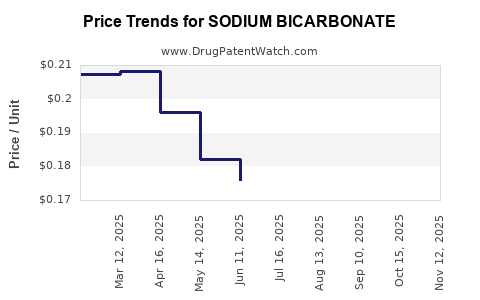
Last updated: September 7, 2026
Sodium bicarbonate is a mature, low-cost pharmaceutical ingredient with limited patent protection and highly fragmented commercial supply. Its principal pharmaceutical markets are injectable emergency medicine, oral alkalinizing products, dialysis and renal care, electrolyte replacement, and compounded hospital formulations. Revenue growth is driven by volume, supply reliability, hospital utilization, and manufacturing costs rather than branded pricing or exclusivity.
The product has no meaningful composition-of-matter patent barrier. Standard sodium bicarbonate injections and oral products are generally exposed to generic competition, although manufacturing controls, sterile-facility capacity, regulatory compliance, and hospital procurement contracts can limit practical competition.
What is the pharmaceutical market for sodium bicarbonate?
Sodium bicarbonate is marketed as an active pharmaceutical ingredient and finished dosage form. Its uses include metabolic acidosis, hyperkalemia-related emergency treatment, urinary alkalinization, antacid therapy, electrolyte replacement, and selected resuscitation protocols.
The principal dosage forms are:
| Dosage form |
Typical strength or presentation |
Primary market |
| Intravenous injection |
4.2%, 8.4%, and concentrated presentations |
Hospitals, emergency departments, critical care |
| Prefilled syringe |
Commonly 50 mEq in 50 mL |
Emergency medicine and operating rooms |
| Oral tablets |
Various strengths |
Antacid and urinary alkalinization products |
| Oral powder or solution |
Variable |
OTC and prescription compounding |
| Dialysis-grade material |
Controlled pharmaceutical or dialysis specifications |
Renal replacement therapy |
| Bulk API |
USP-grade sodium bicarbonate |
Finished-dose manufacturers and compounders |
The injectable segment has the greatest regulatory and operational complexity. The oral segment has lower barriers and more direct price competition. Dialysis applications depend on long-term supply contracts, quality specifications, and integration with dialysis systems.
What is the FDA regulatory status of sodium bicarbonate?
Sodium bicarbonate is an established pharmaceutical ingredient with decades of clinical use. Injectable sodium bicarbonate products are approved or marketed under FDA pathways applicable to sterile prescription drugs, including abbreviated applications and legacy approvals. The FDA-approved labeling identifies use in conditions such as metabolic acidosis and includes warnings concerning alkalosis, sodium loading, tissue injury from extravasation, and electrolyte disturbances.[1]
FDA regulatory status differs by product and dosage form:
- Injectable sodium bicarbonate is a prescription product.
- Oral antacid products may fall under the FDA OTC monograph framework when marketed for permitted antacid uses.
- Products used for urinary alkalinization or other prescription indications may require prescription-drug approval.
- Compounded sodium bicarbonate products are governed by federal and state pharmacy-compounding rules rather than the same commercial approval process as an FDA-approved finished product.
- Pharmaceutical-grade API must meet applicable USP-NF quality requirements.[2]
The regulatory risk is concentrated in sterile manufacturing, container-closure integrity, particulate control, endotoxin control, labeling, and supply-chain qualification. The active ingredient itself is not difficult to synthesize, but injectable production is subject to high manufacturing standards.
What is the Orange Book status of sodium bicarbonate?
Sodium bicarbonate does not have a commercially significant Orange Book exclusivity position comparable to branded small-molecule drugs. Standard sodium bicarbonate products generally have no active ingredient patent protecting the molecule and no meaningful branded patent estate restricting generic entry.
The Orange Book analysis should be conducted at the individual product level because listings can differ by applicant, dosage form, approval pathway, and product status. A finished product may appear under a specific applicant or application number without creating market-wide exclusivity for sodium bicarbonate as a substance.[3]
For commercial diligence, the relevant conclusion is:
| Orange Book issue |
Assessment |
| Active ingredient patent |
No practical blocking patent for sodium bicarbonate |
| Standard injectable formulation patent |
Generally absent or commercially immaterial |
| Method-of-use patent |
No broad, market-blocking position expected |
| Pediatric exclusivity |
Not a central market feature |
| New chemical entity exclusivity |
Not applicable |
| Generic substitution risk |
High |
| Product-specific approval risk |
Relevant for sterile injectables |
When does sodium bicarbonate lose exclusivity?
Sodium bicarbonate has no conventional branded exclusivity cliff. The molecule has been used medicinally for more than a century, and any historic composition or use exclusivity has expired.
The market therefore operates as a mature generic category rather than a product awaiting loss of exclusivity. Competitive entry is governed by:
- FDA approval or lawful marketing status.
- Manufacturing capacity.
- Drug-supply availability.
- Hospital purchasing contracts.
- Quality and sterility performance.
- State substitution and pharmacy procurement rules.
A new supplier can compete without challenging a surviving composition-of-matter patent. The principal commercial risk is execution, not patent clearance.
How many patents cover sodium bicarbonate?
No meaningful patent count can be assigned to sodium bicarbonate without defining the jurisdiction, product, dosage form, and search date. Broad patent databases contain documents that mention sodium bicarbonate as an excipient, buffer, pH-adjusting agent, electrolyte, or component of a combination product. Those documents do not necessarily create enforceable protection over conventional sodium bicarbonate products.
The practical patent categories are:
Formulation patents
Potentially relevant claims may cover:
- Buffered injectable solutions.
- Premixed electrolyte formulations.
- Stable combinations with other active ingredients.
- Specific concentrations or pH ranges.
- Prefilled syringe configurations.
- Controlled-release or effervescent oral products.
- Dialysis concentrates or bicarbonate regeneration systems.
These claims generally protect a particular combination, delivery system, process, or device. They do not ordinarily prevent sale of standard sodium bicarbonate injection or oral sodium bicarbonate.
Method-of-use patents
Method claims may address a particular clinical use, dosing regimen, patient population, or combination treatment. Their commercial value is limited when sodium bicarbonate is widely used off patent and when the product is purchased as a generic hospital supply.
Manufacturing and process patents
Manufacturing claims may cover purification, crystallization, sterile filling, packaging, or production of bicarbonate-containing solutions. Such patents can affect a specific supplier but are unlikely to create a market-wide barrier unless they cover a commercially necessary production method.
What generic entry risks exist for sodium bicarbonate?
Generic entry risk is high for standard injectable and oral products. Sodium bicarbonate has the characteristics of a commodity generic:
- Low active-ingredient cost.
- Multiple potential manufacturers.
- Long clinical history.
- Limited product differentiation.
- Low switching costs for institutional buyers.
- No meaningful branded patent defense.
- Price-based hospital procurement.
Entry is more difficult for sterile injectable presentations than for oral products. A prospective supplier must establish a compliant sterile facility, validate aseptic processing or terminal sterilization where applicable, qualify container systems, and demonstrate stability across the marketed presentation.
The highest competitive risk applies to conventional 8.4% injection, 4.2% injection, oral tablets, and bulk powder. Lower risk applies to specialized presentations requiring prefilled delivery, integrated emergency kits, high-reliability supply, or a validated hospital distribution network.
What patent litigation and Paragraph IV challenges affect sodium bicarbonate?
No major market-defining Paragraph IV litigation is associated with standard sodium bicarbonate. Paragraph IV litigation is primarily relevant when an applicant seeks approval for a product covered by an unexpired listed patent. Sodium bicarbonate lacks the type of active patent estate that typically generates repeated Paragraph IV challenges.
Potential disputes are more likely to involve:
- Product-specific formulation patents.
- Combination products.
- Device or syringe configurations.
- Regulatory status of compounded or bulk products.
- Quality, manufacturing, or labeling issues.
- Contract disputes between suppliers and hospital systems.
The absence of major Paragraph IV activity reflects the maturity of the market rather than a lack of competition.
Which companies supply pharmaceutical sodium bicarbonate?
The supplier base includes diversified generic-drug companies, injectable manufacturers, API producers, hospital-supply companies, and regional compounders. Major commercial participants can vary by country and presentation. In the United States, sodium bicarbonate injection has historically been marketed by companies including Pfizer through Hospira, Fresenius Kabi, and other generic injectable manufacturers. Availability changes with product discontinuations, shortages, acquisitions, and contract awards.
The competitive landscape has four tiers:
| Supplier tier |
Competitive advantage |
Main weakness |
| Large injectable manufacturers |
Sterile capacity, regulatory infrastructure, hospital contracts |
Lower margins and portfolio complexity |
| API manufacturers |
Scale and low unit cost |
Limited finished-dose differentiation |
| Specialty suppliers |
Prefilled syringes, emergency kits, niche formats |
Smaller scale |
| Compounders |
Local availability and customized formulations |
Regulatory and quality-system constraints |
Supplier concentration can increase during manufacturing interruptions. A low-value product can still experience acute shortages when few facilities produce a specific concentration, container, or prefilled format.
How strong is the sodium bicarbonate patent estate?
The patent estate is weak from a market-exclusivity perspective and moderate only for selected delivery systems or combination formulations.
| Patent dimension |
Strength |
Commercial implication |
| Composition of matter |
None of practical relevance |
No molecule-level exclusivity |
| Standard injectable formulation |
Low |
Broad generic exposure |
| Oral dosage forms |
Low |
Numerous substitutes and manufacturers |
| Prefilled syringe or emergency kit |
Potentially moderate |
Product-specific protection may exist |
| Combination products |
Potentially moderate |
Claims depend on formulation and indication |
| Manufacturing process |
Variable |
Can protect efficiency or quality attributes |
| Method of use |
Low to moderate |
Narrow clinical and enforcement scope |
For investors and licensing teams, sodium bicarbonate should be evaluated as a manufacturing and distribution asset rather than a patent asset.
What is the financial trajectory for sodium bicarbonate?
There is no single public financial statement for the global pharmaceutical sodium bicarbonate market. Revenue is distributed across generic injectables, OTC products, API sales, dialysis supplies, hospital contracts, and nonpharmaceutical industrial applications. Public companies generally report sodium bicarbonate within broader injectable, generic, hospital-product, or specialty-pharmaceutical categories.
The financial trajectory is therefore best assessed through market drivers:
| Driver |
Direction |
Financial effect |
| Unit demand in hospitals |
Stable to modest growth |
Supports recurring baseline revenue |
| Average selling price |
Flat or declining |
Limits category revenue growth |
| Sterile manufacturing costs |
Rising over time |
Compresses margins |
| Shortage-related pricing |
Volatile |
Creates temporary upside |
| Hospital purchasing consolidation |
Negative for suppliers |
Increases price pressure |
| Prefilled and ready-to-use products |
Positive |
Supports premium pricing |
| Dialysis and renal-care demand |
Stable growth |
Provides recurring volume |
| API competition |
Strong |
Limits raw-material margins |
Standard sodium bicarbonate is unlikely to deliver pharmaceutical-style revenue expansion. The more probable trajectory is low-single-digit volume growth, flat or declining pricing for basic presentations, and better economics for reliable, ready-to-use, or integrated delivery formats.
Margin performance depends on plant utilization. A manufacturer with excess sterile capacity may accept low prices to maintain production volume. A supplier with limited capacity can obtain stronger pricing during shortages, but this benefit is unstable and can attract new entrants or trigger procurement changes.
How does sodium bicarbonate compare with other generic emergency drugs?
| Product |
Patent risk |
Supply complexity |
Pricing power |
Shortage sensitivity |
| Sodium bicarbonate injection |
Very low |
Moderate to high |
Low |
Moderate to high |
| Calcium chloride injection |
Very low |
Moderate |
Low |
Moderate |
| Naloxone injection |
Product-specific |
High |
Higher in some presentations |
High |
| Epinephrine injection |
Product and device dependent |
High |
Moderate |
High |
| Potassium chloride injection |
Very low |
High due to safety controls |
Low |
High |
| Sterile saline |
Very low |
High |
Low |
High |
Sodium bicarbonate has weaker pricing power than newer emergency drugs but can have stronger clinical persistence because hospitals maintain it as a basic emergency and critical-care product. Demand is less dependent on promotional activity.
What manufacturing and intellectual-property barriers affect sodium bicarbonate?
The principal barriers are operational:
- Qualified pharmaceutical-grade raw materials.
- Sterile filling capability.
- Validated concentration and pH control.
- Container-closure compatibility.
- Stability data.
- Particulate and endotoxin control.
- Reliable glass, plastic, syringe, and stopper supply.
- FDA inspection readiness.
- Hospital and group-purchasing contracts.
For API producers, sodium bicarbonate production is generally accessible at industrial scale. For injectable manufacturers, the cost and time required to establish a compliant sterile line are materially higher. A supplier may also need multiple packaging formats to compete effectively.
Intellectual property can matter at the product level, particularly for prefilled syringes, combination products, or specialized dialysis systems. It is unlikely to protect the core sodium bicarbonate market.
What licensing deals affect sodium bicarbonate?
Sodium bicarbonate has limited licensing activity compared with patented pharmaceutical products. Transactions are more likely to involve:
- Contract manufacturing.
- API supply agreements.
- Hospital distribution.
- Private-label arrangements.
- Emergency-kit assembly.
- Dialysis-system supply.
- Technology licenses for delivery devices or combination formulations.
A sodium bicarbonate licensing transaction should be valued primarily on manufacturing capacity, regulatory approvals, geographic rights, supply commitments, and customer contracts. Royalty economics based on molecule-level exclusivity are generally not available.
What generic launch scenarios are most likely?
Three launch scenarios are commercially plausible:
- A conventional injectable entrant competes on supply reliability and price. This approach can gain share but normally produces modest margins.
- A supplier launches a ready-to-use syringe, premixed presentation, or emergency kit. The product may command a premium if it reduces preparation time and medication-error risk.
- A manufacturer enters through a hospital or dialysis contract. The contract, rather than the patent position, determines near-term revenue visibility.
The most attractive opportunity is not an undifferentiated vial. It is a compliant, supply-secure presentation with a validated customer channel.
What is the geographic coverage of the sodium bicarbonate market?
The United States has a mature hospital injectable market and a large generic procurement system. Europe relies on national and regional tendering, with pricing pressure and country-specific regulatory requirements. Emerging markets have greater variation in manufacturing quality, hospital access, and reimbursement.
Geographic expansion requires more than API registration. Finished products may require:
- Local marketing authorization.
- Country-specific labeling.
- Pharmacopoeial compliance.
- Local pharmacovigilance.
- Importer or distributor arrangements.
- Cold-chain or controlled logistics where applicable.
- Tender eligibility.
The molecule is globally available, but commercial access is jurisdiction-specific.
Key Takeaways
- Sodium bicarbonate is a mature generic pharmaceutical, not a branded exclusivity asset.
- Standard injectable and oral products have high generic-entry exposure.
- No meaningful active-ingredient patent barrier protects the market.
- Paragraph IV litigation and major patent settlements are not central to the category.
- Sterile manufacturing, regulatory compliance, and supply reliability are the main barriers.
- Hospital injectables and dialysis products provide the most durable pharmaceutical demand.
- Basic presentations face flat pricing and margin pressure.
- Prefilled syringes, ready-to-use products, emergency kits, and reliable contract supply offer better commercial positioning.
- Financial performance is determined by volume, capacity utilization, shortage conditions, and procurement contracts.
- Revenue should be analyzed by supplier segment because companies rarely report sodium bicarbonate separately.
FAQs
Is sodium bicarbonate a profitable pharmaceutical product?
It can be profitable at scale, but standard presentations generally have low margins. Profitability improves with efficient sterile production, high plant utilization, shortage-period availability, and differentiated delivery formats.
Does sodium bicarbonate have FDA exclusivity?
Sodium bicarbonate has no practical molecule-level FDA exclusivity. Individual products may have product-specific approval rights, but these do not create broad market protection.
Can a company patent a sodium bicarbonate formulation?
A company may patent a specific combination, concentration range, delivery device, stability profile, or manufacturing process. Such a patent would generally protect the defined product rather than sodium bicarbonate itself.
Is sodium bicarbonate vulnerable to drug shortages?
Yes. The active ingredient is widely available, but shortages can arise from sterile-facility interruptions, component shortages, quality failures, manufacturing discontinuations, or concentration-specific supply constraints.[4]
Is pharmaceutical sodium bicarbonate the same as industrial baking soda?
The chemical substance is the same, but pharmaceutical products must meet applicable pharmaceutical quality, impurity, documentation, and manufacturing requirements. Industrial-grade material cannot automatically be substituted for USP-grade pharmaceutical material.
References
-
U.S. Food and Drug Administration. (2023). Sodium bicarbonate injection prescribing information. FDA-approved product labeling.
-
United States Pharmacopeial Convention. (2024). Sodium bicarbonate monograph. United States Pharmacopeia-National Formulary.
-
U.S. Food and Drug Administration. (2024). Approved drug products with therapeutic equivalence evaluations. Orange Book.
-
U.S. Food and Drug Administration. (2024). Drug shortages database. FDA Drug Shortages Staff.