Last updated: February 19, 2026
Sodium bicarbonate (NaHCO₃), a widely available and inexpensive chemical, serves critical functions in both industrial and pharmaceutical applications. Its market dynamics are influenced by demand from sectors including food and beverage, pharmaceuticals, animal feed, and industrial cleaning. Price fluctuations are primarily driven by raw material costs, energy prices, and regional supply-demand balances.
What is the Current Global Market Size for Sodium Bicarbonate?
The global sodium bicarbonate market was valued at approximately $12.3 billion in 2022. Projections indicate steady growth, with an estimated market size of $13.9 billion by 2027, growing at a compound annual growth rate (CAGR) of 2.4% from 2022 to 2027. The market is segmented by application, with the pharmaceutical sector representing a significant and growing end-use segment due to its diverse therapeutic applications, including antacid formulations, electrolyte replenishment, and adjunctive therapy in dialysis. The food and beverage industry is another major consumer, utilizing sodium bicarbonate as a leavening agent. Industrial applications, such as flue gas desulfurization and chemical synthesis, also contribute substantially to overall demand.
What are the Key Drivers of Sodium Bicarbonate Market Growth?
Several factors drive the demand for sodium bicarbonate.
- Growing Pharmaceutical Industry: The increasing prevalence of gastrointestinal disorders and the expanding use of sodium bicarbonate in injectable solutions for metabolic acidosis are significant growth drivers. Regulatory approvals for new pharmaceutical applications further bolster demand. The global pharmaceutical market is projected to reach $1.9 trillion by 2030, providing a robust foundation for upstream chemical demand [1].
- Food and Beverage Sector Expansion: The consistent demand for baked goods, processed foods, and carbonated beverages, where sodium bicarbonate is a key ingredient, ensures sustained market growth. Rising disposable incomes in emerging economies correlate with increased consumption of these products.
- Environmental Regulations: Stringent environmental regulations, particularly concerning air pollution control, drive the adoption of sodium bicarbonate for flue gas desulfurization in industrial facilities, especially power plants and waste incinerators. For instance, the European Union's Industrial Emissions Directive mandates emission reduction targets, increasing the need for sorbent materials like sodium bicarbonate [2].
- Animal Feed Supplementation: Sodium bicarbonate is used as a buffer in animal feed to maintain optimal rumen pH, particularly in dairy cattle. The growing global demand for animal protein supports the expansion of the livestock industry, thus increasing the demand for feed additives.
What are the Primary Applications of Sodium Bicarbonate?
The applications of sodium bicarbonate span multiple industries:
- Pharmaceuticals: Used as an antacid, in intravenous solutions to treat acidosis, and in effervescent formulations. It also finds use in dialysis solutions. The global antacid market alone was valued at $5.2 billion in 2022 [3].
- Food and Beverage: Acts as a leavening agent in baking (baking soda), a pH regulator in food processing, and a component in carbonated beverages.
- Animal Feed: Functions as a dietary buffer to prevent acidosis in ruminant animals.
- Industrial Cleaning and Detergents: Utilized for its mild abrasive and deodorizing properties.
- Chemical Synthesis: Serves as a raw material or reagent in the production of various chemicals.
- Flue Gas Treatment: Employed to neutralize acidic gases like sulfur dioxide (SO₂) and hydrogen chloride (HCl) emitted from industrial processes.
How Do Raw Material and Production Costs Influence Sodium Bicarbonate Pricing?
The primary raw materials for sodium bicarbonate production are:
- Salt (Sodium Chloride, NaCl): The cost of salt is a significant input. Global salt prices are subject to fluctuations based on mining output, energy costs for extraction and purification, and demand from other industries like chemical manufacturing and de-icing.
- Carbon Dioxide (CO₂): Captured CO₂ or CO₂ produced as a byproduct of other industrial processes is used. The cost of CO₂ is linked to the operational costs of the facilities from which it is sourced.
- Ammonia (NH₃): Used in the Solvay process, ammonia prices are influenced by natural gas prices, a key feedstock for ammonia production.
Energy costs, particularly electricity and natural gas, are critical throughout the production process, affecting both raw material acquisition and the manufacturing operations. Increased energy prices directly translate to higher production costs for sodium bicarbonate.
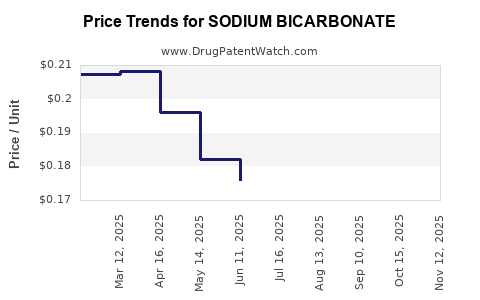
What is the Projected Price Trend for Sodium Bicarbonate?
The average price of sodium bicarbonate has historically ranged between $100 to $300 per ton, varying significantly by grade, purity, and regional market conditions.
| Grade |
Estimated Price Range (USD/ton) |
| Technical |
$100 - $200 |
| Food |
$150 - $250 |
| Pharmaceutical |
$200 - $300+ |
Source: Market research reports, industry publications.
Price Projections:
The price of sodium bicarbonate is expected to experience moderate volatility, with an upward trend over the medium term.
- Short-term (1-2 years): Prices are likely to remain stable or see a slight increase of 1-3% annually, primarily driven by stable demand and manageable raw material costs.
- Medium-term (3-5 years): A potential price increase of 2-5% annually is anticipated. This is due to increasing demand from the pharmaceutical and environmental sectors, coupled with potential cost pressures from rising energy prices and stricter environmental compliance costs for producers.
- Long-term (5+ years): Price trends will be more sensitive to global economic conditions, advancements in production technologies, and the evolution of environmental regulations. If significant disruptions occur in raw material supply chains or if energy costs escalate sharply, price increases could accelerate. Conversely, process innovations leading to greater efficiency could temper price rises.
Factors that could exert downward pressure on prices include increased production capacity in key regions, oversupply situations, and significant technological advancements that reduce manufacturing costs.
What are the Key Regional Market Dynamics?
The global sodium bicarbonate market is characterized by distinct regional supply and demand patterns.
- Asia-Pacific: This region is the largest and fastest-growing market, driven by rapid industrialization, a burgeoning food and beverage sector, and increasing healthcare expenditure in countries like China and India. The establishment of new production facilities and expanding demand for industrial applications contribute to its dominance.
- North America: A mature market with steady demand from the food, pharmaceutical, and industrial cleaning sectors. The shale gas industry's byproduct CO₂ availability can influence regional production economics. Strict environmental regulations for industrial emissions also support demand for flue gas treatment.
- Europe: Significant demand from the pharmaceutical, food, and environmental sectors. The region's focus on sustainability and emission control supports the use of sodium bicarbonate in desulfurization. Production is concentrated among a few major chemical manufacturers.
- Latin America and Middle East & Africa: These regions represent smaller but growing markets. Demand is driven by expanding food processing industries and increasing agricultural activity.
What are the Major Challenges Facing the Sodium Bicarbonate Market?
Despite its growth, the sodium bicarbonate market faces several challenges:
- Raw Material Price Volatility: Fluctuations in the prices of salt, CO₂, and ammonia directly impact production costs and profitability.
- Energy Costs: High and volatile energy prices significantly increase operational expenses, affecting competitiveness.
- Logistics and Transportation: Sodium bicarbonate is a relatively low-value, high-volume commodity. Transportation costs can represent a substantial portion of the delivered price, especially for international shipments.
- Competition from Substitutes: In certain applications, alternative chemicals or processes may offer competitive solutions, potentially limiting market expansion.
- Environmental Compliance: While environmental regulations drive demand in some areas, producers must also comply with their own environmental standards, which can add to operational costs.
Key Takeaways
The sodium bicarbonate market is characterized by stable, albeit modest, growth driven by essential applications in pharmaceuticals, food and beverage, and industrial processes. Raw material and energy costs are the primary determinants of pricing, with an anticipated upward trend in prices over the medium term due to increasing demand and potential cost pressures. The Asia-Pacific region is the dominant and fastest-growing market. Manufacturers must navigate raw material price volatility, energy costs, and logistical challenges to maintain profitability and market share.
Frequently Asked Questions
-
What is the difference between sodium bicarbonate and sodium carbonate?
Sodium bicarbonate (NaHCO₃) is also known as baking soda, while sodium carbonate (Na₂CO₃) is commonly called soda ash. Sodium bicarbonate is a weaker alkali and less soluble in water compared to sodium carbonate. They are related but have distinct chemical properties and applications.
-
How do environmental regulations specifically impact the demand for sodium bicarbonate?
Regulations aimed at reducing air pollution, such as SO₂ emissions from power plants and industrial incinerators, mandate the use of sorbent materials. Sodium bicarbonate is an effective dry sorbent that reacts with and neutralizes these acidic gases, leading to increased demand in this sector.
-
What are the main factors contributing to price differences between different grades of sodium bicarbonate?
The purity of the sodium bicarbonate is the primary differentiator. Pharmaceutical-grade sodium bicarbonate undergoes rigorous purification processes to meet strict pharmacopoeial standards, making it significantly more expensive than technical or food grades, which have less stringent purity requirements.
-
Are there any significant emerging applications for sodium bicarbonate that could impact future market growth?
Research into novel applications, such as its use in advanced battery technologies or as a component in novel drug delivery systems, is ongoing. While these are currently niche, successful development and commercialization could represent future growth drivers.
-
How does the global supply chain for sodium bicarbonate typically operate?
The supply chain involves the extraction or sourcing of raw materials (salt, CO₂, ammonia), the manufacturing of sodium bicarbonate using processes like the Solvay method, and then distribution through various channels to end-users. Major chemical companies operate large-scale production facilities, and distribution networks are established to serve diverse industrial, food, and pharmaceutical clients globally.
Citations
[1] Grand View Research. (2023). Global Pharmaceutical Market Size, Share & Trends Analysis Report By Drug Type, By Therapeutic Class, By Distribution Channel, By Region, And Segment Forecasts, 2023-2030.
[2] European Environment Agency. (2017). Industrial Emissions Directive. Retrieved from [relevant EEA publication or webpage if available, otherwise general reference to the directive]
[3] Allied Market Research. (2023). Antacid Market by Type, Formulation, and Distribution Channel: Global Opportunity Analysis and Industry Forecast, 2021-2031.