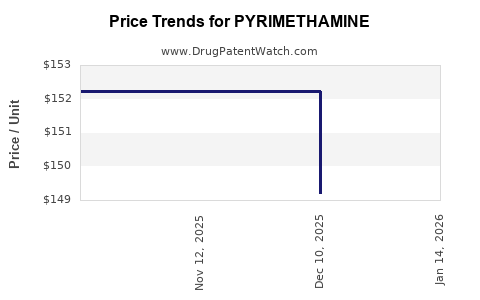
Last updated: September 2, 2026
Pyrimethamine is a mature, low-volume antiparasitic drug with limited underlying demand but unusually high historical pricing power in the U.S. Its commercial profile was reshaped after Turing Pharmaceuticals acquired Daraprim and increased the U.S. list price from $13.50 to $750 per 25 mg tablet in 2015. The molecule has no meaningful composition-of-matter patent protection remaining. Current value depends on brand distribution controls, supply access, regulatory status, and generic competition rather than patent exclusivity.
Public companies have not disclosed a reliable standalone revenue series for pyrimethamine. The drug’s financial trajectory is therefore best assessed through pricing, prescription volume, generic entry, payer restrictions, litigation, and the economics of a small infectious-disease market.
What is pyrimethamine used for and how large is the market?
Pyrimethamine is an antiparasitic folate antagonist used primarily with sulfadiazine or clindamycin and leucovorin for toxoplasmosis. It has also been used in malaria treatment, although resistance and the availability of other antimalarial regimens have reduced its commercial importance in many markets.
The U.S. market is narrow because:
- Toxoplasmosis is an episodic, specialist-managed indication.
- Treatment is concentrated in immunocompromised patients, including people with HIV and transplant recipients.
- Pyrimethamine is usually administered with leucovorin, creating a combination-treatment cost rather than a standalone drug cost.
- Malaria use in the U.S. is limited and generally involves imported or alternative therapies.
- Treatment duration can be long, but patient numbers remain small relative to primary-care drugs.
The World Health Organization continues to recognize pyrimethamine as an important antiparasitic medicine, particularly in combination regimens. Its clinical importance is greater than its volume-based commercial market size.[1]
Key product and market facts
| Metric |
Pyrimethamine / Daraprim position |
| Active ingredient |
Pyrimethamine |
| Primary U.S. indication |
Toxoplasmosis, in combination therapy |
| Dosage form |
25 mg oral tablet |
| Original U.S. approval |
Daraprim NDA 008578, FDA approval in 1953 |
| U.S. reference product |
Daraprim |
| Main commercial owner during price controversy |
Turing Pharmaceuticals, later Vyera Pharmaceuticals |
| Original U.S. list price |
About $13.50 per tablet |
| 2015 U.S. list price |
$750 per tablet |
| Price increase |
Approximately 5,455% |
| Patent maturity |
Composition patents expired decades ago |
| Biosimilar exposure |
None; pyrimethamine is a small-molecule drug |
| Main competitive threat |
Generic pyrimethamine tablets and alternative procurement channels |
How did Daraprim pricing affect pyrimethamine revenue?
The 2015 Daraprim price increase converted a low-priced, mature product into a high-price specialty asset. A 25 mg tablet priced at $750 produces a nominal annual gross value of $273,750 for one tablet per day, before rebates, patient assistance, dosage changes, and treatment interruptions. Actual treatment costs vary substantially because dosing is individualized and patients frequently use combination therapy.
The commercial strategy depended on price rather than volume. Turing placed Daraprim into a restricted distribution model that limited access to specialty pharmacies and hospitals. The model was designed to control dispensing and reimbursement while preserving the economic value of the brand.
The price increase generated severe public and political opposition. It also attracted antitrust scrutiny over alleged restrictions on access to samples and distribution arrangements. The Federal Trade Commission later alleged that Vyera used exclusive supply arrangements and distribution controls to delay generic competition.[2]
Financial trajectory
| Period |
Commercial development |
Financial effect |
| Before 2015 |
Mature, low-priced product |
Limited revenue per prescription |
| 2015 |
Price increased from $13.50 to $750 per tablet |
Sharp increase in gross revenue per treatment |
| 2016-2020 |
Restricted distribution and high list price |
Revenue depended on retaining controlled access and reimbursement |
| 2021 onward |
FTC settlement, litigation, generic competition, reputational damage |
Reduced pricing power and higher legal and operating costs |
| Current market |
Mature product with limited patent protection |
Lower long-term durability; value tied to supply and channel execution |
Standalone Daraprim revenue has not been consistently reported in public company filings. Turing and Vyera were private companies, which limits visibility into sales, gross-to-net discounts, operating income, and treatment volume. Public pricing data therefore provide a stronger basis for assessing the asset than reported revenue.
What patents protect pyrimethamine and Daraprim?
No meaningful patent estate protects the pyrimethamine molecule in the United States today. The original compound and early formulation rights are long expired. Daraprim’s commercial position was not based on a live composition-of-matter patent.
Patent protection profile
| Protection category |
Current position |
| Composition-of-matter patent |
Expired |
| Original therapeutic-use patents |
Expired or commercially immaterial |
| Basic tablet formulation patents |
No known durable blocking estate |
| New crystalline form patents |
No established market-blocking position publicly associated with Daraprim |
| Manufacturing patents |
May exist in isolated cases but are unlikely to block routine generic production |
| FDA regulatory exclusivity |
Original approval predates modern NCE exclusivity rules |
| Biosimilar exclusivity |
Not applicable |
Pyrimethamine was approved before the Hatch-Waxman framework created modern five-year new chemical entity exclusivity. Its current exclusivity does not arise from a new molecular entity designation.
The important distinction is between patent protection and market-access control. A company can preserve commercial friction through a restricted distribution program, limited supplier relationships, specialty-pharmacy contracts, or difficulty obtaining reference-product samples even when the underlying patents are expired. Those tools can delay competition, but they are vulnerable to antitrust enforcement and regulatory scrutiny.
What is the Orange Book status of Daraprim?
Daraprim is associated with FDA approval under NDA 008578. Because the product is an old small-molecule drug, its Orange Book position is materially weaker than that of a recently approved branded medicine.
The relevant commercial questions are:
- Whether any unexpired patents are listed against the current Daraprim product.
- Whether an applicant can obtain reference-product samples.
- Whether an ANDA applicant can demonstrate bioequivalence.
- Whether the restricted distribution model interferes with development or commercial launch.
- Whether the generic applicant can secure an acceptable supply chain for active pharmaceutical ingredient and finished tablets.
A generic applicant challenging any listed patent would use a Paragraph IV certification. In practice, the central risk for pyrimethamine has been access and market execution rather than a credible modern patent barrier.
When did pyrimethamine lose exclusivity?
Pyrimethamine lost meaningful molecule-level exclusivity many years ago. The drug’s 1953 FDA approval predates the five-year NCE exclusivity regime established later under Hatch-Waxman. Any early patents covering the compound or its original uses would have expired by the modern generic era.
The 2015 price increase did not extend patent life. It increased the economic value of the brand during a period in which generic competition was limited by market structure and distribution conditions.
Exclusivity timeline
- 1953: FDA approved Daraprim.
- 1960s-1980s: Original patent and early product protections expired over time.
- 1984: Hatch-Waxman created the modern ANDA and Paragraph IV framework, but pyrimethamine was already an old product.
- 2015: Turing acquired rights and increased the U.S. price.
- 2015 onward: Restricted distribution became a central commercial-control mechanism.
- 2020: FDA approved a generic version of pyrimethamine tablets, according to FDA public communications.
- 2021: FTC litigation against Vyera and related parties produced monetary and conduct remedies.
- 2023: Vyera entered bankruptcy proceedings, weakening the durability of the original commercial model.
Which companies challenged Daraprim and the pyrimethamine market?
Generic competition emerged after a prolonged period in which no broadly available U.S. generic had materially constrained Daraprim pricing.
The main competitive pressure came from generic manufacturers rather than branded pharmaceutical companies. FDA approval of a generic pyrimethamine tablet reduced the strategic importance of Daraprim’s restricted channel and created a lower-cost alternative for pharmacies, hospitals, and payers.[3]
The market has also included compounded or specially sourced pyrimethamine in some settings. Compounding is not equivalent to an FDA-approved generic and does not always provide the same scale, labeling, quality system, or payer acceptance. It can, however, reduce the commercial leverage of a restricted branded product when supply is available.
What generic entry risks exist for Daraprim?
Generic entry risk is high from a patent perspective and moderate to high from a commercial perspective.
Regulatory risk
The drug has a simple oral tablet dosage form and a long clinical history. These factors generally reduce formulation and clinical-development complexity. An ANDA applicant can rely on the reference product’s safety and efficacy findings while demonstrating pharmaceutical equivalence and bioequivalence.
Manufacturing risk
Pyrimethamine is a low-volume product. Generic manufacturers may face:
- Limited active pharmaceutical ingredient demand.
- Supplier concentration.
- Low manufacturing scale.
- Inventory requirements for an intermittent-use medicine.
- Product liability and pharmacovigilance costs disproportionate to sales.
- Pricing pressure after multiple entrants.
These factors can limit the number of durable suppliers even when patent protection is absent.
Commercial risk
The first approved generic may not immediately eliminate Daraprim’s market value. Brand retention can continue where:
- Physicians are familiar with Daraprim.
- Hospitals use existing procurement protocols.
- Patients depend on assistance programs.
- Payers impose different reimbursement rules.
- Generic supply is intermittent.
- Wholesalers do not carry sufficient inventory.
The long-term direction remains unfavorable for the brand. Once a reliable generic supply chain is established, a $750-per-tablet price is difficult to defend in a mature tablet market.
What regulatory status does pyrimethamine have?
Pyrimethamine remains an FDA-approved prescription drug through Daraprim and approved generic products. Its principal U.S. use is toxoplasmosis treatment. The FDA has also recognized the drug’s role in an established therapeutic category with long-standing clinical use.
The product does not face biosimilar substitution because biosimilars apply to biological products, not small-molecule tablets. The relevant substitution framework is generic drug substitution under state pharmacy law and payer policy.
The principal regulatory risks are not approval risk for a new indication. They are manufacturing quality, supply continuity, labeling compliance, adverse-event monitoring, and the ability of suppliers to maintain commercial availability.
What patent litigation and settlement agreements affected pyrimethamine?
The most important legal exposure involved alleged anticompetitive conduct rather than conventional patent infringement litigation.
The FTC charged Vyera Pharmaceuticals and related parties with maintaining monopoly power through exclusive supply arrangements, distribution restrictions, and conduct that allegedly impeded generic access.[2] The litigation produced a settlement involving monetary penalties and restrictions on future conduct. Martin Shkreli was separately ordered to pay a monetary penalty and was barred from participating in the pharmaceutical industry in an FTC-related proceeding.[4]
These matters changed the valuation of Daraprim in three ways:
- They increased expected legal and compliance costs.
- They reduced the durability of distribution-based market barriers.
- They increased the probability that generic manufacturers could obtain access to the reference product and compete.
There is no comparable long-duration patent settlement that creates a clear future monopoly period for pyrimethamine.
How strong is the pyrimethamine patent estate?
The patent estate is weak.
Strength assessment
| Factor |
Assessment |
| Molecule patent life |
Exhausted |
| Remaining term |
No commercially meaningful term expected |
| Formulation differentiation |
Limited for a conventional 25 mg tablet |
| Method-of-use protection |
Old clinical uses provide little current leverage |
| Manufacturing barriers |
Possible operational barriers, but not a reliable patent moat |
| Generic substitution risk |
High |
| Litigation leverage |
Low on patent grounds; higher on access and commercial conduct |
| Lifecycle-management potential |
Limited unless a new formulation or indication is developed |
A new formulation, pediatric dosage form, fixed-dose combination, or delivery system could theoretically create new intellectual-property opportunities. Such products would need clinical, reimbursement, and market-development support. They would not automatically extend the value of the existing Daraprim tablet.
How does pyrimethamine compare with other antiparasitic drugs?
Pyrimethamine occupies a specialized position rather than a broad antiparasitic market.
| Drug or class |
Main commercial role |
Competitive relationship |
| Pyrimethamine |
Toxoplasmosis, selected malaria use |
Specialist, low-volume therapy |
| Sulfadiazine |
Combination partner in toxoplasmosis |
Complementary product |
| Leucovorin |
Mitigates pyrimethamine-associated folate toxicity |
Required companion in many regimens |
| Atovaquone |
Alternative toxoplasmosis therapy in selected patients |
Clinical substitute in some cases |
| Clindamycin |
Alternative combination partner |
Partial substitute |
| Artemisinin-based therapies |
Malaria |
Broader malaria competition, limited direct overlap |
| Trimethoprim-based products |
Antibacterial use |
Mechanistically related but not a direct substitute for toxoplasmosis |
Pyrimethamine’s commercial value is therefore linked to the diagnosed toxoplasmosis population and treatment guidelines, not to the overall antiparasitic drug market.
What is the geographic coverage of pyrimethamine?
Pyrimethamine has global clinical recognition, but its commercial economics differ sharply by geography.
- United States: High historical price, concentrated specialty distribution, strong scrutiny of access practices, and increasing generic risk.
- Europe: More established generic and national reimbursement dynamics, with lower pricing power in many markets.
- Low- and middle-income countries: Public-health procurement and global access considerations are more important than U.S. list price.
- Malaria-endemic markets: Pyrimethamine use is constrained by resistance and changing treatment guidelines.
- Hospitals and public programs: Bulk procurement can produce prices well below U.S. branded pricing.
The U.S. price episode was therefore an outlier rather than a reliable indicator of global pyrimethamine value.
What is the revenue outlook for pyrimethamine?
The revenue outlook is bifurcated.
Brand outlook
Daraprim faces structural revenue pressure from:
- Generic approval.
- Expired patents.
- Antitrust restrictions on distribution practices.
- Payer resistance to high list prices.
- Reputational damage.
- Limited ability to expand the treated population.
- Lack of a credible new indication platform.
Brand revenue can remain material if generic supply is unreliable or if the brand retains hospital and specialist preference. That outcome would depend on channel control and supply reliability rather than exclusivity.
Generic outlook
Generic pyrimethamine is a low-revenue, potentially high-margin niche product if a manufacturer can maintain supply and obtain favorable contracting. The market’s small size limits total sales, but limited competition can support attractive unit economics. Those economics can deteriorate quickly after additional entrants.
Investor and licensing implications
A pyrimethamine asset is unlikely to justify a conventional patent-premium valuation. Its value is more likely to depend on:
- Reliable manufacturing.
- API sourcing.
- Hospital contracts.
- Government or public-health procurement.
- Specialty-pharmacy distribution.
- A differentiated formulation.
- An approved combination product.
- Supply scarcity in a defined geography.
Licensing value would be highest for a company with existing infectious-disease infrastructure, manufacturing capacity, and payer access. A pure patent-acquisition strategy has limited merit.
What generic launch scenarios are most likely?
Scenario 1: One reliable generic supplier
The generic captures substantial volume and forces Daraprim discounts. The brand retains some patients through familiarity and assistance programs. U.S. revenue declines but does not disappear immediately.
Scenario 2: Multiple generic suppliers
Price competition intensifies. Daraprim becomes commercially marginal, and generic pricing approaches the economics of other mature oral tablets.
Scenario 3: Intermittent generic supply
The brand retains a higher share than expected because hospitals and specialists prioritize availability. Revenue remains above pure commodity levels, but the business remains exposed to procurement and regulatory scrutiny.
Scenario 4: New differentiated formulation
A pediatric, combination, or modified-release product creates a separate commercial niche. This would require new clinical evidence and cannot rely on the old tablet’s expired protection.
Key Takeaways
- Pyrimethamine is clinically important but commercially small.
- Daraprim’s 2015 price increase created a temporary high-value U.S. specialty market.
- The $750-per-tablet price was not supported by a current molecule patent.
- The U.S. commercial barrier relied heavily on restricted distribution and access controls.
- FDA-approved generic competition materially increases long-term erosion risk.
- There is no biosimilar risk because pyrimethamine is a small-molecule tablet.
- Public standalone revenue data are limited because the principal commercial owners were private companies.
- The patent estate is weak; manufacturing, supply, contracting, and distribution are the main value drivers.
- A generic can be profitable as a niche product, but the total market is unlikely to support large-scale revenue.
- New formulation or combination-product development is more valuable than acquisition of legacy pyrimethamine patents.
FAQs
Is Daraprim still protected by a patent?
No meaningful composition-of-matter patent protection remains. Current commercial barriers are primarily operational, regulatory, and distribution-related.
Does pyrimethamine have an Orange Book patent?
Daraprim is listed under FDA NDA 008578, but the product’s commercial position does not depend on a modern, blocking patent estate comparable to that of a recently launched branded drug.
Is pyrimethamine a biologic?
No. Pyrimethamine is a synthetic small-molecule drug in tablet form. Generic drug rules apply, not biosimilar rules.
Can a pharmacy substitute generic pyrimethamine for Daraprim?
Substitution depends on FDA therapeutic-equivalence status, state pharmacy law, payer policy, and product availability. A generic may be substitutable when it has the required FDA rating and is available through the dispensing channel.
Why did pyrimethamine become so expensive in the United States?
Turing acquired Daraprim and raised the list price from approximately $13.50 to $750 per tablet in 2015. The strategy relied on the product’s narrow market, limited immediate generic supply, and restricted distribution.
References
-
World Health Organization. (2023). WHO model list of essential medicines: 23rd list. World Health Organization.
-
Federal Trade Commission. (2021). FTC secures settlement with Vyera Pharmaceuticals and Phoenixus AG over alleged anticompetitive conduct involving Daraprim. Federal Trade Commission.
-
U.S. Food and Drug Administration. (2020). FDA approves first generic version of Daraprim. U.S. Department of Health and Human Services.
-
Federal Trade Commission. (2022). Court orders Martin Shkreli to pay $64.6 million and bans him from the pharmaceutical industry for life. Federal Trade Commission.