Last updated: February 21, 2026
What Is the Current Market Position of Probenecid?
Probenecid is a uricosuric agent approved by the FDA in 1951 primarily used to treat gout by increasing uric acid excretion. It also serves in adjunct therapy to antibiotics such as penicillin by blocking renal excretion, hence prolonging drug activity.
The global market for gout medications—including probenecid—was valued at approximately USD 4 billion in 2021. The segment is expected to grow at a compound annual growth rate (CAGR) of 4.3% through 2028. Growth drivers include increasing gout prevalence, especially in developed countries, and expanded off-label uses for conditions like inflammatory diseases and certain kidney disorders.
How Is the Market Structurally Composed?
Probenecid exists as a generic drug with no recent innovations or new formulations approved by regulatory agencies in recent years. It competes predominantly with other gout medications, including:
- Allopurinol (USD 1.5 billion market share)
- Febuxostat (USD 1 billion)
- Uloric (more recent, branded, USD 0.8 billion)
Despite limited patent protections, it maintains a niche role in specific clinical scenarios, especially when first-line therapies are contraindicated. Its low cost (USD 10-20 per prescription) supports continued prescription, especially in regions with resource constraints.
What Are the Financial Trends for Probenecid?
Financial data on probenecid is limited due to its patent expiry and status as a generic medication. Major pharmaceutical companies do not actively market it, and it's often dispensed through generic channels. The drug's revenue remains stable but not growing; sales are mainly driven by existing prescriptions rather than new demand.
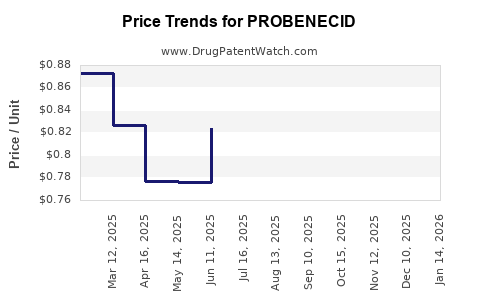
In the United States, annual prescription volume hovers around 1 million, translating to estimated sales of USD 50-70 million annually. Margins are thin due to competition from generics, with wholesale prices dropping steadily over the past decade.
What Future Market Opportunities Exist?
New indications for probenecid are under consideration. Research indicates potential in:
- Treating certain types of kidney stones
- Managing emerging diseases like COVID-19 through uric acid modulation
- Developing sustained-release formulations to improve compliance
Additionally, its mechanism as a uricosuric agent positions it for off-label uses, though regulatory approval remains a barrier.
However, these opportunities face challenges:
- Lack of recent clinical trials or regulatory filings
- Limited patent protections or incentives for formulary inclusion
- Competition from newer, more targeted therapies
In the absence of innovation, the product's financial trajectory will likely remain flat, with minor growth driven by population health trends.
What Regulatory and Policy Factors Affect the Market?
Drug reimbursement policies, particularly in the US, influence prescribing patterns. Medicare and Medicaid tend to favor cost-effective generics like probenecid. Pricing pressures and increasing scrutiny of drug costs may further compress margins.
In emerging markets, government procurement policies favor low-cost generics, supporting stable demand. However, in developed economies, the preference for newer agents with better tolerance profiles limits growth.
Summary of Key Market Metrics
| Metric |
Data |
Notes |
| Market size (2021) |
USD 4 billion |
Includes all gout medications |
| Probenecid-specific sales |
USD 50-70 million |
US prescriptions, stable over 10 years |
| CAGR (2022–2028) |
4.3% |
Driven by aging populations and gout prevalence |
| Patent status |
None, off patent |
No exclusivity; subject to price competition |
| Number of prescriptions (US) |
~1 million annually |
Prescriptions declining slightly, stable overall |
What Are the Strategic Implications?
For pharma companies seeking to capitalize on probenecid, innovation is necessary. Developing novel formulations, combination therapies, or expanding clinical indications could unlock higher revenues. Alternatively, maintaining low-cost generic production supports steady but limited cash flows.
Investors should weigh limited growth potential against low regulatory risk, given its established clinical use and widespread acceptance. Neglected disease areas or unmet needs do not seem to be emerging for probenecid.
Key Takeaways
- Probenecid is a low-cost, off-patent drug serving niche indications in gout management.
- The global market for gout medications is growing at 4.3% CAGR, but probenecid’s market share remains stable.
- Financial performance is constrained by generic competition, with annual sales around USD 50-70 million in the US.
- Future growth depends on new clinical applications or advanced formulations, which face regulatory and commercial barriers.
- Market sustainability relies on cost-effective prescribing and expanding off-label uses rather than innovation.
FAQs
1. Is there any recent clinical research on probenecid?
Limited recent trials exist. Most focus on its traditional uses; some studies explore its role in COVID-19, but no regulatory approvals have been granted based on these findings.
2. How does probenecid compare to newer gout medications?
It has lower efficacy and tolerability; hence, clinicians prefer allopurinol or febuxostat. Cost advantages make it relevant where drug affordability is critical.
3. Are there patent extensions or formulations in development?
No; patent protections expired decades ago. The drug remains a generic medication with no significant reformulation efforts.
4. Could regulatory changes influence probenecid’s market?
Yes, if new indications receive approval or if clinical guidelines favor its use in emerging conditions. Currently, no such changes are confirmed.
5. What is the outlook for probenecid’s commercial viability?
Stable but limited. Growth opportunities are tied to expanding indications, which are currently in early research phases. Market entry barriers are high due to patent expiration and low differentiation.
Citations
- MarketsandMarkets. (2022). Gout Therapeutics Market by Drug Class, Region, and Distribution Channel: Global Forecast to 2028.
- IQVIA. (2022). US Prescription Drug Market Overview.
- U.S. Food and Drug Administration. (2023). Probenecid Label.
- National Institutes of Health. (2021). Research on Probenecid and Renal Diseases.
- DrugBank. (2023). Probenecid Database Entry.